PUBLISHER: Mordor Intelligence | PRODUCT CODE: 2114051

PUBLISHER: Mordor Intelligence | PRODUCT CODE: 2114051
Edible Insects - Market Share Analysis, Industry Trends & Statistics, Growth Forecasts (2026 - 2031)
According to Mordor Intelligence, the edible insects market size is projected to expand from USD 1.22 billion in 2025 and USD 1.41 billion in 2026 to USD 2.70 billion by 2031, registering a CAGR of 13.88% between 2026 to 2031.
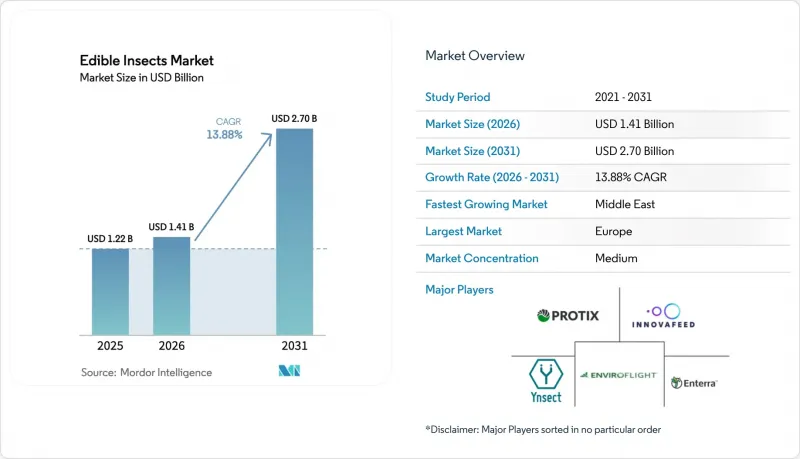
This report is Segmented by Insect Species (Black Soldier Fly, Mealworm, and More), by Product Form (Protein Meal, Insect Oil, and More), by Application (Aquaculture Feed, Livestock Feed, and More), and by Geography (North America, Europe, Asia-Pacific, South America, Middle East, and Africa). The Market Forecasts are Provided in Terms of Value (USD).
Global Edible Insects Market Trends and Insights
Regulatory Approval for Black Soldier Fly (BSF) Meal in Poultry and Swine Diets
In August 2024, the United States Association of American Feed Control Officials finalized ingredient definitions for dried black soldier fly larvae in broiler, layer, and swine diets. This removed the final federal barrier to commercial inclusion rates of up to 10% in complete feeds. The decision followed a two-year review of a safety dossier, which confirmed no mycotoxin accumulation or heavy metal bioconcentration when larvae are reared on pre-consumer food waste. Canada's Canadian Food Inspection Agency approved the use of black soldier fly meal under its feed registration system, enabling cross-border supply chains and allowing United States producers to supply Ontario and Quebec poultry integrators. In March 2025, the European Union extended its 2021 authorization for processed insect protein in aquaculture to include poultry and pig feeds, contingent upon the implementation of traceability protocols to prevent contamination with bovine or porcine protein.
Escalating Fish Meal and Soy Meal Prices Pressuring Feed Margins
Fish meal spot prices reached USD 1,606 per metric ton in the first quarter of 2024 due to El Nino-related anchovy catch declines off the Peruvian coast. Prices later moderated to USD 1,335 per metric ton in the first quarter of 2025 as La Nina conditions restored biomass. Structural volatility persists due to climate-driven recruitment failures and quota reductions by the Peruvian Ministry of Production. Soy meal prices have also fluctuated, with United States Gulf export quotes averaging USD 420 per metric ton in 2024 and USD 450 per metric ton in early 2025, driven by tight South American supplies and strong Chinese import demand. These price dynamics are reshaping procurement strategies, with feed mills increasingly viewing insect protein as a risk mitigation tool. Insect protein is now being incorporated into least-cost formulation models as a capped hedge against marine protein shortages.
High Production Capital Expenditure and Energy Intensive Drying
Establishing a black soldier fly production facility with an annual capacity of 10,000 metric tons requires a substantial initial capital investment. Drying equipment alone constitutes a significant portion of the total project costs. Thermal drying, which reduces moisture content from 70% to 10%, consumes substantial energy per kilogram of dried larvae. This results in considerable electricity expenses for a mid-scale facility operating in regions with typical industrial power rates. Equipment manufacturers such as Buhler and GEA have introduced vacuum drying and microwave-assisted systems that enhance energy efficiency . These advanced systems entail higher capital costs and require specialized maintenance contracts, which add to operational expenses. These high capital requirements restrict market entry to well-funded players with access to project financing or strategic investors. This has created a two-tier market, where integrated feed companies can spread drying costs across multiple protein lines, while independent insect producers face challenges achieving cash flow breakeven within typical debt covenant timelines of 5 to 6 years.
Other drivers and restraints analyzed in the detailed report include:
- Growing Pet Humanization Boosting Demand for Premium Insect Protein
- Carbon Credit Monetization from Organic-Waste Upcycling
- Supply Chain Bio-security and Pathogen Risks
For complete list of drivers and restraints, kindly check the Table Of Contents.
Segment Analysis
Black soldier fly larvae held 57.4% of the edible insect market size in 2025 and are projected to expand at a 11.0% CAGR through 2031. This growth is attributed to their high waste bioconversion efficiency and increasing regulatory acceptance in aquaculture and terrestrial livestock feed applications. The species' capability to process a wide range of organic substrates, such as pre-consumer food waste, brewery spent grains, and poultry manure, allows producers to utilize low-cost or even negative-cost feedstocks. This cost advantage has made black soldier fly larvae a competitive alternative to traditional feed ingredients, particularly in regions where feed costs are a significant concern. Furthermore, the larvae's nutritional profile, which includes high protein and fat content, enhances their appeal as a sustainable feed option for various industries, including aquaculture, poultry, and pet food production.
In June 2024, Tyson Foods announced a joint venture with Protix to build a 60,000 metric ton per year black soldier fly facility in Decatur, Illinois. This initiative highlights the scalability of the species, as the facility will be co-located with a poultry processing complex to utilize rendering waste and supply fresh larvae directly to nearby broiler farms. The co-location strategy not only reduces transportation costs but also ensures a consistent supply of feedstock for larvae production, enhancing operational efficiency. Additionally, the black soldier fly's ability to thrive in ambient temperatures of 25 to 35 degrees Celsius makes it a preferred choice for tropical and subtropical markets in regions such as Southeast Asia, the Middle East, and Sub-Saharan Africa, where cooling costs would otherwise significantly impact operating budgets. The species' adaptability to diverse climatic conditions and its potential to address food waste challenges further solidify its position as a key component in the global edible insect market.
Complete Report Scope:
- By Insect Species
- Black Soldier Fly
- Mealworm
- Cricket
- Others
- By Product Form
- Protein Meal
- Whole Dried Larvae
- Insect Oil
- Frass
- By Application
- Aquaculture Feed
- Livestock Feed
- Pet-Food Ingredients
- By Geography
- North America
- United States
- Canada
- Mexico
- Rest of North America
- Europe
- Germany
- United Kingdom
- France
- Italy
- Spain
- Russia
- Rest of Europe
- Asia-Pacific
- China
- Japan
- India
- South Korea
- Australia
- Rest of Asia-Pacific
- South America
- Brazil
- Argentina
- Chile
- Rest of South America
- Middle East
- United Arab Emirates
- Saudi Arabia
- Israel
- Turkey
- Rest of Middle East
- Africa
- South Africa
- Egypt
- Rest of Africa
- North America
Geography Analysis
Europe held 55% of the edible insect market share in 2025, driven by early regulatory approvals, a robust aquaculture and poultry industry, and retailer sustainability mandates that emphasize low-carbon feed ingredients. The Netherlands and France are key contributors to European production capacity, with companies such as Protix, InnovaFeed, and Ynsect collectively producing 150,000 metric tons annually. A significant portion of this output is allocated to salmon feed for Norwegian and Scottish farms. Germany and the United Kingdom are emerging as secondary hubs, supported by poultry integrators aiming to meet sustainability requirements from retailers like Carrefour and Tesco, which mandate that 10% of feed protein must come from low-emission sources by 2027.
The Middle East is projected to lead regional growth at an 8.0% CAGR through 2031, fueled by sovereign investments in circular economy infrastructure and the expansion of aquaculture in the United Arab Emirates (UAE), Saudi Arabia, and Oman. Saudi Arabia's Vision 2030 initiative includes a goal to produce 600,000 metric tons of farmed fish annually, thereby driving demand for protein to supplement imports of fish meal and soy . Africa is experiencing significant growth, led by Kenya, South Africa, and Nigeria. In these countries, black soldier fly facilities are converting municipal organic waste into larvae, which are sold to tilapia and catfish farmers at prices lower than those of imported fish meal.
Asia-Pacific is projected to grow significantly, led by China, Thailand, and Vietnam, which are major contributors to global shrimp and tilapia production. These countries are leveraging insect-based feed to support their aquaculture industries and reduce reliance on traditional protein sources. South America is experiencing growth concentrated in Brazil and Chile, where salmon and tilapia producers are testing insect meal as an alternative to Argentine soy and Peruvian fish meal. These traditional feed sources face supply challenges due to drought and El Nino cycles, prompting producers to explore more sustainable and stable options. North America is expanding its use of edible insects, with the United States leading adoption in poultry and pet food applications. This growth follows the Association of American Feed Control Officials (AAFCO) approvals in 2024, which have facilitated the integration of insect-based feed into these markets.
- Protix B.V.
- Innovafeed SAS
- EnviroFlight LLC
- Enterra Feed Corporation
- Ynsect
- Nutrition Technologies Group Pte Ltd.
- Entobel Holding Pte Ltd.
- Buhler AG
- Hexafly Biotech Ltd.
- F4F SpA
- Protenga Pte Ltd.
- HiProMine SA
- MealFood Europe S.L.
- Aspire Food Group Ltd.
- Goterra Pty Ltd.
Additional Benefits:
- The market estimate (ME) sheet in Excel format
- 3 months of analyst support
TABLE OF CONTENTS
1 Introduction
- 1.1 Study Assumptions and Market Definition
- 1.2 Scope of the Study
2 Research Methodology
3 Executive Summary
4 Market Landscape
- 4.1 Market Overview
- 4.2 Market Drivers
- 4.2.1 Regulatory approval for black soldier fly (BSF) meal in poultry and swine diets
- 4.2.2 Escalating fish meal and soy meal prices pressuring feed margins
- 4.2.3 Growing pet humanization boosting demand for premium insect protein
- 4.2.4 Carbon credit monetization from organic-waste upcycling
- 4.2.5 Retailer Scope-3 mandates favoring low-footprint feed ingredients
- 4.2.6 Emerging circular bioeconomy subsidies for on farm live larvae systems
- 4.3 Market Restraints
- 4.3.1 High production capital expenditure and energy intensive drying
- 4.3.2 Supply chain bio-security and pathogen risks
- 4.3.3 Potential insect-welfare legislation increasing operating costs
- 4.3.4 Offshoring of European Union capacity is eroding local supply security
- 4.4 Regulatory Landscape
- 4.5 Technological Outlook
- 4.6 Porter's Five Forces Analysis
- 4.6.1 Bargaining Power of Suppliers
- 4.6.2 Bargaining Power of Buyers
- 4.6.3 Threat of New Entrants
- 4.6.4 Threat of Substitutes
- 4.6.5 Intensity of Competitive Rivalry
5 Market Size and Growth Forecasts (Value)
- 5.1 By Insect Species
- 5.1.1 Black Soldier Fly
- 5.1.2 Mealworm
- 5.1.3 Cricket
- 5.1.4 Others
- 5.2 By Product Form
- 5.2.1 Protein Meal
- 5.2.2 Whole Dried Larvae
- 5.2.3 Insect Oil
- 5.2.4 Frass
- 5.3 By Application
- 5.3.1 Aquaculture Feed
- 5.3.2 Livestock Feed
- 5.3.3 Pet-Food Ingredients
- 5.4 By Geography
- 5.4.1 North America
- 5.4.1.1 United States
- 5.4.1.2 Canada
- 5.4.1.3 Mexico
- 5.4.1.4 Rest of North America
- 5.4.2 Europe
- 5.4.2.1 Germany
- 5.4.2.2 United Kingdom
- 5.4.2.3 France
- 5.4.2.4 Italy
- 5.4.2.5 Spain
- 5.4.2.6 Russia
- 5.4.2.7 Rest of Europe
- 5.4.3 Asia-Pacific
- 5.4.3.1 China
- 5.4.3.2 Japan
- 5.4.3.3 India
- 5.4.3.4 South Korea
- 5.4.3.5 Australia
- 5.4.3.6 Rest of Asia-Pacific
- 5.4.4 South America
- 5.4.4.1 Brazil
- 5.4.4.2 Argentina
- 5.4.4.3 Chile
- 5.4.4.4 Rest of South America
- 5.4.5 Middle East
- 5.4.5.1 United Arab Emirates
- 5.4.5.2 Saudi Arabia
- 5.4.5.3 Israel
- 5.4.5.4 Turkey
- 5.4.5.5 Rest of Middle East
- 5.4.6 Africa
- 5.4.6.1 South Africa
- 5.4.6.2 Egypt
- 5.4.6.3 Rest of Africa
- 5.4.1 North America
6 Competitive Landscape
- 6.1 Market Concentration
- 6.2 Strategic Moves
- 6.3 Market Share Analysis
- 6.4 Company Profiles (Includes Global Level Overview, Market Level Overview, Core Segments, Financials as Available, Strategic Information, Market Rank/Share, Products and Services, Recent Developments)
- 6.4.1 Protix B.V.
- 6.4.2 Innovafeed SAS
- 6.4.3 EnviroFlight LLC
- 6.4.4 Enterra Feed Corporation
- 6.4.5 Ynsect
- 6.4.6 Nutrition Technologies Group Pte Ltd.
- 6.4.7 Entobel Holding Pte Ltd.
- 6.4.8 Buhler AG
- 6.4.9 Hexafly Biotech Ltd.
- 6.4.10 F4F SpA
- 6.4.11 Protenga Pte Ltd.
- 6.4.12 HiProMine SA
- 6.4.13 MealFood Europe S.L.
- 6.4.14 Aspire Food Group Ltd.
- 6.4.15 Goterra Pty Ltd.
7 Market Opportunities and Future Outlook

