PUBLISHER: Mordor Intelligence | PRODUCT CODE: 2114052

PUBLISHER: Mordor Intelligence | PRODUCT CODE: 2114052
Grain Storage Silos - Market Share Analysis, Industry Trends & Statistics, Growth Forecasts (2026 - 2031)
According to Mordor Intelligence, the grain storage silos market size in 2026 is estimated at USD 1.68 billion, growing from 2025 value of USD 1.60 billion with 2031 projections showing USD 2.18 billion, growing at 5.3% CAGR over 2026-2031.
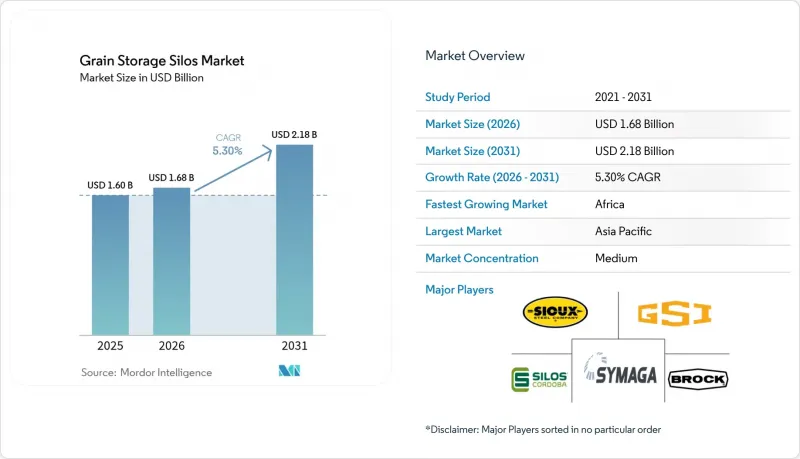
This report is Segmented by Material Type (Steel Silos, Concrete Silos, Metal Silos, and Other Materials), by Grain (Corn, Wheat, Soybean, Rice, and More), by Product Design (Flat-Bottom Silos, Hopper-Bottom Silos, Feed Hoppers, and More), and by Geography (North America, Europe, Asia-Pacific, South America, Middle East, and Africa). The Market Forecasts are Provided in Terms of Value (USD).
Global Grain Storage Silos Market Trends and Insights
Digital monitoring and IoT-enabled grain-quality sensors
Connected sensors now provide real-time temperature, moisture, and CO2 readings that flag spoilage trends weeks in advance, enabling predictive aeration that trims unplanned downtime by USD 320,000 per facility each year. Cloud dashboards aggregate data across multiple locations, transforming silo management from manual inspection to analytics-driven oversight. Payback periods often drop below two harvests as energy consumption falls and quality premiums rise. Technology suppliers are integrating wireless probes into galvanized panels at the factory, turning hardware and software into a single value proposition. Momentum is strongest in North America, but fast-growing pilot projects in Southeast Asia signal broadening adoption.
Government-backed strategic grain-reserve expansions
China lifted its 2025 grain stockpiling budget to secure domestic supply buffers, while India approved a USD 15 billion cooperative plan that triples wheat capacity to 9 million metric tons by 2028. Tunisia, backed by multilateral lenders, is upgrading 206,000 metric tons of legacy silos and adding 181,000 metric tons of fresh space to stabilize import bills. These national programs prioritize high-capacity flat-bottom designs with automated fumigation, driving orders for turnkey installations above 50,000 metric tons. Long-term contracts give manufacturers pricing visibility and underpin the shift toward domestically fabricated panels to curb currency risk.
High up-front capital and steel-price volatility
Spot hot-rolled coil prices surged 18% in early 2025 on tariff uncertainty, lifting bin costs for basic builds. Contractors now insert price-escalation clauses that share risk with growers, nevertheless, many smallholders pivot to hermetic bags despite their shorter life. Index-based steel hedging remains underused in agriculture, although larger cooperatives are experimenting with swaps to cap exposure. Suppliers of square silos claim 15% less steel per metric ton of capacity, an advantage gaining traction among price-sensitive buyers.
Other drivers and restraints analyzed in the detailed report include:
- Surge in on-farm storage demand for price arbitrage
- Rising production volatility requiring buffer storage
- Pest infestation and mold risk inflating OPEX
For complete list of drivers and restraints, kindly check the Table Of Contents.
Segment Analysis
Steel silos captured 77.65% of 2025 revenue, cementing their role as the workhorse solution for high-volume elevators. They benefit from standardized panel designs that allow rapid mass production and easy global shipping. Magnelis-coated sheets lengthen service life to 25 years without repainting, curbing the total cost of ownership. The grain storage silos market size for steel units is forecast to grow at a steady clip as replacement cycles converge with new builds in Asia. Metal silos, largely aluminum-alloy variants, are advancing at a 6.55% CAGR by 2031, propelled by lighter structures that require smaller foundations, a boon in soft-soil geographies. Composite and hybrid systems remain an early-stage niche but deliver moisture resistance prized for rice and seed storage.
In concrete, demand concentrates in port terminals and ethanol plants where 200,000 metric tons blocks offer seismic stability and minimal upkeep. Galvanized steel, however, is gaining share in North America after code revisions raised wind-load and roof-strength standards. Original equipment manufacturers (OEMs) responded with bins that assemble in under 12 days. Smart sensors now arrive factory-fitted, and some vendors embed fiber-optic cables during panel rolling, teeing up structural-health monitoring subscriptions. Sustainability audits favor steel for its recyclability at end-of-life, bolstering its dominance in the grain storage silos market.
Complete Report Scope:
- By Material Type
- Steel Silos
- Concrete Silos
- Metal Silos
- Other Materials
- By Product Design
- Flat-Bottom Silos
- Hopper-Bottom Silos
- Square/Rectangular Silos
- Feed Hoppers
- Farm Silos
- By Grain Type
- Corn
- Wheat
- Soybean
- Rice
- Barley and Others
- By Geography
- North America
- United States
- Canada
- Mexico
- Rest of North America
- Europe
- Germany
- United Kingdom
- France
- Italy
- Spain
- Netherlands
- Russia
- Rest of Europe
- Asia-Pacific
- China
- India
- Japan
- Australia
- Southeast Asia
- Rest of Asia-Pacific
- South America
- Brazil
- Argentina
- Rest of South America
- Middle East
- Saudi Arabia
- United Arab Emirates
- Rest of Middle East
- Africa
- South Africa
- Nigeria
- Rest of Africa
- North America
Geography Analysis
The Asia-Pacific region retained a 35.05% revenue lead in 2025, driven by expansive reserve strategies in China and India. China's enlarged 2025 stockpiling budget and India's USD 15 billion cooperative build-out funnel orders toward domestic fabricators and global Original equipment manufacturers (OEMs) partnering on turnkey complexes. Projects in Bangladesh and Thailand underscore cross-border spillover as exporters upgrade terminals for bulk rice. Yet challenges persist in China, where on-farm corn losses reach 2.41% because many bins lack forced aeration, indicating a rural upcycle in small and mid-scale steel units.
Africa is the fastest-growing region at a projected 6.08% CAGR, driven by hunger mitigation efforts targeting the continent's 282 million undernourished citizens. Donor-funded warehouses in Nigeria and Kenya combine metal silos with solar aeration to cut diesel reliance. Research in Uganda has shown that improved metal designs can slash insect prevalence by 87%, with 4.5-year payback periods. Countries along the Sahel are evaluating community-scale banks to reduce post-harvest losses that hover near 30%.
North America and Europe move steadily as technology retrofits offset mature capacity. American co-ops are replacing 1970s bins with corrosion-resistant panels and rooftop safety cages that meet Occupational Safety and Health Administration's (OSHA) 2025 ladder rules. Europe is phasing in fumigant-free storage, prompting investments in gas-tight construction and automated refrigeration tunnels for malting barley. South America faces a critical gap. Brazil's current assets cover only 55% of production, leading to costly field piles and quality downgrades. Meanwhile, Middle Eastern importers layer strategic reserves on top of port terminals to secure staple cereals, with Saudi and United Arab Emirates financiers underwriting 200,000 metric ton builds that include ambient-control rooms for desert climates.
- Sioux Steel Company
- Grain Systems Inc. (AGCO Corporation)
- Symaga, S.A.U.
- SCG Silos Grupo (Silos Cordoba Grupo)
- Superior Manufacturing LLC
- Rostfrei Steels Pvt. Ltd.
- Henan SRON Silo Engineering Co., Ltd.(SRON Group)
- Brock Grain Systems (CTB Inc. - Berkshire Hathaway)
- Meridian Manufacturing Inc. (WGI Westman Group Inc.)
- Nelson Silos
- SCE Silo Construction & Engineering NV
- Ahrens Group Pty Ltd
- Behlen Manufacturing Company
- Bentall Rowlands Group
- Skess Corporation
Additional Benefits:
- The market estimate (ME) sheet in Excel format
- 3 months of analyst support
TABLE OF CONTENTS
1 Introduction
- 1.1 Study Assumptions and Market Definition
- 1.2 Scope of the Study
2 Research Methodology
3 Executive Summary
4 Market Landscape
- 4.1 Market Overview
- 4.2 Market Drivers
- 4.2.1 Digital monitoring and IoT-enabled grain-quality sensors
- 4.2.2 Government-backed strategic grain-reserve expansions
- 4.2.3 Surge in on-farm storage demand for price arbitrage
- 4.2.4 Rising production volatility requires buffer storage
- 4.2.5 Shift toward bulk-export infrastructure
- 4.2.6 Adoption of modular square and composite silos
- 4.3 Market Restraints
- 4.3.1 High up-front capital and steel-price volatility
- 4.3.2 Pest infestation and mold risk inflating OPEX
- 4.3.3 Regulatory curbs on fumigation chemicals
- 4.3.4 Fragmented aftermarket service in emerging markets
- 4.4 Regulatory Landscape
- 4.5 Technological Outlook
- 4.6 Porter's Five Forces
- 4.6.1 Bargaining Power of Suppliers
- 4.6.2 Bargaining Power of Buyers
- 4.6.3 Threat of New Entrants
- 4.6.4 Threat of Substitute Products
- 4.6.5 Intensity of Competitive Rivalry
5 Market Size and Growth Forecasts (Value)
- 5.1 By Material Type
- 5.1.1 Steel Silos
- 5.1.2 Concrete Silos
- 5.1.3 Metal Silos
- 5.1.4 Other Materials
- 5.2 By Product Design
- 5.2.1 Flat-Bottom Silos
- 5.2.2 Hopper-Bottom Silos
- 5.2.3 Square/Rectangular Silos
- 5.2.4 Feed Hoppers
- 5.2.5 Farm Silos
- 5.3 By Grain Type
- 5.3.1 Corn
- 5.3.2 Wheat
- 5.3.3 Soybean
- 5.3.4 Rice
- 5.3.5 Barley and Others
- 5.4 By Geography
- 5.4.1 North America
- 5.4.1.1 United States
- 5.4.1.2 Canada
- 5.4.1.3 Mexico
- 5.4.1.4 Rest of North America
- 5.4.2 Europe
- 5.4.2.1 Germany
- 5.4.2.2 United Kingdom
- 5.4.2.3 France
- 5.4.2.4 Italy
- 5.4.2.5 Spain
- 5.4.2.6 Netherlands
- 5.4.2.7 Russia
- 5.4.2.8 Rest of Europe
- 5.4.3 Asia-Pacific
- 5.4.3.1 China
- 5.4.3.2 India
- 5.4.3.3 Japan
- 5.4.3.4 Australia
- 5.4.3.5 Southeast Asia
- 5.4.3.6 Rest of Asia-Pacific
- 5.4.4 South America
- 5.4.4.1 Brazil
- 5.4.4.2 Argentina
- 5.4.4.3 Rest of South America
- 5.4.5 Middle East
- 5.4.5.1 Saudi Arabia
- 5.4.5.2 United Arab Emirates
- 5.4.5.3 Rest of Middle East
- 5.4.6 Africa
- 5.4.6.1 South Africa
- 5.4.6.2 Nigeria
- 5.4.6.3 Rest of Africa
- 5.4.1 North America
6 Competitive Landscape
- 6.1 Market Concentration
- 6.2 Strategic Moves
- 6.3 Market Share Analysis
- 6.4 Company Profiles (Includes Global-Level Overview, Market-Level Overview, Core Segments, Financials as Available, Strategic Information, Market Rank/Share, Products and Services, Recent Developments)
- 6.4.1 Sioux Steel Company
- 6.4.2 Grain Systems Inc. (AGCO Corporation)
- 6.4.3 Symaga, S.A.U.
- 6.4.4 SCG Silos Grupo (Silos Cordoba Grupo)
- 6.4.5 Superior Manufacturing LLC
- 6.4.6 Rostfrei Steels Pvt. Ltd.
- 6.4.7 Henan SRON Silo Engineering Co., Ltd.(SRON Group)
- 6.4.8 Brock Grain Systems (CTB Inc. - Berkshire Hathaway)
- 6.4.9 Meridian Manufacturing Inc. (WGI Westman Group Inc.)
- 6.4.10 Nelson Silos
- 6.4.11 SCE Silo Construction & Engineering NV
- 6.4.12 Ahrens Group Pty Ltd
- 6.4.13 Behlen Manufacturing Company
- 6.4.14 Bentall Rowlands Group
- 6.4.15 Skess Corporation
7 Market Opportunities and Future Outlook

