PUBLISHER: Mordor Intelligence | PRODUCT CODE: 2114056

PUBLISHER: Mordor Intelligence | PRODUCT CODE: 2114056
Cervical Pillows - Market Share Analysis, Industry Trends & Statistics, Growth Forecasts (2026 - 2031)
According to Mordor Intelligence, the cervical pillows market size was valued at USD 5.09 billion in 2025 and is estimated to grow from USD 5.37 billion in 2026 to reach USD 7.02 billion by 2031, at a CAGR of 5.51% during the forecast period (2026-2031).
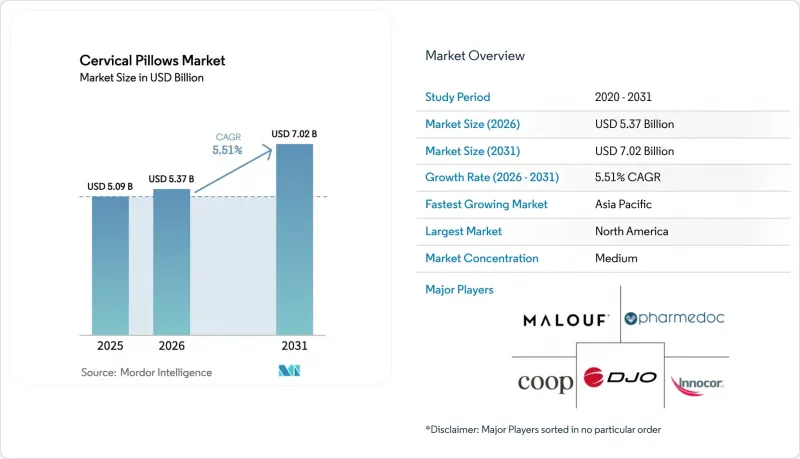
This report is Segmented by Product Type (Standard Pillow, Rolls, Water-Based Pillow, and Other Product Types), Application (Cervical Spondylosis, Whiplash Injuries, and More), Material Type (Polyester Fiber, and More), and Geography (North America, Europe, Asia-Pacific, Middle East and Africa, and South America). The Market Forecasts are Provided in Terms of Value (USD).
Global Cervical Pillows Market Trends and Insights
Accelerating E-Commerce Penetration in Home-Healthcare Products
Online storefronts offer manufacturers direct access to niche buyer segments, eliminating the markups that retailers previously added to inflate prices. Casper Sleep sold more than 34,000 pillow units through its proprietary site in 2025, reinforcing the appeal of free returns and 90-night trials that lower switching costs. Precision advertising targets side sleepers, back sleepers, or patients with cervical pain with messages that match individual sleep profiles. Brands utilize real-time reviews and telemetry from companion apps to iterate on loft and firmness, a feedback loop that is impossible in traditional brick-and-mortar channels. Smart Nora demonstrates premium price tolerance with a USD 439 product that inflates a thin pad beneath the user's pillow to mitigate snoring, proving that IoT add-ons can lift margins while working within pure-play online distribution.
Growing Clinical Evidence Linking Cervical Alignment to Sleep Quality
Peer-reviewed findings released in 2024 and 2025 have strengthened the medical acceptance of specialized cervical pillows. A January 2025 randomized trial showed that head extension via an adjustable cervical collar reduced respiratory event indices by 4.5 events per hour in moderate obstructive sleep apnea patients, a result now cited in pillow marketing materials directed at pulmonologists. A cross-sectional investigation in 2024 reported that individuals with cervical symptoms spent 185.1 minutes nightly in provocative postures compared with 83.8 minutes for controls, linking inadequate pillow support to sleep fragmentation. A Physical Therapy Korea study demonstrated that hybrid foam prototypes maintained a peak head-neck interface pressure of 57.03 mmHg, significantly lower than that of neck-support foam, thereby validating dual-layer designs that combine contouring and comfort. These data points help manufacturers translate clinical metrics-such as pain reduction, sleep efficiency, and cervical angle retention-into compelling value propositions for healthcare professionals and consumers alike.
Low Insurance Reimbursement for Preventive Sleep Aids
Most payers classify cervical pillows as non-essential wellness items, excluding them from formularies that cover hospital beds or CPAP devices. U.S. consumers, therefore, pay retail prices ranging from USD 66 for fiber-filled models to USD 299 for cooling or sensor-enabled designs, thereby limiting prescriptions to those who can self-fund. Flexible spending and health savings accounts offer partial relief, but they require additional paperwork that can hinder clinician recommendations. The reimbursement gap narrows only when pillows prove to be cost-effective in managing sleep apnea or post-surgical recovery, a finding that remains limited in payer documentation.
Other drivers and restraints analyzed in the detailed report include:
- Adoption of Smart Sensor-Embedded Orthopedic Pillows
- Rising Corporate Wellness and Ergonomic Workplace Programs
- Price Sensitivity in Emerging Economies
For complete list of drivers and restraints, kindly check the Table Of Contents.
Segment Analysis
Water-based pillows have captured user attention by blending customizable firmness with clinically proven pain relief, and they are projected to deliver a 7.54% CAGR from 2026 to 2031, outperforming the overall cervical pillows market. Standard pillows, while still holding 46.65% of the cervical pillows market share in 2025, face substitution by dynamic designs that prevent permanent loft loss.
Clinical validation from Johns Hopkins University underpins Mediflow's water-chamber product line, which has sold 7 million units and allows users to fine-tune firmness by adding water volumes that range from 2 to 5 liters. Rolls remain confined to therapeutic niches such as traction therapy, and hybrid solutions that bond memory foam cores with soft fiber layers lure buyers who want both contouring and surface comfort. Comparative studies that show hybrid prototypes lowering peak pressure to 57.03 mmHg highlight a trend toward multi-material architectures that mimic the benefits of water without fluid maintenance.
Complete Report Scope:
- By Product Type
- Standard Pillow
- Rolls
- Water-Based Pillow
- Other Product Types
- By Application
- Cervical Spondylosis
- Whiplash Injuries
- Temporomandibular Disorders
- Other Applications
- By Material Type
- Polyester Fiber
- Gel-Infused Foam
- Water-Filled
- Other Material Types
- Geography
- North America
- United States
- Canada
- Mexico
- Europe
- Germany
- United Kingdom
- France
- Italy
- Spain
- Rest Of Europe
- Asia-Pacific
- China
- Japan
- India
- Australia
- South Korea
- Rest Of Asia-Pacific
- Middle East And Africa
- GCC
- South Africa
- Rest Of Middle East And Africa
- South America
- Brazil
- Argentina
- Rest Of South America
- North America
Geography Analysis
North America accounted for 43.56% of the cervical pillows market in 2025, driven by the highest recorded age-standardized neck pain prevalence of 4,900.7 per 100,000 and employer budgets that regularly include ergonomic accessories. Smart-pillow prototypes and impending technology-platform entries reinforce the region's role as the first adopter of sensor-enabled bedding. Market saturation tempers growth prospects because many households already own at least one orthopedic pillow, and upgrades rather than first purchases now drive volume.
The Asia-Pacific region is projected to grow at a 6.43% CAGR between 2026 and 2031, contributing the most significant absolute increase to the cervical pillows market. China alone hosts 48 million cases of neck pain, and e-commerce giants such as Alibaba and JD.com create direct paths to urban consumers who routinely purchase health devices online. Japan and South Korea exhibit a high willingness to pay for cooling gels and smart sensors, while India and Indonesia maintain demand for polyester models priced below USD 30. Brands tailor assortments by city tier, often pairing flagship products with stripped-down variants to meet diverse spending power.
Europe's demand profile remains steady, driven by aging demographics and stringent safety standards that prioritize products with documented clinical benefits. Western European prevalence of 4,636.1 per 100,000 translates into consistent institutional orders for certified orthopedic pillows. Language fragmentation and varying distribution norms challenge pan-regional rollouts, prompting brands to consider country-specific partnerships. The Middle East, Africa, and South America together hold smaller shares, constrained by lower incomes and weaker enforcement against counterfeit imports. Pilot projects with local distributors or contract manufacturers help offset import tariffs and shorten delivery lead times in these regions.
- Airhawk
- Alex Orthopedic
- Bedgear
- Casper Sleep
- CNH Pillow
- Contour Products
- Coop Home Goods
- Custom Craftworks
- DJO Global
- Hall Innovations
- Innocor
- J-Pillow
- Malouf
- Mediflow
- My Pillow
- PharMeDoc
- Sissel GmbH
- Tempur Sealy International
- Therapeutic Pillow International
- Xtreme Comforts
Additional Benefits:
- The market estimate (ME) sheet in Excel format
- 3 months of analyst support
TABLE OF CONTENTS
1 Introduction
- 1.1 Study Assumptions & Market Definition
- 1.2 Scope Of The Study
2 Research Methodology
3 Executive Summary
4 Market Landscape
- 4.1 Market Overview
- 4.2 Market Drivers
- 4.2.1 Accelerating E-Commerce Penetration in Home-Healthcare Products
- 4.2.2 Growing Clinical Evidence Linking Cervical Alignment to Sleep Quality
- 4.2.3 Adoption of Smart, Sensor-Embedded Orthopedic Pillows
- 4.2.4 Rising Corporate Wellness & Ergonomic Workplace Programs
- 4.2.5 Expansion of Assisted-Living Facilities & Geriatric Care
- 4.3 Market Restraints
- 4.3.1 Low Insurance Reimbursement for Preventive Sleep Aids
- 4.3.2 Price Sensitivity in Emerging Economies
- 4.3.3 Counterfeit & Low-Quality Imports Undermining Brand Value
- 4.4 Value / Supply-Chain Analysis
- 4.5 Regulatory Landscape
- 4.6 Technological Outlook
- 4.7 Porter's Five Forces Analysis
- 4.7.1 Threat Of New Entrants
- 4.7.2 Bargaining Power Of Buyers
- 4.7.3 Bargaining Power Of Suppliers
- 4.7.4 Threat Of Substitutes
- 4.7.5 Intensity Of Competitive Rivalry
5 Market Size & Growth Forecasts (Value, USD)
- 5.1 By Product Type
- 5.1.1 Standard Pillow
- 5.1.2 Rolls
- 5.1.3 Water-Based Pillow
- 5.1.4 Other Product Types
- 5.2 By Application
- 5.2.1 Cervical Spondylosis
- 5.2.2 Whiplash Injuries
- 5.2.3 Temporomandibular Disorders
- 5.2.4 Other Applications
- 5.3 By Material Type
- 5.3.1 Polyester Fiber
- 5.3.2 Gel-Infused Foam
- 5.3.3 Water-Filled
- 5.3.4 Other Material Types
- 5.4 Geography
- 5.4.1 North America
- 5.4.1.1 United States
- 5.4.1.2 Canada
- 5.4.1.3 Mexico
- 5.4.2 Europe
- 5.4.2.1 Germany
- 5.4.2.2 United Kingdom
- 5.4.2.3 France
- 5.4.2.4 Italy
- 5.4.2.5 Spain
- 5.4.2.6 Rest Of Europe
- 5.4.3 Asia-Pacific
- 5.4.3.1 China
- 5.4.3.2 Japan
- 5.4.3.3 India
- 5.4.3.4 Australia
- 5.4.3.5 South Korea
- 5.4.3.6 Rest Of Asia-Pacific
- 5.4.4 Middle East And Africa
- 5.4.4.1 GCC
- 5.4.4.2 South Africa
- 5.4.4.3 Rest Of Middle East And Africa
- 5.4.5 South America
- 5.4.5.1 Brazil
- 5.4.5.2 Argentina
- 5.4.5.3 Rest Of South America
- 5.4.1 North America
6 Competitive Landscape
- 6.1 Market Concentration
- 6.2 Market Share Analysis
- 6.3 Company Profiles {(Includes Global Level Overview, Market Level Overview, Core Segments, Financials as Available, Strategic Information, Market Rank/Share for Key Companies, Products & Services, and Recent Developments)}
- 6.3.1 Airhawk
- 6.3.2 Alex Orthopedic
- 6.3.3 Bedgear
- 6.3.4 Casper Sleep
- 6.3.5 CNH Pillow
- 6.3.6 Contour Products
- 6.3.7 Coop Home Goods
- 6.3.8 Custom Craftworks (Pivotal Health Solutions)
- 6.3.9 DJO Global
- 6.3.10 Hall Innovations
- 6.3.11 Innocor Inc.
- 6.3.12 J-Pillow
- 6.3.13 Malouf
- 6.3.14 Mediflow
- 6.3.15 My Pillow
- 6.3.16 PharMeDoc
- 6.3.17 Sissel GmbH
- 6.3.18 Tempur Sealy International
- 6.3.19 Therapeutic Pillow International
- 6.3.20 Xtreme Comforts
7 Market Opportunities & Future Outlook
- 7.1 White-Space & Unmet-Need Assessment

