PUBLISHER: Mordor Intelligence | PRODUCT CODE: 2114061

PUBLISHER: Mordor Intelligence | PRODUCT CODE: 2114061
Africa Agar - Market Share Analysis, Industry Trends & Statistics, Growth Forecasts (2026 - 2031)
According to Mordor Intelligence, the Africa agar market size was valued at USD 15.18 million in 2025 and estimated to grow from USD 16.01 million in 2026 to reach USD 20.91 million by 2031, at a CAGR of 5.48% during the forecast period (2026-2031).
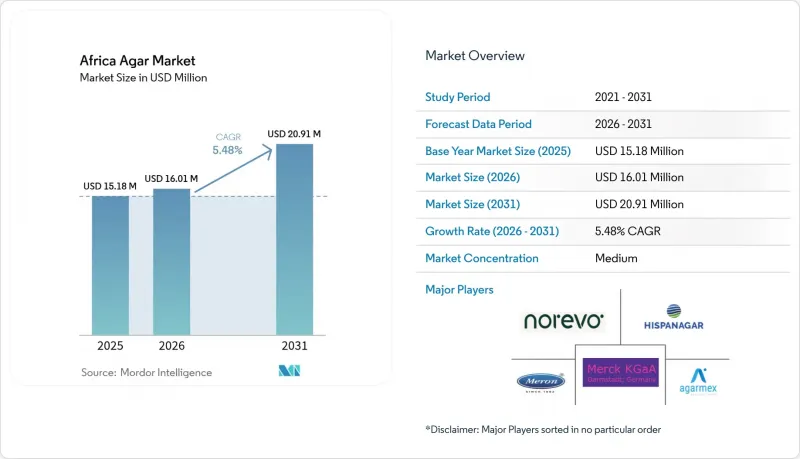
This report is Segmented by Form (Powder, Strips, and Flakes), by Application (Food and Beverage, Pharmaceuticals, Cosmetics, and Other Applications), and by Geography (South Africa, Egypt, Nigeria, and Rest of Africa). The Market Forecasts are Provided in Terms of Value (USD).
Africa Agar Market Trends and Insights
Food and beverage fortification leveraging agar's calcium and iron content
Agar's mineral composition makes it a versatile ingredient for fortified food formulations aimed at addressing micronutrient deficiencies in Sub-Saharan Africa. In this region, over 60% of children under five are affected by iron-deficiency anemia, and calcium intake remains below recommended levels in several countries. The World Health Organization's fortification initiatives, such as mandatory wheat flour fortification in Nigeria and voluntary dairy fortification in South Africa, have increased the demand for multi-functional hydrocolloids. These hydrocolloids must enhance texture, extend shelf life, and provide nutritional benefits without compromising sensory qualities. Derived from the cell walls of red algae, often harvested in African waters, agar contains approximately 0.5-0.63% calcium and 0.013-0.021% iron by dry weight, depending on the species and processing methods. These mineral properties make agar a valuable complementary fortificant in products such as jellies, dairy desserts, and beverage suspensions, offering both nutritional enrichment and functional benefits. Additionally, Nigeria's National Agency for Food and Drug Administration and Control has emphasized biofortification and fortification as key strategies under the National Food Safety Policy, potentially paving the way for broader regulatory acceptance of agar-fortified products.
Sustainability push for seaweed aquaculture in Morocco and Tanzania
Morocco's 3,500-kilometer Atlantic coastline and Tanzania's Zanzibar archipelago have become key areas for seaweed aquaculture development, supported by international donor programs and private-sector initiatives focused on sustainable marine ingredients. The GlobalSeaweedSTAR program, a four-year initiative led by the Scottish Association for Marine Science and funded by UK Research and Innovation, has implemented projects in Tanzania and Madagascar to address disease management, strain improvement, and farmer livelihoods. Notably, over 80% of Tanzania's more than 20,000 seaweed farmers are women . Tanzania's seaweed industry, traditionally centered on exporting dried red algae (primarily Eucheuma denticulatum and Kappaphycus alvarezii) for carrageenan extraction, continues to face challenges such as outbreaks of ice-ice disease, fluctuating market prices, and limited value-added infrastructure . A significant portion of the output is still exported as raw dried seaweed rather than processed products. Efforts to shift toward Gracilaria cultivation for agar production are in the early stages, hindered by issues such as limited seed stock availability, insufficient farmer training, and the lack of local extraction facilities. However, pilot projects led by Aqua Farms Organization and the University of Dar es Salaam are making progress in advancing disease diagnostics and biosecurity protocols.
High import dependency raising raw material costs
Africa's agar supply chain relies heavily on imports, with over 85% of its hydrocolloid needs sourced from Asian producers, including China, Indonesia, and Chile. This dependency exposes buyers to currency fluctuations, shipping cost volatility, and supply chain disruptions. The pharmaceutical industry imports over 70% of its medicines and raw materials, with a similar reliance on specialty food ingredients, such as agar. Currency depreciation in key markets, such as Nigeria's naira losing over 40% against the US dollar between 2023 and 2024, and Egypt's pound devaluation, has increased costs for dollar-denominated agar imports, reducing margins for food processors and pharmaceutical manufacturers. Tanzania's seaweed aquaculture sector, which produces over 25,000 metric tonnes annually, exports dried seaweed for processing in Asia instead of establishing local agar extraction facilities, thereby sustaining import dependency and limiting value addition.
Other drivers and restraints analyzed in the detailed report include:
- Rising vegan and halal food demand across urban Africa
- Trade-hub positioning of South Africa for regional distribution
- Competition from cheaper carrageenan and pectin blends
For complete list of drivers and restraints, kindly check the Table Of Contents.
Segment Analysis
Powder is projected to account for 66.65% of the Africa agar market share in 2025, with a compound annual growth rate (CAGR) of 6.62% through 2031. This growth reflects consistent demand from diagnostic laboratories, confectionery production lines, and capsule manufacturers. Bacteriological-grade agar, offering a gel strength of 600-1,200 g/cm2, aligns with microbiology protocols established by WHO reference laboratories. Additionally, its rapid hydration properties support high-throughput dairy operations in Gauteng, where agar is dosed at 2-3 kilograms per tonne of yogurt base.
Strips and flakes maintain a niche presence, primarily among artisanal confectioners and culinary schools. Demand for strips persists in home-baking channels due to their visual dissolution assurance and availability in smaller pack sizes. However, the rise of supermarket chains stocking pre-hydrated dessert mixes is reducing the reliance on manual strip usage. The growing preference for powdered agar reflects broader industrial scaling trends within the Africa agar market.
Complete Report Scope:
- By Form
- Powder
- Strips
- Flakes
- By Application
- Food and Beverage
- Pharmaceuticals
- Cosmetics
- Other Applications
- By Geography
- South Africa
- Egypt
- Nigeria
- Rest of Africa
List of Companies Covered in this Report:
- Meron Group
- Hispanagar SA
- Agarmex S.A.
- Merck KGaA
- Marine Science Co. Ltd.
- NOREVO GmbH
- ROKO Industries
- Iberagar
- Green Fresh Group
- Fujian Global Ocean Biotech
- Agar Brasileiro
- Sobigel
- Taike Biotechnology
- Java Biocolloid
- Qingdao Gather Great Ocean
- Putian Chengxiang Jingyi Seaweed
- Kingyen
- Mingfu Fujian
- Wako Pure Chemical
- Thermo Fisher Scientific (agarose lines)
- Lonza Group (agarose lines)
Additional Benefits:
- The market estimate (ME) sheet in Excel format
- 3 months of analyst support
TABLE OF CONTENTS
1 INTRODUCTION
- 1.1 Study Assumptions and Market Definition
- 1.2 Scope of the Study
2 RESEARCH METHODOLOGY
3 EXECUTIVE SUMMARY
4 MARKET LANDSCAPE
- 4.1 Market Overview
- 4.2 Market Drivers
- 4.2.1 Food and beverage fortification leveraging agar's calcium and iron content
- 4.2.2 Sustainability push for seaweed aquaculture in Morocco and Tanzania
- 4.2.3 Rising vegan and halal food demand across urban Africa
- 4.2.4 Trade-hub positioning of South Africa for regional distribution
- 4.2.5 Shift toward clean-label natural food stabilizers
- 4.2.6 Expansion of artisanal cosmetics and skincare utilizing natural thickeners
- 4.3 Market Restraints
- 4.3.1 High import dependency raising raw material costs
- 4.3.2 Competition from cheaper carrageenan and pectin blends
- 4.3.3 Stringent food safety regulations compliance costs
- 4.3.4 Limited local seaweed processing infrastructure
- 4.4 Supply Chain Analysis
- 4.5 Regulatory and Technological Outlook
- 4.6 Porter's Five Forces Analysis
- 4.6.1 Threat of New Entrants
- 4.6.2 Bargaining Power of Buyers
- 4.6.3 Bargaining Power of Suppliers
- 4.6.4 Threat of Substitutes
- 4.6.5 Intensity of Competitive Rivalry
5 MARKET SIZE AND GROWTH FORECATS (VALUE)
- 5.1 By Form
- 5.1.1 Powder
- 5.1.2 Strips
- 5.1.3 Flakes
- 5.2 By Application
- 5.2.1 Food and Beverage
- 5.2.2 Pharmaceuticals
- 5.2.3 Cosmetics
- 5.2.4 Other Applications
- 5.3 By Geography
- 5.3.1 South Africa
- 5.3.2 Egypt
- 5.3.3 Nigeria
- 5.3.4 Rest of Africa
6 COMPETITIVE LANDSCAPE
- 6.1 Market Concentration
- 6.2 Strategic Moves
- 6.3 Market Ranking Analysis
- 6.4 Company Profiles {(includes Global level Overview, Market level overview, Core Segments, Financials as available, Strategic Information, Market Rank/Share for key companies, Products and Services, and Recent Developments)}
- 6.4.1 Meron Group
- 6.4.2 Hispanagar SA
- 6.4.3 Agarmex S.A.
- 6.4.4 Merck KGaA
- 6.4.5 Marine Science Co. Ltd.
- 6.4.6 NOREVO GmbH
- 6.4.7 ROKO Industries
- 6.4.8 Iberagar
- 6.4.9 Green Fresh Group
- 6.4.10 Fujian Global Ocean Biotech
- 6.4.11 Agar Brasileiro
- 6.4.12 Sobigel
- 6.4.13 Taike Biotechnology
- 6.4.14 Java Biocolloid
- 6.4.15 Qingdao Gather Great Ocean
- 6.4.16 Putian Chengxiang Jingyi Seaweed
- 6.4.17 Kingyen
- 6.4.18 Mingfu Fujian
- 6.4.19 Wako Pure Chemical
- 6.4.20 Thermo Fisher Scientific (agarose lines)
- 6.4.21 Lonza Group (agarose lines)
7 MARKET OPPORTUNITIES AND FUTURE OUTLOOK

