PUBLISHER: Mordor Intelligence | PRODUCT CODE: 2114077

PUBLISHER: Mordor Intelligence | PRODUCT CODE: 2114077
Mobile Device Management - Market Share Analysis, Industry Trends & Statistics, Growth Forecasts (2026 - 2031)
According to Mordor Intelligence, the mobile device management market size stands at USD 11.11 billion in 2026 and is projected to reach USD 26.04 billion by 2031, reflecting an 18.57% CAGR over the period.
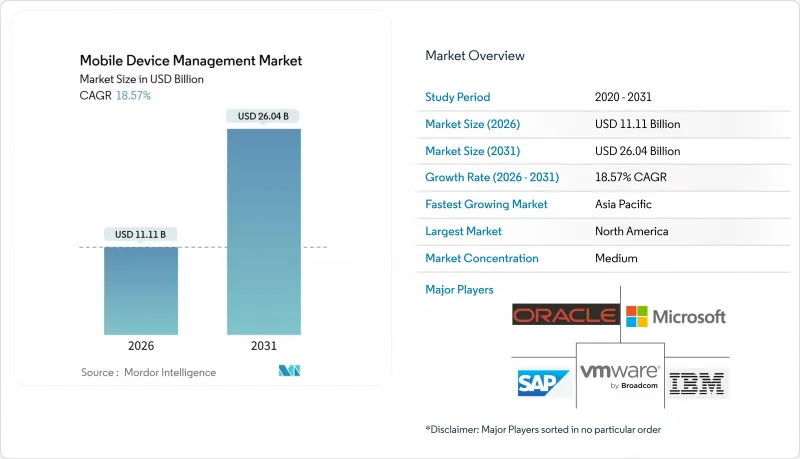
This report is Segmented by Deployment Mode (On-Premise, and Cloud), Device Type (Smartphones and Tablets, Laptops and Desktops, and More), End-User Industry (IT and Telecom, BFSI, and More), Ownership Model (Corporate-Owned Devices, BYOD, COPE, CYOD), and Geography (North America, South America, Europe, Asia Pacific, Middle East, Africa). The Market Forecasts are Provided in Terms of Value (USD).
Global Mobile Device Management Market Trends and Insights
Explosion of Enterprise BYOD Policies
Hybrid work has pushed 82% of organizations to allow employee-owned phones and tablets on corporate networks in 2025, up from 67% in 2023. This expanded fleet multiplies operating-system permutations, personal cloud apps, and unmanaged data paths, demanding containerization and remote-wipe controls. Insurers are increasingly denying or surcharging coverage when unmanaged endpoints exist, making MDM adoption a prerequisite for risk transfer. Cost savings from eliminating corporate device stipends can entice finance teams; however, breach-related penalties under the GDPR or the California Consumer Privacy Rights Act may offset those savings. As a result, executives view the Mobile Device Management market as a direct hedge against regulatory fines and premium hikes rather than an optional efficiency tool.
Accelerating Shift to Cloud-Native UEM Suites
Organizations are abandoning on-premise consoles for cloud platforms that consolidate phones, laptops, wearables, and IoT devices behind a single policy fabric. Microsoft Intune, integrated with Azure Active Directory, exemplifies how conditional access decisions now assess real-time device health, user identity, and app context. Elastic capacity removes server procurement cycles, while automatic updates ensure continuous compliance with emerging zero-trust guidelines. Medium-term gains include machine-learning remediation of configuration drift and predictive hardware failure alerts, cutting endpoint management labor by as much as 40%. Delayed migrations risk technical debt as emerging standards such as FIDO2 and post-quantum algorithms outpace on-premise software release cycles.
Up-Front Integration Cost with Legacy IAM/ITSM Stacks
Enterprises relying on outdated identity managers and help-desk tools must fund custom APIs, directory sync, and workflow orchestration when deploying modern MDM. Consulting fees often exceed USD 500,000, and projects can last a year, straining budgets for mid-sized firms. Mixed authentication protocols create single points of failure and incident-response delays, while strict change-control boards in finance and healthcare prolong testing cycles. This cost friction temporarily slows the uptake of Mobile Device Management among heavily regulated incumbents.
Other drivers and restraints analyzed in the detailed report include:
- Surge in Cyber-Insurance Mandates for Endpoint Control
- 5G-Enabled Field-Service Workforce Expansion
- Fragmented Regulatory Data-Sovereignty Rules
For complete list of drivers and restraints, kindly check the Table Of Contents.
Segment Analysis
Cloud-hosted platforms controlled 65.13% of 2025 revenue, confirming their dominance in the Mobile Device Management market. The model's 19.12% CAGR to 2031 reflects elastic scaling, automatic feature updates, and pay-as-you-go pricing that converts capital outlays into operating expenses. Vendors such as Microsoft and VMware expose REST APIs that integrate with SIEM, IAM, and EDR tools, trimming integration timelines. Even defense and financial institutions that once rejected public cloud now adopt hybrid blueprints that mirror policies across sovereign data centers for disaster recovery, further enlarging the cloud's footprint.
Autonomous endpoint management accelerates the shift, as machine-learning engines analyze telemetry, predict component failures, and self-correct drift. Gartner estimates a 40% cut in labor costs by 2029 when autonomous capabilities mature, underscoring why the Mobile Device Management market favors cloud delivery. Zero-touch provisioning enables devices to ship directly to end users and self-enroll through QR codes, a practice that was cemented during pandemic lockdowns. The value proposition, however, hinges on hardware attestation and a secure supply chain, because compromised firmware can defeat remote-management safeguards before devices even connect.
Smartphones and tablets owned 48.28% of 2025 revenue, but industrial IoT endpoints will grow at 20.34% CAGR as factories embed cellular modules in robots, fleets deploy rugged handhelds, and utilities install smart meters. Cellular IoT connections are projected to reach 5.6 billion by 2030, each requiring certificate rotation, patching, and network-access controls. Laptops remain vital for code development and financial modeling, yet browser-based apps flatten their growth curve.
Rugged and wearable devices thrive in construction, mining, and clinical settings where harsh environments or infection-control rules preclude consumer hardware. Lightweight protocols such as OMA-DM and LwM2M shrink agent footprints, conserving battery and CPU. 5G network slicing offers dedicated bandwidth for telemetry, ensuring reliable throughput for autonomous vehicles or remote surgery. These dynamics channel investment toward IoT-oriented functionality within the Mobile Device Management market, including power-aware policy polling and edge-cached updates.
Complete Report Scope:
- By Deployment Mode
- On-Premise
- Cloud
- By Device Type
- Smartphones and Tablets
- Laptops and Desktops
- Rugged and Wearable Devices
- IoT/IIoT Endpoints
- By End-User Industry
- IT and Telecom
- BFSI
- Healthcare and Life Sciences
- Retail and E-Commerce
- Government and Public Sector
- Manufacturing
- Education
- Transportation and Logistics
- By Ownership Model
- Corporate-Owned Devices
- BYOD
- COPE (Corporate-Owned, Personally Enabled)
- CYOD (Choose-Your-Own-Device)
- By Geography
- North America
- United States
- Canada
- Mexico
- South America
- Brazil
- Argentina
- Rest of South America
- Europe
- Germany
- United Kingdom
- France
- Italy
- Spain
- Russia
- Rest of Europe
- Asia Pacific
- China
- Japan
- South Korea
- India
- Australia
- New Zealand
- Rest of Asia Pacific
- Middle East
- United Arab Emirates
- Saudi Arabia
- Turkey
- Rest of Middle East
- Africa
- South Africa
- Nigeria
- Kenya
- Rest of Africa
- North America
Geography Analysis
North America held a 38.71% share in 2025, buoyed by early BYOD uptake, rigorous cyber-insurance clauses, and a dense vendor ecosystem. The United States Cybersecurity and Infrastructure Security Agency classifies endpoint management as a core safeguard for critical infrastructure, accelerating public-sector rollouts. Canadian and Mexican data-protection laws are driving the growth of regionally hosted cloud instances, yet the United States-Mexico-Canada Agreement facilitates cross-border data flow. Market growth steadies as large enterprises near saturation, but small firms without dedicated IT staff remain a significant expansion vector for the Mobile Device Management market.
Europe's trajectory depends on GDPR compliance and ESG directives. Germany, the United Kingdom, and France anchor demand, while the Corporate Sustainability Due Diligence Directive rewards vendors that disclose their carbon footprints and support the right to repair. Russian sanctions restrict Western cloud services, prompting the development of domestic alternatives. Works councils routinely negotiate device-tracking limitations under GDPR Article 88, affecting feature uptake more than license volumes.
Asia Pacific is the fastest-growing region at 10.23% CAGR, underpinned by India's Digital India scheme, China's smart manufacturing push, and Japan's Society 5.0 infrastructure vision. South Korea's mature 5G landscape encourages early adoption of low-latency MDM features for autonomous systems. Australia and New Zealand strengthen cybersecurity baselines through the Essential Eight, reinforcing MDM's role. The Middle East sees momentum in the United Arab Emirates and Saudi Arabia, while Africa's nascent uptake concentrates in Nigeria and Kenya's fintech ecosystems. Collectively, these initiatives broaden the Mobile Device Management market but demand feature localization and sovereign data hosting.
- VMware Inc.
- Microsoft Corporation (Intune)
- IBM Corporation
- Citrix Systems Inc.
- SAP SE
- Broadcom Inc. (Symantec)
- Cisco Systems Inc.
- Ivanti Software Inc.
- JAMF Software LLC
- SOTI Inc.
- ManageEngine (Zoho Corporation)
- Hexnode (UEM)
- 42Gears Mobility Systems
- Scalefusion
- Baramundi Software AG
- Addigy
- Miradore Ltd.
- Kaspersky Lab
- Sophos Group plc
- MobileIron Inc.
- BlackBerry Limited
- Check Point Software Technologies Ltd.
- Google LLC (Android Enterprise)
- Lookout Inc.
Additional Benefits:
- The market estimate (ME) sheet in Excel format
- 3 months of analyst support
TABLE OF CONTENTS
1 INTRODUCTION
- 1.1 Study Assumptions and Market Definition
- 1.2 Scope of the Study
2 RESEARCH METHODOLOGY
3 EXECUTIVE SUMMARY
4 MARKET LANDSCAPE
- 4.1 Market Overview
- 4.2 Market Drivers
- 4.2.1 Explosion of Enterprise BYOD Policies
- 4.2.2 Accelerating Shift to Cloud-Native UEM Suites
- 4.2.3 Surge in Cyber-Insurance Mandates for Endpoint Control
- 4.2.4 5G-Enabled Field-Service Workforce Expansion
- 4.2.5 Post-Quantum Security Preparations Elevating Device Trust Stacks
- 4.2.6 ESG-Linked Procurement Favouring Secure-Device Vendors
- 4.3 Market Restraints
- 4.3.1 Up-Front Integration Cost with Legacy IAM/ITSM Stacks
- 4.3.2 Fragmented Regulatory Data-Sovereignty Rules
- 4.3.3 Growing Employee Privacy Push-Back on Device Tracking
- 4.3.4 Limited Battery/CPU Headroom on Rugged IoT Endpoints
- 4.4 Industry Value Chain Analysis
- 4.5 Regulatory Landscape
- 4.6 Technological Outlook
- 4.7 Porter's Five Forces Analysis
- 4.7.1 Bargaining Power of Suppliers
- 4.7.2 Bargaining Power of Buyers
- 4.7.3 Threat of New Entrants
- 4.7.4 Threat of Substitutes
- 4.7.5 Intensity of Competitive Rivalry
- 4.8 Impact Assessment of Key Stakeholders
- 4.9 Key Use Cases and Case Studies
- 4.10 Impact of Macroeconomic Factors on the Market
5 MARKET SIZE AND GROWTH FORECASTS (VALUE)
- 5.1 By Deployment Mode
- 5.1.1 On-Premise
- 5.1.2 Cloud
- 5.2 By Device Type
- 5.2.1 Smartphones and Tablets
- 5.2.2 Laptops and Desktops
- 5.2.3 Rugged and Wearable Devices
- 5.2.4 IoT/IIoT Endpoints
- 5.3 By End-User Industry
- 5.3.1 IT and Telecom
- 5.3.2 BFSI
- 5.3.3 Healthcare and Life Sciences
- 5.3.4 Retail and E-Commerce
- 5.3.5 Government and Public Sector
- 5.3.6 Manufacturing
- 5.3.7 Education
- 5.3.8 Transportation and Logistics
- 5.4 By Ownership Model
- 5.4.1 Corporate-Owned Devices
- 5.4.2 BYOD
- 5.4.3 COPE (Corporate-Owned, Personally Enabled)
- 5.4.4 CYOD (Choose-Your-Own-Device)
- 5.5 By Geography
- 5.5.1 North America
- 5.5.1.1 United States
- 5.5.1.2 Canada
- 5.5.1.3 Mexico
- 5.5.2 South America
- 5.5.2.1 Brazil
- 5.5.2.2 Argentina
- 5.5.2.3 Rest of South America
- 5.5.3 Europe
- 5.5.3.1 Germany
- 5.5.3.2 United Kingdom
- 5.5.3.3 France
- 5.5.3.4 Italy
- 5.5.3.5 Spain
- 5.5.3.6 Russia
- 5.5.3.7 Rest of Europe
- 5.5.4 Asia Pacific
- 5.5.4.1 China
- 5.5.4.2 Japan
- 5.5.4.3 South Korea
- 5.5.4.4 India
- 5.5.4.5 Australia
- 5.5.4.6 New Zealand
- 5.5.4.7 Rest of Asia Pacific
- 5.5.5 Middle East
- 5.5.5.1 United Arab Emirates
- 5.5.5.2 Saudi Arabia
- 5.5.5.3 Turkey
- 5.5.5.4 Rest of Middle East
- 5.5.6 Africa
- 5.5.6.1 South Africa
- 5.5.6.2 Nigeria
- 5.5.6.3 Kenya
- 5.5.6.4 Rest of Africa
- 5.5.1 North America
6 COMPETITIVE LANDSCAPE
- 6.1 Market Concentration
- 6.2 Strategic Moves
- 6.3 Market Share Analysis
- 6.4 Company Profiles
- 6.4.1 VMware Inc.
- 6.4.2 Microsoft Corporation (Intune)
- 6.4.3 IBM Corporation
- 6.4.4 Citrix Systems Inc.
- 6.4.5 SAP SE
- 6.4.6 Broadcom Inc. (Symantec)
- 6.4.7 Cisco Systems Inc.
- 6.4.8 Ivanti Software Inc.
- 6.4.9 JAMF Software LLC
- 6.4.10 SOTI Inc.
- 6.4.11 ManageEngine (Zoho Corporation)
- 6.4.12 Hexnode (UEM)
- 6.4.13 42Gears Mobility Systems
- 6.4.14 Scalefusion
- 6.4.15 Baramundi Software AG
- 6.4.16 Addigy
- 6.4.17 Miradore Ltd.
- 6.4.18 Kaspersky Lab
- 6.4.19 Sophos Group plc
- 6.4.20 MobileIron Inc.
- 6.4.21 BlackBerry Limited
- 6.4.22 Check Point Software Technologies Ltd.
- 6.4.23 Google LLC (Android Enterprise)
- 6.4.24 Lookout Inc.
7 MARKET OPPORTUNITIES AND FUTURE OUTLOOK
- 7.1 White-Space and Unmet-Need Assessment

