PUBLISHER: Mordor Intelligence | PRODUCT CODE: 2114081

PUBLISHER: Mordor Intelligence | PRODUCT CODE: 2114081
Cognitive Analytics - Market Share Analysis, Industry Trends & Statistics, Growth Forecasts (2026 - 2031)
According to Mordor Intelligence, cognitive analytics market size in 2026 is estimated at USD 10.1 billion, growing from 2025 value of USD 7.45 billion with 2031 projections showing USD 46.16 billion, growing at 35.52% CAGR over 2026-2031.
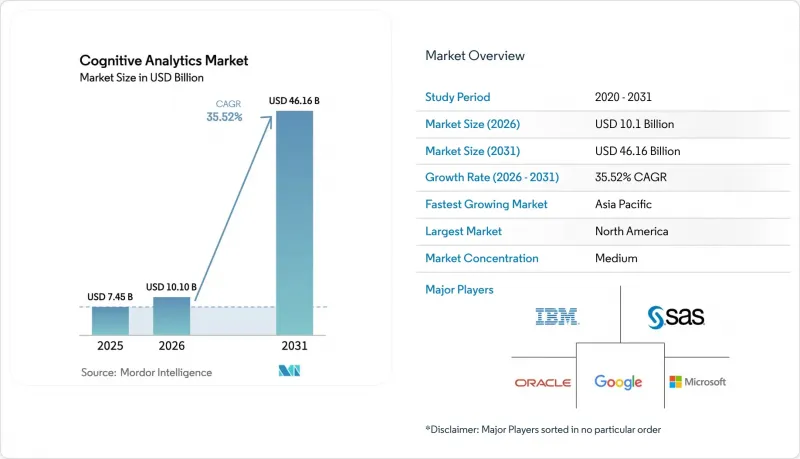
This report is Segmented by Deployment (On-Premises and Cloud), Component Type (Tools and Services), Technology Type (Natural Language Processing (NLP), Machine and Deep Learning, and More), End-User Industry (BFSI, Manufacturing, Healthcare, and More), and Geography. The Market Forecasts are Provided in Terms of Value (USD).
Global Cognitive Analytics Market Trends and Insights
Surge in enterprise adoption of AI-powered solutions
Seventy-two percent of organizations deploy AI in at least one function, signalling a decisive shift from experimentation to scaled roll-outs. Leadership expectations align: 63% foresee noticeable financial impact within two years, and 85% anticipate AI-driven business-model change. Documented returns, 15:1 benefit-cost ratios and 25% revenue uplifts, reinforce further investment. Yet only 21% have redesigned workflows to harness AI, highlighting integration gaps that cognitive analytics platforms must bridge.
Rapid decline in cloud-compute and storage costs
Organizations are slashing data-lake spend by up to 80% using dynamic scaling and spot-instance strategies. The plunge opens the cognitive analytics market to mid-sized enterprises previously priced out. FinOps engines now auto-optimize spending, turning cost savings into a flywheel for wider analytics deployments.
Implementation complexity and skills gap
Eighty percent of IT managers cite talent shortages, and 52% of firms call it the number-one barrier to advanced analytics. Japan alone could face 789,000 vacant software-engineer positions by 2030. No-code workflows, automated model deployment, and vendor-delivered training are becoming essential features.
Other drivers and restraints analyzed in the detailed report include:
- Real-time decision-making demand in BFSI and healthcare
- NLP-driven conversational analytics integration
- Data-privacy / compliance restrictions
For complete list of drivers and restraints, kindly check the Table Of Contents.
Segment Analysis
On-Premises architectures controlled 57.20% of the cognitive analytics market share in 2025, driven by data-sovereignty mandates in healthcare and financial services. Cloud/Hosted offerings, however, are forecast to swell at 37.05% CAGR, propelled by 80% infrastructure cost cuts and sovereign-AI programs earmarking USD 110 billion for local clouds in Asia-Pacific. Hybrid set-ups that place sensitive workloads on-site while leveraging cloud analytics engines are proliferating. Microsoft's USD 80 billion spend on AI-ready data centers underscores the infrastructure race. Regional regulatory differences shape adoption: GDPR pushes Europe toward hybrid models, whereas North American enterprises gravitate to all-cloud estates.
Edge computing enriches these hybrids by processing data locally and forwarding feature sets for model retraining in the cloud, harmonizing latency, compliance, and cost. US defense projects seeking tactical AI insights exemplify use cases demanding both on-device inference and centralized model control. The combined approach is poised to dominate new deployments over the outlook period, solidifying the cognitive analytics market as a blended cloud-edge ecosystem.
Tools captured 54.30% of the cognitive analytics market size in 2025, but Services are expanding at 36.02% CAGR through 2031. Implementation support, training, and managed operations absorb the skills deficit that 80% of IT leaders report. Advisory teams now package change-management and governance consulting to comply with the EU AI Act. Outcome-based contracts, where vendors accept a revenue-share instead of licenses, are gaining appeal, evidenced by Palantir's recent financial-services deals.
Demand for integration services rises as enterprises mesh cognitive engines with ERP, CRM, and IoT platforms. Vendors respond by launching low-code connectors and pre-built workflow templates. Training services include "train-the-trainer" programs to seed internal expertise, mitigating future dependency on external consultants. Over the forecast, services revenue is set to close the gap with tools as businesses prioritize faster time-to-value.
Complete Report Scope:
- By Deployment
- On-Premises
- Cloud / Hosted
- By Component Type
- Tools
- Services
- By Technology Type
- Natural Language Processing (NLP)
- Machine and Deep Learning
- Automated Reasoning
- Generative-AI Techniques
- By End-user Industry
- BFSI
- Manufacturing
- IT and Telecommunication
- Aerospace and Defense
- Healthcare
- Retail and Consumer Goods
- Government and Public Sector
- By Geography
- North America
- United States
- Canada
- Mexico
- South America
- Brazil
- Argentina
- Rest of South America
- Europe
- United Kingdom
- Germany
- France
- Rest of Europe
- Asia-Pacific
- China
- Japan
- India
- Australia
- South Korea
- Rest of Asia-Pacific
- Middle East and Africa
- Middle East
- Saudi Arabia
- United Arab Emirates
- Rest of Middle East
- Africa
- South Africa
- Nigeria
- Rest of Africa
- Middle East
- North America
Geography Analysis
North America held 45.60% of 2025 revenues, anchored by USD 154 billion in enterprise AI spending and technology giants' USD 300 billion infrastructure commitments. Microsoft's USD 80 billion investment exemplifies the scale required to maintain latency-free analytics access. Venture funding depth and a regulatory environment that balances innovation with data stewardship have kept adoption steady. Talent shortages remain acute; competitive salaries and reliance on consulting partners typify mitigation strategies, bolstering the services revenue pool.
Asia-Pacific is the growth engine, advancing at 37.20% CAGR as sovereign-AI strategies funnel USD 110 billion toward local compute and algorithm R&D. Japan's AI market, at USD 4.5 billion in 2024, is set to reach USD 7.3 billion by 2027, while China's conversational-AI revenues are projected at USD 5.19 billion by 2030. India's 17.8% CAGR demonstrates widespread digital-transformation agendas. Hyperscaler data-center roll-outs and locally trained large-language models answer linguistic diversity and data-residency rules, widening the regional addressable market.
Europe's trajectory intertwines with the AI Act. Compliance spending, up to USD 3.3 billion, reshapes budgeting and vendor selection. Governance-built-in solutions gain preference, turning regulation into a moat for capable providers. Market fragmentation arises as member states refine risk categories, demanding modular architectures. Meanwhile, emerging markets in South America and the Middle East and Africa register steady progress, leveraging smart-city and financial-inclusion initiatives though impeded by infrastructure and skills constraints.
- Google LLC
- IBM Corporation
- Microsoft Corporation
- Amazon Web Services (AWS)
- Oracle Corporation
- SAS Institute Inc.
- Cisco Systems Inc.
- SAP SE
- Tableau (Salesforce)
- MicroStrategy Inc.
- Palantir Technologies
- HPE (Hewlett Packard Enterprise)
- Cloudera Inc.
- Databricks Inc.
- Snowflake Inc.
- Teradata Corporation
- QlikTech International
- ThoughtSpot Inc.
- OpenText Corporation
- Narrative Science
- Databricks Inc.
- Sinequa
Additional Benefits:
- The market estimate (ME) sheet in Excel format
- 3 months of analyst support
TABLE OF CONTENTS
1 Introduction
- 1.1 Study Assumptions and Market Definition
- 1.2 Scope of the Study
2 Research Methodology
3 Executive Summary
4 Market Landscape
- 4.1 Market Overview
- 4.2 Market Drivers
- 4.2.1 Surge in enterprise adoption of AI-powered solutions
- 4.2.2 Rapid decline in cloud-compute and storage costs
- 4.2.3 Real-time decision-making demand in BFSI and healthcare
- 4.2.4 NLP-driven conversational analytics integration
- 4.2.5 Emergence of autonomous "AI agent" analytics platforms
- 4.2.6 Synthetic-data marketplaces for model training
- 4.3 Market Restraints
- 4.3.1 Implementation complexity and skills gap
- 4.3.2 Data-privacy / compliance restrictions
- 4.3.3 Model-hallucination and observability risk
- 4.3.4 Rising carbon footprint of large AI workloads
- 4.4 Value Chain Analysis
- 4.5 Regulatory Landscape
- 4.6 Technological Outlook
- 4.7 Porter's Five Forces Analysis
- 4.7.1 Threat of New Entrants
- 4.7.2 Bargaining Power of Buyers
- 4.7.3 Bargaining Power of Suppliers
- 4.7.4 Threat of Substitutes
- 4.7.5 Competitive Rivalry
- 4.8 Investment Analysis
5 MARKET SIZE AND GROWTH FORECASTS (VALUE)
- 5.1 By Deployment
- 5.1.1 On-Premises
- 5.1.2 Cloud / Hosted
- 5.2 By Component Type
- 5.2.1 Tools
- 5.2.2 Services
- 5.3 By Technology Type
- 5.3.1 Natural Language Processing (NLP)
- 5.3.2 Machine and Deep Learning
- 5.3.3 Automated Reasoning
- 5.3.4 Generative-AI Techniques
- 5.4 By End-user Industry
- 5.4.1 BFSI
- 5.4.2 Manufacturing
- 5.4.3 IT and Telecommunication
- 5.4.4 Aerospace and Defense
- 5.4.5 Healthcare
- 5.4.6 Retail and Consumer Goods
- 5.4.7 Government and Public Sector
- 5.5 By Geography
- 5.5.1 North America
- 5.5.1.1 United States
- 5.5.1.2 Canada
- 5.5.1.3 Mexico
- 5.5.2 South America
- 5.5.2.1 Brazil
- 5.5.2.2 Argentina
- 5.5.2.3 Rest of South America
- 5.5.3 Europe
- 5.5.3.1 United Kingdom
- 5.5.3.2 Germany
- 5.5.3.3 France
- 5.5.3.4 Rest of Europe
- 5.5.4 Asia-Pacific
- 5.5.4.1 China
- 5.5.4.2 Japan
- 5.5.4.3 India
- 5.5.4.4 Australia
- 5.5.4.5 South Korea
- 5.5.4.6 Rest of Asia-Pacific
- 5.5.5 Middle East and Africa
- 5.5.5.1 Middle East
- 5.5.5.1.1 Saudi Arabia
- 5.5.5.1.2 United Arab Emirates
- 5.5.5.1.3 Rest of Middle East
- 5.5.5.2 Africa
- 5.5.5.2.1 South Africa
- 5.5.5.2.2 Nigeria
- 5.5.5.2.3 Rest of Africa
- 5.5.5.1 Middle East
- 5.5.1 North America
6 COMPETITIVE LANDSCAPE
- 6.1 Market Concentration
- 6.2 Strategic Moves
- 6.3 Market Share Analysis
- 6.4 Company Profiles (includes Global level Overview, Market level overview, Core Segments, Financials as available, Strategic Information, Market Rank/Share for key companies, Products and Services, and Recent Developments)
- 6.4.1 Google LLC
- 6.4.2 IBM Corporation
- 6.4.3 Microsoft Corporation
- 6.4.4 Amazon Web Services (AWS)
- 6.4.5 Oracle Corporation
- 6.4.6 SAS Institute Inc.
- 6.4.7 Cisco Systems Inc.
- 6.4.8 SAP SE
- 6.4.9 Tableau (Salesforce)
- 6.4.10 MicroStrategy Inc.
- 6.4.11 Palantir Technologies
- 6.4.12 HPE (Hewlett Packard Enterprise)
- 6.4.13 Cloudera Inc.
- 6.4.14 Databricks Inc.
- 6.4.15 Snowflake Inc.
- 6.4.16 Teradata Corporation
- 6.4.17 QlikTech International
- 6.4.18 ThoughtSpot Inc.
- 6.4.19 OpenText Corporation
- 6.4.20 Narrative Science
- 6.4.21 Databricks Inc.
- 6.4.22 Sinequa
7 MARKET OPPORTUNITIES AND FUTURE OUTLOOK
- 7.1 White-space and Unmet-need Assessment

