PUBLISHER: Mordor Intelligence | PRODUCT CODE: 2114090

PUBLISHER: Mordor Intelligence | PRODUCT CODE: 2114090
Online Advertising - Market Share Analysis, Industry Trends & Statistics, Growth Forecasts (2026 - 2031)
According to Mordor Intelligence, the online advertising market size is projected to expand from USD 290.82 billion in 2025 and USD 323.74 billion in 2026 to USD 525.39 billion by 2031, registering a CAGR of 10.17% between 2026 to 2031.
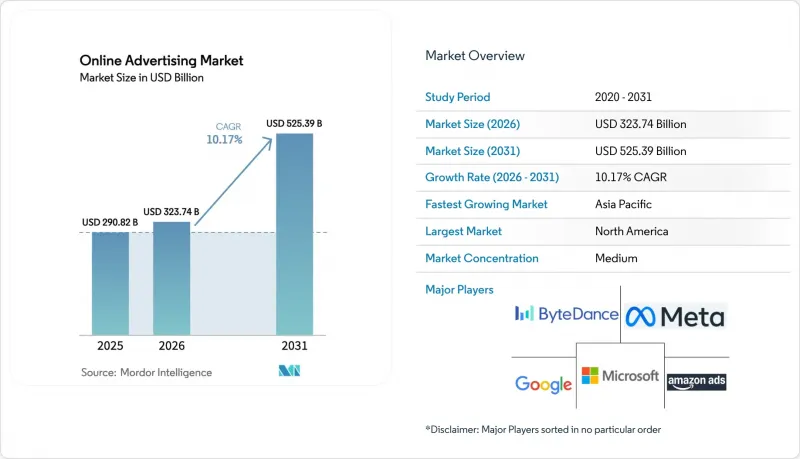
This report is Segmented by Advertising Format (Social Media, Search Engine, Video, and Email, and Display Advertising), Platform (Mobile, Desktop and Laptop, Connected TV, and Other Platforms), End-User Vertical (Automotive, Retail and E-Commerce, and More), Ad Buying Model (Programmatic Real-Time Bidding, and More), and Geography. The Market Forecasts are Provided in Terms of Value (USD).
Global Online Advertising Market Trends and Insights
Retail Media Networks Monetization Driving Closed-Loop ROAS for CPG Brands
Retail media networks grew into strategic profit centers in 2025 as Amazon Ads, Walmart Connect, and Instacart Ads jointly attracted roughly USD 50 billion in annual spend. Brands value the closed-loop attribution that links on-site impressions to confirmed checkouts, eliminating guesswork around viewability proxies. Bain and Company calculated three-to-five-times higher return on ad spend for retail media versus open-web display in 2025. Sam's Club extended its Member Access Platform by giving suppliers transactional data for granular audience segmentation capabilities that conventional publishers cannot match. As a result, legacy display outlets lose budget share, and inventory supply is concentrating in vertically integrated ecosystems that own both ad server and point of sale.
Increasing Smartphone Penetration Boosting Mobile Ad Impressions Globally
Global smartphone subscriptions hit 6.8 billion in 2025, lifting mobile to 63.79% of total spend and giving advertisers an always-on screen that dominates daily media time. Users average 4.8 hours per day on handheld devices, more than double desktop engagement. Cheaper 5G phones in India, Indonesia, and Nigeria are enlarging addressable audiences where desktop ownership remains below 20%. Google's Performance Max campaigns generated 18% more conversions per dollar on mobile placements than desktop during H1 2025, reinforcing advertiser preference for mobile-first creative strategies.
Signal-Loss from Third-Party-Cookie Deprecation in the European Union Undermining Targeting
Google's staged phase-out of third-party cookies removed cross-site IDs for 65% of European web users by mid-2025. IAB Europe recorded a 23% decline in programmatic CPMs for open-web publishers during H1 2025. Criteo's European revenue slid 11% year-over-year in Q2 2025 as commerce-data partnerships failed to fully replace deterministic cookies. Privacy Sandbox APIs remain below 30% adoption as of December 2025, widening the performance gap between walled gardens and open web.
Other drivers and restraints analyzed in the detailed report include:
- Shift of TV Budgets to Connected-TV Platforms Expanding Programmatic Video Inventory
- 5G-Enabled Immersive Video Ads Accelerating Spend in South-East Asia
- Digital-Services Taxes in the United Kingdom and France Squeezing Platform Margins
For complete list of drivers and restraints, kindly check the Table Of Contents.
Segment Analysis
Video accounted for 29% of 2025 spend and is growing at a 10.59% CAGR, outpacing the broader online advertising market. YouTube Shorts logged 70 billion daily views in 2025, and Alphabet activated mid-roll monetization in Q2, unlocking fresh inventory. TikTok's in-feed units generated USD 14.5 billion in 2024 revenue, expanding 35% year-over-year. Advertisers embed product tags inside video frames for one-tap purchases, blending commerce with entertainment. Search retained a leading 39.16% share in 2025 because intent-rich queries convert two-to-three times better than interruptive placements, though growth moderates as incremental query volume plateaus. Display faces structural headwinds from cookie deprecation, steering spend to contextual placements that carry lower CPMs. Email remains niche for direct-to-consumer brands using owned lists to bypass platform fees, yet inbox saturation and tightening spam filters cap scale.
A second wave of innovation ties video directly to transaction data. Amazon's Fire TV integrates shoppable overlays tied to Prime checkout, while Meta's Advantage+ generates video creatives on the fly, trimming CPA by 12% in pilot studies. As video merges with commerce and automation, the format's share within online advertising market size is poised to keep widening over the forecast horizon.
Mobile maintained 63.79% of spend in 2025 because smartphones accompany users throughout the day and drive multisession behavior. Connected-TV share remains smaller but rises at an 11.09% CAGR, the fastest platform trajectory within the online advertising market. Amazon's Prime Video introduced ads to 200 million global viewers, temporarily softening CPMs by 12% in Q1 2024 before demand caught up. Roku finished 2024 with 85 million active accounts, and Samsung Ads now reads viewing data from 60 million smart TVs across North America and Europe. Desktop usage declines among younger cohorts who favor mobile-first consumption, though it retains value for workplace B2B campaigns. Other screens such as in-game or digital out-of-home add incremental reach but lack unified measurement, limiting budget flows for now.
Cross-screen identity solutions seek to tie household-level exposure on connected-TV to mobile retargeting. The Trade Desk's Ventura OS offers a single dashboard for planning across display, audio, and streaming, simplifying workflow for midsize advertisers entering programmatic buying. As addressability improves, connected-TV could challenge mobile for incremental dollars, especially for brand video budgets relocating from broadcast.
Complete Report Scope:
- By Advertising Format
- Social Media
- Search Engine
- Video
- Display Advertising
- By Platform
- Mobile
- Desktop and Laptop
- Connected TV
- Other Platforms
- By End-User Vertical
- Automotive
- Retail and E-commerce
- Healthcare and Pharma
- BFSI
- Telecom
- Other End-User Verticals
- By Ad Buying Model
- Programmatic Real-Time Bidding
- Programmatic Guaranteed
- Direct Insertion Order
- Self-Serve
- By Geography
- North America
- United States
- Canada
- Mexico
- South America
- Brazil
- Argentina
- Rest of South America
- Europe
- Germany
- United Kingdom
- France
- Italy
- Spain
- Rest of Europe
- Asia Pacific
- China
- Japan
- South Korea
- India
- Australia
- New Zealand
- Rest of Asia Pacific
- Middle East and Africa
- Middle East
- United Arab Emirates
- Saudi Arabia
- Turkey
- Rest of Middle East
- Africa
- South Africa
- Rest of Africa
- Middle East
- North America
Geography Analysis
North America contributed 35.19% of 2025 spending, anchored by the United States where per-capita outlay reached USD 650 and Google, Meta, and Amazon absorbed over 60% of budget. Canada rose 9% in 2025, powered by Loblaw's PC Optimum and Canadian Tire's Triangle Rewards retail networks. Mexico advanced 12% as Mercado Libre monetized shopper data. While privacy regulation such as the California Consumer Privacy Act lifts compliance overhead, high-value consumers sustain premium CPMs.
Asia Pacific is the fastest-growing region at an 11.37% CAGR. China generated roughly USD 120 billion in 2025 advertising revenue as Taobao and Douyin blended video, commerce, and payments. India, Indonesia, and Vietnam rely on mobile-only users, letting advertisers skip desktop era infrastructure. Japan shifted budgets to connected-TV where NHK and Fuji Television launched ad-supported streaming. South Korea doubles down on super-app ecosystems from Naver and Kakao. Australia's CartologyAI pushes programmatic audio while New Zealand emulates these models.
Europe faces cookie deprecation and digital-services taxes that damp open-web monetization. Germany, the United Kingdom, and France deliver 55% of regional spend. The United Kingdom still grew 7% in 2025 as brands took refuge within walled gardens. France saw 18% connected-TV growth thanks to Canal+ programmatic ad insertion. Italy and Spain expanded 9% and 8% respectively on back of mobile commerce.
South America added 13% in 2025, with Brazil at 60% of regional spend as Mercado Libre and Magazine Luiza grew retail media. Argentina contracted 5% amid currency stress. Lower per-capita outlay at USD 85 limits upside, and connected-TV trails due to broadband gaps.
Middle East and Africa are the smallest yet expanding swiftly. The United Arab Emirates and Saudi Arabia concentrate 70% of Middle East spend. Turkey rose 15% in 2025 despite lira volatility, and South Africa increased 11% on mobile WhatsApp Business placements. Infrastructure bottlenecks restrain high-bandwidth formats but young demographics offer long-run potential within the online advertising market.
- Google LLC
- Meta Platforms Inc.
- Amazon.com Inc. (Amazon Ads)
- ByteDance Ltd. (TikTok)
- Microsoft Corp. (LinkedIn, Bing Ads)
- Alibaba Group (Alimama)
- Tencent Holdings Ltd. (WeChat, Tencent Ads)
- Baidu Inc.
- Snap Inc.
- Pinterest Inc.
- X Corp. (Twitter)
- Spotify Technology S.A.
- Roku Inc.
- Comcast Corp. (FreeWheel)
- Samsung Ads
- Verizon Media (Yahoo)
- Adobe Inc.
- Oracle Advertising
- The Trade Desk Inc.
- Magnite Inc.
- Criteo S.A.
- Taboola Inc.
- PubMatic Inc.
Additional Benefits:
- The market estimate (ME) sheet in Excel format
- 3 months of analyst support
TABLE OF CONTENTS
1 INTRODUCTION
- 1.1 Study Assumptions and Market Definition
- 1.2 Scope of the Study
2 RESEARCH METHODOLOGY
3 EXECUTIVE SUMMARY
4 MARKET LANDSCAPE
- 4.1 Market Overview
- 4.2 Market Drivers
- 4.2.1 Retail Media Networks Monetization Driving Closed-Loop ROAS for CPG Brands
- 4.2.2 Increasing Smartphone Penetration Boosting Mobile Ad Impressions Globally
- 4.2.3 Shift of TV Budgets to Connected TV Platforms Expanding Programmatic Video Inventory
- 4.2.4 5G-Enabled Immersive Video Ads Accelerating Spend in South-East Asia
- 4.2.5 AI-Generated Dynamic Creative Optimisation Reducing CPA in North America
- 4.2.6 Commerce-Search Integration in Super-Apps Fueling In-App Ads Across China and South-East Asia
- 4.3 Market Restraints
- 4.3.1 Signal-Loss from Third-Party-Cookie Deprecation in the EU Undermining Targeting
- 4.3.2 Digital-Services Taxes in the United Kingdom and France Squeezing Platform Margins
- 4.3.3 Strict Privacy Regulations such as CCPA and LGPD Raising Compliance Costs
- 4.3.4 Fraudulent Traffic from AI-Generated Bots Inflating CPMs in Emerging Markets
- 4.4 Regulatory Outlook
- 4.5 Technological Outlook (AI, Privacy Sandbox, Clean Rooms)
- 4.6 Impact of Macroeconomic Factors on the Market
- 4.7 Industry Value-Chain Analysis
- 4.8 Porter's Five Forces Analysis
- 4.8.1 Threat of New Entrants
- 4.8.2 Bargaining Power of Suppliers
- 4.8.3 Bargaining Power of Buyers
- 4.8.4 Threat of Substitutes
- 4.8.5 Intensity of Rivalry
5 MARKET SIZE AND GROWTH FORECASTS (VALUE)
- 5.1 By Advertising Format
- 5.1.1 Social Media
- 5.1.2 Search Engine
- 5.1.3 Video
- 5.1.4 Email
- 5.1.5 Display Advertising
- 5.2 By Platform
- 5.2.1 Mobile
- 5.2.2 Desktop and Laptop
- 5.2.3 Connected TV
- 5.2.4 Other Platforms
- 5.3 By End-User Vertical
- 5.3.1 Automotive
- 5.3.2 Retail and E-commerce
- 5.3.3 Healthcare and Pharma
- 5.3.4 BFSI
- 5.3.5 Telecom
- 5.3.6 Other End-User Verticals
- 5.4 By Ad Buying Model
- 5.4.1 Programmatic Real-Time Bidding
- 5.4.2 Programmatic Guaranteed
- 5.4.3 Direct Insertion Order
- 5.4.4 Self-Serve
- 5.5 By Geography
- 5.5.1 North America
- 5.5.1.1 United States
- 5.5.1.2 Canada
- 5.5.1.3 Mexico
- 5.5.2 South America
- 5.5.2.1 Brazil
- 5.5.2.2 Argentina
- 5.5.2.3 Rest of South America
- 5.5.3 Europe
- 5.5.3.1 Germany
- 5.5.3.2 United Kingdom
- 5.5.3.3 France
- 5.5.3.4 Italy
- 5.5.3.5 Spain
- 5.5.3.6 Rest of Europe
- 5.5.4 Asia Pacific
- 5.5.4.1 China
- 5.5.4.2 Japan
- 5.5.4.3 South Korea
- 5.5.4.4 India
- 5.5.4.5 Australia
- 5.5.4.6 New Zealand
- 5.5.4.7 Rest of Asia Pacific
- 5.5.5 Middle East and Africa
- 5.5.5.1 Middle East
- 5.5.5.1.1 United Arab Emirates
- 5.5.5.1.2 Saudi Arabia
- 5.5.5.1.3 Turkey
- 5.5.5.1.4 Rest of Middle East
- 5.5.5.2 Africa
- 5.5.5.2.1 South Africa
- 5.5.5.2.2 Rest of Africa
- 5.5.5.1 Middle East
- 5.5.1 North America
6 COMPETITIVE LANDSCAPE
- 6.1 Market Concentration
- 6.2 Strategic Developments
- 6.3 Market Share Analysis
- 6.4 Company Profiles (includes Global Level Overview, Market Level Overview, Core Segments, Financials as Available, Strategic Information, Market Rank/Share for Key Companies, Products and Services, and Recent Developments)
- 6.4.1 Google LLC
- 6.4.2 Meta Platforms Inc.
- 6.4.3 Amazon.com Inc. (Amazon Ads)
- 6.4.4 ByteDance Ltd. (TikTok)
- 6.4.5 Microsoft Corp. (LinkedIn, Bing Ads)
- 6.4.6 Alibaba Group (Alimama)
- 6.4.7 Tencent Holdings Ltd. (WeChat, Tencent Ads)
- 6.4.8 Baidu Inc.
- 6.4.9 Snap Inc.
- 6.4.10 Pinterest Inc.
- 6.4.11 X Corp. (Twitter)
- 6.4.12 Spotify Technology S.A.
- 6.4.13 Roku Inc.
- 6.4.14 Comcast Corp. (FreeWheel)
- 6.4.15 Samsung Ads
- 6.4.16 Verizon Media (Yahoo)
- 6.4.17 Adobe Inc.
- 6.4.18 Oracle Advertising
- 6.4.19 The Trade Desk Inc.
- 6.4.20 Magnite Inc.
- 6.4.21 Criteo S.A.
- 6.4.22 Taboola Inc.
- 6.4.23 PubMatic Inc.
7 MARKET OPPORTUNITIES AND FUTURE OUTLOOK
- 7.1 White-Space and Unmet-Need Assessment

