PUBLISHER: Mordor Intelligence | PRODUCT CODE: 2114098

PUBLISHER: Mordor Intelligence | PRODUCT CODE: 2114098
Osteoarthritis Treatment - Market Share Analysis, Industry Trends & Statistics, Growth Forecasts (2026 - 2031)
According to Mordor Intelligence, the osteoarthritis treatment market size is estimated at USD 8.04 billion in 2026, and is expected to reach USD 10.14 billion by 2031, at a CAGR of 4.74% during the forecast period (2026-2031).
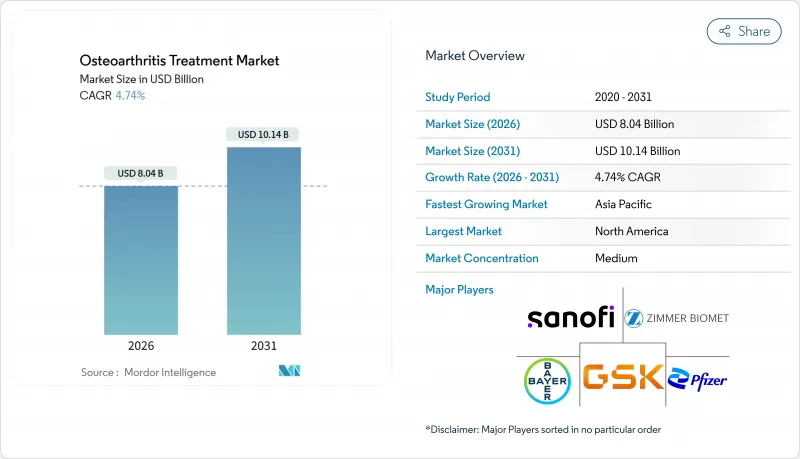
This report is Segmented by Drugs (NSAIDs, and More), Anatomy (Ankle, Hip, Knee, Shoulder, Other Anatomies), Distribution Channel (Hospital, Retail, and Online Pharmacies), End User (Hospitals, and More), and Geography (North America, Europe, Asia-Pacific, Middle East and Africa, and South America). The Market Forecasts are Provided in Terms of Value (USD).
Global Osteoarthritis Treatment Market Trends and Insights
Rapidly Aging Global Population
United Nations projections indicate that 1.4 billion people will be aged 60 or older by 2030, up from 1 billion in 2020. Japan illustrates the impact, with 29% of residents already over 65 years. The prevalence of osteoarthritis is expected to reach 1 billion cases worldwide by 2050. China's 280 million citizens aged 60 and above in 2024 are accelerating demand for cost-effective injections over surgery, according to. Pharmaceutical pipelines are adjusting; Novartis advanced its Wnt-pathway inhibitor LNA043 into Phase 2b during 2024.
Rising Obesity and Sedentary Lifestyles
The World Health Organization reported more than 1 billion obese individuals worldwide in 2022. Obesity raises the risk of knee osteoarthritis fivefold and quickens cartilage loss. Novo Nordisk's STEP 9 trial demonstrated a 13.7% weight loss with semaglutide, reducing knee pain scores by 41.7 points in 2024. U.S. obesity-related medical costs exceed USD 170 billion annually. A 2024 Lancet study linked fewer than 5,000 daily steps to 22% faster cartilage thinning.
High Cost of Advanced Biologic Therapies
Platelet-rich plasma costs USD 700-1,200 per injection and requires three sessions, yet Medicare offers no national coverage. Stem-cell injections priced at USD 3,000-7,000 showed no superiority to corticosteroids in a 2023 Nature Medicine trial. Amniotic suspension allografts, priced at USD 2,500-4,000, have faced repeated FDA warning letters for unsubstantiated claims. Pacira acquired GQ Bio in 2025 to develop PCRX-201 gene therapy that may debut at above USD 10,000 per dose. India's Ayushman Bharat scheme reimburses only generic NSAIDs and corticosteroids, leaving viscosupplements as out-of-pocket purchases.
Other drivers and restraints analyzed in the detailed report include:
- Growing Adoption of Single-Injection Viscosupplements
- AI-Enabled Early Diagnostics
- Safety Concerns and Regulatory Scrutiny Around Long-Term NSAID Use
For complete list of drivers and restraints, kindly check the Table Of Contents.
Segment Analysis
Hyaluronic acid injections are forecast to rise at a 6.54% CAGR through 2031 as single-dose products remove adherence barriers. NSAIDs retained a 41.43% revenue share in 2025, yet topical diclofenac gels are gaining favor due to their lower systemic exposure. Corticosteroids, such as ZILRETTA, offer 12 weeks of relief, thereby limiting the need for repeat procedures. Biologics account for a small portion of spending but dominate R&D budgets. In 2024, GlaxoSmithKline partnered with Relation Therapeutics to identify genetic targets, with USD 200 million in milestones. The osteoarthritis treatment market share is likely to tip toward injectables if forthcoming disease-modifying candidates demonstrate structural benefit.
The FDA approval of HYMOVIS ONE in 2025 validated the one-shot approach, following a 600-patient trial that demonstrated six-month pain reduction equivalent to that of three-dose regimens. ESCEO's 2024 guideline shift triggered European demand despite fragmented reimbursement. Opioid prescribing for osteoarthritis dropped 40% in the U.S. between 2020 and 2024 after CDC guideline updates. Pharmaceutical pipelines, therefore, prioritize structural agents that can postpone the need for replacement surgery and preserve pricing power in the face of generic NSAID competition.
Knee disease accounted for 46.76% of the osteoarthritis treatment market size in 2025, owing to its high biomechanical load and clear surgical pathways. Shoulder cases are projected to grow at 6.76% through 2031 as chronic rotator-cuff injuries progress to glenohumeral degeneration in aging workers and athletes. Hip disease follows a similar growth pattern but faces slower viscosupplement uptake because injections are technically complex. Ankle and small-joint disease together account for less than 10% of spending.
Smith & Nephew acquired CartiHeal for USD 180 million upfront in 2024, targeting focal defects that can precede knee replacement. Reverse total shoulder arthroplasty has expanded indications, leading to increased use of presurgical injections. The osteoarthritis treatment market share for shoulder interventions is expected to climb as implant survival improves and patients seek delay strategies before prosthesis.
Complete Report Scope:
- By Drugs
- Non-Steroidal Anti-Inflammatory Drugs (NSAIDs)
- Corticosteroids
- Hyaluronic Acid Injections
- Biologics & Disease-Modifying Therapies
- Other Drugs
- By Anatomy
- Ankle Osteoarthritis
- Hip Osteoarthritis
- Knee Osteoarthritis
- Shoulder Osteoarthritis
- Other Anatomies
- By Distribution Channel
- Hospital Pharmacies
- Retail Pharmacies
- Online Pharmacies
- By End User
- Hospitals
- Ambulatory Surgical Centers
- Orthopedic & Rheumatology Clinics
- Sports Medicine Centers
- Homecare Settings
- Geography
- North America
- United States
- Canada
- Mexico
- Europe
- Germany
- United Kingdom
- France
- Italy
- Spain
- Rest Of Europe
- Asia-Pacific
- China
- Japan
- India
- Australia
- South Korea
- Rest Of Asia-Pacific
- Middle East And Africa
- GCC
- South Africa
- Rest Of Middle East And Africa
- South America
- Brazil
- Argentina
- Rest Of South America
- North America
Geography Analysis
North America generated 42.65% of osteoarthritis treatment revenue in 2025, primarily driven by Medicare reimbursement for injections and surgeries. Local contractors tightened prior authorization, resulting in a 35% increase in denial rates for hyaluronic acid between 2023 and 2025. The FDA approval of HYMOVIS ONE and AI-based detection tools underscores the region's leadership in innovation. Canada limits viscosupplement coverage, keeping penetration below 15% in Ontario.
The Asia-Pacific region is projected to expand at a rate of 5.64% through 2031, as Japan's super-aged population and China's 280 million seniors seek injections to defer surgery. Japan reimburses over 2 million viscosupplement injections annually. China added several hyaluronic acid brands to its national drug list in 2024, boosting domestic output. India's public scheme excludes viscosupplements, but the rising income of the middle class is supporting a self-pay market. South Korea's universal coverage and rapid aging underpin double-digit growth in Seoul and Busan.
Europe grows more slowly because cost-effectiveness thresholds vary. NICE confines hyaluronic acid use to salvage cases in the UK. Germany covers multi-injection regimens that boost volume but cap per-patient spend. ESCEO's 2024 endorsement of single-injection products may harmonize reimbursement over time. In the Middle East, the UAE and Saudi Arabia are building orthopedic centers that attract medical tourists, whereas sub-Saharan Africa relies on low-cost NSAIDs. South American growth is concentrated in Brazil, where private insurance uptake is improving viscosupplement access despite currency volatility.
- Abbott Laboratories
- Anika Therapeutics
- Bayer
- Bioventus
- Ferring Pharmaceuticals
- Flexion Therapeutics Inc.
- GlaxoSmithKline
- Johnson & Johnson
- LG Chem
- Novartis
- Pfizer
- Sanofi
- Seikagaku
- Smiths Group
- Teva Pharmaceutical Industries
- Viatris
- Zimmer Biomet
Additional Benefits:
- The market estimate (ME) sheet in Excel format
- 3 months of analyst support
TABLE OF CONTENTS
1 Introduction
- 1.1 Study Assumptions & Market Definition
- 1.2 Scope Of The Study
2 Research Methodology
3 Executive Summary
4 Market Landscape
- 4.1 Market Overview
- 4.2 Market Drivers
- 4.2.1 Rapidly Aging Global Population and Rising Osteoarthritis Prevalence
- 4.2.2 Rising Obesity and Sedentary Lifestyles
- 4.2.3 Growing Adoption of Minimally Invasive Intra-Articular Injections and Single-Injection Viscosupplements
- 4.2.4 Expanding Insurance Coverage and Reimbursement for Non-Surgical Therapies in Emerging Markets
- 4.2.5 Advances in Regenerative Medicine and Disease-Modifying Therapies
- 4.2.6 AI-Enabled Early Diagnostics and Personalized Treatment Pathways
- 4.3 Market Restraints
- 4.3.1 High Cost of Advanced Biologic Therapies
- 4.3.2 Safety Concerns and Regulatory Scrutiny Around Long-Term NSAID and Opioid Use
- 4.3.3 Limited Clinical Evidence for Novel Regenerative Treatments Hindering Physician Adoption
- 4.3.4 Variability in Reimbursement Policies Across Regions
- 4.4 Value / Supply-Chain Analysis
- 4.5 Regulatory Landscape
- 4.6 Technological Outlook
- 4.7 Porter's Five Forces
- 4.7.1 Bargaining Power Of Suppliers
- 4.7.2 Bargaining Power Of Buyers / Consumers
- 4.7.3 Threat Of New Entrants
- 4.7.4 Threat Of Substitute Products
- 4.7.5 Intensity Of Competitive Rivalry
5 Market Size & Growth Forecasts (Value, USD)
- 5.1 By Drugs
- 5.1.1 Non-Steroidal Anti-Inflammatory Drugs (NSAIDs)
- 5.1.2 Corticosteroids
- 5.1.3 Hyaluronic Acid Injections
- 5.1.4 Biologics & Disease-Modifying Therapies
- 5.1.5 Other Drugs
- 5.2 By Anatomy
- 5.2.1 Ankle Osteoarthritis
- 5.2.2 Hip Osteoarthritis
- 5.2.3 Knee Osteoarthritis
- 5.2.4 Shoulder Osteoarthritis
- 5.2.5 Other Anatomies
- 5.3 By Distribution Channel
- 5.3.1 Hospital Pharmacies
- 5.3.2 Retail Pharmacies
- 5.3.3 Online Pharmacies
- 5.4 By End User
- 5.4.1 Hospitals
- 5.4.2 Ambulatory Surgical Centers
- 5.4.3 Orthopedic & Rheumatology Clinics
- 5.4.4 Sports Medicine Centers
- 5.4.5 Homecare Settings
- 5.5 Geography
- 5.5.1 North America
- 5.5.1.1 United States
- 5.5.1.2 Canada
- 5.5.1.3 Mexico
- 5.5.2 Europe
- 5.5.2.1 Germany
- 5.5.2.2 United Kingdom
- 5.5.2.3 France
- 5.5.2.4 Italy
- 5.5.2.5 Spain
- 5.5.2.6 Rest Of Europe
- 5.5.3 Asia-Pacific
- 5.5.3.1 China
- 5.5.3.2 Japan
- 5.5.3.3 India
- 5.5.3.4 Australia
- 5.5.3.5 South Korea
- 5.5.3.6 Rest Of Asia-Pacific
- 5.5.4 Middle East And Africa
- 5.5.4.1 GCC
- 5.5.4.2 South Africa
- 5.5.4.3 Rest Of Middle East And Africa
- 5.5.5 South America
- 5.5.5.1 Brazil
- 5.5.5.2 Argentina
- 5.5.5.3 Rest Of South America
- 5.5.1 North America
6 Competitive Landscape
- 6.1 Market Concentration
- 6.2 Market Share Analysis
- 6.3 Company Profiles {(Includes Global Level Overview, Market Level Overview, Core Segments, Financials as Available, Strategic Information, Market Rank/Share for Key Companies, Products & Services, and Recent Developments)}
- 6.3.1 Abbott Laboratories
- 6.3.2 Anika Therapeutics Inc.
- 6.3.3 Bayer AG
- 6.3.4 Bioventus LLC
- 6.3.5 Ferring Pharmaceuticals
- 6.3.6 Flexion Therapeutics Inc.
- 6.3.7 Glaxosmithkline Plc
- 6.3.8 Johnson & Johnson
- 6.3.9 LG Chem
- 6.3.10 Novartis AG
- 6.3.11 Pfizer Inc.
- 6.3.12 Sanofi SA
- 6.3.13 Seikagaku Corporation
- 6.3.14 Smith & Nephew
- 6.3.15 Teva Pharmaceutical Industries Ltd.
- 6.3.16 Viatris Inc.
- 6.3.17 Zimmer Biomet
7 Market Opportunities & Future Outlook
- 7.1 White-space & Unmet-Need Assessment

