PUBLISHER: Mordor Intelligence | PRODUCT CODE: 2114103

PUBLISHER: Mordor Intelligence | PRODUCT CODE: 2114103
Household Cleaners - Market Share Analysis, Industry Trends & Statistics, Growth Forecasts (2026 - 2031)
According to Mordor Intelligence, the household cleaners market size in 2026 is estimated at USD 170.47 billion, growing from 2025 value of USD 162.93 billion with 2031 projections showing USD 213.76 billion, growing at 4.63% CAGR over 2026-2031.
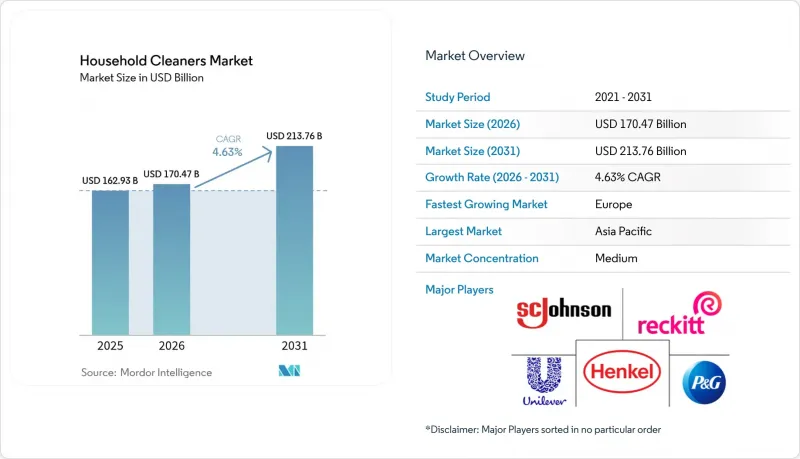
This report is Segmented by Product Type (Dishwashing, Laundry Care, Surface Care, and Toilet Care), Form (Liquids, Powders, Bars, and More), Formulation (Synthetic and Natural/Organic), Distribution Channel (Supermarkets and Hypermarkets, Convenience Stores, Online Retail Stores, and More), and Geography. The Market Forecasts are Provided in Terms of Value (USD).
Global Household Cleaners Market Trends and Insights
Heightened hygiene and sanitation awareness
Post-pandemic hygiene consciousness fundamentally altered consumer cleaning behaviors. This behavioral shift extends beyond immediate pandemic concerns, as 85% of consumers indicate they will maintain heightened cleaning practices long-term. As of July 2025, the Centers for Disease Control and Prevention highlighted that 2.3 billion people worldwide still lack access to basic handwashing facilities with soap and water at home. This underscores significant market expansion opportunities, particularly in developing regions.. Moreover, healthcare facility protocols increasingly influence household cleaning standards, with professional-grade disinfectants gaining traction in residential applications. Furthermore, the WHO's guidelines on sanitation and health reinforce the critical role of cleaning products in disease prevention, supporting sustained demand growth across all product categories.
Demand for eco-friendly and sustainable products
Environmental consciousness drives accelerating demand for sustainable cleaning solutions, with the U.S. Environmental Protection Agency's Safer Choice program certifying nearly 2,000 products that meet stringent health and environmental criteria. Along the same line, the 2024 updates to the Safer Choice Standard introduced enhanced packaging sustainability requirements and new energy efficiency criteria, creating competitive advantages for compliant manufacturers. European markets lead this transition, with the EU Ecolabel criteria revision emphasizing concentrated products and plant-based ingredients to reduce environmental impact. Moreover, Ecocert's natural cleaning product certification allows manufacturers to market globally with two labeling levels: 'Ecodetergents' (maximum 5% synthetic ingredients) and 'Ecodetergents made with Organic' (minimum 95% natural ingredients, minimum 10% organic). Furthermore, consumer willingness to pay premium prices for environmentally responsible products sustains higher margins while driving innovation in bio-based formulations.
Intense market competition
Market saturation in developed regions intensifies competitive pressures, with private-label alternatives capturing an increasing share from branded manufacturers through aggressive pricing strategies. The Federal Trade Commission's antitrust enforcement activities, including the Amazon case alleging monopolistic behavior in online retail, highlight competitive concerns that affect household cleaner distribution channels. Similarly, Turkish Competition Authority findings reveal high market concentration among major retailers, creating buyer power dynamics that pressure supplier margins and limit pricing flexibility. Along the same line, promotional intensity escalates as manufacturers compete for shelf space and consumer attention, eroding profitability across the value chain. Furthermore, digital disruption enables new entrants to bypass traditional distribution channels, challenging established players' market positions. The commoditization of basic cleaning functions forces manufacturers to invest heavily in innovation and marketing to maintain differentiation.
Other drivers and restraints analyzed in the detailed report include:
- Product innovation and specialty cleaners
- Technological integration in cleaning devices
- Environmental regulations on packaging waste
For complete list of drivers and restraints, kindly check the Table Of Contents.
Segment Analysis
Laundry Care commands 62.58% market share in 2025, reflecting its essential role in household maintenance and the category's broad product portfolio spanning liquid detergents, powder formulations, and specialty additives. Dishwashing emerges as the fastest-growing segment at 6.08% CAGR through 2031, driven by convenience innovations like single-use pods and concentrated formulations that simplify usage while reducing packaging waste. Surface care and toilet care segments maintain steady growth trajectories, supported by increased hygiene awareness and specialized product development for targeted cleaning applications.
The powder detergent resurgence in developing markets contrasts with liquid dominance in developed regions, as Chemical and Engineering News reports that powders lead by volume globally despite liquids' value share advantage. Unilever's January 2024 introduction of laundry sheets represents mass market innovation that addresses sustainability concerns while maintaining cleaning efficacy. Thus, the dishwashing segment benefits from premiumization trends as consumers invest in specialized formulations for different surface types and soil conditions, while regulatory compliance factors influence product development, with EPA Safer Choice certifications becoming increasingly important for market access and consumer acceptance.
Liquids maintain a 38.12% market share in 2025, supported by consumer preference for convenience and ease of use in developed markets. However, Powders experience remarkable growth at 6.15% CAGR through 2031, driven by cost advantages in emerging economies and environmental benefits from reduced packaging requirements. The powder revival reflects economic pressures in developing regions where consumers prioritize value over convenience, particularly as appliance ownership increases and enables effective powder usage.
Bars and other alternative forms capture niche segments focused on specific applications or environmental considerations. The form preference varies significantly by geography, with powders remaining popular in Africa, India, and parts of Europe where economic factors outweigh convenience considerations. Procter & Gamble's research indicates similar market shares by value between liquids and powders globally, though powders lead in volume terms. Innovation in powder formulations addresses traditional limitations such as dissolution rates and residue concerns, making them more competitive with liquid alternatives. The 2% annual growth projection for powdered detergents reflects increasing appliance ownership in developing countries and sustained cost advantages over liquid formulations.
Complete Report Scope:
- By Product Type
- Dishwashing
- Laundry Care
- Surface Care
- Toilet Care
- By Form
- Liquids
- Powders
- Bars
- Others
- By Formulation
- Synthetic
- Natural/Organic
- By Distribution Channel
- Supermarkets & Hypermarkets
- Convenience Stores
- Online Retail Stores
- Other Retail Channels
- By Geography
- North America
- United States
- Canada
- Mexico
- Rest of North America
- South America
- Brazil
- Argentina
- Colombia
- Chile
- Venezuela
- Rest of South America
- Europe
- United Kingdom
- Germany
- France
- Italy
- Spain
- Sweden
- Belgium
- Poland
- Netherlands
- Rest of Europe
- Asia-Pacific
- China
- Japan
- India
- Thailand
- Singapore
- Indonesia
- South Korea
- Australia
- New Zealand
- Rest of Asia Pacific
- Middle East and Africa
- South Africa
- Nigeria
- Egypt
- Morocco
- Turkey
- Rest of Middle East and Africa
- North America
Geography Analysis
Asia-Pacific held 30.92% of category value in 2025, anchored by the scale of China and India, rising middle-class incomes, and rapid urbanization that elevates hygiene priorities. Manufacturers localize production to skirt import duties and respond quickly to scent and packaging preferences unique to each sub-region. Retail infrastructure modernizes via discount chains and e-commerce super-apps, expanding product reach beyond tier-one cities. Government sanitation campaigns, particularly in India, lift penetration of branded cleaners in rural districts previously reliant on bar soap.
Europe is the fastest-growing territory, advancing at a 6.03% CAGR toward 2031 as the EU Detergents Regulation's biodegradability clause reshapes procurement toward greener inputs. Consumers routinely scrutinize label disclosures, rewarding transparent brands with repeat purchases and word-of-mouth advocacy. Concentrated pods and water-free tablets lower transport emissions, aligning with corporate net-zero pledges and unlocking retailer preferential shelf plans. The household cleaners market size for Europe is on track, buoyed by premium pricing architectures that offset modest volume growth.
North America benefits from entrenched brand loyalty and high per-capita consumption, ensuring baseline stability even in economic slowdowns. EPA Safer Choice revisions push formulators to excise contentious preservatives, raising reformulation costs but differentiating compliant SKUs on the shelf. South America and the Middle East and Africa show mixed prospects; currency volatility and fragmented logistics hinder rapid scale-up, yet urban migration and retail formalization create long-term upside. Regional joint ventures and micro-distribution partnerships help multinationals manage political risk while gaining local insights.
- Procter & Gamble Co.
- Reckitt Benckiser Group plc
- Unilever plc
- Henkel AG & Co. KGaA
- S. C. Johnson & Son Inc.
- Colgate-Palmolive Co.
- The Clorox Company
- Church & Dwight Co. Inc.
- Kao Corporation
- McBride plc
- Vikara Services Pvt. Ltd. (The Better Home)
- Seventh Generation Inc.
- Ecover (Werner & Mertz)
- Method Products PBC
- 3M (Home Care Division)
- The Libman Company
- Amway Corp.
- Godrej Consumer Products Ltd.
- Betco Corporation
- Sodasan GmbH
Additional Benefits:
- The market estimate (ME) sheet in Excel format
- 3 months of analyst support
TABLE OF CONTENTS
1 INTRODUCTION
- 1.1 Study Assumptions and Market Definition
- 1.2 Scope of the Study
2 RESEARCH METHODOLOGY
3 EXECUTIVE SUMMARY
4 MARKET LANDSCAPE
- 4.1 Market Overview
- 4.2 Market Drivers
- 4.2.1 Heightened hygiene and sanitation awareness
- 4.2.2 Demand for eco-friendly and sustainable products
- 4.2.3 Product innovation and specialty cleaners
- 4.2.4 Technological integration in cleaning devices
- 4.2.5 Public health campaigns and awareness drives
- 4.2.6 Premiumization trend
- 4.3 Market Restraints
- 4.3.1 Intense market competition
- 4.3.2 Environmental regulations on packaging waste
- 4.3.3 Environmental and health concerns
- 4.3.4 Stringent regulatory requirements
- 4.4 Consumer Behaviour Analysis
- 4.5 Regulatory Landscape
- 4.6 Technological Outlook
- 4.7 Porter's Five Forces
- 4.7.1 Threat of New Entrants
- 4.7.2 Bargaining Power of Buyers
- 4.7.3 Bargaining Power of Suppliers
- 4.7.4 Threat of Substitutes
- 4.7.5 Threat of Competitive Rivalry
5 MARKET SIZE AND GROWTH FORECASTS (VALUE AND VOLUME)
- 5.1 By Product Type
- 5.1.1 Dishwashing
- 5.1.2 Laundry Care
- 5.1.3 Surface Care
- 5.1.4 Toilet Care
- 5.2 By Form
- 5.2.1 Liquids
- 5.2.2 Powders
- 5.2.3 Bars
- 5.2.4 Others
- 5.3 By Formulation
- 5.3.1 Synthetic
- 5.3.2 Natural/Organic
- 5.4 By Distribution Channel
- 5.4.1 Supermarkets & Hypermarkets
- 5.4.2 Convenience Stores
- 5.4.3 Online Retail Stores
- 5.4.4 Other Retail Channels
- 5.5 By Geography
- 5.5.1 North America
- 5.5.1.1 United States
- 5.5.1.2 Canada
- 5.5.1.3 Mexico
- 5.5.1.4 Rest of North America
- 5.5.2 South America
- 5.5.2.1 Brazil
- 5.5.2.2 Argentina
- 5.5.2.3 Colombia
- 5.5.2.4 Chile
- 5.5.2.5 Venezuela
- 5.5.2.6 Rest of South America
- 5.5.3 Europe
- 5.5.3.1 United Kingdom
- 5.5.3.2 Germany
- 5.5.3.3 France
- 5.5.3.4 Italy
- 5.5.3.5 Spain
- 5.5.3.6 Sweden
- 5.5.3.7 Belgium
- 5.5.3.8 Poland
- 5.5.3.9 Netherlands
- 5.5.3.10 Rest of Europe
- 5.5.4 Asia-Pacific
- 5.5.4.1 China
- 5.5.4.2 Japan
- 5.5.4.3 India
- 5.5.4.4 Thailand
- 5.5.4.5 Singapore
- 5.5.4.6 Indonesia
- 5.5.4.7 South Korea
- 5.5.4.8 Australia
- 5.5.4.9 New Zealand
- 5.5.4.10 Rest of Asia Pacific
- 5.5.5 Middle East and Africa
- 5.5.5.1 South Africa
- 5.5.5.2 Nigeria
- 5.5.5.3 Egypt
- 5.5.5.4 Morocco
- 5.5.5.5 Turkey
- 5.5.5.6 Rest of Middle East and Africa
- 5.5.1 North America
6 COMPETITIVE LANDSCAPE
- 6.1 Market Concentration
- 6.2 Strategic Moves
- 6.3 Market Share Analysis
- 6.4 Company Profiles (includes Global level Overview, Market level overview, Core Segments, Financials as available, Strategic Information, Market Rank/Share for key companies, Products and Services, and Recent Developments)
- 6.4.1 Procter & Gamble Co.
- 6.4.2 Reckitt Benckiser Group plc
- 6.4.3 Unilever plc
- 6.4.4 Henkel AG & Co. KGaA
- 6.4.5 S. C. Johnson & Son Inc.
- 6.4.6 Colgate-Palmolive Co.
- 6.4.7 The Clorox Company
- 6.4.8 Church & Dwight Co. Inc.
- 6.4.9 Kao Corporation
- 6.4.10 McBride plc
- 6.4.11 Vikara Services Pvt. Ltd. (The Better Home)
- 6.4.12 Seventh Generation Inc.
- 6.4.13 Ecover (Werner & Mertz)
- 6.4.14 Method Products PBC
- 6.4.15 3M (Home Care Division)
- 6.4.16 The Libman Company
- 6.4.17 Amway Corp.
- 6.4.18 Godrej Consumer Products Ltd.
- 6.4.19 Betco Corporation
- 6.4.20 Sodasan GmbH
7 MARKET OPPORTUNITIES AND FUTURE OUTLOOK

