PUBLISHER: Mordor Intelligence | PRODUCT CODE: 2114118

PUBLISHER: Mordor Intelligence | PRODUCT CODE: 2114118
Cardiovascular Ultrasound System - Market Share Analysis, Industry Trends & Statistics, Growth Forecasts (2026 - 2031)
According to Mordor Intelligence, the cardiovascular ultrasound system market size was valued at USD 1.89 billion in 2025 and estimated to grow from USD 1.95 billion in 2026 to reach USD 2.29 billion by 2031, at a CAGR of 3.29% during the forecast period (2026-2031).
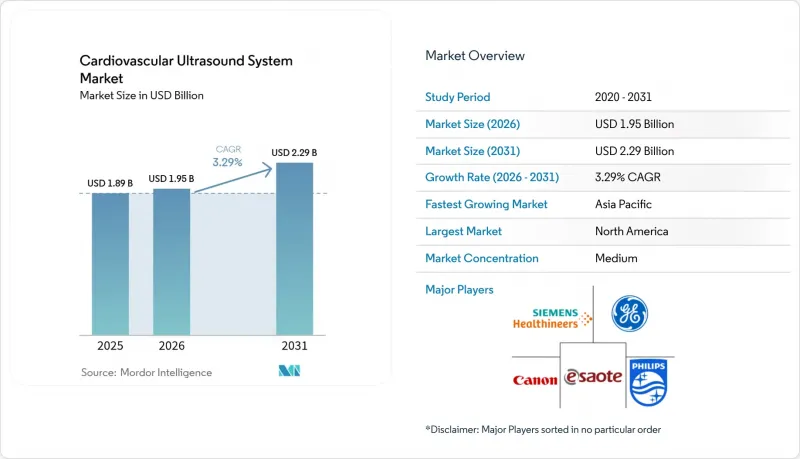
This report is Segmented by Test Type (Transthoracic Echocardiogram, Transesophageal Echocardiogram, and More), Technology (2D, 3D and 4D, Doppler Imaging), Portability (Cart/Trolley-Based, Portable/Hand-Held), Device Display (Color Display, and More), End User (Hospitals, and More), and Geography (North America, Europe, and More). The Market Forecasts are Provided in Terms of Value (USD).
Global Cardiovascular Ultrasound System Market Trends and Insights
Escalating Global Prevalence of Cardiovascular Diseases and Aging Demographics
Cardiovascular diseases remained the leading cause of hospital admissions in England, recording 1.5 million inpatient episodes in 2022-23.Similar upward trends are evident across Asia and North America, propelled by sedentary lifestyles, dietary changes and population aging. Point-of-care echocardiography has become integral to early detection strategies, supporting routine screening in ambulatory settings. Research published in 2025 demonstrated that trained clinicians can use cardiac POCUS to identify hypertrophic cardiomyopathy, diastolic dysfunction and tamponade with high accuracy. As older adults require more frequent cardiac monitoring, demand for repeatable radiation-free imaging rises, anchoring long-run growth in the cardiovascular ultrasound system market.
Technological Advancements: AI-Driven Quantification, 3-D/4-D Imaging and Miniaturisation
Deep-learning algorithms now automate chamber delineation, wall-motion scoring and valvular quantification, bringing interpretation times down by up to 40% compared with manual review. FDA-cleared 3-D quantification of mitral regurgitation allows volumetric assessment that was unattainable with 2-D imaging. Miniaturised probes fit in a pocket yet deliver diagnostic image quality, permitting exams at the bedside, in ambulances and even at home. These capabilities democratise access, widen the referral base and reinforce technology refresh cycles throughout the cardiovascular ultrasound system market.
High Capital Cost of Premium Cardiovascular Ultrasound Platforms
Top-tier scanners with 3-D capabilities can exceed USD 250,000, pricing out smaller providers and prolonging replacement cycles. Total cost of ownership further rises with service contracts and software upgrades. Tiered product lines and refurbished systems offer partial relief, but the cost gap between entry and premium remains large, restraining penetration in budget-constrained markets.
Other drivers and restraints analyzed in the detailed report include:
- Expansion of Point-of-Care & Emergency-Department Ultrasound Applications
- Shift from Invasive Cardiac Diagnostics toward Non-Invasive Ultrasound Modalities
- Reimbursement Pressure and Budget Constraints in Developed Markets
For complete list of drivers and restraints, kindly check the Table Of Contents.
Segment Analysis
Transthoracic echocardiography delivered 51.73% of 2025 revenues, underpinning its role as a routine, non-invasive cornerstone across all care settings. Its broad clinical utility secures replacement demand and ensures the cardiovascular ultrasound system market size tied to TTE remains substantial. Stress echocardiography is expanding fastest at an 8.31% CAGR to 2031 because it reveals inducible ischemia without radiation and fits preventive cardiology protocols. Rapid case throughput and reimbursements aligned with functional assessments further spur adoption.
TEE retains importance for valve evaluation and structural heart interventions. With 4-D probes now offering real-time volumetric guidance during transcatheter procedures, the segment sustains steady growth. Niche applications such as fetal and pediatric echocardiography drive technology tailoring, creating opportunities for compact, high-frequency transducers.
Two-dimensional imaging continues to generate 42.74% of cardiovascular ultrasound system market size due to mature workflows, familiarity and cost advantages. Diagnostic confidence from 2-D plus color Doppler remains sufficient for most routine exams. However, 3-D & 4-D imaging is on a 9.02% CAGR trajectory as interventional cardiologists demand volumetric guidance for valve repair and congenital corrections. Automated 3-D quantification of regurgitation severity adds reproducibility and shortens reporting time.
Enhanced Doppler modes such as vector flow mapping and micro-vascular imaging extend functional insights, anchoring 2-D-centric systems in everyday practice. Vendors leverage shared hardware to offer modular upgrades, smoothing the transition toward advanced modalities without full platform replacement, sustaining the cardiovascular ultrasound system market.
Complete Report Scope:
- By Test Type
- Transthoracic Echocardiogram (TTE)
- Transesophageal Echocardiogram (TEE)
- Stress Echocardiogram
- Other Test Types
- By Technology
- 2-D
- 3-D & 4-D
- Doppler Imaging
- By Portability
- Cart/Trolley-Based
- Portable/Hand-Held
- By Device Display
- Color Display
- Black & White (B/W) Display
- By End User
- Hospitals
- Ambulatory Surgery & Emergency Centers
- Diagnostic Imaging Centers & Others
- By Geography
- North America
- United States
- Canada
- Mexico
- Europe
- Germany
- United Kingdom
- France
- Italy
- Spain
- Rest of Europe
- Asia-Pacific
- China
- Japan
- India
- Australia
- South Korea
- Rest of Asia-Pacific
- Middle East & Africa
- GCC
- South Africa
- Rest of Middle East & Africa
- South America
- Brazil
- Argentina
- Rest of South America
- North America
Geography Analysis
North America contributed 32.12% of global revenue in 2025, backed by advanced infrastructure and quick uptake of AI-enabled upgrades. Workforce shortages persist; 46.3% of U.S. counties have no resident cardiologist, affecting 22 million people. Vendors market workflow automation and remote reading to mitigate staffing gaps.
Asia-Pacific is the fastest-growing territory at an 8.62% CAGR through 2031. China's volume-based procurement and local manufacturing incentives foster competitive domestic suppliers, while India's tier-2 cities add echo capacity through private hospital chains. Portable, battery-powered systems resonate in rural clinics, driving breadth of adoption across socioeconomic tiers.
Europe maintains a balanced profile with strong reimbursement for non-invasive imaging and a large aging population. Middle East & Africa and South America are smaller yet expanding as governments prioritise cardiovascular disease management. Brazil leads regional uptake through private insurance penetration and growing elective procedure volumes. Collectively, geographic trends underscore the need for scalable solutions that range from premium carts to ultra-portable probes within the cardiovascular ultrasound system market.
- Canon
- GE Healthcare
- Siemens Healthineers
- Koninklijke Philips
- FUJIFILM / Hitachi Healthcare
- Samsung Group
- Mindray
- Esaote
- Butterfly Network Inc.
- Chison Medical Imaging
- Clarius Mobile Health
- Terason (Teratech Corp.)
- Supersonic Imagine (Hologic)
- Shenzhen Wisonic Medical
- Medisono
- United Imaging Healthcare
- Shenzhen Landwind Medical
- ContextVision AB
- Whale Imaging
Additional Benefits:
- The market estimate (ME) sheet in Excel format
- 3 months of analyst support
TABLE OF CONTENTS
1 Introduction
- 1.1 Study Assumptions & Market Definition
- 1.2 Scope of the Study
2 Research Methodology
3 Executive Summary
4 Market Landscape
- 4.1 Market Overview
- 4.2 Market Drivers
- 4.2.1 Escalating Global Prevalence of Cardiovascular Diseases and Aging Demographics
- 4.2.2 Technological Advancements: AI-Driven Quantification, 3-D/4-D Imaging and Miniaturisation
- 4.2.3 Expansion of Point-of-Care & Emergency-Department Ultrasound Applications
- 4.2.4 Shift from Invasive Cardiac Diagnostics toward Non-Invasive Ultrasound Modalities
- 4.2.5 Growing Emphasis on Early Diagnosis & Preventive Cardiology
- 4.2.6 Integration of AI & Cloud-Based Imaging Platforms
- 4.3 Market Restraints
- 4.3.1 High Capital Cost of Premium Cardiovascular Ultrasound Platforms
- 4.3.2 Reimbursement Pressure and Budget Constraints in Developed Markets
- 4.3.3 Shortage of Skilled Sonographers and Advanced Echo Interpreters
- 4.3.4 Limited Access in Low-Income & Rural Settings
- 4.4 Regulatory Landscape
- 4.5 Technology Outlook
- 4.6 Porter's Five Forces Analysis
- 4.6.1 Threat of New Entrants
- 4.6.2 Bargaining Power of Buyers
- 4.6.3 Bargaining Power of Suppliers
- 4.6.4 Threat of Substitutes
- 4.6.5 Competitive Rivalry
5 Market Size & Growth Forecasts (Value in USD)
- 5.1 By Test Type
- 5.1.1 Transthoracic Echocardiogram (TTE)
- 5.1.2 Transesophageal Echocardiogram (TEE)
- 5.1.3 Stress Echocardiogram
- 5.1.4 Other Test Types
- 5.2 By Technology
- 5.2.1 2-D
- 5.2.2 3-D & 4-D
- 5.2.3 Doppler Imaging
- 5.3 By Portability
- 5.3.1 Cart/Trolley-Based
- 5.3.2 Portable/Hand-Held
- 5.4 By Device Display
- 5.4.1 Color Display
- 5.4.2 Black & White (B/W) Display
- 5.5 By End User
- 5.5.1 Hospitals
- 5.5.2 Ambulatory Surgery & Emergency Centers
- 5.5.3 Diagnostic Imaging Centers & Others
- 5.6 By Geography
- 5.6.1 North America
- 5.6.1.1 United States
- 5.6.1.2 Canada
- 5.6.1.3 Mexico
- 5.6.2 Europe
- 5.6.2.1 Germany
- 5.6.2.2 United Kingdom
- 5.6.2.3 France
- 5.6.2.4 Italy
- 5.6.2.5 Spain
- 5.6.2.6 Rest of Europe
- 5.6.3 Asia-Pacific
- 5.6.3.1 China
- 5.6.3.2 Japan
- 5.6.3.3 India
- 5.6.3.4 Australia
- 5.6.3.5 South Korea
- 5.6.3.6 Rest of Asia-Pacific
- 5.6.4 Middle East & Africa
- 5.6.4.1 GCC
- 5.6.4.2 South Africa
- 5.6.4.3 Rest of Middle East & Africa
- 5.6.5 South America
- 5.6.5.1 Brazil
- 5.6.5.2 Argentina
- 5.6.5.3 Rest of South America
- 5.6.1 North America
6 Competitive Landscape
- 6.1 Market Concentration
- 6.2 Market Share Analysis
- 6.3 Company Profiles (includes Global level Overview, Market level overview, Core Segments, Financials as available, Strategic Information, Market Rank/Share for key companies, Products & Services, and Recent Developments)
- 6.3.1 Canon Medical Systems Corporation
- 6.3.2 GE HealthCare
- 6.3.3 Siemens Healthcare GmbH
- 6.3.4 Koninklijke Philips N.V.
- 6.3.5 FUJIFILM / Hitachi Healthcare
- 6.3.6 Samsung Medison
- 6.3.7 Mindray Medical International
- 6.3.8 Esaote SpA
- 6.3.9 Butterfly Network Inc.
- 6.3.10 Chison Medical Imaging
- 6.3.11 Clarius Mobile Health
- 6.3.12 Terason (Teratech Corp.)
- 6.3.13 Supersonic Imagine (Hologic)
- 6.3.14 Shenzhen Wisonic Medical
- 6.3.15 Medisono LLC
- 6.3.16 United Imaging Healthcare
- 6.3.17 Shenzhen Landwind Medical
- 6.3.18 ContextVision AB
- 6.3.19 Whale Imaging
7 Market Opportunities & Future Outlook
- 7.1 White-Space & Unmet-Need Assessment

