PUBLISHER: Mordor Intelligence | PRODUCT CODE: 2114120

PUBLISHER: Mordor Intelligence | PRODUCT CODE: 2114120
Surgical Kits - Market Share Analysis, Industry Trends & Statistics, Growth Forecasts (2026 - 2031)
According to Mordor Intelligence, the surgical kits market size was valued at USD 17.32 billion in 2025 and is estimated to grow from USD 18.48 billion in 2026 to reach USD 25.57 billion by 2031, at a CAGR of 6.72% during the forecast period (2026-2031).
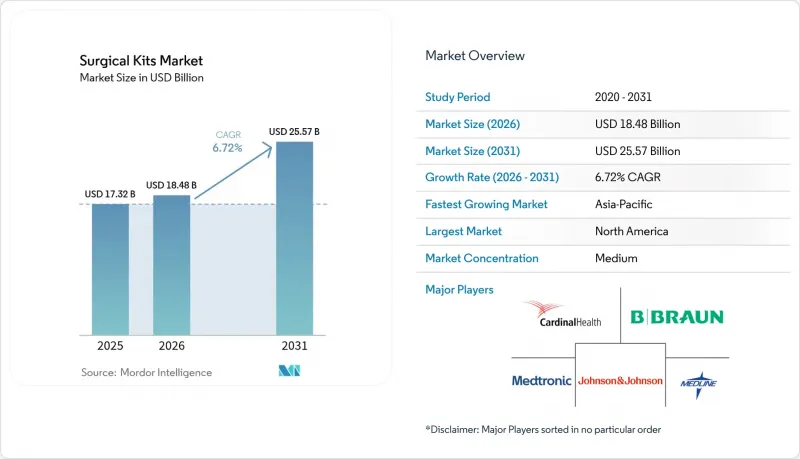
This report is Segmented by Procedure Type (Cardiovascular Surgery, and More), Component (Instruments and More), Kit Configuration (Standardised Procedure Packs, and More), Material Type (Woven Textiles, and More), Sterilization Method (Ethylene Oxide, and More), Sterility (Sterile Kits, Non-Sterile Kits), End User (Hospitals, and More), and Geography. The Market Forecasts are Provided in Terms of Value (USD).
Global Surgical Kits Market Trends and Insights
Growing Surgical Procedure Volume Worldwide
Global surgical volume climbed to 421 million procedures in 2024 from 387 million in 2022 as aging populations and chronic diseases lifted elective interventions. The World Health Organization projects 62% of incremental demand to emanate from low- and middle-income nations by 2030, prompting governments to standardize essential-procedure packs that shave 18 minutes off set-up time and raise theater utilization. China expanded its surgical reimbursement catalog to 1,200 procedures in 2025, spurring a 23% rise in kit purchases by provincial hospitals. India deployed 3,400 mobile surgical units equipped with trauma packs in rural districts, demonstrating how procedure growth extends beyond fixed facilities. As case volumes swell, the surgical kits market benefits from predictable, repeat demand cycles that underpin vendor capacity-planning.
Shift Toward Customized Procedure Packs for OR Efficiency
Tailored packs cut tray set-up by 14 minutes per orthopedic case and save USD 47 in nursing labor, according to a 2024 multicenter U.S. study. Seventy-eight percent of knee-replacement surgeries used surgeon-specific packs in 2025, transferring inventory risk to assemblers. Workflow complexity remains a concern; 34% of circulating nurses reported tray discrepancies weekly, delaying cases. Vendors now integrate barcode scanning with electronic health-records to verify contents in real time before a patient enters the room, reinforcing the value proposition of customization without eroding efficiency.
Reimbursement Pressure in Low-Income Settings
Public payers in 38 low-income nations reimburse procedures at 40-60% below the cost of single-use packs, forcing hospitals to rely on reusable sets and autoclaves. Kenya's national insurer allotted just USD 0.32 per surgical case for disposables in 2025, far below the USD 8-12 needed for basic drape-and-gown sets. Resin inflation of 11% annually from 2023-2025 widened the gap. Donor initiatives, such as Gavi's advance-market commitment covering 2 million kits yearly at USD 6 apiece, remain confined to 11 countries.
Other drivers and restraints analyzed in the detailed report include:
- Stricter Infection-Control Regulations Boosting Single-Use Sterile Kits
- Expansion of Ambulatory Surgery Centers Demanding Standardized Kits
- Supply-Chain Volatility in Non-Woven Barrier Materials
For complete list of drivers and restraints, kindly check the Table Of Contents.
Segment Analysis
Orthopedic surgery held 25.54% of the surgical kits market share in 2025, buoyed by USD 1,200-1,800 joint-replacement packs that bundle implant trials and cement systems. Yet ENT & thoracic kits are growing briskly at 9.25% CAGR on the back of minimally invasive sinus and video-assisted thoracoscopic procedures that favor disposable trocars. An evidence review showed video-assisted lobectomy shaved 2.1 days off inpatient stay, bolstering payer support for single-use instrument sets that speed discharge. Cardiovascular kits tick along at mid-single-digit growth as transcatheter valves eclipse open-heart volumes. General surgery and obstetrics draw steady demand, the latter lifted by rising institutional deliveries in Asia-Pacific.
Shifting procedures to ambulatory sites compress kit footprints; ENT cases in U.S. ASCs jumped 27% between 2023-2025. Vendors now unbundle orthopedic implant trials to shave 15-20% off pack cost. Regulatory reclassification of laparoscopic instruments to Class II intensified 510(k) hurdles, favoring incumbents with robust validation labs.
Drapes & gowns generated 26.54% of component revenue in 2025, mandated by universal-barrier protocols. Sutures & adhesives, however, outpace at 8.65% CAGR, propelled by bioresorbable polymers that erase follow-up removal visits. A 2025 meta-analysis reported cyanoacrylate adhesives cut infection by 1.2 percentage points in clean-contaminated wounds. Instruments, disposables, and implants each add incremental value but mirror overall market trajectory.
Innovation fuels component economics. Antimicrobial-coated drapes slashed contamination 34% in controlled trials, commanding a 25% premium. RFID-tagged suture packs reduced stockouts nearly 30%, underscoring tech's growing role in inventory stewardship.
Customized packs absorbed 54.15% of the surgical kits market size in 2025 as surgeons fine-tuned instruments to personal technique. Emergency & trauma packs, by contrast, post a 9.82% CAGR, catalyzed by standardized hemorrhage-control kits in ambulances and field hospitals. The American College of Surgeons' Stop the Bleed campaign trained 2.3 million civilians by 2025, expanding demand for public-access trauma kits.
Digital configurators now let surgeons drag-and-drop components in a 3-D workspace, previewing the tray before orders lock. Regulatory oversight intensifies when drug-device combos appear in a pack, elongating approval by up to nine months.
Complete Report Scope:
- By Procedure Type
- Cardiovascular Surgery
- Orthopedic Surgery
- Obstetrics & Gynecology
- General Surgery
- Neurosurgery
- Ophthalmic Surgery
- Urology Surgery
- ENT & Thoracic Surgery
- Other Procedures
- By Component
- Instruments & Tools
- Drapes & Gowns
- Disposable Supplies
- Sutures & Adhesives
- Implants & Fixation Accessories
- Other Components
- By Kit Configuration
- Standardised Procedure Packs
- Customized Procedure Packs
- Emergency & Trauma Packs
- By Material Type
- Non-woven Fabrics (SMS, Spunlace)
- Woven Textiles
- Hybrid / Composite Materials
- Bio-based / Compostable Materials
- By Sterilization Method
- Ethylene Oxide
- Gamma Radiation
- E-beam Irradiation
- Steam / Autoclave
- Plasma
- By Sterility
- Sterile Kits
- Non-sterile Kits
- By End User
- Hospitals
- Ambulatory Surgical Centers
- Specialty Clinics
- Military & Field Hospitals
- Home & Office-based Surgical Suites
- By Distribution Channel
- Direct Institutional Sales
- Group Purchasing Organizations (GPOs)
- Third-Party Distributors
- E-commerce Platforms
- By Geography
- North America
- United States
- Canada
- Mexico
- Europe
- Germany
- United Kingdom
- France
- Italy
- Spain
- Rest of Europe
- Asia-Pacific
- China
- India
- Japan
- Australia
- South Korea
- Rest of Asia-Pacific
- Middle East and Africa
- GCC
- South Africa
- Rest of Middle East and Africa
- South America
- Brazil
- Argentina
- Rest of South America
- North America
Geography Analysis
North America led at 45.53% in 2025, fueled by rigorous UDI mandates and robust value-analysis cultures. The U.S. added 4.8 million outpatient procedures to ASC settings between 2023-2025, fortifying demand for standardized packs. Ethylene-oxide emission curbs and polypropylene price swings pose near-term headwinds.
Asia-Pacific advances 10.1% CAGR to 2031. China installed 12,000 surgical suites under Healthy China 2030, driving bulk-buying of procedure packs. India reimbursed 18 million surgical episodes in 2025 through Ayushman Bharat, ratcheting kit uptake. Japan's cataract volumes rose 11% in 2024-2025, and new minimally invasive orthopedic codes won coverage in 2024.
Europe occupies a sturdy mid-30s share, but sustainability and post-market surveillance requirements inflate compliance spend by 15-20%, uplifting barriers against low-cost entrants. Middle East & Africa grow modestly, concentrated in GCC medical-tourism hubs, while South America relies on public-private partnerships to expand theater capacity.
- Ansell Healthcare
- Aspen Surgical
- B. Braun
- Beckton Dickinson
- Cardinal Health
- The Cooper Companies
- Defries Industries
- Henry Schein
- Hogy Medical Co., Ltd.
- Integra LifeSciences
- Johnson & Johnson
- Lohmann & Rauscher GmbH
- Medline Industries
- Medtronic
- Merit Medical Systems
- Molnlycke Health Care
- Multigate Medical Products
- Owens & Minor Inc. (Halyard Health)
- Solventum Corp
- Steris plc
- Terumo Cardiovascular Systems
Additional Benefits:
- The market estimate (ME) sheet in Excel format
- 3 months of analyst support
TABLE OF CONTENTS
1 Introduction
- 1.1 Study Assumptions & Market Definition
- 1.2 Scope of the Study
2 Research Methodology
3 Executive Summary
4 Market Landscape
- 4.1 Market Overview
- 4.2 Market Drivers
- 4.2.1 Growing surgical procedure volume worldwide
- 4.2.2 Shift toward customized procedure packs for OR efficiency
- 4.2.3 Stricter infection-control regulations boosting single-use sterile kits
- 4.2.4 Expansion of ambulatory surgery centers demanding standardized kits
- 4.2.5 Digital traceability (UDI/RFID) mandates enabling real-time inventory analytics
- 4.2.6 OEM-CPT vendor partnerships for just-in-time case-cart delivery models
- 4.3 Market Restraints
- 4.3.1 Reimbursement pressure in low-income settings
- 4.3.2 Supply-chain volatility in non-woven barrier materials
- 4.3.3 Sustainability concerns over disposables driving regulatory scrutiny
- 4.3.4 Customization complexity causing workflow mis-alignment
- 4.4 Supply-Chain Analysis
- 4.5 Regulatory Landscape
- 4.6 Technological Outlook
- 4.7 Porter's Five Forces
- 4.7.1 Threat of New Entrants
- 4.7.2 Bargaining Power of Buyers
- 4.7.3 Bargaining Power of Suppliers
- 4.7.4 Threat of Substitutes
- 4.7.5 Competitive Rivalry
5 Market Size & Growth Forecasts (Value, USD)
- 5.1 By Procedure Type
- 5.1.1 Cardiovascular Surgery
- 5.1.2 Orthopedic Surgery
- 5.1.3 Obstetrics & Gynecology
- 5.1.4 General Surgery
- 5.1.5 Neurosurgery
- 5.1.6 Ophthalmic Surgery
- 5.1.7 Urology Surgery
- 5.1.8 ENT & Thoracic Surgery
- 5.1.9 Other Procedures
- 5.2 By Component
- 5.2.1 Instruments & Tools
- 5.2.2 Drapes & Gowns
- 5.2.3 Disposable Supplies
- 5.2.4 Sutures & Adhesives
- 5.2.5 Implants & Fixation Accessories
- 5.2.6 Other Components
- 5.3 By Kit Configuration
- 5.3.1 Standardised Procedure Packs
- 5.3.2 Customized Procedure Packs
- 5.3.3 Emergency & Trauma Packs
- 5.4 By Material Type
- 5.4.1 Non-woven Fabrics (SMS, Spunlace)
- 5.4.2 Woven Textiles
- 5.4.3 Hybrid / Composite Materials
- 5.4.4 Bio-based / Compostable Materials
- 5.5 By Sterilization Method
- 5.5.1 Ethylene Oxide
- 5.5.2 Gamma Radiation
- 5.5.3 E-beam Irradiation
- 5.5.4 Steam / Autoclave
- 5.5.5 Plasma
- 5.6 By Sterility
- 5.6.1 Sterile Kits
- 5.6.2 Non-sterile Kits
- 5.7 By End User
- 5.7.1 Hospitals
- 5.7.2 Ambulatory Surgical Centers
- 5.7.3 Specialty Clinics
- 5.7.4 Military & Field Hospitals
- 5.7.5 Home & Office-based Surgical Suites
- 5.8 By Distribution Channel
- 5.8.1 Direct Institutional Sales
- 5.8.2 Group Purchasing Organizations (GPOs)
- 5.8.3 Third-Party Distributors
- 5.8.4 E-commerce Platforms
- 5.9 By Geography
- 5.9.1 North America
- 5.9.1.1 United States
- 5.9.1.2 Canada
- 5.9.1.3 Mexico
- 5.9.2 Europe
- 5.9.2.1 Germany
- 5.9.2.2 United Kingdom
- 5.9.2.3 France
- 5.9.2.4 Italy
- 5.9.2.5 Spain
- 5.9.2.6 Rest of Europe
- 5.9.3 Asia-Pacific
- 5.9.3.1 China
- 5.9.3.2 India
- 5.9.3.3 Japan
- 5.9.3.4 Australia
- 5.9.3.5 South Korea
- 5.9.3.6 Rest of Asia-Pacific
- 5.9.4 Middle East and Africa
- 5.9.4.1 GCC
- 5.9.4.2 South Africa
- 5.9.4.3 Rest of Middle East and Africa
- 5.9.5 South America
- 5.9.5.1 Brazil
- 5.9.5.2 Argentina
- 5.9.5.3 Rest of South America
- 5.9.1 North America
6 Competitive Landscape
- 6.1 Market Concentration
- 6.2 Market Share Analysis
- 6.3 Company Profiles (includes Global level Overview, Market level overview, Core Segments, Financials as available, Strategic Information, Market Rank/Share for key companies, Products & Services, and Recent Developments)
- 6.3.1 Ansell Healthcare
- 6.3.2 Aspen Surgical
- 6.3.3 B. Braun Melsungen AG
- 6.3.4 Becton, Dickinson and Company
- 6.3.5 Cardinal Health, Inc.
- 6.3.6 CooperSurgical, Inc.
- 6.3.7 Defries Industries
- 6.3.8 Henry Schein, Inc.
- 6.3.9 Hogy Medical Co., Ltd.
- 6.3.10 Integra LifeSciences
- 6.3.11 Johnson & Johnson (Ethicon)
- 6.3.12 Lohmann & Rauscher GmbH
- 6.3.13 Medline Industries, LP
- 6.3.14 Medtronic plc
- 6.3.15 Merit Medical Systems
- 6.3.16 Molnlycke Health Care AB
- 6.3.17 Multigate Medical Products
- 6.3.18 Owens & Minor Inc. (Halyard Health)
- 6.3.19 Solventum Corp
- 6.3.20 Steris plc
- 6.3.21 Terumo Cardiovascular Systems
7 Market Opportunities & Future Outlook
- 7.1 White-space & Unmet-need Assessment

