PUBLISHER: Mordor Intelligence | PRODUCT CODE: 2114122

PUBLISHER: Mordor Intelligence | PRODUCT CODE: 2114122
Veterinary Software - Market Share Analysis, Industry Trends & Statistics, Growth Forecasts (2026 - 2031)
According to Mordor Intelligence, the veterinary software market size is expected to increase from USD 1.85 billion in 2025 to USD 1.96 billion in 2026 and reach USD 2.64 billion by 2031, growing at a CAGR of 6.14% over 2026-2031.
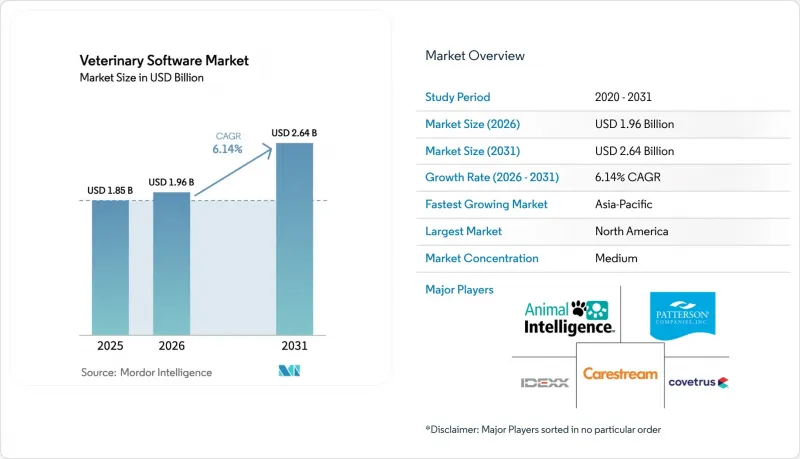
This report is Segmented by Product (Practice Management Software, Veterinary Imaging Software, Tele-Health Platforms, and Other Products), Delivery Model (On-Premise, Cloud-Based, and Hybrid), Animal Type (Companion Animals, Farm/Livestock Animals, Equine, and Mixed Practices), and Geography (North America, Europe, and More). The Market Forecasts are Provided in Terms of Value (USD).
Global Veterinary Software Market Trends and Insights
Increasing Companion Animal Ownership and Healthcare Expenditure
Pet ownership climbed to record levels in 2024, with U.S. households spending USD 147 billion on pets, including USD 38.3 billion on veterinary care. Clinics that once relied on paper files now need longitudinal records, automated recalls, and mobile payment tools to keep pace with preventive and specialty care. Vendors have responded by embedding client-communication portals that trim no-show rates by up to 30%, directly lifting revenue per visit. Higher case complexity creates a virtuous cycle: sophisticated software enables data-driven treatment plans, and successful outcomes justify premium pricing. The United Kingdom offers a parallel example: CVS Group standardized 500-plus clinics on Provet Cloud in 2024 to unlock chain-wide benchmarking and compliance reporting, transforming software from a cost center into a profit lever.
Growing Adoption of Cloud-Based Practice-Management Systems
Cloud practice-management suites eliminate server purchases, shorten deployment windows, and provide instant access to patient files across sites. IDEXX launched the Vello platform in February 2024, allowing clinics to add new locations in days while pulling diagnostic data straight into the medical chart. Compliance is another catalyst: the European Union's Regulation 2019/6 demands electronic antimicrobial reporting, a task cloud systems handle with automated uploads, whereas legacy platforms need manual exports . Subscription fees ranging from USD 200-800 per veterinarian per month convert large capital outlays into predictable operating expenses that align vendor incentives with clinic success. Rural practices still worry about bandwidth and sovereignty, but hybrid models that keep local data for daily workflow while syncing to the cloud for analytics are easing that concern.
High Initial Acquisition and Implementation Costs
Complete migration can exceed USD 50,000 for a mid-sized clinic once hardware, data conversion, and staff training costs are factored in. A 2024 American Veterinary Medical Association survey found that 42% of respondents cited cost as the chief barrier. Productivity often dips for three to six months after the go-live date as teams adjust to the new workflows. While cloud models lower capital outlay, annual subscription fees of USD 10,000 or more per veterinarian can strain practices that are already thinly capitalized. Tiered pricing helps but risks fragmenting feature sets, slowing the network effects that anchor platform value.
Other drivers and restraints analyzed in the detailed report include:
- Integration of Diagnostic Imaging and Laboratory Workflows with PIMS
- Expansion of Telehealth and Remote Consultation Services
- Data Security, Privacy, and Cyber-Threat Concerns
For complete list of drivers and restraints, kindly check the Table Of Contents.
Segment Analysis
Practice-management suites booked 52.45% of 2025 revenue, validating their role as the digital spine for scheduling, billing, medical records, and stock control. IDEXX Neo and Covetrus Ascend bundle integrated payments, diagnostics connectivity, and automated recalls, locking in users through workflow depth. Telehealth engines hold a smaller denominator but are scaling at an 8.54% CAGR to 2031. The investment signals are clear: FirstVet raised EUR 20 million in 2024, and TeleVet added USD 2 million in 2025 to extend asynchronous triage. Beyond pure remote care, imaging platforms such as Web PACS offer DICOM-compliant storage for referral traffic, while IDEXX inVue Dx marries on-site diagnostic hardware with cloud decision support.
Competition now pivots toward convergence. Vendors design single dashboards that surface lab flags, imaging thumbnails, and teleconsult transcripts inside the standard chart. The approach raises switching costs and underpins a durable subscription stream. Compliance modules have become mandatory; for instance, European clinics cannot submit antimicrobial data without in-app reporting. As a result, investors reward platforms that own end-to-end data pipelines rather than point solutions.
Complete Report Scope:
- By Product
- Practice Management Software
- Veterinary Imaging Software
- Tele-Health Platforms
- Other Products
- By Delivery Model
- On-Premise
- Cloud-Based
- Hybrid
- By Animal Type
- Companion Animals
- Farm/Livestock Animals
- Equine
- Mixed Practices
- Geography
- North America
- United States
- Canada
- Mexico
- Europe
- Germany
- United Kingdom
- France
- Italy
- Spain
- Rest of Europe
- Asia-Pacific
- China
- Japan
- India
- Australia
- South Korea
- Rest of Asia-Pacific
- Middle East & Africa
- GCC
- South Africa
- Rest of Middle East & Africa
- South America
- Brazil
- Argentina
- Rest of South America
- North America
Geography Analysis
North America maintained 45.32% of 2025 revenue, underpinned by high per-pet healthcare spend and aggressive clinic roll-up strategies. Mars Veterinary Health, National Veterinary Associates, and Thrive Pet Healthcare now manage thousands of outlets, each demanding unified platforms for billing, inventory, and teleconsults. The region's maturity means nearly every clinic uses basic software, so growth comes from layering predictive analytics, AI diagnostics, and real-time supply chain dashboards on top of existing records. Canada mirrors U.S. adoption but adds provincial privacy nuances that oblige configurable user-consent workflows. Private-equity appetite confirms the thesis: Patient Square Capital's USD 4.1 billion acquisition of Patterson Companies in December 2024 hinged partly on cross-selling software to the distributor's installed base.
Asia-Pacific is the fastest-growing arena, posting a 7.43% CAGR through 2031. China represents roughly 40% of regional spend, but software uptake is fragmented across local vendors that tailor interfaces to Mandarin and integrate with domestic payment rails. India's public investment in digital livestock monitoring aims to lift productivity and disease surveillance, yet patchy rural connectivity still limits cloud migrations. In contrast, Japan and Australia approach North American penetration levels, favoring premium analytics and full diagnostics integration. Multilingual support, local cloud hosting, and currency-specific billing are non-negotiable, forcing Western incumbents to partner with regional integrators or risk losing to homegrown competitors.
Europe occupies the middle ground in share but leads in policy innovation. Regulation 2019/6 has already shifted antimicrobial tracking online, and the Big Data Strategy outlines a centralized EU Veterinary Data Hub. The European Health Data Space, effective March 2025, adds zoonotic-disease surveillance, pushing clinics toward cloud or hybrid deployments capable of secure data exchange. Nordhealth's partnerships with CVS Group and Vets for Pets prove that platforms built around GDPR resilience can pull business from domestic rivals. Latin America and the Middle East & Africa trail in infrastructure. Urban pockets such as Sao Paulo, Mexico City, and Dubai are early adopters, using cloud suites to circumvent local IT shortages, but rural areas remain largely paper-based.
- 2i Nova
- Airvet
- Animal Intelligence Software
- Business Infusions
- Carestream Health
- Covetrus
- DaySmart Vet
- Digitail
- ezyVet
- FirmCloud
- FirstVet
- Henry Schein (NaVetor)
- Hippo Manager Software
- IDEXX
- Nordhealth (Provet Cloud)
- Patterson Companies
- Shepherd Veterinary Software
- TeleVet
- Timeless Veterinary Systems
- Vetport
- Vetspire Inc.
- Vetter Software
Additional Benefits:
- The market estimate (ME) sheet in Excel format
- 3 months of analyst support
TABLE OF CONTENTS
1 Introduction
- 1.1 Study Assumptions & Market Definition
- 1.2 Scope of the Study
2 Research Methodology
3 Executive Summary
4 Market Landscape
- 4.1 Market Overview
- 4.2 Market Drivers
- 4.2.1 Increasing Companion Animal Ownership and Healthcare Expenditure
- 4.2.2 Growing Adoption of Cloud-Based Practice Management Systems
- 4.2.3 Integration of Diagnostic Imaging and Laboratory Workflows with PIMS
- 4.2.4 Expansion of Telehealth and Remote Consultation Services
- 4.2.5 Consolidation of Veterinary Clinic Chains Driving Enterprise Software Demand
- 4.2.6 Emergence of Data Analytics and Business Intelligence for Practice Optimization
- 4.3 Market Restraints
- 4.3.1 High Initial Acquisition and Implementation Costs
- 4.3.2 Data Security, Privacy, and Cyber-Threat Concerns
- 4.3.3 Limited Digital Infrastructure in Emerging Markets
- 4.3.4 Fragmented Regulatory and Interoperability Standards
- 4.4 Value / Supply-Chain Analysis
- 4.5 Regulatory Landscape
- 4.6 Technological Outlook
- 4.7 Porter's Five Forces Analysis
- 4.7.1 Threat Of New Entrants
- 4.7.2 Bargaining Power Of Buyers
- 4.7.3 Bargaining Power Of Suppliers
- 4.7.4 Threat Of Substitute Products
- 4.7.5 Intensity Of Competitive Rivalry
5 Market Size & Growth Forecasts (Value, USD)
- 5.1 By Product
- 5.1.1 Practice Management Software
- 5.1.2 Veterinary Imaging Software
- 5.1.3 Tele-Health Platforms
- 5.1.4 Other Products
- 5.2 By Delivery Model
- 5.2.1 On-Premise
- 5.2.2 Cloud-Based
- 5.2.3 Hybrid
- 5.3 By Animal Type
- 5.3.1 Companion Animals
- 5.3.2 Farm/Livestock Animals
- 5.3.3 Equine
- 5.3.4 Mixed Practices
- 5.4 Geography
- 5.4.1 North America
- 5.4.1.1 United States
- 5.4.1.2 Canada
- 5.4.1.3 Mexico
- 5.4.2 Europe
- 5.4.2.1 Germany
- 5.4.2.2 United Kingdom
- 5.4.2.3 France
- 5.4.2.4 Italy
- 5.4.2.5 Spain
- 5.4.2.6 Rest of Europe
- 5.4.3 Asia-Pacific
- 5.4.3.1 China
- 5.4.3.2 Japan
- 5.4.3.3 India
- 5.4.3.4 Australia
- 5.4.3.5 South Korea
- 5.4.3.6 Rest of Asia-Pacific
- 5.4.4 Middle East & Africa
- 5.4.4.1 GCC
- 5.4.4.2 South Africa
- 5.4.4.3 Rest of Middle East & Africa
- 5.4.5 South America
- 5.4.5.1 Brazil
- 5.4.5.2 Argentina
- 5.4.5.3 Rest of South America
- 5.4.1 North America
6 Competitive Landscape
- 6.1 Market Concentration
- 6.2 Market Share Analysis
- 6.3 Company Profiles (includes Global Level Overview, Market Level Overview, Core Segments, Financials As Available, Strategic Information, Market Rank/Share For Key Companies, Products & Services, And Recent Developments)
- 6.3.1 2i Nova
- 6.3.2 Airvet
- 6.3.3 Animal Intelligence Software Inc.
- 6.3.4 Business Infusions
- 6.3.5 Carestream Health
- 6.3.6 Covetrus Inc.
- 6.3.7 DaySmart Vet
- 6.3.8 Digitail
- 6.3.9 ezyVet
- 6.3.10 FirmCloud Corp.
- 6.3.11 FirstVet
- 6.3.12 Henry Schein (NaVetor)
- 6.3.13 Hippo Manager Software
- 6.3.14 IDEXX Laboratories Inc.
- 6.3.15 Nordhealth (Provet Cloud)
- 6.3.16 Patterson Companies Inc.
- 6.3.17 Shepherd Veterinary Software
- 6.3.18 TeleVet
- 6.3.19 Timeless Veterinary Systems
- 6.3.20 Vetport
- 6.3.21 Vetspire Inc.
- 6.3.22 Vetter Software Inc.
7 Market Opportunities & Future Outlook
- 7.1 White-Space & Unmet-Need Assessment

