PUBLISHER: Mordor Intelligence | PRODUCT CODE: 2114125

PUBLISHER: Mordor Intelligence | PRODUCT CODE: 2114125
Contrast Media Injectors - Market Share Analysis, Industry Trends & Statistics, Growth Forecasts (2026 - 2031)
According to Mordor Intelligence, the contrast media injectors market size is expected to grow from USD 1.96 billion in 2025 to USD 2.11 billion in 2026 and is forecast to reach USD 3.03 billion by 2031 at 7.54% CAGR over 2026-2031.
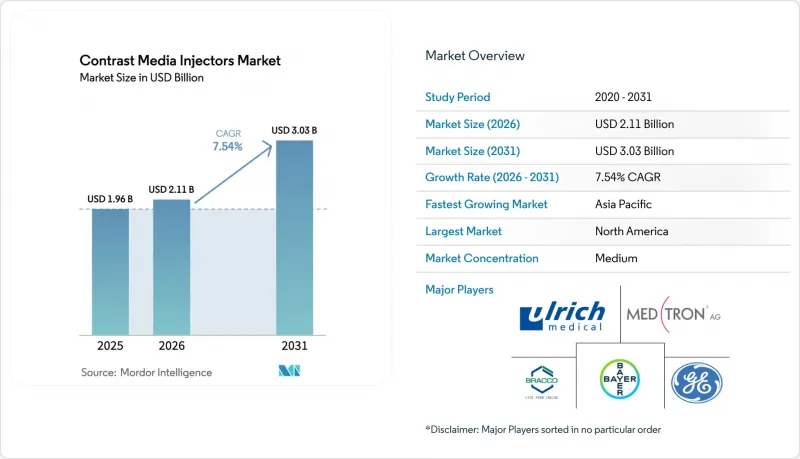
This report is Segmented by Products (Injector Systems [CT Injector Systems, and More] and Consumables [Tubing, and More]), Type of Injectors (Single-Head Injectors, Dual-Head Injectors, and Syringeless Injectors), by Application (Radiology, Interventional Cardiology, and Other Applications), and Geography (North America, Europe, and More). The Market Forecasts are Provided in Terms of Value (USD).
Global Contrast Media Injectors Market Trends and Insights
Rising Demand for Minimally Invasive Diagnostic and Interventional Procedures
Real-time imaging now underpins CT-guided biopsies, valve replacements, and neuro-thrombectomies, each of which requires precise bolus timing that only automated injectors can deliver. NHS England logged 46.6 million diagnostic studies in 2024, including 7.65 million contrast-enhanced CT scans that overwhelmingly used power injectors. Updated cardiology guidelines published in 2024 recommend using the lowest feasible iodine volume, a standard achievable only with systems able to meter sub-milliliter flow. Dual-head injectors have been shown to cut cath-lab procedure time by close to 15% by eliminating manual syringe swaps. Vendors that synchronize injector parameters with scanner protocols through HL7 interfaces are well-positioned, because smaller manufacturers struggle to replicate this software depth. Taken together, procedure growth and workflow complexity safeguard demand for next-generation platforms across the contrast media injectors market.
Rapid CT/MRI Installation Growth in Mid-Income Hospitals
China, India, and Southeast Asia are buying high-slice CT and 3-Tesla MRI scanners at an unprecedented pace, and injector purchases are typically bundled into each scanner deal. Wipro GE Healthcare committed INR 8,000 crore (USD 960 million) in 2024 to scale Indian manufacturing aimed at tier-2 and tier-3 cities, where scanner density sits below two units per 100,000 residents. These hospitals are more price-sensitive than their metropolitan peers, so they favor basic single-head models but on volumes large enough to lift overall market value. Government stimulus programs that subsidize scanner acquisitions often overlook injectors, prompting vendors to create flexible leasing or pay-per-procedure plans. As mid-income facilities expand advanced imaging capacity, the pull-through effect materially lifts the contrast media injectors market.
High Capital Cost of Advanced Multi-Head Systems
Dual-head and syringeless injectors are priced 40-60% above single-head models, putting them beyond the reach of many public hospitals and small outpatient facilities. Bracco's Max 3 syringeless MR injector, FDA-cleared in December 2024, costs USD 80,000-100,000 per unit, a figure that only high-volume centers can amortize. Australia's 2024-25 federal budget funded MRI scanners but left injector purchases to local capital budgets, forcing radiology departments to prioritize essential imaging hardware over ancillary systems. CFOs still recovering from pandemic-era supply shocks continue to defer large equipment outlays. This headwind tempers near-term growth for premium platforms within the contrast media injectors market.
Other drivers and restraints analyzed in the detailed report include:
- Regulatory Push for Contrast-Dose Tracking and Safety Automation
- AI-Powered Injection Protocols Improving Workflow and Reducing Waste
- Adverse Events and Nephrotoxicity Concerns Around Contrast Use
For complete list of drivers and restraints, kindly check the Table Of Contents.
Segment Analysis
Consumables commanded 53.56% of revenue in 2025, an outcome that underscores the large installed base still reliant on single-use tubing and syringes. Bayer's Centargo platform, cleared in late 2024, uses a multi-patient reservoir that reduces per-scan disposable expense by close to 30%, a saving that high-volume centers see immediately. Injector systems are forecast to grow at an 8.25% CAGR through 2031 as hospitals refresh fleets to gain AI integration, dose-tracking, and wireless connectivity. CT injectors remain the largest sub-segment because CT generates more contrast studies than MR, though higher-field MRI installations are lifting demand for MR-conditional power injectors. The consumables stream is being squeezed by syringeless technology and AI-based dose reduction, but infection-control protocols still obligate single-use tubing, ensuring stable if slower growth for disposable lines within the contrast media injectors market size.
Consumable revenue is increasingly tied to service bundles in which hospitals sign multiyear deals that lock in tubing prices in exchange for discounted maintenance. Bracco's 2024 investment to triple capacity at its Geneva ultrasound-contrast site signals confidence that volume gains will outpace per-unit dose declines. The bifurcation is clear: premium injectors with low consumable intensity appeal to research hospitals, while budget systems with higher disposable consumption continue to dominate community settings, sustaining a balanced revenue mix across the contrast media injectors market.
Complete Report Scope:
- By Products
- Injector Systems
- CT Injector Systems
- MRI Injector Systems
- Cardiovascular/Angiography Injector Systems
- Consumables
- Tubing
- Syringes
- Other Consumables
- Injector Systems
- By Type of Injectors
- Single-Head Injectors
- Dual-Head Injectors
- Syringeless Injectors
- By Application
- Radiology
- Interventional Cardiology
- Other Applications
- Geography
- North America
- United States
- Canada
- Mexico
- Europe
- Germany
- United Kingdom
- France
- Italy
- Spain
- Rest of Europe
- Asia-Pacific
- China
- Japan
- India
- Australia
- South Korea
- Rest of Asia-Pacific
- Middle East & Africa
- GCC
- South Africa
- Rest of Middle East & Africa
- South America
- Brazil
- Argentina
- Rest of South America
- North America
Geography Analysis
North America maintained 36.13% of global revenue in 2025, supported by more than 40,000 CT and 13,000 MR scanners in the United States alone. Early adoption of AI injection software and syringeless hardware drives replacement demand, while payer incentives push providers to document every dose. Yet volume growth has plateaued as mature hospitals prioritize utilization over expansion.
Asia-Pacific is forecast to post a 9.51% CAGR through 2031 as China, India, Indonesia, and Vietnam expand public hospital networks. Wipro GE's 2024 investment underscores the scale of upcoming installations; injector sales typically track scanner shipments with a one-for-one ratio in mid-income facilities. Siemens Healthineers reported 8.2% organic growth in Asia-Pacific excluding China for fiscal 2024, confirming robust demand for imaging infrastructure. These conditions will sustain strong unit growth for the contrast media injectors market throughout the region.
Europe remains sizable but slow growing, constrained by budget caps and longer equipment replacement cycles. Australia's 2024 decision to trim CT fees by 2% evidences cost containment, compelling providers to seek injectors with lower consumable costs. The Middle East and parts of Africa continue to buy premium systems for medical-tourism hubs, while currency depreciation in South America inflates capital costs and lengthens replacement intervals. Divergent regional economics obligate suppliers to maintain dual portfolios that span entry-level single-heads and premium syringeless designs, a strategy that underpins global resilience of the contrast media injectors market.
- AngioDynamics (Navilyst)
- APOLLO RT Co., Ltd.
- Bayer AG (MEDRAD)
- Bracco Imaging S.p.A.
- Canon
- Cook Group
- CS Diagnostics GmbH
- GE Healthcare
- Guerbet Group
- Imaxeon Pty Ltd.
- Injekta A/S
- Medtron
- Nemoto Kyorindo Co., Ltd.
- SCITON Medical
- Shenzhen Anke High-Tech Co., Ltd.
- Shenzhen Seacrown Electromechanical Co., Ltd.
- Siemens Healthineers
- SinoMDT (Sino Medical-Device Tech.)
- Ulrich Medical GmbH & Co. KG
- Vivid Imaging
Additional Benefits:
- The market estimate (ME) sheet in Excel format
- 3 months of analyst support
TABLE OF CONTENTS
1 Introduction
- 1.1 Study Assumptions & Market Definition
- 1.2 Scope of the Study
2 Research Methodology
3 Executive Summary
4 Market Landscape
- 4.1 Market Overview
- 4.2 Market Drivers
- 4.2.1 Rising demand for minimally-invasive diagnostic & interventional procedures
- 4.2.2 Rapid CT/MRI installation growth in mid-income hospitals
- 4.2.3 Regulatory push for contrast-dose tracking & safety automation
- 4.2.4 AI-powered injector protocols improving workflow & reducing waste
- 4.2.5 Emergence of value-based outpatient imaging chains
- 4.2.6 Growing adoption of dual- and syringeless systems in mobile stroke & cath labs
- 4.3 Market Restraints
- 4.3.1 High capital cost of advanced multi-head systems
- 4.3.2 Adverse events & nephrotoxicity concerns around contrast use
- 4.3.3 Supply-chain volatility for single-use tubing & syringes
- 4.3.4 Regional reimbursement caps on consumables
- 4.4 Supply-Chain Analysis
- 4.5 Regulatory Landscape
- 4.6 Technological Outlook
- 4.7 Porter's Five Forces Analysis
- 4.7.1 Threat of New Entrants
- 4.7.2 Bargaining Power of Buyers/Consumers
- 4.7.3 Bargaining Power of Suppliers
- 4.7.4 Threat of Substitute Products
- 4.7.5 Intensity of Competitive Rivalry
5 Market Size & Growth Forecasts (Value - USD)
- 5.1 By Products
- 5.1.1 Injector Systems
- 5.1.1.1 CT Injector Systems
- 5.1.1.2 MRI Injector Systems
- 5.1.1.3 Cardiovascular/Angiography Injector Systems
- 5.1.2 Consumables
- 5.1.2.1 Tubing
- 5.1.2.2 Syringes
- 5.1.2.3 Other Consumables
- 5.1.1 Injector Systems
- 5.2 By Type of Injectors
- 5.2.1 Single-Head Injectors
- 5.2.2 Dual-Head Injectors
- 5.2.3 Syringeless Injectors
- 5.3 By Application
- 5.3.1 Radiology
- 5.3.2 Interventional Cardiology
- 5.3.3 Other Applications
- 5.4 Geography
- 5.4.1 North America
- 5.4.1.1 United States
- 5.4.1.2 Canada
- 5.4.1.3 Mexico
- 5.4.2 Europe
- 5.4.2.1 Germany
- 5.4.2.2 United Kingdom
- 5.4.2.3 France
- 5.4.2.4 Italy
- 5.4.2.5 Spain
- 5.4.2.6 Rest of Europe
- 5.4.3 Asia-Pacific
- 5.4.3.1 China
- 5.4.3.2 Japan
- 5.4.3.3 India
- 5.4.3.4 Australia
- 5.4.3.5 South Korea
- 5.4.3.6 Rest of Asia-Pacific
- 5.4.4 Middle East & Africa
- 5.4.4.1 GCC
- 5.4.4.2 South Africa
- 5.4.4.3 Rest of Middle East & Africa
- 5.4.5 South America
- 5.4.5.1 Brazil
- 5.4.5.2 Argentina
- 5.4.5.3 Rest of South America
- 5.4.1 North America
6 Competitive Landscape
- 6.1 Market Concentration
- 6.2 Market Share Analysis
- 6.3 Company Profiles (includes Global level Overview, Market level overview, Core Segments, Financials as available, Strategic Information, Market Rank/Share, Products & Services, Recent Developments)
- 6.3.1 AngioDynamics (Navilyst)
- 6.3.2 APOLLO RT Co., Ltd.
- 6.3.3 Bayer AG (MEDRAD)
- 6.3.4 Bracco Imaging S.p.A.
- 6.3.5 Canon Medical Systems
- 6.3.6 Cook Medical
- 6.3.7 CS Diagnostics GmbH
- 6.3.8 GE Healthcare
- 6.3.9 Guerbet Group
- 6.3.10 Imaxeon Pty Ltd.
- 6.3.11 Injekta A/S
- 6.3.12 Medtron AG
- 6.3.13 Nemoto Kyorindo Co., Ltd.
- 6.3.14 SCITON Medical
- 6.3.15 Shenzhen Anke High-Tech Co., Ltd.
- 6.3.16 Shenzhen Seacrown Electromechanical Co., Ltd.
- 6.3.17 Siemens Healthineers
- 6.3.18 SinoMDT (Sino Medical-Device Tech.)
- 6.3.19 Ulrich Medical GmbH & Co. KG
- 6.3.20 Vivid Imaging
7 Market Opportunities & Future Outlook
- 7.1 White-space & Unmet-Need Assessment

