PUBLISHER: Mordor Intelligence | PRODUCT CODE: 2114128

PUBLISHER: Mordor Intelligence | PRODUCT CODE: 2114128
Flea And Tick Product - Market Share Analysis, Industry Trends & Statistics, Growth Forecasts (2026 - 2031)
According to Mordor Intelligence, the flea and tick product market size is expected to grow from USD 7.40 billion in 2025 to USD 8.09 billion in 2026 and is forecast to reach USD 12.63 billion by 2031 at 9.32% CAGR over 2026-2031.
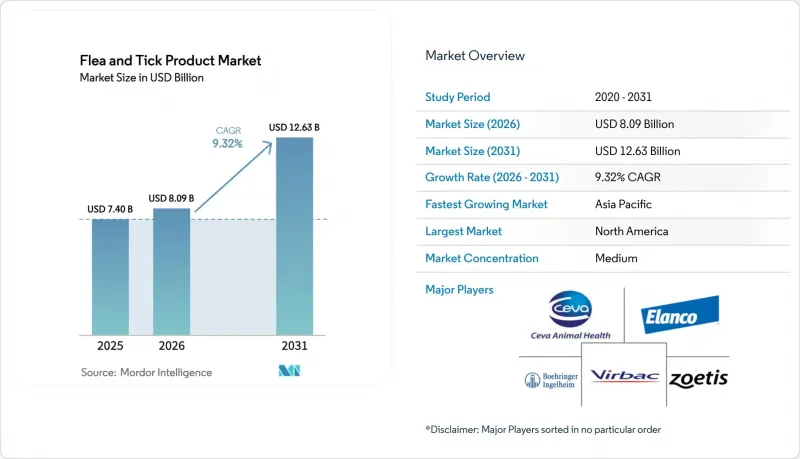
This report is Segmented by Product Form (Oral Chews and Tablets, Spot-On Topicals, Sprays and Mists, Collars, Shampoos and Dips, Powders and Dusts, Others), Animal (Dogs, Cats, Other Animals), Distribution Channel (Veterinary Clinics, Retail Pet Stores and Pharmacies, and More), and Geography (North America, and More). The Market Forecasts are Provided in Terms of Value (USD).
Global Flea And Tick Product Market Trends and Insights
High Prevalence of Flea- and Tick-Borne Diseases in Pets
CDC surveillance logged 89,000 Lyme disease cases in 2023, 68.5% above the 2017-2019 baseline, while veterinary laboratories report Ehrlichia and Anaplasma positivity exceeding 5% in 15 U.S. states. Rising Babesia gibsoni detection in Japanese and South Korean dogs further widens the prophylaxis addressable base. Treatment outlays ranging from USD 500 to USD 2,000 per canine case contrast with annual preventive costs near USD 300, prompting owners to view year-round regimens as a cost-saving necessity. The resulting demand uptick directly underpins current double-digit expansion of oral, long-duration options.
Increasing Pet Adoption and Humanization Trend
The American Pet Products Association documented pet ownership in 66% of U.S. households in 2024, up 10 percentage points versus 2019. China reached 120.75 million companion animals in 2023, while India's pet sector is set to hit USD 24.8 billion by 2032 on a 20% CAGR. Owners increasingly select premium combination chewables - exemplified by Simparica Trio and NexGard Plus - to bundle flea, tick, heartworm, and intestinal parasite control into one monthly dose. Growing pet insurance eligibility for preventive care in the U.K. and Scandinavia also nudges compliance.
Adverse-Event and Safety Concerns with Chemicals
The FDA's updated 2024 alert on isoxazolines details neurologic events in a small subset of pets, recommending caution for animals with seizure histories. The EMA's pharmacovigilance panel reviewed 1,200 Bravecto reports and reaffirmed a positive benefit-risk ratio while advising closer veterinarian guidance. Social-media groups spotlight anecdotal cases, pushing a minority of owners toward botanical choices such as cedar-oil sprays from Wondercide, which posted 40% revenue growth in 2024.
Other drivers and restraints analyzed in the detailed report include:
- Growing Owner Awareness of Zoonotic Risks
- Tele-Health and E-Commerce Subscriptions Expand Access
- Emerging Acaricide Resistance in Tick Populations
For complete list of drivers and restraints, kindly check the Table Of Contents.
Segment Analysis
Oral chews and tablets are slated for a 10.49% CAGR, the quickest within the flea and tick products market, as FDA-approved Simparica Trio and NexGard Plus add heartworm and intestinal parasite coverage in a single monthly chew. Spot-on topicals still held 48.42% of 2025 revenue, but their share is eroding as owners prefer mess-free systemic options. Collars capture an 8-month window of efficacy yet face environmental scrutiny over neonicotinoid residues. Sprays, powders, and shampoos account for <10% combined, confined to shelter and kennel usage. Bravecto Quantum's 12-month injectable model exemplifies the shift toward ultra-long-duration solutions, eliminating monthly owner reminders and bolstering adherence documented as low as 45% among non-subscription users.
Consumer preference for flavored chewables also lifts palatability R&D, with beef, chicken, and fish variants tailored to breed size. Systemic delivery avoids dermal irritation, a frequent pyrethroid complaint, reinforcing oral dominance within the flea and tick products market.
Complete Report Scope:
- By Product Form
- Oral Chews and Tablets
- Spot-On Topicals
- Sprays & Mists
- Collars
- Shampoos & Dips
- Powders & Dusts
- Others
- By Animal
- Dogs
- Cats
- Other Animals
- By Distribution Channel
- Veterinary Clinics
- Retail Pet Stores & Pharmacies
- E-commerce and Subscription Platforms
- Others
- By Geography
- North America
- United States
- Canada
- Mexico
- Europe
- Germany
- United Kingdom
- France
- Italy
- Spain
- Rest of Europe
- Asia-Pacific
- China
- Japan
- India
- Australia
- South Korea
- Rest of Asia-Pacific
- Middle East and Africa
- GCC
- South Africa
- Rest of Middle East and Africa
- South America
- Brazil
- Argentina
- Rest of South America
- North America
Geography Analysis
North America commanded 41.98% of 2025 revenue, anchored by USD 200 - USD 400 annual per-pet preventive spending and an entrenched clinic network. Continued vector-borne disease growth sustains demand, especially as Ixodes scapularis pushes into Canada's southern provinces. Europe follows at 28%, yet faces emerging eco-toxicology regulations that may limit fipronil and permethrin usage.
Asia-Pacific posts the fastest 10.54% CAGR through 2031 owing to China's expanding urban pet base and India's rapid 20% sector CAGR. Slower regulatory approvals can extend launch cycles by up to 36 months, affording local generics an interim share. South America and the Middle East & Africa jointly deliver under 15% but hold headroom as veterinary infrastructure improves; the African Medicines Agency, founded 2024, intends to streamline approvals across 55 member states.
- Bayer AG (Seresto)
- Bimeda Animal Health
- Boehringer Ingelheim
- Central Garden & Pet
- Ceva Sante Animale
- Dechra Pharmaceuticals
- Ecto Development
- Elanco
- Hartz Mountain
- Laboratoires Expanscience
- Merck
- PetArmor (Tevra)
- PetIQ / Sergeant's
- Professional Pet Products
- Promika (Manna Pro)
- Vetoquinol
- Virbac
- Wellmark International
- Wondercide
- Zoetis
Additional Benefits:
- The market estimate (ME) sheet in Excel format
- 3 months of analyst support
TABLE OF CONTENTS
1 Introduction
- 1.1 Study Assumptions & Market Definition
- 1.2 Scope of the Study
2 Research Methodology
3 Executive Summary
4 Market Landscape
- 4.1 Market Overview
- 4.2 Market Drivers
- 4.2.1 High prevalence of flea- & tick-borne diseases in pets
- 4.2.2 Increasing pet adoption & humanization trend
- 4.2.3 Growing owner awareness of zoonotic risks
- 4.2.4 Tele-health & e-commerce subscriptions expand access
- 4.2.5 Regulatory push for long-duration combo formulations
- 4.2.6 Climate-driven expansion of tick habitats
- 4.3 Market Restraints
- 4.3.1 Adverse-event & safety concerns with chemicals
- 4.3.2 Counterfeit & sub-standard products in grey market
- 4.3.3 Emerging acaricide resistance in tick populations
- 4.3.4 Tightening EU eco-toxicology regulations on actives
- 4.4 Value / Supply-Chain Analysis
- 4.5 Regulatory Landscape
- 4.6 Technological Outlook
- 4.7 Porter's Five Forces Analysis
- 4.7.1 Threat of New Entrants
- 4.7.2 Bargaining Power of Buyers
- 4.7.3 Bargaining Power of Suppliers
- 4.7.4 Threat of Substitutes
- 4.7.5 Intensity of Rivalry
5 Market Size & Growth Forecasts (Value, USD)
- 5.1 By Product Form
- 5.1.1 Oral Chews and Tablets
- 5.1.2 Spot-On Topicals
- 5.1.3 Sprays & Mists
- 5.1.4 Collars
- 5.1.5 Shampoos & Dips
- 5.1.6 Powders & Dusts
- 5.1.7 Others
- 5.2 By Animal
- 5.2.1 Dogs
- 5.2.2 Cats
- 5.2.3 Other Animals
- 5.3 By Distribution Channel
- 5.3.1 Veterinary Clinics
- 5.3.2 Retail Pet Stores & Pharmacies
- 5.3.3 E-commerce and Subscription Platforms
- 5.3.4 Others
- 5.4 By Geography
- 5.4.1 North America
- 5.4.1.1 United States
- 5.4.1.2 Canada
- 5.4.1.3 Mexico
- 5.4.2 Europe
- 5.4.2.1 Germany
- 5.4.2.2 United Kingdom
- 5.4.2.3 France
- 5.4.2.4 Italy
- 5.4.2.5 Spain
- 5.4.2.6 Rest of Europe
- 5.4.3 Asia-Pacific
- 5.4.3.1 China
- 5.4.3.2 Japan
- 5.4.3.3 India
- 5.4.3.4 Australia
- 5.4.3.5 South Korea
- 5.4.3.6 Rest of Asia-Pacific
- 5.4.4 Middle East and Africa
- 5.4.4.1 GCC
- 5.4.4.2 South Africa
- 5.4.4.3 Rest of Middle East and Africa
- 5.4.5 South America
- 5.4.5.1 Brazil
- 5.4.5.2 Argentina
- 5.4.5.3 Rest of South America
- 5.4.1 North America
6 Competitive Landscape
- 6.1 Market Concentration
- 6.2 Market Share Analysis
- 6.3 Company Profiles (includes Global level Overview, Market level overview, Core Segments, Financials as available, Strategic Information, Market Rank/Share, Products & Services, Recent Developments)
- 6.3.1 Bayer AG (Seresto)
- 6.3.2 Bimeda Animal Health
- 6.3.3 Boehringer Ingelheim
- 6.3.4 Central Garden & Pet
- 6.3.5 Ceva Sante Animale
- 6.3.6 Dechra Pharmaceuticals
- 6.3.7 Ecto Development
- 6.3.8 Elanco
- 6.3.9 Hartz Mountain
- 6.3.10 Laboratoires Francodex
- 6.3.11 Merck Animal Health
- 6.3.12 PetArmor (Tevra)
- 6.3.13 PetIQ / Sergeant's
- 6.3.14 Professional Pet Products
- 6.3.15 Promika (Manna Pro)
- 6.3.16 Vetoquinol
- 6.3.17 Virbac
- 6.3.18 Wellmark International
- 6.3.19 Wondercide
- 6.3.20 Zoetis
7 Market Opportunities & Future Outlook
- 7.1 White-space & Unmet-Need Assessment

