PUBLISHER: Mordor Intelligence | PRODUCT CODE: 2114170

PUBLISHER: Mordor Intelligence | PRODUCT CODE: 2114170
Practice Management System - Market Share Analysis, Industry Trends & Statistics, Growth Forecasts (2026 - 2031)
According to Mordor Intelligence, the practice management system market size is expected to grow from USD 12.73 billion in 2025 to USD 13.81 billion in 2026 and is forecast to reach USD 20.75 billion by 2031 at 8.48% CAGR over 2026-2031.
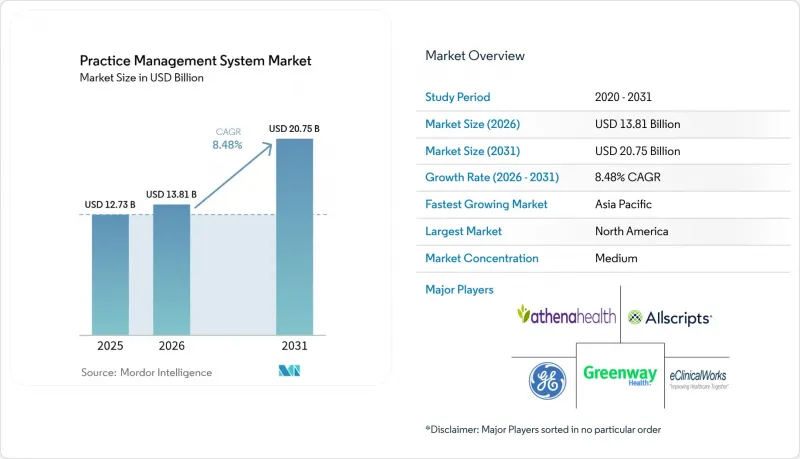
This report is Segmented by Product Type (Stand-Alone PMS and Integrated PMS), Component (Software and Services), Deployment Mode (On-Premise, and More), Functionality (Scheduling, and More), End-User (Hospitals, Pharmacies, and More), Practice Size (Solo, and More), and Geography (North America, and More). The Market Forecasts are Provided in Terms of Value (USD).
Global Practice Management System Market Trends and Insights
Rising Demand for Operational Efficiency
Physician burnout reached 63% in 2024, and administrative turnover surpassed 25%, so practices prioritize automation to protect clinical capacity. Modern platforms cut routine workload by 40%, largely through digital check-in, real-time eligibility, and automated prior authorization. Predictive scheduling allows practices to manage higher visit volumes without proportional staffing increases, an advantage as fee-for-service rates flatten even while operating expenses rise. Workforce stress in North America and Europe accelerates platform upgrades because talent shortages prevent manual back-office scaling. Vendors embedding AI for claims scrubbing or smart task routing gain share as practices measure outcomes in hours saved rather than features listed.
Regulatory Compliance and Incentive Programs
The CMS Merit-based Incentive Payment System imposes up to 9% payment adjustments tied to quality scores, so practices adopt systems that can track, validate, and transmit metrics in near real time. Integrated platforms deliver 85% higher scores than disparate tools, translating directly into revenue protection. The 21st Century Cures Act prohibits information blocking and sets tight interoperability deadlines, forcing replacement of legacy software that cannot deliver FHIR-based data exchange. State initiatives such as California's Advanced Primary Care program layer additional incentives, reinforcing the need for comprehensive workflow coverage. HIPAA security updates further elevate demand for platforms with embedded encryption, audit logs, and multifactor authentication features.
Limited Health IT Workforce
Unfilled health IT vacancies topped 40,000 in the United States during 2024, delaying many go-lives as staff training backlogs grew. Small practices lack dedicated technicians and lean on vendor services, yet 65% of solo physicians report inadequate support for optimization tasks. Security expertise is especially scarce while healthcare accounts for 45% more cyber attacks than other sectors, prompting organizations to outsource monitoring to platform providers. Although managed services relieve pressure, they heighten dependency and may erode negotiation leverage over time.
Other drivers and restraints analyzed in the detailed report include:
- Growth of Integrated Healthcare IT Ecosystems
- Expansion of Outpatient and Ambulatory Care
- High Implementation and Maintenance Costs
For complete list of drivers and restraints, kindly check the Table Of Contents.
Segment Analysis
Integrated solutions held 61.88% revenue in 2025 and are projected to grow at 10.02% CAGR through 2031, reinforcing their status as the core of the Practice Management System market. Practices gravitate toward single-vendor stacks that converge scheduling, billing, and clinical data because silo elimination reduces re-work, lowers interface costs, and improves audit trails. In value-based contracts, seamless data transfer between charting and revenue modules helps physicians reconcile outcome metrics against payment incentives without manual reconciliation. Ecosystem vendors such as Epic exploit patient-portal stickiness; organizations that adopt MyChart within their practice management workflow report 25% higher portal engagement and fewer no-shows.
Stand-alone modules still appeal to high-volume procedural specialties like dermatology or ophthalmology where finely tuned templates and fast charge capture outweigh cross-departmental hand-offs. Some groups intentionally build best-of-breed stacks mixing niche charting tools with enterprise scheduling backbones. FHIR R4 lowers switching friction by standardizing data interchange, allowing specialists to keep high-performance niche applications while feeding required data to parent hospital EHRs. Still, compliance deadlines and cyber concerns push many holdouts toward integrated upgrades, a trend likely to sustain double-digit growth across the Practice Management System market through 2030.
Software dominated with 69.85% share in 2025, but services are accelerating at a 9.28% CAGR as implementations grow more strategic. Conversion from paper or legacy systems necessitates process re-engineering, interface building, and multi-week staff training that few clinics can manage internally. Cloud migration services see particular velocity because 60% of practices have committed to moving core workloads by 2027. Vendors respond with packaged onboarding, analytics tuning, and managed cyber defense, smoothing adoption but expanding recurring fees.
Long-term optimization contracts emphasize KPI monitoring, dashboard customization, and periodic workflow refreshes to reflect regulatory updates. Specialty clinics often purchase coding audits and denial recovery services that promise uplift in net collections. The rebound in service demand means the Practice Management System industry sees margin shift from licenses toward high-touch engagement, a dynamic that will likely widen the gap between full-service vendors and license-only competitors.
Complete Report Scope:
- By Product Type
- Stand-alone PMS
- Integrated PMS
- By Component
- Software
- Services
- By Deployment Mode
- On-premise
- Cloud-based
- Hybrid
- By Functionality
- Scheduling
- Billing & Revenue-Cycle Management
- Claims Management
- e-Prescription
- Clinical Workflow
- Telehealth Integration
- By End-user
- Hospitals
- Pharmacies
- Diagnostic Laboratories
- Other End-users
- By Practice Size
- Solo
- Small Group (2-5 physicians)
- Mid-size (6-20 physicians)
- Large Group (>20 physicians)
- Geography
- North America
- United States
- Canada
- Mexico
- Europe
- Germany
- United Kingdom
- France
- Italy
- Spain
- Rest of Europe
- Asia-Pacific
- China
- Japan
- India
- Australia
- South Korea
- Rest of Asia-Pacific
- Middle East & Africa
- GCC
- South Africa
- Rest of Middle East & Africa
- South America
- Brazil
- Argentina
- Rest of South America
- North America
Geography Analysis
North America held 41.96% share in 2025, propelled by federal incentives, private insurance complexity, and a mature vendor ecosystem. CMS requirements, HIPAA security updates, and the 21st Century Cures Act form a regulatory trio that effectively mandates modern practice software. Canadian provinces also bankroll interoperability projects; Ontario's Digital First initiative subsidizes upgrades and accelerates EHR-PMS integration. High wage inflation intensifies automation ROI, prompting even smaller U.S. clinics to adopt cloud solutions sooner than peers abroad.
Asia-Pacific posts a 9.12% CAGR, the fastest globally. China's Healthy China 2030 roadmap funds hospital-to-community IT links, while India's Digital Health Mission sets national data exchange protocols that favor integrated suppliers. Southeast Asia's private hospital chains expand regionally, standardizing on cloud platforms for cross-border clinics. Australia and South Korea exemplify advanced markets with compulsory e-prescription and telehealth coverage, locking in steady replacement cycles.
Europe records moderate but resilient demand underpinned by GDPR, ePrescription mandates, and public health system modernization. Germany's Hospital Future Act allocates EUR 4 billion for digital upgrades, including practice management at affiliated outpatient centers. The United Kingdom's NHS reforms encourage primary-care networks to merge administrative functions and share analytics. Middle East and Africa show early-stage adoption centered in urban private facilities. Gulf Cooperation Council states fund national digitial records, while South Africa's private groups deploy cloud PMS to serve dispersed rural outreach clinics.
- Accumedic Computer Systems
- Advanced Data Systems Corp.
- AdvancedMD
- AdvantEdge Healthcare Solutions
- Allscripts
- Athenahealth
- CareCloud
- DrChrono (Ripple Health)
- eClinicalWorks
- Epic Systems
- GE Healthcare
- Greenway Health
- Henry Schein
- Kareo
- Mckesson
- Meditech
- NextGen Healthcare
- Oracle
- PracticeSuite, Inc.
- RXNT
Additional Benefits:
- The market estimate (ME) sheet in Excel format
- 3 months of analyst support
TABLE OF CONTENTS
1 Introduction
- 1.1 Study Assumptions & Market Definition
- 1.2 Scope of the Study
2 Research Methodology
3 Executive Summary
4 Market Landscape
- 4.1 Market Overview
- 4.2 Market Drivers
- 4.2.1 Rising Demand for Operational Efficiency
- 4.2.2 Regulatory Compliance and Incentive Programs
- 4.2.3 Growth of Integrated Healthcare IT Ecosystems
- 4.2.4 Expansion of Outpatient and Ambulatory Care
- 4.2.5 Transition to Value-Based Care Models
- 4.2.6 Adoption of Artificial Intelligence in Revenue Cycle
- 4.3 Market Restraints
- 4.3.1 Limited Health IT Workforce
- 4.3.2 High Implementation and Maintenance Costs
- 4.3.3 Interoperability and Data Privacy Concerns
- 4.3.4 Market Consolidation among Providers
- 4.4 Value / Supply-Chain Analysis
- 4.5 Regulatory Landscape
- 4.6 Technological Outlook
- 4.7 Porter's Five Forces
- 4.7.1 Threat of New Entrants
- 4.7.2 Bargaining Power of Buyers
- 4.7.3 Bargaining Power of Suppliers
- 4.7.4 Threat of Substitutes
- 4.7.5 Competitive Rivalry
5 Market Size & Growth Forecasts (Value, USD)
- 5.1 By Product Type
- 5.1.1 Stand-alone PMS
- 5.1.2 Integrated PMS
- 5.2 By Component
- 5.2.1 Software
- 5.2.2 Services
- 5.3 By Deployment Mode
- 5.3.1 On-premise
- 5.3.2 Cloud-based
- 5.3.3 Hybrid
- 5.4 By Functionality
- 5.4.1 Scheduling
- 5.4.2 Billing & Revenue-Cycle Management
- 5.4.3 Claims Management
- 5.4.4 e-Prescription
- 5.4.5 Clinical Workflow
- 5.4.6 Telehealth Integration
- 5.5 By End-user
- 5.5.1 Hospitals
- 5.5.2 Pharmacies
- 5.5.3 Diagnostic Laboratories
- 5.5.4 Other End-users
- 5.6 By Practice Size
- 5.6.1 Solo
- 5.6.2 Small Group (2-5 physicians)
- 5.6.3 Mid-size (6-20 physicians)
- 5.6.4 Large Group (>20 physicians)
- 5.7 Geography
- 5.7.1 North America
- 5.7.1.1 United States
- 5.7.1.2 Canada
- 5.7.1.3 Mexico
- 5.7.2 Europe
- 5.7.2.1 Germany
- 5.7.2.2 United Kingdom
- 5.7.2.3 France
- 5.7.2.4 Italy
- 5.7.2.5 Spain
- 5.7.2.6 Rest of Europe
- 5.7.3 Asia-Pacific
- 5.7.3.1 China
- 5.7.3.2 Japan
- 5.7.3.3 India
- 5.7.3.4 Australia
- 5.7.3.5 South Korea
- 5.7.3.6 Rest of Asia-Pacific
- 5.7.4 Middle East & Africa
- 5.7.4.1 GCC
- 5.7.4.2 South Africa
- 5.7.4.3 Rest of Middle East & Africa
- 5.7.5 South America
- 5.7.5.1 Brazil
- 5.7.5.2 Argentina
- 5.7.5.3 Rest of South America
- 5.7.1 North America
6 Competitive Landscape
- 6.1 Market Concentration
- 6.2 Market Share Analysis
- 6.3 Company Profiles (includes Global level Overview, Market level overview, Core Segments, Financials as available, Strategic Information, Market Rank/Share for key companies, Products & Services, and Recent Developments)
- 6.3.1 Accumedic Computer Systems
- 6.3.2 Advanced Data Systems Corp.
- 6.3.3 AdvancedMD
- 6.3.4 AdvantEdge Healthcare Solutions
- 6.3.5 Allscripts Healthcare Solutions, Inc.
- 6.3.6 Athenahealth
- 6.3.7 CareCloud
- 6.3.8 DrChrono (Ripple Health)
- 6.3.9 eClinicalWorks
- 6.3.10 Epic Systems Corporation
- 6.3.11 GE HealthCare
- 6.3.12 Greenway Health LLC
- 6.3.13 Henry Schein (MicroMD)
- 6.3.14 Kareo, Inc.
- 6.3.15 McKesson Corporation
- 6.3.16 MEDITECH
- 6.3.17 NextGen Healthcare
- 6.3.18 Oracle Cerner
- 6.3.19 PracticeSuite, Inc.
- 6.3.20 RXNT
7 Market Opportunities & Future Outlook
- 7.1 White-space & Unmet-need Assessment

