PUBLISHER: Mordor Intelligence | PRODUCT CODE: 2114174

PUBLISHER: Mordor Intelligence | PRODUCT CODE: 2114174
RF Power Semiconductor - Market Share Analysis, Industry Trends & Statistics, Growth Forecasts (2026 - 2031)
According to Mordor Intelligence, the rF power semiconductor market size is expected to grow from USD 27.08 billion in 2025 to USD 29.7 billion in 2026 and is forecast to reach USD 47.15 billion by 2031 at 9.69% CAGR over 2026-2031.
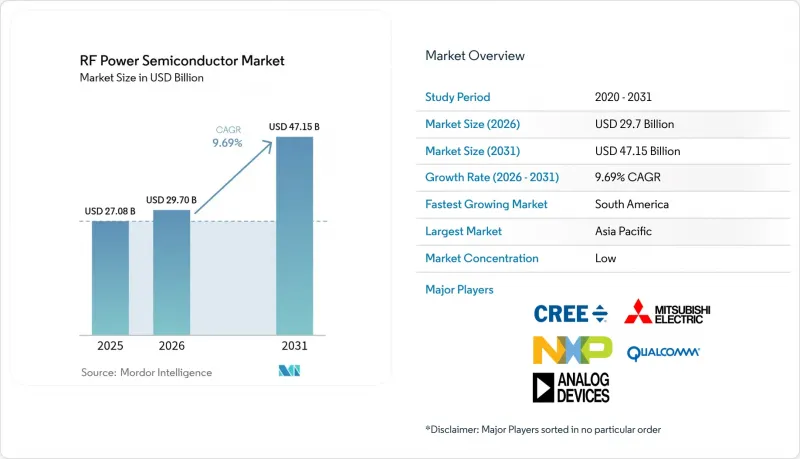
This report is Segmented by Technology (LDMOS, Gaas, Gan, Si Other), Frequency Band, Power Level, Device Type (RF Power Amplifiers, RF Front-End Modules and More), Application (Telecom Infrastructure, Aerospace/Defense, and More), and Geography. The Market Forecasts are Provided in Terms of Value (USD).
Global RF Power Semiconductor Market Trends and Insights
5G Macro-Cell Densification Wave
Next-generation macro sites require 3-5 times higher RF power density than 4G to enable massive-MIMO coverage. Vendors now specify GaN-on-SiC amplifiers above 3.5 GHz where LDMOS faces thermal limits. Ericsson's 2025 AIR 3266 radio delivers 400 W output while cutting energy use by 30%. Elevated power levels push front-end modules toward higher integration and tighter linearity targets, a trend amplified by enterprise private-network rollouts.
Surge in Mobile RF Front-End Complexity
Handsets integrate up to 15 bands and support Wi-Fi 7 plus UWB, demanding power amplifiers that keep efficiency across disparate spectra. Qualcomm's FastConnect 7900 merges Wi-Fi 7, Bluetooth, and UWB on 6 nm, shaving power draw by 40%. Satellite back-up links and automotive V2X further raise spectral overlap, intensifying demand for multi-protocol PA modules.
High Die Cost and Wafer-Level Yield Challenges
GaN-on-SiC yields remain 60-70% versus 85-90% for silicon. Wolfspeed's Mohawk Valley plant reported 20% wafer-start utilization in early 2024, illustrating the gradual ramp toward cost parity. Substrate scarcity and complex epitaxy keep die prices 3-5 times higher than LDMOS, limiting GaN's reach in cost-sensitive devices.
Other drivers and restraints analyzed in the detailed report include:
- Rapid GaN Adoption for >3 GHz Base Stations
- Industrial Solid-State RF Heating and Plasma Tools
- Export-Control Headwinds on Wide-Bandgap Devices
For complete list of drivers and restraints, kindly check the Table Of Contents.
Segment Analysis
The RF power semiconductor market size for technology segmentation stood at USD 27.08 billion in 2025, with LDMOS contributing 35.40% revenue. GaN's 14.58% CAGR through 2031 reflects its superior power density at >3 GHz, while GaAs retains niches in ultra-low-noise links. Infineon's roadmap signals mass-market GaN adoption across telecom and EV powertrains.
Growth momentum centers on sub-6 GHz coverage where LDMOS offers low cost. Yet every new high-band site favours GaN, accelerating a dual-technology landscape. MACOM's USD 345 million upgrade to 100 mm and 150 mm GaN lines under the CHIPS Act underscores industry efforts to localize wide-bandgap supply. As yields improve, GaN's share could overtake LDMOS in new macro-radio deployments by 2028.
Sub-6 GHz held 60.40% of RF power semiconductor market share in 2025, riding nationwide 5G rollouts. The 20-40 GHz slice is poised for a 13.76% CAGR as operators trial 6G and LEO constellations tap Ku-band windows.
System designers now demand amplifiers spanning multiple bands to simplify inventory. NXP's Airfast portfolio offers 41% PAE across 3.6-3.8 GHz, cutting component counts. Above 40 GHz, use cases remain specialized, yet defence radar and backhaul links sustain steady demand. Multiband capability will be a decisive spec in the next upgrade cycle.
Complete Report Scope:
- By Technology
- LDMOS
- GaAs
- GaN
- Si (Other)
- By Frequency Band
- Sub-6 GHz
- 6 - 20 GHz
- 20 - 40 GHz
- More than 40 GHz (mmWave)
- By Power Level
- Less than 10 W
- 10 - 50 W
- 50 - 200 W
- More than 200 W
- By Device Type
- RF Power Amplifiers
- RF Front-End Modules
- RF Switches / Tuners
- RF Filters and Multiplexers
- By Application
- Telecom Infrastructure
- Aerospace and Defense
- Wired Broadband
- Satellite Communication
- Industrial and Automotive RF Energy
- Geography
- North America
- United States
- Canada
- Mexico
- Europe
- United Kingdom
- Germany
- France
- Italy
- Rest of Europe
- Asia-Pacific
- China
- Japan
- India
- South Korea
- Rest of Asia
- Middle East
- Israel
- Saudi Arabia
- United Arab Emirates
- Turkey
- Rest of Middle East
- Africa
- South Africa
- Egypt
- Rest of Africa
- South America
- Brazil
- Argentina
- Rest of South America
- North America
Geography Analysis
Asia-Pacific dominated the RF power semiconductor market with a 44.20% revenue share in 2025 on the back of China's rapid 5G construction and South Korea's mmWave pilots. Chinese researchers recently cut GaN defect densities, an advance that may lift local yields and temper import reliance. Japan contributes specialty compound processes for automotive and industrial fields. Regional expansions in private networks across manufacturing clusters propel mid-range power device demand.
North America and Europe display technology-driven growth. Operators now retrofit 4G macro grids with energy-saving GaN PAs, while federal incentives such as the U.S. CHIPS Act bankroll domestic fabs. MACOM expects up to USD 70 million in direct funding to modernize Massachusetts and North Carolina sites. Defense primes in both regions require radiation-hardened GaN parts, fostering premium sub-segments shielded from consumer price swings.
South America posts the fastest 12.95% CAGR through 2031. Brazil's BRL 47 billion spectrum auction earmarked BRL 42 billion for network buildouts that prioritize 5G-ready gear. Rural broadband gaps in Argentina and mining automation in Chile elevate demand for long-reach sub-6 GHz PAs. Middle East and Africa see selective adoption, with satellite backhaul filling coverage voids and government digitization programs stimulating modest but consistent volumes.
- Ampleon Netherlands B.V.
- Analog Devices, Inc.
- Broadcom Inc.
- Cree, Inc. (d/b/a Wolfspeed)
- Infineon Technologies AG
- MACOM Technology Solutions Holdings, Inc.
- Mitsubishi Electric Corporation
- Murata Manufacturing Co., Ltd.
- NXP Semiconductors N.V.
- ON Semiconductor Corporation
- Qorvo, Inc.
- Qualcomm Incorporated
- Renesas Electronics Corporation
- Skyworks Solutions, Inc.
- STMicroelectronics N.V.
- Sumitomo Electric Device Innovations, Inc.
- Tagore Technology, Inc.
- Teledyne e2v Semiconductors SAS
- Toshiba Electronic Devices and Storage Corporation
- UMS - United Monolithic Semiconductors GmbH
Additional Benefits:
- The market estimate (ME) sheet in Excel format
- 3 months of analyst support
TABLE OF CONTENTS
1 INTRODUCTION
- 1.1 Study Assumptions and Market Definition
- 1.2 Scope of the Study
2 RESEARCH METHODOLOGY
3 EXECUTIVE SUMMARY
4 MARKET LANDSCAPE
- 4.1 Market Overview
- 4.2 Market Drivers
- 4.2.1 5G macro-cell densification wave
- 4.2.2 Surge in mobile RF front-end complexity (Wi-Fi 6E/7, UWB, NTN)
- 4.2.3 Rapid GaN adoption for 3 GHz base-stations
- 4.2.4 Industrial solid-state RF heating and plasma tools
- 4.2.5 Proliferation of private 5G/6G campus networks
- 4.2.6 Automotive RF energy applications expansion
- 4.3 Market Restraints
- 4.3.1 High die cost and wafer-level yield challenges
- 4.3.2 Export-control headwinds on wide-bandgap devices
- 4.3.3 Thermal / packaging limits above 40 GHz
- 4.3.4 Fab capacity tightness for SiC/GaN epi-wafers
- 4.4 Value / Supply-Chain Analysis
- 4.5 Regulatory Landscape
- 4.6 Technological Outlook
- 4.7 Porter's Five Forces
- 4.7.1 Bargaining Power of Suppliers
- 4.7.2 Bargaining Power of Buyers/Consumers
- 4.7.3 Threat of New Entrants
- 4.7.4 Threat of Substitute Products
- 4.7.5 Intensity of Competitive Rivalry
5 MARKET SIZE and GROWTH FORECASTS
- 5.1 By Technology
- 5.1.1 LDMOS
- 5.1.2 GaAs
- 5.1.3 GaN
- 5.1.4 Si (Other)
- 5.2 By Frequency Band
- 5.2.1 Sub-6 GHz
- 5.2.2 6 - 20 GHz
- 5.2.3 20 - 40 GHz
- 5.2.4 More than 40 GHz (mmWave)
- 5.3 By Power Level
- 5.3.1 Less than 10 W
- 5.3.2 10 - 50 W
- 5.3.3 50 - 200 W
- 5.3.4 More than 200 W
- 5.4 By Device Type
- 5.4.1 RF Power Amplifiers
- 5.4.2 RF Front-End Modules
- 5.4.3 RF Switches / Tuners
- 5.4.4 RF Filters and Multiplexers
- 5.5 By Application
- 5.5.1 Telecom Infrastructure
- 5.5.2 Aerospace and Defense
- 5.5.3 Wired Broadband
- 5.5.4 Satellite Communication
- 5.5.5 Industrial and Automotive RF Energy
- 5.6 Geography
- 5.6.1 North America
- 5.6.1.1 United States
- 5.6.1.2 Canada
- 5.6.1.3 Mexico
- 5.6.2 Europe
- 5.6.2.1 United Kingdom
- 5.6.2.2 Germany
- 5.6.2.3 France
- 5.6.2.4 Italy
- 5.6.2.5 Rest of Europe
- 5.6.3 Asia-Pacific
- 5.6.3.1 China
- 5.6.3.2 Japan
- 5.6.3.3 India
- 5.6.3.4 South Korea
- 5.6.3.5 Rest of Asia
- 5.6.4 Middle East
- 5.6.4.1 Israel
- 5.6.4.2 Saudi Arabia
- 5.6.4.3 United Arab Emirates
- 5.6.4.4 Turkey
- 5.6.4.5 Rest of Middle East
- 5.6.5 Africa
- 5.6.5.1 South Africa
- 5.6.5.2 Egypt
- 5.6.5.3 Rest of Africa
- 5.6.6 South America
- 5.6.6.1 Brazil
- 5.6.6.2 Argentina
- 5.6.6.3 Rest of South America
- 5.6.1 North America
6 COMPETITIVE LANDSCAPE
- 6.1 Market Concentration
- 6.2 Strategic Moves
- 6.3 Market Share Analysis
- 6.4 Company Profiles (includes Global level Overview, Market level overview, Core Segments, Financials as available, Strategic Information, Market Rank/Share for key companies, Products and Services, and Recent Developments)
- 6.4.1 Ampleon Netherlands B.V.
- 6.4.2 Analog Devices, Inc.
- 6.4.3 Broadcom Inc.
- 6.4.4 Cree, Inc. (d/b/a Wolfspeed)
- 6.4.5 Infineon Technologies AG
- 6.4.6 MACOM Technology Solutions Holdings, Inc.
- 6.4.7 Mitsubishi Electric Corporation
- 6.4.8 Murata Manufacturing Co., Ltd.
- 6.4.9 NXP Semiconductors N.V.
- 6.4.10 ON Semiconductor Corporation
- 6.4.11 Qorvo, Inc.
- 6.4.12 Qualcomm Incorporated
- 6.4.13 Renesas Electronics Corporation
- 6.4.14 Skyworks Solutions, Inc.
- 6.4.15 STMicroelectronics N.V.
- 6.4.16 Sumitomo Electric Device Innovations, Inc.
- 6.4.17 Tagore Technology, Inc.
- 6.4.18 Teledyne e2v Semiconductors SAS
- 6.4.19 Toshiba Electronic Devices and Storage Corporation
- 6.4.20 UMS - United Monolithic Semiconductors GmbH
7 MARKET OPPORTUNITIES and FUTURE OUTLOOK
- 7.1 White-space and unmet-need assessment

