PUBLISHER: Mordor Intelligence | PRODUCT CODE: 2114175

PUBLISHER: Mordor Intelligence | PRODUCT CODE: 2114175
IoT Data Management - Market Share Analysis, Industry Trends & Statistics, Growth Forecasts (2026 - 2031)
According to Mordor Intelligence, ioT data management market size in 2026 is estimated at USD 92.39 billion, growing from 2025 value of USD 79.31 billion with 2031 projections showing USD 197.94 billion, growing at 16.49% CAGR over 2026-2031.
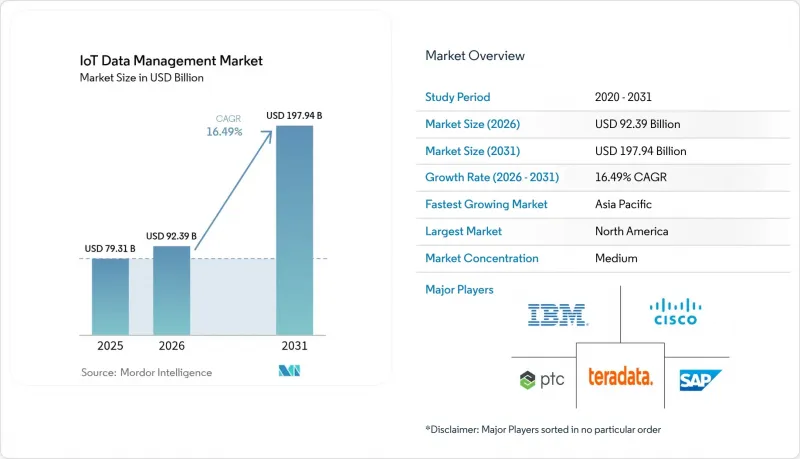
This report is Segmented by Solution (Integration, Migration, Analytics, and More), Deployment Model (Cloud, On-Premise, Hybrid), Data Type (Structured, Semi-Structured, Unstructured, Time-Series), End-User Industry (Agriculture, BFSI, and More), Application (Predictive Maintenance, Smart Metering, Smart Grid Analytics, and More), and Geography. The Market Forecasts are Provided in Terms of Value (USD).
Global IoT Data Management Market Trends and Insights
Proliferation of Connected Devices Spurring Data Volumes
Industrial plants now deploy thousands of sensors per line, generating terabytes of telemetry that traditional data stores cannot absorb. Bosch shortened AI rollout cycles from months to weeks by automating data-pipeline orchestration, underscoring the scale challenges of sensor growth. Healthcare sees a similar surge as remote patient monitors stream continuous biometrics, needing HIPAA-compliant, low-latency storage. Velocity and variety pressures are pushing enterprises toward stream-first, time-series-native architectures that synchronize edge and cloud data in sub-second windows.
Cloud-Native Data Lakes and Analytics Maturity
Containerized and serverless data-lake patterns auto-scale with ingestion peaks, dissolving prior capacity-planning bottlenecks. Snowflake's Openflow release in June 2025 illustrates friction-free cross-cloud data mobility that accelerates AI prototyping. Built-in ML pipelines now run directly inside lake environments, avoiding costly ETL steps and strengthening governance via lineage, encryption, and granular permissions.
Fragmented Standards and Interoperability Gaps
Divergent protocols force businesses to build custom middleware that inflates maintenance costs and slows rollouts. Legacy industrial gear exacerbates complexity by requiring translation layers to talk to modern IoT platforms. Proprietary data models heighten vendor lock-in, burdening teams with parallel catalogs and lineage trackers that sap productivity and elevate risk.
Other drivers and restraints analyzed in the detailed report include:
- Regulatory Push for Data Governance and Security
- Real-Time Edge Analytics for Operational Efficiency
- High Total Cost of Ownership for End-to-End Stacks
For complete list of drivers and restraints, kindly check the Table Of Contents.
Segment Analysis
Analytics held a 36.42% revenue lead in 2025 as enterprises pivoted from raw-data capture to actionable insight generation within the IoT data management market. The need to visualize anomalies, optimize asset utilization, and feed predictive algorithms propelled analytics adoption alongside integrated dashboards that democratize insights for frontline staff.
Stream processing is slated for a 16.86% CAGR, reflecting a decisive transition to continuous decision loops in manufacturing, healthcare, and mobility. Teradata's integrated enterprise vector store debuted in March 2025 to power AI-ready workloads that unify traditional analytics and generative models. Security, metadata management, and time-series-optimized storage deepen platform stickiness, positioning full-stack suites as default enterprise choices.
Cloud retained a commanding 70.35% share in 2025 thanks to limitless scalability and opex-friendly pricing, delivering elastic compute for AI-intensive workloads across the IoT data management market. Yet hybrid configurations will post a 17.12% CAGR as data-sovereignty rules and latency-sensitive use cases keep select workloads on-premises.
Organizations increasingly process high-frequency data at the edge, forwarding aggregated analytics to cloud lakes for enterprise reporting. Hitachi Vantara's EverFlex with Cisco Powered Hybrid Cloud showcases on-demand infrastructure ranging from IaaS to Containers-as-a-Service, bundled under flexible subscriptions. The convergence of edge orchestration and centralized governance unlocks new deployment patterns that align cost, compliance, and performance goals.
Complete Report Scope:
- By Solution
- Integration
- Migration
- Analytics
- Storage
- Security
- Visualization and Dashboards
- Metadata Management
- Stream Processing
- By Deployment Model
- Cloud
- On-Premise
- Hybrid
- By Data Type
- Structured
- Semi-Structured
- Unstructured
- Time-Series
- By End-User Industry
- Automotive and Transportation
- Healthcare and Life Sciences
- Government and Smart Cities
- Manufacturing and Industrial
- Energy and Utilities
- Retail and E-commerce
- Agriculture
- BFSI
- Others
- By Application
- Predictive Maintenance
- Asset Tracking and Fleet Management
- Smart Metering
- Supply-Chain Visibility
- Remote Patient Monitoring
- Smart Grid Analytics
- By Geography
- North America
- United States
- Canada
- Mexico
- South America
- Brazil
- Argentina
- Rest of South America
- Europe
- Germany
- United Kingdom
- France
- Italy
- Spain
- Russia
- Rest of Europe
- Asia Pacific
- China
- Japan
- India
- South Korea
- Rest of Asia Pacific
- Middle East and Africa
- Middle East
- Saudi Arabia
- United Arab Emirates
- Turkey
- Rest of Middle East
- Africa
- South Africa
- Nigeria
- Rest of Africa
- Middle East
- North America
Geography Analysis
North America generated 40.55% of 2025 revenue, anchored by hyperscaler ecosystems, abundant data-science talent, and regulatory clarity that speeds enterprise adoption. Ongoing 5G and edge rollouts support sub-second processing needs in smart-factory and telehealth programs. AWS signaled healthy momentum with robust Q1 2025 cloud revenue.
Asia Pacific will pace global growth at an 17.56% CAGR to 2031 as China's industrial-IoT drive and India's smart-city spend enlarge addressable volumes. Huawei's AI Data Lake and 5.5G network solutions reveal regional commitment to low-latency, AI-centric infrastructure. Rising Southeast-Asian deployments in logistics and agriculture further broaden demand.
Europe sustains measured expansion through Industry 4.0 and stringent privacy rules that necessitate localized processing. Germany's automotive lines, the UK's digital-health pilots, and Nordic smart-grid projects exemplify high-value, compliance-first engagements within the IoT data management market. Meanwhile, Latin America and Middle East & Africa remain early-stage, yet infrastructure programs and urbanization create long-run upside for vendors offering turnkey, cost-efficient solutions.
- Amazon Web Services (AWS)
- Microsoft Corp. (Azure)
- IBM Corp.
- SAP SE
- Cisco Systems Inc.
- Oracle Corp.
- Google Cloud Platform
- PTC Inc.
- Teradata Corp.
- Hewlett Packard Enterprise
- SAS Institute Inc.
- Fujitsu Ltd.
- Cloudera Inc.
- Snowflake Inc.
- Databricks Inc.
- Hitachi Vantara LLC
- Huawei Technologies Co. Ltd.
- Bosch.IO GmbH
- MongoDB Inc.
- Software AG
Additional Benefits:
- The market estimate (ME) sheet in Excel format
- 3 months of analyst support
TABLE OF CONTENTS
1 Introduction
- 1.1 Study Assumptions and Market Definition
- 1.2 Scope of the Study
2 Research Methodology
3 Executive Summary
4 Market Landscape
- 4.1 Market Overview
- 4.2 Market Drivers
- 4.2.1 Proliferation of connected devices spurring data volumes
- 4.2.2 Cloud-native data lakes and analytics maturity
- 4.2.3 Regulatory push for data governance and security
- 4.2.4 Real-time edge analytics for operational efficiency
- 4.2.5 5G network-slicing enabling prioritised IoT data streams
- 4.2.6 Emergence of data-marketplaces monetising sensor data
- 4.3 Market Restraints
- 4.3.1 Fragmented standards and interoperability gaps
- 4.3.2 High total cost of ownership for end-to-end stacks
- 4.3.3 Sustainability concerns over energy footprint
- 4.3.4 Data-sovereignty regulations restricting cross-border flows
- 4.4 Value / Supply-Chain Analysis
- 4.5 Regulatory Landscape
- 4.6 Technological Outlook
- 4.7 Porter's Five Forces Analysis
- 4.7.1 Threat of New Entrants
- 4.7.2 Bargaining Power of Buyers
- 4.7.3 Bargaining Power of Suppliers
- 4.7.4 Threat of Substitutes
- 4.7.5 Intensity of Competitive Rivalry
- 4.8 Investment Analysis
5 Market Size and Growth Forecasts (Value, 2021-2030)
- 5.1 By Solution
- 5.1.1 Integration
- 5.1.2 Migration
- 5.1.3 Analytics
- 5.1.4 Storage
- 5.1.5 Security
- 5.1.6 Visualization and Dashboards
- 5.1.7 Metadata Management
- 5.1.8 Stream Processing
- 5.2 By Deployment Model
- 5.2.1 Cloud
- 5.2.2 On-Premise
- 5.2.3 Hybrid
- 5.3 By Data Type
- 5.3.1 Structured
- 5.3.2 Semi-Structured
- 5.3.3 Unstructured
- 5.3.4 Time-Series
- 5.4 By End-User Industry
- 5.4.1 Automotive and Transportation
- 5.4.2 Healthcare and Life Sciences
- 5.4.3 Government and Smart Cities
- 5.4.4 Manufacturing and Industrial
- 5.4.5 Energy and Utilities
- 5.4.6 Retail and E-commerce
- 5.4.7 Agriculture
- 5.4.8 BFSI
- 5.4.9 Others
- 5.5 By Application
- 5.5.1 Predictive Maintenance
- 5.5.2 Asset Tracking and Fleet Management
- 5.5.3 Smart Metering
- 5.5.4 Supply-Chain Visibility
- 5.5.5 Remote Patient Monitoring
- 5.5.6 Smart Grid Analytics
- 5.6 By Geography
- 5.6.1 North America
- 5.6.1.1 United States
- 5.6.1.2 Canada
- 5.6.1.3 Mexico
- 5.6.2 South America
- 5.6.2.1 Brazil
- 5.6.2.2 Argentina
- 5.6.2.3 Rest of South America
- 5.6.3 Europe
- 5.6.3.1 Germany
- 5.6.3.2 United Kingdom
- 5.6.3.3 France
- 5.6.3.4 Italy
- 5.6.3.5 Spain
- 5.6.3.6 Russia
- 5.6.3.7 Rest of Europe
- 5.6.4 Asia Pacific
- 5.6.4.1 China
- 5.6.4.2 Japan
- 5.6.4.3 India
- 5.6.4.4 South Korea
- 5.6.4.5 Rest of Asia Pacific
- 5.6.5 Middle East and Africa
- 5.6.5.1 Middle East
- 5.6.5.1.1 Saudi Arabia
- 5.6.5.1.2 United Arab Emirates
- 5.6.5.1.3 Turkey
- 5.6.5.1.4 Rest of Middle East
- 5.6.5.2 Africa
- 5.6.5.2.1 South Africa
- 5.6.5.2.2 Nigeria
- 5.6.5.2.3 Rest of Africa
- 5.6.5.1 Middle East
- 5.6.1 North America
6 Competitive Landscape
- 6.1 Market Concentration
- 6.2 Strategic Moves
- 6.3 Market Share Analysis
- 6.4 Company Profiles (includes Global level Overview, Market level overview, Core Segments, Financials as available, Strategic Information, Market Rank/Share, Products and Services, Recent Developments)
- 6.4.1 Amazon Web Services (AWS)
- 6.4.2 Microsoft Corp. (Azure)
- 6.4.3 IBM Corp.
- 6.4.4 SAP SE
- 6.4.5 Cisco Systems Inc.
- 6.4.6 Oracle Corp.
- 6.4.7 Google Cloud Platform
- 6.4.8 PTC Inc.
- 6.4.9 Teradata Corp.
- 6.4.10 Hewlett Packard Enterprise
- 6.4.11 SAS Institute Inc.
- 6.4.12 Fujitsu Ltd.
- 6.4.13 Cloudera Inc.
- 6.4.14 Snowflake Inc.
- 6.4.15 Databricks Inc.
- 6.4.16 Hitachi Vantara LLC
- 6.4.17 Huawei Technologies Co. Ltd.
- 6.4.18 Bosch.IO GmbH
- 6.4.19 MongoDB Inc.
- 6.4.20 Software AG
7 Market Opportunities and Future Outlook
- 7.1 White-space and Unmet-need Assessment

