PUBLISHER: Mordor Intelligence | PRODUCT CODE: 2114263

PUBLISHER: Mordor Intelligence | PRODUCT CODE: 2114263
Asia-Pacific Weight Management Supplement - Market Share Analysis, Industry Trends & Statistics, Growth Forecasts (2026 - 2031)
According to Mordor Intelligence, Asia-Pacific weight management supplement market size in 2026 is estimated at USD 3.27 billion, growing from 2025 value of USD 3.01 billion with 2031 projections showing USD 4.97 billion, growing at 8.71% CAGR over 2026-2031.
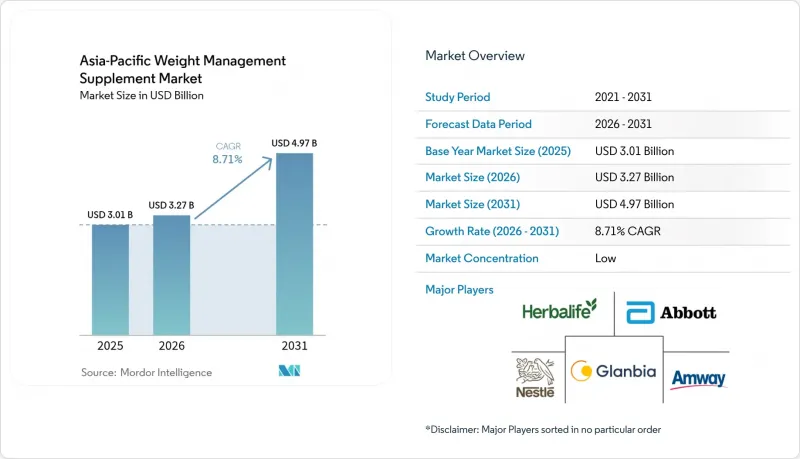
This report is Segmented by Product Type (Vitamins and Minerals, Botanicals, and More), Form (Powders, Tablets/Capsules, and More), Distribution Channel (Supermarkets/Hypermarkets, Online Retail Stores, and More), and Country (China, India, Japan, South Korea, Australia, and More). The Market Forecasts are Provided in Terms of Value (USD).
Asia-Pacific Weight Management Supplement Market Trends and Insights
Rising obesity rates and lifestyle-related health issues
The increasing prevalence of obesity and lifestyle-related health issues across the Asia-Pacific region is driving the growing demand for weight management supplements. These supplements are gaining popularity among both younger and older adults as more people face challenges in maintaining a healthy weight. In India, for instance, approximately 23% of men and 24% of women were classified as overweight or obese in 2023, with urban areas showing even higher rates, according to the Business Group on Health. Consumers are increasingly seeking easy-to-use, non-stigmatizing solutions that can seamlessly integrate into their daily routines. Non-prescription weight management supplements are gaining popularity as they offer a practical and accessible option. Major companies, such as Abbott Laboratories, Herbalife Nutrition Ltd., and Nestle Health Science, are leading the market by providing products designed for appetite control, metabolic support, and balanced nutrition.
Higher prevalence of meal skipping and irregular eating habits
Skipping meals and irregular eating habits are becoming more common across the Asia-Pacific region, leading to a growing dependence on weight management supplements. In India, a study published in January 2025 by the Journal of Medicinal and Pharmaceutical Chemistry Research revealed that 71.4% of employees regularly skip breakfast, with many doing so daily or every other day. This trend highlights how busy work schedules and fast-paced urban lifestyles disrupt regular eating patterns. As a result, there is an increasing demand for weight management solutions, such as vitamin supplements that promote satiety, metabolism-boosting capsules, and appetite-control products. These supplements help prevent overeating later in the day and provide consistent energy levels throughout the day. Their portability and ease of use make them a practical choice for individuals with hectic routines, allowing them to gradually integrate them into their daily lives as a convenient and effective solution for managing weight.
Competition from traditional herbal remedies and home treatments
Traditional herbal remedies and home treatments continue to pose significant competition to branded weight management supplements in the Asia-Pacific region. In India, the reliance on traditional options remains widespread. According to a June 2024 Press Information Bureau report, around 85% of rural households and 86% of urban households had at least one member familiar with medicinal plants, home remedies, or local health traditions. This strong cultural connection drives the continued use of Ayurvedic products, such as Triphala in India, lotus-leaf-based blends in China, and Jamu turmeric tonics in Indonesia. These traditional remedies are often viewed as cost-effective, easily accessible, and reliable, making them a preferred choice for many consumers. Their deep-rooted presence in the region's culture and healthcare practices creates a significant challenge for the adoption of modern, branded supplements.
Other drivers and restraints analyzed in the detailed report include:
- Popularity of K-beauty and K-wellness trends
- Growing awareness of health, fitness, and body image
- Increasing awareness of side effects linked to thermogenic stimulants
For complete list of drivers and restraints, kindly check the Table Of Contents.
Segment Analysis
Vitamins and minerals accounted for 35.02% of the Asia-Pacific weight management supplement market in 2025, demonstrating their strong appeal as a trusted and straightforward option for consumers. Multivitamin products are widely used to fill nutrient gaps caused by missed meals, strict diets, or busy schedules. Their adaptability makes them suitable for all age groups, ensuring they remain a regular part of daily health practices. This steady demand has helped the segment maintain its dominant position in the regional market.
Amino-acid-based supplements are projected to grow at a notable 10.16% CAGR from 2026 to 2031, driven by the rising preference for safer, non-stimulant options. Ingredients such as carnitine and conjugated linoleic acid are particularly popular among consumers seeking metabolic support without the side effects associated with high-caffeine products. The growing interest in gym workouts and home fitness routines has increased demand for these supplements, as they support goals such as improving physical performance and enhancing fat metabolism. This trend positions the amino-acid segment to grow faster than traditional categories, reshaping the market landscape in the region.
Complete Report Scope:
- By Product Type
- Vitamins and Minerals
- Botanicals
- Amino Acids
- Others
- By Form
- Powders
- Tablets/Capsules
- Gummies
- Others
- By Distribution Channel
- Supermarkets/Hypermarkets
- Health and Wellness Stores
- Online Retail Stores
- Other Channels
- By Country
- China
- India
- Japan
- South Korea
- Australia
- Indonesia
- Thailand
- Vietnam
- Philippines
- Malaysia
- Singapore
- New Zealand
- Rest of Asia-Pacific
List of Companies Covered in this Report:
- Abbott Laboratories
- Herbalife Nutrition Ltd.
- Nestle SA
- Amway Corp
- Glanbia PLC
- Apkavit Lifesciences
- Pharmacare Laboratories Australia
- Lifecare Nutritions
- Otsuka Pharmaceutical Co.
- FANCL Corporation
- Cipla
- Adret Retail Private Limited (Kapiva)
- Evlution Nutrition
- Nutra Holdings
- Arcadia Consumer Healthcare
- GST corporation
- Fullife Healthcare Pvt Ltd
- Bright LifeCare Pvt. Ltd. (MuscleBlaze)
- Himalaya Wellness
- Shaklee Corporation
Additional Benefits:
- The market estimate (ME) sheet in Excel format
- 3 months of analyst support
TABLE OF CONTENTS
1 INTRODUCTION
- 1.1 Study Assumptions and Market Definition
- 1.2 Scope of the Study
2 RESEARCH METHODOLOGY
3 EXECUTIVE SUMMARY
4 MARKET LANDSCAPE
- 4.1 Market Overview
- 4.2 Market Drivers
- 4.2.1 Rising obesity rates and lifestyle-related health issues
- 4.2.2 Growing awareness of health, fitness, and body image
- 4.2.3 Popularity of K-beauty and K-wellness trends
- 4.2.4 Higher prevalence of meal skipping and irregular eating habits
- 4.2.5 Expanding influence of celebrity endorsements and fitness influencers
- 4.2.6 Rising demand for gluten-free, sugar-free, and low-calorie formulations
- 4.3 Market Restraints
- 4.3.1 Competition from traditional herbal remedies and home treatments
- 4.3.2 Increasing awareness of side effects associated with thermogenic and stimulant-based supplements
- 4.3.3 Growing scrutiny from health authorities on unverified claims
- 4.3.4 Inconsistent labelling practices and lack of transparency on ingredient origins
- 4.4 Regulatory Outlook
- 4.5 Supply Chain Analysis
- 4.6 Porter's Five Forces
- 4.6.1 Threat of New Entrants
- 4.6.2 Bargaining Power of Buyers
- 4.6.3 Bargaining Power of Suppliers
- 4.6.4 Threat of Substitute Products
- 4.6.5 Intensity of Competitive Rivalry
5 MARKET SIZE AND GROWTH FORECASTS (VALUE)
- 5.1 By Product Type
- 5.1.1 Vitamins and Minerals
- 5.1.2 Botanicals
- 5.1.3 Amino Acids
- 5.1.4 Others
- 5.2 By Form
- 5.2.1 Powders
- 5.2.2 Tablets/Capsules
- 5.2.3 Gummies
- 5.2.4 Others
- 5.3 By Distribution Channel
- 5.3.1 Supermarkets/Hypermarkets
- 5.3.2 Health and Wellness Stores
- 5.3.3 Online Retail Stores
- 5.3.4 Other Channels
- 5.4 By Country
- 5.4.1 China
- 5.4.2 India
- 5.4.3 Japan
- 5.4.4 South Korea
- 5.4.5 Australia
- 5.4.6 Indonesia
- 5.4.7 Thailand
- 5.4.8 Vietnam
- 5.4.9 Philippines
- 5.4.10 Malaysia
- 5.4.11 Singapore
- 5.4.12 New Zealand
- 5.4.13 Rest of Asia-Pacific
6 COMPETITIVE LANDSCAPE
- 6.1 Market Concentration
- 6.2 Strategic Moves
- 6.3 Market Positioning Analysis
- 6.4 Company Profiles (includes Global-level Overview, Market-level Overview, Core Segments, Financials (if available), Strategic Information, Market Rank/Share, Products and Services, Recent Developments)
- 6.4.1 Abbott Laboratories
- 6.4.2 Herbalife Nutrition Ltd.
- 6.4.3 Nestle SA
- 6.4.4 Amway Corp
- 6.4.5 Glanbia PLC
- 6.4.6 Apkavit Lifesciences
- 6.4.7 Pharmacare Laboratories Australia
- 6.4.8 Lifecare Nutritions
- 6.4.9 Otsuka Pharmaceutical Co.
- 6.4.10 FANCL Corporation
- 6.4.11 Cipla
- 6.4.12 Adret Retail Private Limited (Kapiva)
- 6.4.13 Evlution Nutrition
- 6.4.14 Nutra Holdings
- 6.4.15 Arcadia Consumer Healthcare
- 6.4.16 GST corporation
- 6.4.17 Fullife Healthcare Pvt Ltd
- 6.4.18 Bright LifeCare Pvt. Ltd. (MuscleBlaze)
- 6.4.19 Himalaya Wellness
- 6.4.20 Shaklee Corporation
7 MARKET OPPORTUNITIES AND FUTURE OUTLOOK

