PUBLISHER: Mordor Intelligence | PRODUCT CODE: 2114265

PUBLISHER: Mordor Intelligence | PRODUCT CODE: 2114265
Premium Alcoholic Beverages - Market Share Analysis, Industry Trends & Statistics, Growth Forecasts (2026 - 2031)
According to Mordor Intelligence, the premium alcoholic beverages market size is expected to grow from USD 782.11 billion in 2025 to USD 814.72 billion in 2026 and is forecast to reach USD 999.35 billion by 2031 at 4.17% CAGR over 2026-2031.
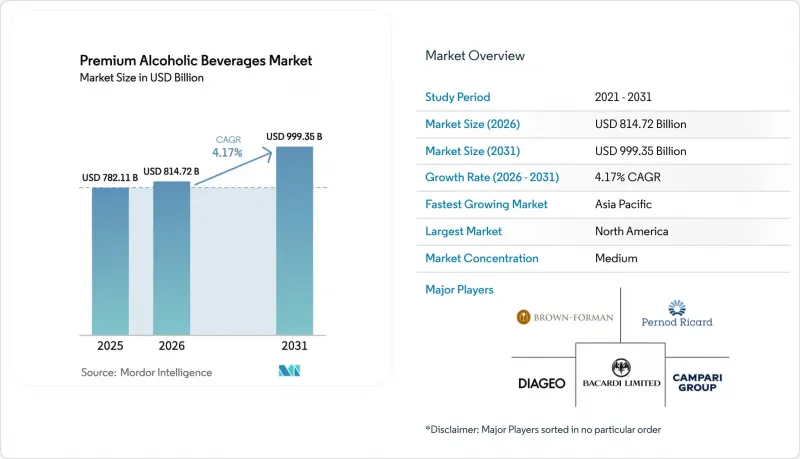
This report is Segmented by Product Type (Beer, Wine, and Spirits), End User (Male and Female), Packaging (Glass Bottles, Cans, and Others), Distribution Channel (On-Trade, and Off-Trade), and Geography (North America, Europe, Asia-Pacific, South America, and the Middle East and Africa). The Market Forecasts are Provided in Terms of Value (USD) and Volume.
Global Premium Alcoholic Beverages Market Trends and Insights
Growing popularity of craft beers, artisanal spirits, and flavored innovations like cbd-infused options
Craft breweries and micro-distilleries are redefining consumer expectations with small-batch production, local ingredients, and unique flavors that large-scale brands struggle to replicate. In 2024, the United States had 9,796 craft breweries, contributing over 13% of total beer volume, according to the Brewers Association. Artisanal spirits, such as botanical gin, whiskey aged in unique casks, and tequila finished in wine barrels, command 20-40% price premiums, enabling profitability with lower production volumes. CBD-infused alcoholic beverages face delays due to regulatory hurdles, as the U.S. Alcohol and Tobacco Tax and Trade Bureau requires individual approval for hemp-derived CBD in alcohol. However, niche producers in permissive states are building brand equity ahead of potential federal harmonization. Additionally, innovations like adaptogenic herbs, nootropics, and fermented botanicals are attracting wellness-focused consumers, blending indulgence with functional benefits and blurring the line between alcoholic beverages and nutraceuticals.
Mixology trends and cocktail culture drive premium spirit consumption in upscale bars
Craft cocktail bars and speakeasy-style venues have elevated spirits from basic commodities to premium culinary ingredients, with bartenders playing a key role as brand ambassadors who educate consumers about terroir, distillation techniques, and flavor pairings. This premiumization trend is self-reinforcing, as higher check averages encourage venues to stock rare bottles, attracting enthusiasts willing to travel for exclusive tastings and boosting off-premise sales. Agave-based spirits, particularly tequila, highlight this dynamic, with U.S. imports reaching approximately 70.7 million proof gallons in 2024 and premium and ultra-premium segments growing significantly faster than mixto categories. The revival of cocktail culture has also driven renewed demand for bitters, vermouths, and liqueurs, enabling niche producers to thrive without direct competition from multinational portfolios. On-premise consumption serves as a discovery channel, where consumers try new brands in bars and later purchase them in retail. E-commerce platforms are replicating this pathway through virtual tastings and subscription boxes, further enhancing brand discovery and consumer engagement.
Counterfeiting risks undermine brand trust and authenticity in luxury segments
In 2024, counterfeit premium spirits and wines continue to erode brand equity and pose health risks, with fatalities reported in India and Southeast Asia due to fake bottles containing methanol or industrial alcohol. Luxury scotch and rare Japanese whisky are frequent targets, with Sotheby's estimating 5-10% of auction submissions as counterfeit or mislabeled. To combat this, Sotheby's introduced blockchain-based provenance tracking and tamper-evident closures, while Diageo deployed NFC-enabled labels on select ultra-premium products, allowing smartphone-based authenticity checks. However, adoption remains limited due to high costs exceeding USD 0.50 per unit. The Asia-Pacific region faces acute counterfeiting issues due to weak intellectual property enforcement and fragmented distribution networks, enabling gray-market operators to infiltrate supply chains. Beyond lost sales, brands risk liability for harm caused by counterfeit products and face long-term reputational damage.
Other drivers and restraints analyzed in the detailed report include:
- Sustainable sourcing and eco-friendly packaging meet wellness demands
- E-commerce expands access to rare and aged beverages
- Intense competition from craft distilleries and standard alcohols
For complete list of drivers and restraints, kindly check the Table Of Contents.
Segment Analysis
In 2025, spirits seized a commanding 52.39% of the market share, buoyed by a trend towards premiumization in whiskey, tequila, and gin. Consumers are increasingly opting for aged expressions and craft-distilled offerings that highlight their unique terroir and production methods. Diageo's tequila portfolio, led by Don Julio and Casamigos, saw an 8% volume surge in FY2024. Meanwhile, scotch enjoyed a 3% uptick, outpacing flat trends in the broader category, a testament to effective premiumization strategies. The spirits segment boasts higher margins, averaging 60-70% gross profit per liter for premium spirits, compared to 40-50% for beer, and a longer shelf life. This longevity allows producers to navigate demand fluctuations without the risk of spoilage. Regulatory measures, like the U.S. Craft Beverage Modernization Act, which slashed federal excise taxes for small distillers, have eased entry barriers and spurred a surge in craft distilleries.
Wine is set to outpace all product types with a projected 5.52% CAGR growth from 2026 to 2031. This momentum is driven by organic and biodynamic viticulture, which commands a 25-40% retail premium. Consumers increasingly link regenerative agriculture with enhanced taste and health benefits. Treasury Wine Estates highlighted this trend, noting its luxury portfolio, led by Penfolds, accounted for 48% of total revenue in FY2024, despite making up just 12% of the volume. This underscores the lucrative margin potential in premium wine. While beer may not be the fastest-growing segment, it remains a cornerstone of on-premise consumption. Craft breweries have evolved into experiential venues, bolstering brand loyalty and driving additional revenue through taproom sales.
In 2025, male consumers represented 53.45% of the market volume, a trend consistent with historical patterns and a higher per-capita intake. However, this male dominance is waning as producers craft offerings that cater to female tastes. In 2024, Brown-Forman's Woodford Reserve Bourbon introduced a lower-proof variant, targeting female consumers with a preference for smoother flavors. This move highlights a nuanced understanding of gender-based taste differences, steering clear of cliched packaging. Meanwhile, products aimed at men continue to spotlight heritage, craftsmanship, and robust flavors. Aged whiskeys and barrel-strength spirits, in particular, have garnered a loyal following among enthusiasts who treat collecting as a cherished hobby.
From 2026 to 2031, premium offerings tailored for women are projected to grow at a 4.89% CAGR, outpacing all other segments. This surge is largely fueled by ready-to-drink (RTD) cocktails, botanical-infused spirits, and low-calorie wines, all of which resonate with contemporary wellness trends. Constellation Brands' Fresca Mixed line, boasting just 100 calories per serving and a focus on natural ingredients, swiftly captured 2.3% of the RTD market within half a year of its 2024 debut. Furthermore, the female demographic is championing transparency in product ingredients. Brands that openly share comprehensive ingredient lists and nutritional data are seeing better performance than those that opt for ambiguous "natural flavors" labels. This push for clarity is prompting many in the industry to reformulate their products. In a bid to resonate with this evolving demographic, producers are increasingly bringing female master distillers and winemakers on board, not just for diverse product development but also to underscore authenticity and representation.
Complete Report Scope:
- Product Type
- Beer
- Wine
- Spirits
- End User
- Male
- Female
- Packaging
- Glass Bottles
- Cans
- Others
- Distribution Channel
- On-trade
- Off-trade
- Supermarkets/Hypermarkets
- Online Retail Store
- Specialty Stores
- Other Off-trade Distribution Channels
- Geography
- North America
- United States
- Canada
- Mexico
- Rest of North America
- Europe
- Germany
- United Kingdom
- Italy
- France
- Spain
- Netherlands
- Poland
- Belgium
- Sweden
- Rest of Europe
- Asia-Pacific
- China
- India
- Japan
- Australia
- Indonesia
- South Korea
- Thailand
- Singapore
- Rest of Asia-Pacific
- South America
- Brazil
- Argentina
- Colombia
- Chile
- Peru
- Rest of South America
- Middle East and Africa
- South Africa
- Saudi Arabia
- United Arab Emirates
- Nigeria
- Egypt
- Morocco
- Turkey
- Rest of Middle East and Africa
- North America
Geography Analysis
In 2025, North America captured 36.87% of the market share, driven by the rapid growth of craft distilleries, increasing exports of agave-based spirits from Mexico, and the rising demand for premium products in the U.S. and Canada. The U.S. craft spirits market included 2,687 distilleries in 2024, generating over USD 7.8 billion in revenue, as consumers increasingly preferred locally produced and exclusive offerings. Mexican tequila and mezcal exports reached 35 million 9-liter cases, with premium categories growing faster due to the influence of celebrity endorsements and the growing popularity of mixology. Additionally, regulatory support, such as the U.S. Craft Beverage Modernization Act and relaxed state shipping laws, played a significant role in boosting the market.
Asia-Pacific is projected to grow at a 6.13% CAGR from 2026 to 2031, leading global market expansion. This growth is driven by the rising demand for Japanese whisky, the internationalization of Chinese baijiu, and the increasing popularity of Indian single malts. Japanese whisky achieved record export levels, while Chinese baijiu producers partnered with luxury venues to position baijiu as a premium spirit. Despite fragmented regulations, governments across the region are easing restrictions to promote alcohol exports and support the market's growth.
Europe, renowned for its historic wine regions and scotch whisky heritage, is experiencing slower growth due to market saturation and regulatory challenges, such as the EU's 2025/40 Packaging Regulation. However, craft distilleries in countries like Germany, the Netherlands, and Poland are disrupting traditional brands with innovative offerings. In 2024, alcohol duty reforms in the United Kingdom provided much-needed support to smaller producers, enabling them to compete more effectively. South America is witnessing a shift toward premiumization in wine and cachaca, driven by the adoption of geographic indications and organic certifications. Meanwhile, in the Middle East and Africa, demand for imported spirits and wines is rising in tourism hubs like Dubai and South Africa. Luxury hotels in these regions are catering to affluent travelers, further driving market growth.
- Diageo PLC
- Heineken Holdings N.V.
- Edward Snell And Company (pty) Ltd
- Pernod Ricard
- Anheuser-busch Inbev SA/NV
- Suntory Holdings Limited
- Brown Forman Corporation
- Refriango LDA
- Delta Corporation Limited
- Molson Coors Beverage Company
- Carlsberg AS
- Treasury Wine Estates
- Remy Cointreau SA
- Beam Suntory
- Kweichow Moutai
- Wuliangye Yibin
- Asahi Group Holdings
- William Grant & Sons
- The Edrington Group
- Tito's (Fifth Generation Inc.)
- Thai Beverage PLC
Additional Benefits:
- The market estimate (ME) sheet in Excel format
- 3 months of analyst support
TABLE OF CONTENTS
1 INTRODUCTION
- 1.1 Study Assumptions and Market Definition
- 1.2 Scope of the Study
2 RESEARCH METHODOLOGY
3 EXECUTIVE SUMMARY
4 MARKET LANDSCAPE
- 4.1 Market Overview
- 4.2 Market Drivers
- 4.2.1 Growing popularity of craft beers, artisanal spirits, and flavored innovations like CBD-infused options
- 4.2.2 Mixology trends and cocktail culture drive premium spirit consumption in upscale bars
- 4.2.3 Sustainable sourcing and eco-friendly packaging meet wellness demands
- 4.2.4 E-commerce expands access to rare and aged beverages
- 4.2.5 Low-calorie and RTD premium cocktails cater to moderate consumption
- 4.2.6 Surge in on-trade channels like brewpubs, taprooms, and luxury hospitality venues fueling premium sales
- 4.3 Market Restraints
- 4.3.1 Counterfeiting risks undermine brand trust and authenticity in luxury segments
- 4.3.2 Intense competition from craft distilleries and standard alcohols
- 4.3.3 Fluctuations in raw material availability
- 4.3.4 Rising popularity of non-alcoholic and moderation movements
- 4.4 Supply Chain Analysis
- 4.5 Regulatory Landscape
- 4.6 Technological Outlook
- 4.7 Porter's Five Forces Analysis
- 4.7.1 Threat of New Entrants
- 4.7.2 Bargaining Power of Buyers
- 4.7.3 Bargaining Power of Suppliers
- 4.7.4 Threat of Substitutes
- 4.7.5 Intensity of Competitive Rivalry
5 MARKET SIZE AND GROWTH FORECASTS (VALUE AND VOLUME)
- 5.1 Product Type
- 5.1.1 Beer
- 5.1.2 Wine
- 5.1.3 Spirits
- 5.2 End User
- 5.2.1 Male
- 5.2.2 Female
- 5.3 Packaging
- 5.3.1 Glass Bottles
- 5.3.2 Cans
- 5.3.3 Others
- 5.4 Distribution Channel
- 5.4.1 On-trade
- 5.4.2 Off-trade
- 5.4.2.1 Supermarkets/Hypermarkets
- 5.4.2.2 Online Retail Store
- 5.4.2.3 Specialty Stores
- 5.4.2.4 Other Off-trade Distribution Channels
- 5.5 Geography
- 5.5.1 North America
- 5.5.1.1 United States
- 5.5.1.2 Canada
- 5.5.1.3 Mexico
- 5.5.1.4 Rest of North America
- 5.5.2 Europe
- 5.5.2.1 Germany
- 5.5.2.2 United Kingdom
- 5.5.2.3 Italy
- 5.5.2.4 France
- 5.5.2.5 Spain
- 5.5.2.6 Netherlands
- 5.5.2.7 Poland
- 5.5.2.8 Belgium
- 5.5.2.9 Sweden
- 5.5.2.10 Rest of Europe
- 5.5.3 Asia-Pacific
- 5.5.3.1 China
- 5.5.3.2 India
- 5.5.3.3 Japan
- 5.5.3.4 Australia
- 5.5.3.5 Indonesia
- 5.5.3.6 South Korea
- 5.5.3.7 Thailand
- 5.5.3.8 Singapore
- 5.5.3.9 Rest of Asia-Pacific
- 5.5.4 South America
- 5.5.4.1 Brazil
- 5.5.4.2 Argentina
- 5.5.4.3 Colombia
- 5.5.4.4 Chile
- 5.5.4.5 Peru
- 5.5.4.6 Rest of South America
- 5.5.5 Middle East and Africa
- 5.5.5.1 South Africa
- 5.5.5.2 Saudi Arabia
- 5.5.5.3 United Arab Emirates
- 5.5.5.4 Nigeria
- 5.5.5.5 Egypt
- 5.5.5.6 Morocco
- 5.5.5.7 Turkey
- 5.5.5.8 Rest of Middle East and Africa
- 5.5.1 North America
6 COMPETITIVE LANDSCAPE
- 6.1 Market Concentration
- 6.2 Strategic Moves
- 6.3 Market Share Analysis
- 6.4 Company Profiles (includes Global level Overview, Market level overview, Core Segments, Financials as available, Strategic Information, Market Rank/Share for key companies, Products and Services, and Recent Developments)
- 6.4.1 Diageo PLC
- 6.4.2 Heineken Holdings N.V.
- 6.4.3 Edward Snell And Company (pty) Ltd
- 6.4.4 Pernod Ricard
- 6.4.5 Anheuser-busch Inbev SA/NV
- 6.4.6 Suntory Holdings Limited
- 6.4.7 Brown Forman Corporation
- 6.4.8 Refriango LDA
- 6.4.9 Delta Corporation Limited
- 6.4.10 Molson Coors Beverage Company
- 6.4.11 Carlsberg AS
- 6.4.12 Treasury Wine Estates
- 6.4.13 Remy Cointreau SA
- 6.4.14 Beam Suntory
- 6.4.15 Kweichow Moutai
- 6.4.16 Wuliangye Yibin
- 6.4.17 Asahi Group Holdings
- 6.4.18 William Grant & Sons
- 6.4.19 The Edrington Group
- 6.4.20 Tito's (Fifth Generation Inc.)
- 6.4.21 Thai Beverage PLC
7 MARKET OPPORTUNITIES AND FUTURE OUTLOOK

