PUBLISHER: Mordor Intelligence | PRODUCT CODE: 2114274

PUBLISHER: Mordor Intelligence | PRODUCT CODE: 2114274
Vietnam Agricultural Tractor - Market Share Analysis, Industry Trends & Statistics, Growth Forecasts (2026 - 2031)
According to Mordor Intelligence, the Vietnam agricultural tractor market size is expected to grow from USD 311.0 million in 2025 to USD 330.96 million in 2026 and is forecast to reach USD 451.78 million by 2031 at 6.42% CAGR over 2026-2031.
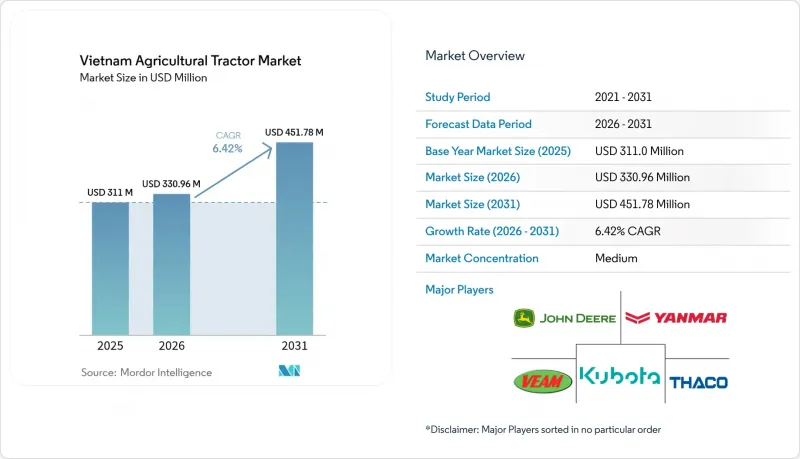
This report is Segmented by Engine Power (Less Than 15 HP, 15-30 HP, 31-45 HP, and More), by Drive Type (Two-Wheel Drive and Four-Wheel Drive), by Application (Row-Crop Farming and Orchard and Plantation), and by Propulsion Technology (Diesel, Hybrid, and Fully Electric). The Market Forecasts are Provided in Terms of Value (USD).
Vietnam Agricultural Tractor Market Trends and Insights
Rising Focus on Farm Mechanization
Labor migration to industrial centers is creating workforce gaps in agriculture, driving farms to adopt mechanization to maintain productivity. National development plans encourage a shift from manual labor, increasing the need for machinery across rural regions. In coastal areas, machinery services have become an income stream, helping farmers access equipment without ownership costs. Larger plot sizes in fertile regions like the Mekong Delta support mechanized farming adoption. Inspection centers ensure equipment meets safety standards, increasing confidence in machine use and supporting the transition to technology-driven agricultural practices.
Surge in Government Mechanization Subsidies
Government financial initiatives are increasing agricultural machinery adoption through low-interest loans and support for local equipment manufacturers. These subsidies lower farmers' financial burden and encourage investment in productivity-enhancing tools. The programs strengthen domestic parts suppliers, reducing import dependence and shortening delivery times. Performance-based funding ensures subsidized equipment improves crop yields and operational efficiency. This approach modernizes farming practices and strengthens the agricultural supply chain, supporting rural economic development.
Highly Fragmented Landholding Structure
Vietnam's agricultural sector is characterized by small, fragmented landholdings, which restrict farmers' ability to invest in machinery due to limited economies of scale. The small plot sizes make individual equipment ownership financially impractical. Land-service providers have emerged as intermediaries, offering shared machinery access. In mountainous areas, steep terrain increases operational costs and limits the use of large machinery. Despite government initiatives for land consolidation to improve mechanization potential, traditional social practices and inheritance laws impede progress, forcing farmers to rely on informal sharing arrangements and community-based solutions.
Other drivers and restraints analyzed in the detailed report include:
- Growth of Contract-farming Programs
- Expansion of High-value Crop Acreage
- Limited Rural Charging Infrastructure for E-tractors
For complete list of drivers and restraints, kindly check the Table Of Contents.
Segment Analysis
The 46-75 HP segment accounts for 40.62% of the 2025 Vietnam agricultural tractor market size, demonstrating its versatility across Vietnamese terrains. These mid-range agricultural tractors effectively handle plowing, harrowing, and transport tasks in rice paddies and upland fields. Their capacity to operate multi-row planters while navigating tight headlands makes them popular among farmers seeking balanced power and maneuverability. Compact 31- 45 HP units show the highest growth at 5.74% CAGR, driven by smaller farm sizes in regions like the Mekong Delta, where cost and agility are primary concerns.
Agricultural tractors under 15 HP maintain their presence in terraced northern plots, while units above 75 HP serve larger contract farms. The industry now incorporates GPS, ISOBUS compatibility, and telemetry in mid-power machines as standard features. These frames readily accommodate precision agriculture upgrades like variable-rate fertilization, and manufacturers focusing on 31-75 HP models for hybridization position themselves for increased volume and margins.
Four-wheel-drive tractors represent 57.48% of the Vietnam agricultural tractor market share in 2025, growing at a 6.43% CAGR. Their prevalence reflects the requirement for reliable traction in water-logged rice paddies and steep coffee estates. These machines reduce slippage, minimize soil compaction, and support heavier implements without stalling essential features in monsoon regions. Two-wheel-drive units remain viable in dry upland areas but decline as financing options improve four-wheel-drive accessibility.
Four-wheel-drive agricultural tractors record 18% more annual operating hours, improving investment returns. Electric variants face engineering challenges due to the increased power requirements of four-wheel systems. While intelligent torque vectoring manages power consumption, a reliable charging infrastructure remains crucial. Manufacturers now focus on power-train efficiency algorithms and traction optimization, competing on fuel or watt-hour consumption per hectare to meet data-driven farming needs.
Complete Report Scope:
- By Engine Power
- Less than 15 HP
- 15 - 30 HP
- 31- 45 HP
- 46 -75 HP
- Above 75 HP
- By Drive Type
- Two-wheel Drive (2WD)
- Four-wheel Drive (4WD)
- By Application
- Row-crop Farming
- Orchard and Plantation
- By Propulsion Technology
- Diesel
- Hybrid
- Fully Electric
List of Companies Covered in this Report:
- Kubota Corporation
- Yanmar Holdings Co., Ltd.
- Vietnam Engine & Agricultural Machinery Corp (VEAM)
- Iseki & Co., Ltd.
- Truong Hai Group Corporation (THACO)
- Deere & Company (TTC Bien Hoa)
- Mahindra & Mahindra Ltd.
- LS Group
- Zetor Tractors a.s. (HTC Investments)
- Zoomlion Heavy Industry Science and Technology Co., Ltd.
Additional Benefits:
- The market estimate (ME) sheet in Excel format
- 3 months of analyst support
TABLE OF CONTENTS
1 Introduction
- 1.1 Study Assumptions and Market Definition
- 1.2 Scope of the Study
2 Research Methodology
3 Executive Summary
4 Market Landscape
- 4.1 Market Overview
- 4.2 Market Drivers
- 4.2.1 Rising Focus on Farm Mechanization
- 4.2.2 Surge in Government Mechanization Subsidies
- 4.2.3 Growth of Contract-farming Programs
- 4.2.4 Expansion of High-value Crop Acreage
- 4.2.5 Growing Trade Support for Agricultural Goods
- 4.2.6 Emerging Low-interest Agribank Credit Lines
- 4.3 Market Restraints
- 4.3.1 Highly Fragmented Landholding Structure
- 4.3.2 Volatility in Farm Commodity Prices
- 4.3.3 Limited Rural Charging Infrastructure for E-tractors
- 4.3.4 Shortage of Skilled Farmers
- 4.4 Regulatory Landscape
- 4.5 Technological Outlook
- 4.6 Porter's Five Forces Analysis
- 4.6.1 Bargaining Power of Suppliers
- 4.6.2 Bargaining Power of Buyers
- 4.6.3 Threat of New Entrants
- 4.6.4 Threat of Substitute Products
- 4.6.5 Intensity of Competitive Rivalry
5 Market Size and Growth Forecasts (Value)
- 5.1 By Engine Power
- 5.1.1 Less than 15 HP
- 5.1.2 15 - 30 HP
- 5.1.3 31- 45 HP
- 5.1.4 46 -75 HP
- 5.1.5 Above 75 HP
- 5.2 By Drive Type
- 5.2.1 Two-wheel Drive (2WD)
- 5.2.2 Four-wheel Drive (4WD)
- 5.3 By Application
- 5.3.1 Row-crop Farming
- 5.3.2 Orchard and Plantation
- 5.4 By Propulsion Technology
- 5.4.1 Diesel
- 5.4.2 Hybrid
- 5.4.3 Fully Electric
6 Competitive Landscape
- 6.1 Market Concentration
- 6.2 Strategic Moves
- 6.3 Market Share Analysis
- 6.4 Company Profiles (Includes Global Level Overview, Market Level Overview, Core Segments, Financials as Available, Strategic Information, Market Rank/Share for Key Companies, Products and Services, and Recent Developments)
- 6.4.1 Kubota Corporation
- 6.4.2 Yanmar Holdings Co., Ltd.
- 6.4.3 Vietnam Engine & Agricultural Machinery Corp (VEAM)
- 6.4.4 Iseki & Co., Ltd.
- 6.4.5 Truong Hai Group Corporation (THACO)
- 6.4.6 Deere & Company (TTC Bien Hoa)
- 6.4.7 Mahindra & Mahindra Ltd.
- 6.4.8 LS Group
- 6.4.9 Zetor Tractors a.s. (HTC Investments)
- 6.4.10 Zoomlion Heavy Industry Science and Technology Co., Ltd.
7 Market Opportunities and Future Outlook

