PUBLISHER: Mordor Intelligence | PRODUCT CODE: 2114283

PUBLISHER: Mordor Intelligence | PRODUCT CODE: 2114283
Ball Clay - Market Share Analysis, Industry Trends & Statistics, Growth Forecasts (2026 - 2031)
According to Mordor Intelligence, the ball clay market size is estimated at USD 477.73 million in 2026, and is expected to reach USD 609.14 million by 2031, at a CAGR of 4.98% during the forecast period (2026-2031).
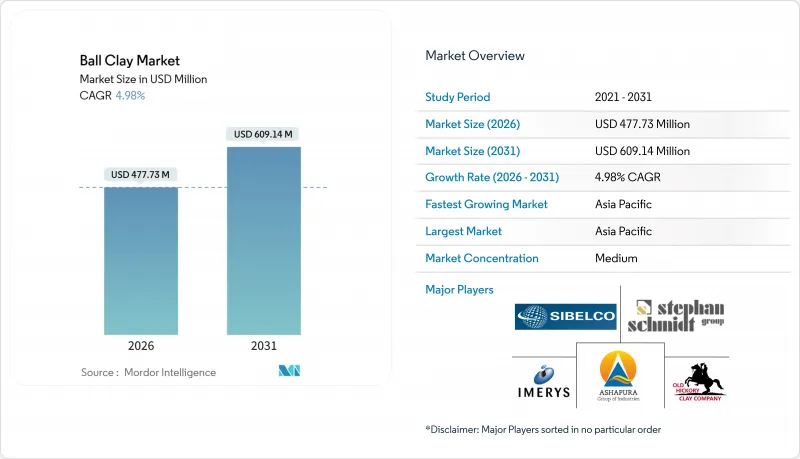
This report is Segmented by End-User Industry (Ceramic [Sanitary Ware, Wall and Floor Tiles, Tableware, Bricks, and Other Ceramics] and Non-Ceramic [Adhesives and Sealants, Rubbers and Plastics, Fertilizers and Insecticides, and Other Non-Ceramics]) and Geography (Asia-Pacific, North America, Europe, South America, and Middle-East and Africa). The Market Forecasts are Provided in Terms of Value (USD).
Global Ball Clay Market Trends and Insights
Surge in Sanitary-Ware Installations Across Asia-Pacific High-Rise Housing
As urbanization accelerates in China and India, the demand for sanitary ware has transitioned from mere replacements to initial installations. Developers are now equipping multi-story towers with vitreous china fixtures, which leverage the plasticity of ball clay for their thin-wall casting. India's ceramic tile industry is witnessing significant growth. Concurrently, the output of sanitary ware is on the rise, driven by building codes that mandate separate wet areas in apartments exceeding 600 square feet. Thailand's market for sanitary fixtures is largely dominated by key players, who collectively source substantial volumes of UK ball clay. Developers are now pre-ordering fixtures months prior to project handovers, securing their ball clay demand earlier in the construction timeline. Over half of the world's vitreous china sanitary ware is produced using UK ball clay. This specific clay, with its unique kaolinite-mica-quartz balance, allows for lower-water slip casting and boasts a firing shrinkage of under 8%. The region's affinity for thin, glossy white surfaces heightens the demand for premium, low-iron grades.
Expansion of Ceramic Tile Capacity in India and ASEAN
In 2023, India claimed the title of the world's lowest-cost tile producer, buoyed by a surge in activity at Morbi-based factories, which ramped up their utilization. Meanwhile, Vietnam, with its plants boasting significant capacity, managed to produce less than its potential in 2024. This shortfall presents a significant opportunity for increased ball clay orders, especially as exports begin to pick up. In Indonesia, producers face a challenge: logistics for raw materials. Imports from Australia and Malaysia inflate landed prices compared to locally sourced kaolin. Furthermore, rising kaolin costs are prompting formulators to pivot towards blended bodies. These blends incorporate lower-grade ball clay, but only where the whiteness tolerances permit. In a move underscoring the region's growing demand, Kajaria is constructing its eighth plant in Nepal, projecting an additional need for ball clay, further bolstering import demand across South Asia.
Availability of Substitutes (Kaolin, Synthetic Binders)
Low-plasticity products, including construction bricks and economy tiles, benefit from cost savings when using kaolin and synthetic binders. Between 2020 and 2024, Indian tile plants reduced their ball clay content, opting for locally sourced kaolin that costs less. China's vast kaolin reserves allow for compositions with a higher proportion of kaolin and a lower proportion of ball clay. While binders such as polyvinyl alcohol enhance green strength, they fall short of ball clay in firing-shrinkage predictability, restricting their use in vitreous ceramics. This limitation impacts the market growth rate.
Other drivers and restraints analyzed in the detailed report include:
- Rebound in North-American Residential Remodeling
- Tightening Specifications in European Union Food-Contact Tableware
- Environmental-Impact Permitting Delays at Open-Pit Mines
For complete list of drivers and restraints, kindly check the Table Of Contents.
Segment Analysis
Ceramic applications held 93.19% of the ball clay market share in 2025 and should mirror the overall 4.98% CAGR to 2031. Asia-Pacific's construction boom, particularly in high-rises, is driving the sanitaryware market, with vitreous china output now incorporating blends sourced from the UK. Wall and floor tiles dominate U.S. consumption, and large-format porcelain tiles are now requiring higher plasticity indices. In Europe, tableware is consolidating, influenced by stringent EU migration rules that favor premium, low-iron grades. As the industry shifts towards kaolin, bricks and other construction ceramics are losing market share. This shift is evident as Indian brick manufacturers have reduced their ball clay content. While the ball clay market for non-ceramic applications is currently modest, it shows potential for growth. Formulators of adhesives and sealants are turning to surface-treated products like Amlok 321 for improved sag resistance. Meanwhile, compounders in rubber and plastics are incorporating ball clay to ensure dimensional stability. Although fertilizer and pesticide carriers occupy a small portion of the market, their growth is hampered by competition from higher-CEC clays. The real growth potential lies in 3D-printed technical ceramics, where ultra-plastic blends can meet stringent particle specifications, a feat standard kaolin struggles to achieve.
These trends are further bolstered by secondary effects. Producers of sanitaryware in China and India are now forward-contracting their supplies in advance, leading to tighter spot volumes. In Germany and Italy, tableware manufacturers are diversifying their sourcing strategies to mitigate risks from disruptions in Ukraine, consequently boosting the demand for certified UK grades. In the U.S., infrastructure spending is driving the adhesive sector's growth, especially with state-level "Buy American" clauses promoting domestically mined inputs. Furthermore, the intersection of additive manufacturing and biomedical research is unveiling a fresh opportunity, which is poised to grow significantly in the coming years.
Complete Report Scope:
- By End-User Industry
- Ceramic
- Sanitary Ware
- Wall and Floor Tiles
- Tableware
- Bricks
- Other Ceramics (Construction Ceramics and Refractories)
- Non-ceramic
- Adhesives and Sealants
- Rubbers and Plastics
- Fertilizers and Insecticides
- Other Non-ceramics
- Ceramic
- By Geography
- Asia-Pacific
- China
- India
- Japan
- South Korea
- Australia
- Rest of Asia-Pacific
- North America
- United States
- Canada
- Mexico
- Europe
- Germany
- United Kingdom
- France
- Italy
- Russia
- Rest of Europe
- South America
- Brazil
- Argentina
- Rest of South America
- Middle-East and Africa
- Saudi Arabia
- South Africa
- Rest of Middle-East and Africa
- Asia-Pacific
Geography Analysis
Asia-Pacific retained 38.06% of the ball clay market share in 2025 and is set for a 5.14% CAGR, the fastest worldwide. Morbi, India, with a significant tile capacity, consumes a substantial amount annually and is ramping up imports from the UK and Thailand. In China, producers are adjusting ball clay ratios to ensure plasticity as feldspar costs rise. Meanwhile, Vietnam's under-utilized plants hint at untapped demand. In Thailand, eight leading sanitaryware manufacturers are turning to the UK for premium glazing, underscoring the latter's significance.
By 2025, North America is poised to capture a notable market share. The U.S. caters to both its domestic market and exports. Tennessee stands out, providing high-plasticity grades crucial for large-format tiles. While housing-start cycles introduce demand fluctuations, trends like larger bathroom spaces and remodeling choices ensure steady growth. Manufacturers in Canada and Mexico are sourcing from U.S. mines, capitalizing on freight savings that bolster regional specialization.
Europe faces challenges post-Ukraine's output decline. To fill the gap, UK basins, especially Bovey and Petrockstowe, are dispatching significant reserves to clients across the continent. Germany's Stephan Schmidt KG is meeting EU standards by offering certified low-iron grades for tableware. Spain and Italy, once dependent on Ukrainian kaolin, have shifted their reliance to imports from the UK and Germany, making their supply chains more vulnerable to political and regulatory changes.
South America and the combined regions of the Middle-East and Africa hold a modest share in the market but show promise for medium-term growth. Brazil, standing as a leading tile producer, is leveraging deposits from Sao Paulo and Parana, with Argentine imports filling any supply voids. In Saudi Arabia, a construction surge is driving a rise in sanitaryware imports. South Africa is curating its offerings, sourcing premium materials from Europe for upscale sanitaryware, while using local kaolin for more basic brick production.
- 20 Microns
- Amarnath Industries
- Amarnath Industries
- ASHAPURA GROUP OF INDUSTRIES
- Ashok Alco - chem Limited (AACL)
- Finore Minerals LLP
- G & W Mineral Resources
- Golcha Associated (Associated Soapstone Distribution Company Pvt. Ltd)
- Gujarat Mineral Development Corporation Ltd
- Imerys
- JLD Minerals
- KaMin LLC
- Kentucky-Tennessee Clay Co.
- Mahavir Minerals Ltd.
- Modkha Marine Sdn Bhd
- Mota Ceramic Solutions
- Old Hickory Clay Company
- Sibelco
- Stephan Schmidt KG
Additional Benefits:
- The market estimate (ME) sheet in Excel format
- 3 months of analyst support
TABLE OF CONTENTS
1 Introduction
- 1.1 Study Assumptions and Market Definition
- 1.2 Scope of the Study
2 Research Methodology
3 Executive Summary
4 Market Landscape
- 4.1 Market Overview
- 4.2 Market Drivers
- 4.2.1 Surge in sanitary-ware installations across Asia-Pacific high-rise housing
- 4.2.2 Expansion of ceramic tile capacity in India and ASEAN
- 4.2.3 Rebound in North-American residential remodeling
- 4.2.4 Tightening specifications in European Union food-contact tableware
- 4.2.5 3-D-printed advanced ceramics requiring ultra-plastic blends
- 4.3 Market Restraints
- 4.3.1 Availability of substitutes (kaolin, synthetic binders)
- 4.3.2 Environmental-impact permitting delays at open-pit mines
- 4.3.3 Concentration of Tier-1 deposits in politically sensitive belts
- 4.4 Value Chain Analysis
- 4.5 Porter's Five Forces
- 4.5.1 Bargaining Power of Suppliers
- 4.5.2 Bargaining Power of Consumers
- 4.5.3 Threat of New Entrants
- 4.5.4 Threat of Substitutes
- 4.5.5 Degree of Competition
5 Market Size and Growth Forecasts(Value)
- 5.1 By End-User Industry
- 5.1.1 Ceramic
- 5.1.1.1 Sanitary Ware
- 5.1.1.2 Wall and Floor Tiles
- 5.1.1.3 Tableware
- 5.1.1.4 Bricks
- 5.1.1.5 Other Ceramics (Construction Ceramics and Refractories)
- 5.1.2 Non-ceramic
- 5.1.2.1 Adhesives and Sealants
- 5.1.2.2 Rubbers and Plastics
- 5.1.2.3 Fertilizers and Insecticides
- 5.1.2.4 Other Non-ceramics
- 5.1.1 Ceramic
- 5.2 By Geography
- 5.2.1 Asia-Pacific
- 5.2.1.1 China
- 5.2.1.2 India
- 5.2.1.3 Japan
- 5.2.1.4 South Korea
- 5.2.1.5 Australia
- 5.2.1.6 Rest of Asia-Pacific
- 5.2.2 North America
- 5.2.2.1 United States
- 5.2.2.2 Canada
- 5.2.2.3 Mexico
- 5.2.3 Europe
- 5.2.3.1 Germany
- 5.2.3.2 United Kingdom
- 5.2.3.3 France
- 5.2.3.4 Italy
- 5.2.3.5 Russia
- 5.2.3.6 Rest of Europe
- 5.2.4 South America
- 5.2.4.1 Brazil
- 5.2.4.2 Argentina
- 5.2.4.3 Rest of South America
- 5.2.5 Middle-East and Africa
- 5.2.5.1 Saudi Arabia
- 5.2.5.2 South Africa
- 5.2.5.3 Rest of Middle-East and Africa
- 5.2.1 Asia-Pacific
6 Competitive Landscape
- 6.1 Market Concentration
- 6.2 Strategic Moves
- 6.3 Market Share(%)/Ranking Analysis
- 6.4 Company Profiles (includes Global level Overview, Market level overview, Core Segments, Financials as available, Strategic Information, Products and Services, and Recent Developments)
- 6.4.1 20 Microns
- 6.4.2 Amarnath Industries
- 6.4.3 Amarnath Industries
- 6.4.4 ASHAPURA GROUP OF INDUSTRIES
- 6.4.5 Ashok Alco - chem Limited (AACL)
- 6.4.6 Finore Minerals LLP
- 6.4.7 G & W Mineral Resources
- 6.4.8 Golcha Associated (Associated Soapstone Distribution Company Pvt. Ltd)
- 6.4.9 Gujarat Mineral Development Corporation Ltd
- 6.4.10 Imerys
- 6.4.11 JLD Minerals
- 6.4.12 KaMin LLC
- 6.4.13 Kentucky-Tennessee Clay Co.
- 6.4.14 Mahavir Minerals Ltd.
- 6.4.15 Modkha Marine Sdn Bhd
- 6.4.16 Mota Ceramic Solutions
- 6.4.17 Old Hickory Clay Company
- 6.4.18 Sibelco
- 6.4.19 Stephan Schmidt KG
7 Market Opportunities and Future Outlook
- 7.1 White-space and Unmet-Need Assessment

