PUBLISHER: Mordor Intelligence | PRODUCT CODE: 2114284

PUBLISHER: Mordor Intelligence | PRODUCT CODE: 2114284
Laser Diode - Market Share Analysis, Industry Trends & Statistics, Growth Forecasts (2026 - 2031)
According to Mordor Intelligence, the laser diode market size is projected to be USD 8.59 billion in 2025, USD 9.37 billion in 2026, and reach USD 14.48 billion by 2031, growing at a CAGR of 9.09% from 2026 to 2031.
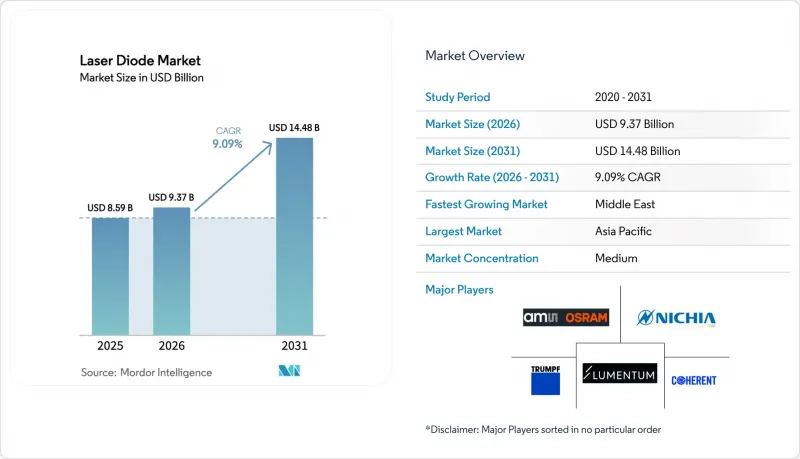
This report is Segmented by Type (Edge-Emitting, VCSEL, and More), Wavelength (Infrared, Red, and More), Output Power (Low, Mid, and High), Operating Mode (Continuous-Wave, and Pulsed), Packaging Configuration (TO-CAN, C-Mount, and More), End-User Application (Telecommunications and Datacom, Industrial, and More), and Geography (North America, and More). Market Forecasts are Provided in Terms of Value (USD).
Global Laser Diode Market Trends and Insights
Proliferation of 3D Sensing and Face-ID in Smartphones Propelling VCSEL Demand
Global smartphone makers shipped roughly 1.2 billion handsets with embedded VCSEL arrays in 2025, enabling secure facial authentication and depth-enhanced imaging. Apple drove the pace by expanding TrueDepth adoption, prompting Lumentum to boost its Thailand die-sorting capacity by 30% to meet iPhone 17 orders. Android OEMs followed suit, with Samsung and Xiaomi selecting ams OSRAM 940-nanometer arrays that maintain false-reject rates below 0.5% in bright sunlight. VCSELs cut assembly cost because they withstand reflow humidity, eliminating hermetic sealing that edge-emitters require. Compliance with IEC 60825-1 Class 1 limits has led suppliers to finetune beam divergence and duty cycles, keeping peak exposure within 0.39 milliwatts at the cornea, thereby sustaining momentum in the laser diode market.
Rapid Deployment of FTTH Networks Leveraging 1550 nm DFB Lasers
Worldwide FTTH lines exceeded 680 million in 2025, with China contributing 58% of net additions under provincial gigabit mandates. Distributed-feedback lasers at 1550 nanometers minimize chromatic dispersion, enabling 40 kilometer passive optical links that support 1:128 split ratios. MACOM released a 25-gigabit indium-phosphide DFB with integrated electro-absorption modulator in 2025, shrinking module footprint by 40% and lowering power budgets in dense access nodes. Turkey's national fiber plan deployed 4.2 million new homes that same year using Sumitomo Electric lasers, further broadening the addressable laser diode market. OpenLight's 1.6-terabit DR8 transceiver, demoed in September 2025, validates that these same 1550 nanometer lanes will move inside AI clusters by 2027.
Thermal Management Challenges Limiting Continuous-Wave Scaling Above 20 W
Junction temperatures climb above 85 degrees Celsius when continuous output exceeds 20 watts, cutting carrier-recombination efficiency by 12% per 10-degree rise and shortening lifetime. Microchannel coolers add USD 45 per module and consume 15 watts for pumping, eroding the efficiency edge over lamp-pumped solid-state lasers. Synthetic diamond plates offer five-fold higher thermal conductivity, tested by nLIGHT in 100-watt fiber-coupled modules that achieved an 18 degree reduction in junction temperature but at USD 12 per square centimeter premium. IEEE researchers in 2025 proposed gallium-indium phase-change inserts that absorb transient heat during pulsed duty but remain incompatible with telecom hermeticity standards. Until packaging costs fall, this restraint will moderate the top-end of the laser diode market power roadmap.
Other drivers and restraints analyzed in the detailed report include:
- Automotive LiDAR Programs Adopting 905 nm Pulsed Lasers
- Rising Use of High-Power Diode Lasers in Metal Additive Manufacturing
- Supply-Chain Dependency on Gallium and Indium Causing Price Volatility
For complete list of drivers and restraints, kindly check the Table Of Contents.
Segment Analysis
Edge-emitting devices led the laser diode market with 46.13% share in 2025, owing to unmatched single-mode coupling efficiency for long-haul links. VCSEL arrays are forecast to grow at 10.98% through 2031, driven by wafer-level testing speeds that reach 12,000 dice per hour, far surpassing cleaved-facet edge emitters. Quantum-cascade lasers remain niche in mid-infrared sensing, while Fabry-Perot diodes serve cost-sensitive short-reach networks.
Production economics favor VCSELs in consumer electronics where board space is at a premium and hermetic sealing can be skipped, cutting assembly steps by 25%. Edge emitters will stay dominant in dense wavelength-division multiplexing, yet a gradual mix shift toward VCSELs keeps competitive focus on high-throughput wafer fabrication. This dynamic underscores how emitter innovation is central to sustaining long-run expansion of the laser diode market.
Infrared sources between 700 and 1600 nanometers generated 49.21% of 2025 revenue, underlining their role in telecom, industrial sensing, and fiber-laser pumping. Blue diodes at 400 to 500 nanometers are projected to expand at 11.82% CAGR as laser-phosphor projectors deliver 4,000 lumens from 3-watt chips, replacing mercury lamps in displays and automotive head-up systems.
Nichia's 450 nanometer devices achieved 42% wall-plug efficiency, enabling a 5,000-lumen portable projector that weighs just 1.8 kilograms. Red and green bands grow modestly, while ultraviolet yields lag due to GaN-on-silicon defect densities. Collectively these trends diversify revenue streams, supporting stable long-term prospects for the laser diode market.
Complete Report Scope:
- By Type
- Edge-Emitting Laser Diodes
- VCSEL
- Quantum Cascade Lasers
- DFB and DBR
- Fabry-Perot Laser Diodes
- By Wavelength
- Infrared (700-1600 nm)
- Red (630-700 nm)
- Blue (400-500 nm)
- Green (500-570 nm)
- Ultraviolet (Less than 400 nm)
- By Output Power
- Low Power (Less than 1 W)
- Mid Power (1-10 W)
- High Power (More than 10 W)
- By Operating Mode
- Continuous-Wave (CW)
- Pulsed
- By Packaging Configuration
- TO-CAN
- C-Mount
- HHL and Butterfly
- Module/Sub-System
- By End-User Application
- Telecommunications and Datacom
- Industrial Processing and Manufacturing
- Healthcare and Medical
- Automotive
- Consumer Electronics and Display
- Defense and Security
- Research and Academia
- By Geography
- North America
- United States
- Canada
- Mexico
- South America
- Brazil
- Argentina
- Rest of South America
- Europe
- United Kingdom
- Germany
- France
- Spain
- Italy
- Rest of Europe
- Asia-Pacific
- China
- India
- Japan
- Australia
- South Korea
- Rest of Asia-Pacific
- Middle East
- Saudi Arabia
- United Arab Emirates
- Turkey
- Rest of Middle East
- Africa
- South Africa
- Kenya
- Rest of Africa
- North America
Geography Analysis
Asia-Pacific generated 53.61% of global revenue in 2025, backed by Japan's integrated supply chains and China's USD 47 billion semiconductor stimulus that lifted compound-semiconductor wafer output by 34% from 2023. South Korea consumed 92 million diodes for smartphones and 5G backhaul, illustrating the region's balanced mix of consumer and infrastructure demand.
North America contributed roughly 22% of sales, leveraging defense appropriations and hyperscaler procurement. Lumentum expanded California cleanrooms in August 2025 to meet CHIPS Act domestic-content thresholds. Europe held an 18% share, with German automakers integrating LiDAR in 1.8 million cars and the UK National Health Service rolling out laser-based diagnostics in 420 hospitals.
The Middle East, projected at a 12.46% CAGR, is wiring Saudi Vision 2030's fiber backbone and UAE hyperscale clusters that will drive 15 exabytes per month of cross-border traffic by 2029. South America and Africa remain emerging, yet Brazil's national broadband plan and Kenya's fiber backhaul projects underscore incremental opportunities for suppliers attuned to local standards. Together, these patterns reinforce a geographically diversified laser diode market.
- Coherent Corp.
- Lumentum Holdings Inc.
- Nichia Corporation
- TRUMPF SE + Co KG
- OSRAM Opto Semiconductors GmbH
- IPG Photonics Corp.
- Hamamatsu Photonics K.K.
- Sharp Corp.
- Sumitomo Electric Industries Ltd.
- Sony Corp.
- Mitsubishi Electric Corp.
- Ushio Inc.
- Jenoptik AG
- Thorlabs Inc.
- Frankfurt Laser Co.
- OSI Laser Diode Inc.
- Lasea SA
- Newport Corp.
- Rohm Semiconductor
- nLIGHT Inc.
- Excelitas Technologies Corp.
- Broadcom Inc.
Additional Benefits:
- The market estimate (ME) sheet in Excel format
- 3 months of analyst support
TABLE OF CONTENTS
1 INTRODUCTION
- 1.1 Study Assumptions and Market Definition
- 1.2 Scope of the Study
2 RESEARCH METHODOLOGY
3 EXECUTIVE SUMMARY
4 MARKET LANDSCAPE
- 4.1 Market Overview
- 4.2 Market Drivers
- 4.2.1 Proliferation of 3D Sensing and Face-ID in Smartphones Propelling VCSEL Demand
- 4.2.2 Rapid Deployment of FTTH Networks Leveraging 1550 nm DFB Lasers
- 4.2.3 Automotive LiDAR Programs Adopting 905 nm Pulsed Lasers
- 4.2.4 Rising Use of High-Power Diode Lasers in Metal Additive Manufacturing
- 4.2.5 Defense Funding Surge for Directed-Energy Weapons Utilizing Diode-Pumped Modules
- 4.2.6 Miniaturization of Medical Aesthetic Devices Integrating Blue-Green GaN Lasers
- 4.3 Market Restraints
- 4.3.1 Thermal Management Challenges Limiting Continuous-Wave Scaling Above 20 W
- 4.3.2 Supply-Chain Dependency on Gallium and Indium Causing Price Volatility
- 4.3.3 Safety Regulations on Eye Exposure Restricting Consumer-Grade Power in Europe
- 4.3.4 Yield Variability in GaN-on-Silicon Wafer Fabrication Raising Costs for Blu-ray Lasers
- 4.4 Industry Value Chain Analysis
- 4.5 Impact of Macroeconomic Factors on the Market
- 4.6 Technological Outlook
- 4.7 Porter's Five Forces Analysis
- 4.7.1 Bargaining Power of Suppliers
- 4.7.2 Bargaining Power of Buyers
- 4.7.3 Threat of New Entrants
- 4.7.4 Threat of Substitutes
- 4.7.5 Intensity of Competitive Rivalry
5 MARKET SIZE AND GROWTH FORECASTS (VALUE)
- 5.1 By Type
- 5.1.1 Edge-Emitting Laser Diodes
- 5.1.2 VCSEL
- 5.1.3 Quantum Cascade Lasers
- 5.1.4 DFB and DBR
- 5.1.5 Fabry-Perot Laser Diodes
- 5.2 By Wavelength
- 5.2.1 Infrared (700-1600 nm)
- 5.2.2 Red (630-700 nm)
- 5.2.3 Blue (400-500 nm)
- 5.2.4 Green (500-570 nm)
- 5.2.5 Ultraviolet (Less than 400 nm)
- 5.3 By Output Power
- 5.3.1 Low Power (Less than 1 W)
- 5.3.2 Mid Power (1-10 W)
- 5.3.3 High Power (More than 10 W)
- 5.4 By Operating Mode
- 5.4.1 Continuous-Wave (CW)
- 5.4.2 Pulsed
- 5.5 By Packaging Configuration
- 5.5.1 TO-CAN
- 5.5.2 C-Mount
- 5.5.3 HHL and Butterfly
- 5.5.4 Module/Sub-System
- 5.6 By End-User Application
- 5.6.1 Telecommunications and Datacom
- 5.6.2 Industrial Processing and Manufacturing
- 5.6.3 Healthcare and Medical
- 5.6.4 Automotive
- 5.6.5 Consumer Electronics and Display
- 5.6.6 Defense and Security
- 5.6.7 Research and Academia
- 5.7 By Geography
- 5.7.1 North America
- 5.7.1.1 United States
- 5.7.1.2 Canada
- 5.7.1.3 Mexico
- 5.7.2 South America
- 5.7.2.1 Brazil
- 5.7.2.2 Argentina
- 5.7.2.3 Rest of South America
- 5.7.3 Europe
- 5.7.3.1 United Kingdom
- 5.7.3.2 Germany
- 5.7.3.3 France
- 5.7.3.4 Spain
- 5.7.3.5 Italy
- 5.7.3.6 Rest of Europe
- 5.7.4 Asia-Pacific
- 5.7.4.1 China
- 5.7.4.2 India
- 5.7.4.3 Japan
- 5.7.4.4 Australia
- 5.7.4.5 South Korea
- 5.7.4.6 Rest of Asia-Pacific
- 5.7.5 Middle East
- 5.7.5.1 Saudi Arabia
- 5.7.5.2 United Arab Emirates
- 5.7.5.3 Turkey
- 5.7.5.4 Rest of Middle East
- 5.7.6 Africa
- 5.7.6.1 South Africa
- 5.7.6.2 Kenya
- 5.7.6.3 Rest of Africa
- 5.7.1 North America
6 COMPETITIVE LANDSCAPE
- 6.1 Market Concentration
- 6.2 Strategic Moves
- 6.3 Market Share Analysis
- 6.4 Company Profiles (Includes Global-Level Overview, Market-Level Overview, Core Segments, Financials, Strategic Information, Market Rank/Share, Products and Services, Recent Developments)
- 6.4.1 Coherent Corp.
- 6.4.2 Lumentum Holdings Inc.
- 6.4.3 Nichia Corporation
- 6.4.4 TRUMPF SE + Co KG
- 6.4.5 OSRAM Opto Semiconductors GmbH
- 6.4.6 IPG Photonics Corp.
- 6.4.7 Hamamatsu Photonics K.K.
- 6.4.8 Sharp Corp.
- 6.4.9 Sumitomo Electric Industries Ltd.
- 6.4.10 Sony Corp.
- 6.4.11 Mitsubishi Electric Corp.
- 6.4.12 Ushio Inc.
- 6.4.13 Jenoptik AG
- 6.4.14 Thorlabs Inc.
- 6.4.15 Frankfurt Laser Co.
- 6.4.16 OSI Laser Diode Inc.
- 6.4.17 Lasea SA
- 6.4.18 Newport Corp.
- 6.4.19 Rohm Semiconductor
- 6.4.20 nLIGHT Inc.
- 6.4.21 Excelitas Technologies Corp.
- 6.4.22 Broadcom Inc.
7 MARKET OPPORTUNITIES AND FUTURE OUTLOOK
- 7.1 White-Space and Unmet-Need Assessment

