PUBLISHER: Mordor Intelligence | PRODUCT CODE: 2114294

PUBLISHER: Mordor Intelligence | PRODUCT CODE: 2114294
Bipolar Disorder - Market Share Analysis, Industry Trends & Statistics, Growth Forecasts (2026 - 2031)
According to Mordor Intelligence, the bipolar disorder market size is expected to grow from USD 5.01 billion in 2025 to USD 5.14 billion in 2026 and is forecast to reach USD 5.82 billion by 2031 at 2.52% CAGR over 2026-2031.
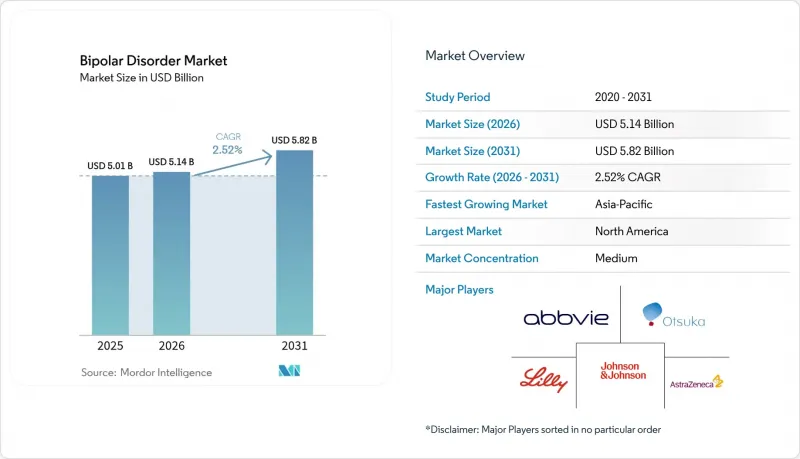
This report is Segmented by Drug Class (Mood Stabilizers, and More), Mechanism of Action (Selective Serotonin Reuptake Inhibitor, and More), Disease Type (Bipolar I Disorder, and More), Distribution Channel (Hospital Pharmacies, and More), Treatment Setting (In-Patient, and More), Geography (North America, Europe, and More). The Market Forecasts are Provided in Terms of Value (USD).
Global Bipolar Disorder Market Trends and Insights
Rising Prevalence & Earlier Diagnosis of Bipolar Spectrum Disorders
Machine-learning classifiers now distinguish bipolar disorder from major depression with 85% pooled accuracy, cutting historic misdiagnosis lags that averaged 9.5 years. Blood-based RNA-editing biomarker panels validated with 0.904 AUC make earlier prodromal-phase intervention feasible. Smartphone-based digital phenotyping detects mood-state shifts with 88% sensitivity and 89% specificity relative to clinician assessments, while sustained telemedicine utilization broadens specialty access in underserved communities. Earlier recognition is translating into swifter treatment initiation, lower disability-adjusted life-year burdens, and heightened demand across every stage of the bipolar disorder market.
Government-Led Mental-Health Parity Laws & Reimbursement Expansion
Final rules under the Mental Health Parity and Addiction Equity Act effective January 2025 compel private health plans to prove equivalent access metrics for mental-health and medical benefits. New CMS billing codes extend Medicare and Medicaid reimbursement to prescription digital therapeutics, setting a precedent later echoed by several European payers. Region-wide EMA coordination eliminates duplicative trials, shortening time-to-market for novel agents. These policies reduce out-of-pocket costs, improve adherence, and support measurable cost-savings from fewer acute-care episodes-all reinforcing steady demand within the bipolar disorder market.
Persistent Safety Concerns (Weight Gain, Metabolic Risk) for SGAs
Studies indicate 4-13% of SGA-treated patients gain at least 7% body weight, compared with 2-5% on placebo. Clozapine induces metabolic syndrome in about 30% of users, prompting regulators to mandate routine BMI and glycemic monitoring. Metformin remains the most-studied adjunct for psychotropic-related weight gain, while GLP-1 receptor agonists enter phase-3 evaluation as combination partners. These cardiometabolic liabilities temper prescribing enthusiasm, especially for patients with pre-existing risk factors, and could modestly dampen bipolar disorder market growth.
Other drivers and restraints analyzed in the detailed report include:
- Rapid Uptake of Second-Generation Antipsychotics & Long-Acting Injectables
- Digital Phenotyping & AI-Driven Screening Tools Boosting Treatment Rates
- High Mis-/Under-Diagnosis in Primary-Care Settings
For complete list of drivers and restraints, kindly check the Table Of Contents.
Segment Analysis
Second-generation antipsychotics held 50.78% of bipolar disorder market share in 2025, underscoring their broad efficacy across all mood phases. Quetiapine and lumateperone illustrate dual dopamine-serotonin modulation that stabilizes mania and depression, aligning with 2024 Veterans Affairs treatment algorithms. Lithium prescriptions fell from 31% to 16% of patients due to monitoring burdens, though its neuroprotective value endures. Anticonvulsants such as lamotrigine safeguard cognitive function and remain central to maintenance therapy.
Antidepressants represent the fastest-growing category, expanding at a 4.18% CAGR as Caplyta gains traction for bipolar depression. Regimens increasingly combine antidepressants with mood stabilizers to prevent manic switching, broadening therapeutic flexibility. Pipeline diversity spans glutamate and GABA modulators that seek superior tolerability. Collectively, these trends reinforce sustained revenue generation inside the bipolar disorder market while opening room for differentiated newcomers across the bipolar disorder industry.
Dopamine D2/D3 partial agonists accounted for 36.95% of the bipolar disorder market size in 2025, reflecting a balance of efficacy and softer side-effect profiles. Aripiprazole's stabilizing action without full receptor blockade typifies this class's appeal and spurs similar candidates in mid-stage trials.
Glutamate-pathway agents show the highest forward CAGR at 4.71% as ketamine's rapid antidepressant response validates NMDA receptor targeting. Serotonin-norepinephrine reuptake inhibitors preserve utility where cognitive activation is a therapeutic goal, although selective serotonin reuptake inhibitors require mood-stabilizer co-administration. GABA modulators and ion-channel stabilizers, led by lithium and lamotrigine, continue as backbone options. Mechanistic diversification reduces clinical inertia and broadens prescriber choice throughout the bipolar disorder market.
Complete Report Scope:
- By Drug Class
- Mood Stabilizers
- Anticonvulsants
- Second-Generation Antipsychotics
- Antidepressants
- Other Drug Classes
- By Mechanism of Action
- Selective Serotonin Reuptake Inhibitor
- Serotonin Norepinephrine Reuptake Inhibitor
- Dopamine D?/D? Partial Agonists
- GABA Modulators
- Glutamate Pathway Modulators
- Ion-channel Stabilizers
- By Disease Type
- Bipolar I Disorder
- Bipolar II Disorder
- Cyclothymia & Others
- By Distribution Channel
- Hospital Pharmacies
- Retail Pharmacies
- Online Pharmacies
- Specialty Clinics
- By Treatment Setting
- In-patient
- Out-patient
- Digital Therapeutics / Home-based Care
- Geography
- North America
- United States
- Canada
- Mexico
- Europe
- Germany
- United Kingdom
- France
- Italy
- Spain
- Rest of Europe
- Asia-Pacific
- China
- Japan
- India
- Australia
- South Korea
- Rest of Asia-Pacific
- Middle East & Africa
- GCC
- South Africa
- Rest of Middle East & Africa
- South America
- Brazil
- Argentina
- Rest of South America
- North America
Geography Analysis
North America dominated the bipolar disorder market with 42.11% share in 2025. Parity-law enforcement effective 2025 obliges health plans to match mental-health benefits with medical coverage. Early uptake of LAIs and rapid pathways for digital therapeutics speed diffusion of innovation. FDA approvals for Uzedy and Fanapt reinforce treatment diversity, while integrated delivery networks negotiate value-based contracts that reward relapse reduction.
Europe maintains robust demand through centralized EMA approvals that streamline cross-border launches. Universal healthcare financing guarantees baseline access, although country-specific health-technology assessments steer price negotiations. Variability in legacy lithium use reflects differing monitoring infrastructures, and post-Brexit divergence may lengthen UK-specific timelines for certain agents.
Asia-Pacific is the fastest-growing region at 3.52% CAGR. China's regulatory reforms trimmed NDA review times and widened reimbursement for innovative therapies, strengthening commercial cases for novel agents. Japan's annual drug-price revisions nudge manufacturers to pursue high-value indications, while India's generic manufacturing base rises as a global supplier. Nonetheless, limited specialist density and diagnostic under-recognition still temper treated-prevalence gains, leaving substantial headroom in the bipolar disorder market.
- Johnson & Johnson
- Otsuka
- Abbvie
- Eli Lilly and Company
- AstraZeneca
- Pfizer
- GlaxoSmithKline
- Novartis
- Lundbeck A/S
- Sunovion (Sumitomo Pharma)
- Intra-Cellular Therapies Inc.
- Vanda Pharmaceuticals
- Acadia Pharmaceuticals Inc.
- Alkermes plc
- Bristol-Myers Squibb
- Roche
- Teva Pharmaceutical Industries
- Aurobindo Pharma Ltd.
- Dr Reddy's Laboratories Ltd.
- Cipla
- Hikma Pharmaceuticals
Additional Benefits:
- The market estimate (ME) sheet in Excel format
- 3 months of analyst support
TABLE OF CONTENTS
1 Introduction
- 1.1 Study Assumptions & Market Definition
- 1.2 Scope of the Study
2 Research Methodology
3 Executive Summary
4 Market Landscape
- 4.1 Market Overview
- 4.2 Market Drivers
- 4.2.1 Rising Prevalence & Earlier Diagnosis Of Bipolar Spectrum Disorders
- 4.2.2 Government-Led Mental-Health Parity Laws & Reimbursement Expansion
- 4.2.3 Rapid Uptake Of Second-Generation Antipsychotics & Long-Acting Injectables
- 4.2.4 Digital Phenotyping & AI-Driven Screening Tools Boosting Treatment Rates
- 4.2.5 Real-World Evidence (RWE) Platforms Accelerating Label Expansions
- 4.3 Market Restraints
- 4.3.1 Persistent Safety Concerns (Weight Gain, Metabolic Risk) For Sgas
- 4.3.2 High Mis-/Under-Diagnosis In Primary-Care Settings
- 4.3.3 Patent Cliffs For Leading Brands (E.G., Latuda, Vraylar) Post-2027
- 4.3.4 Data-Privacy Barriers Limiting Adoption Of Digital Therapeutics
- 4.4 Regulatory Landscape
- 4.5 Porter's Five Forces Analysis
- 4.5.1 Threat of New Entrants
- 4.5.2 Bargaining Power of Buyers
- 4.5.3 Bargaining Power of Suppliers
- 4.5.4 Threat of Substitutes
- 4.5.5 Competitive Rivalry
5 Market Size & Growth Forecasts (Value, USD)
- 5.1 By Drug Class
- 5.1.1 Mood Stabilizers
- 5.1.2 Anticonvulsants
- 5.1.3 Second-Generation Antipsychotics
- 5.1.4 Antidepressants
- 5.1.5 Other Drug Classes
- 5.2 By Mechanism of Action
- 5.2.1 Selective Serotonin Reuptake Inhibitor
- 5.2.2 Serotonin Norepinephrine Reuptake Inhibitor
- 5.2.3 Dopamine D2/D3 Partial Agonists
- 5.2.4 GABA Modulators
- 5.2.5 Glutamate Pathway Modulators
- 5.2.6 Ion-channel Stabilizers
- 5.3 By Disease Type
- 5.3.1 Bipolar I Disorder
- 5.3.2 Bipolar II Disorder
- 5.3.3 Cyclothymia & Others
- 5.4 By Distribution Channel
- 5.4.1 Hospital Pharmacies
- 5.4.2 Retail Pharmacies
- 5.4.3 Online Pharmacies
- 5.4.4 Specialty Clinics
- 5.5 By Treatment Setting
- 5.5.1 In-patient
- 5.5.2 Out-patient
- 5.5.3 Digital Therapeutics / Home-based Care
- 5.6 Geography
- 5.6.1 North America
- 5.6.1.1 United States
- 5.6.1.2 Canada
- 5.6.1.3 Mexico
- 5.6.2 Europe
- 5.6.2.1 Germany
- 5.6.2.2 United Kingdom
- 5.6.2.3 France
- 5.6.2.4 Italy
- 5.6.2.5 Spain
- 5.6.2.6 Rest of Europe
- 5.6.3 Asia-Pacific
- 5.6.3.1 China
- 5.6.3.2 Japan
- 5.6.3.3 India
- 5.6.3.4 Australia
- 5.6.3.5 South Korea
- 5.6.3.6 Rest of Asia-Pacific
- 5.6.4 Middle East & Africa
- 5.6.4.1 GCC
- 5.6.4.2 South Africa
- 5.6.4.3 Rest of Middle East & Africa
- 5.6.5 South America
- 5.6.5.1 Brazil
- 5.6.5.2 Argentina
- 5.6.5.3 Rest of South America
- 5.6.1 North America
6 Competitive Landscape
- 6.1 Market Concentration
- 6.2 Market Share Analysis
- 6.3 Company Profiles (includes Global level Overview, Market level overview, Core Business Segments, Financials, Headcount, Key Information, Market Rank, Market Share, Products and Services, and analysis of Recent Developments)
- 6.3.1 Johnson & Johnson (Janssen)
- 6.3.2 Otsuka Holdings Co. Ltd.
- 6.3.3 AbbVie Inc.
- 6.3.4 Eli Lilly and Company
- 6.3.5 AstraZeneca plc
- 6.3.6 Pfizer Inc.
- 6.3.7 GlaxoSmithKline plc
- 6.3.8 Novartis AG
- 6.3.9 Lundbeck A/S
- 6.3.10 Sunovion (Sumitomo Pharma)
- 6.3.11 Intra-Cellular Therapies Inc.
- 6.3.12 Vanda Pharmaceuticals Inc.
- 6.3.13 Acadia Pharmaceuticals Inc.
- 6.3.14 Alkermes plc
- 6.3.15 Bristol-Myers Squibb Co.
- 6.3.16 Roche Holding AG
- 6.3.17 Teva Pharmaceutical Industries Ltd.
- 6.3.18 Aurobindo Pharma Ltd.
- 6.3.19 Dr Reddy's Laboratories Ltd.
- 6.3.20 Cipla Ltd.
- 6.3.21 Hikma Pharmaceuticals plc
7 Market Opportunities & Future Outlook
- 7.1 White-space & Unmet-need Assessment

