PUBLISHER: Mordor Intelligence | PRODUCT CODE: 2114295

PUBLISHER: Mordor Intelligence | PRODUCT CODE: 2114295
Scar Treatment - Market Share Analysis, Industry Trends & Statistics, Growth Forecasts (2026 - 2031)
According to Mordor Intelligence, the scar treatment market size is expected to increase from USD 24.78 billion in 2025 to USD 26.93 billion in 2026 and reach USD 42.44 billion by 2031, growing at a CAGR of 9.52% over 2026-2031.
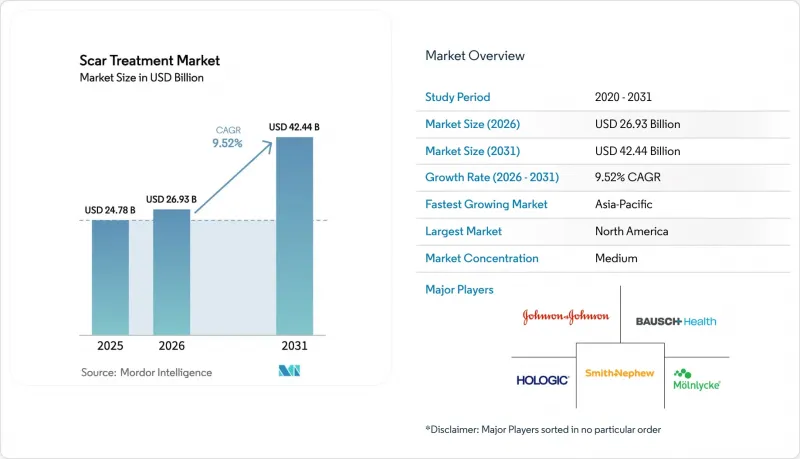
This report is Segmented by Product Type (Topical Products, Laser Devices, Surface Treatment Devices, Injectable Products, Surgical Invasive Procedures), Treatment Modality (Non-Energy-Based, and More), Patient Age Group (Pediatric, and More), Scar Type (Atrophic, and More), End User (Hospitals, and More), and Geography (North America, and More). The Market Forecasts are Provided in Terms of Value (USD).
Global Scar Treatment Market Trends and Insights
Rapid Adoption of Minimally Invasive Aesthetic Procedures
Patient familiarity with botulinum toxin, fillers, and skin-tightening treatments is translating into demand for laser and radiofrequency scar revision. The 40% rise in minimally invasive procedures during 2020-2024 cemented bundled offerings where a single platform addresses wrinkles and acne scarring in one visit. Clinics report higher ticket sizes when scar packages accompany anti-aging care, and multi-indication consoles such as Cutera's Excel V+ allow faster payback on capital outlays. Marketing emphasizes shorter downtime versus traditional ablative resurfacing, appealing to working adults. Training programs by device makers have proliferated, ensuring consistent protocol adoption across urban centers. The result is a virtuous cycle of consumer education, clinician confidence, and platform upgrades fueling the scar treatment market.
Rising Acne Prevalence Among Adolescents & Young Adults
Urban dietary shifts, stress, and pollution are extending acne into the late 20s, enlarging the pool of atrophic scar candidates. Epidemiology shows 85% of teenagers and up to 54% of adults over 25 experiencing active lesions. Fractional CO2 and picosecond lasers achieve 50-70% scar depth reduction after three to five sessions, giving dermatologists evidence-based talking points. FDA clearance of Cutera's AviClear acne laser in 2022, with 87% one-year clearance documented in 2024, implies fewer new scars over time. Social media transparency around skin journeys reduces stigma and motivates early intervention. Together these factors expand both preventive and corrective segments of the scar treatment market.
High Procedure Costs Outside Insurance Coverage
Fractional CO2 sessions cost USD 1,000-2,500 in North America, and three to five visits are common. Only functional burns or keloids sometimes qualify for insurance reimbursement, leaving acne scars and stretch marks self-pay. A 2024 ASDS poll showed 42% of interested patients walked away because of price. Cheaper entry-level lasers aim to cut session fees to USD 500-800 but may lack premium precision. Unless financing plans or coverage widens faster, sticker shock will temper near-term scar treatment market growth.
Other drivers and restraints analyzed in the detailed report include:
- Growing Medical Tourism for Cosmetic Dermatology in APAC
- Reimbursement Expansion for Burn & Trauma Scar Revision
- Limited Efficacy Data for OTC Topical Products
For complete list of drivers and restraints, kindly check the Table Of Contents.
Segment Analysis
Topical products captured 53.63% of the scar treatment market share in 2025, driven by accessible silicone gels and sheets that cut scar height by up to 50% when used 12 weeks post-injury. However, laser devices are charting an 11.68% CAGR to 2031 as clinics invest in fractional CO2, picosecond, and AI-enabled systems offering predictable collagen remodeling. That trajectory positions lasers to command a greater slice of scar treatment market size by decade's end.
Capital purchases are eased by multi-indication consoles serving pigment, vascular, and resurfacing indications. Meanwhile, injectables and surface devices such as radiofrequency microneedling are rising on combination-therapy protocols that smooth texture and elevate depressions. Surgical excision remains a niche for refractory hypertrophic or contracture scars, but bioprinted grafts could disrupt this small segment once scaling resolves.
Non-energy methods, dominated by silicone occlusion and intralesional steroids, held 61.67% of 2025 revenue. Hydrating dressings modulate fibroblast activity, and triamcinolone injections flatten keloids by up to 70%. Yet energy-based procedures are growing 12.79% annually, narrowing the gap in scar treatment market size. Fractional CO2 creates microthermal zones that trigger neocollagenesis, while picosecond lasers minimize thermal damage, crucial for darker skin types.
Radiofrequency microneedling systems such as Lutronic's Genius heat the reticular dermis to 60-65 °C, contracting collagen without epidermal injury. Intense pulsed light and ultrasound occupy specialty niches for redness or shallow texture. Surgical and biologic interventions remain reserved for severe burns but could climb if regenerative grafts clear late-stage trials.
Complete Report Scope:
- By Product Type
- Topical Products
- Laser Devices
- Surface Treatment Devices (Dermabrasion & Micro-needling)
- Injectable Products (Dermal Fillers & Steroids)
- Surgical Invasive Procedures
- By Treatment Modality
- Non-Energy-Based (Topical, Silicone, Injectables)
- Energy-Based (Laser, RF, Ultrasound, IPL)
- Surgical & Biologic Interventions (Excision, Grafting, Bioprinted Skin)
- By Patient Age Group
- Pediatric (0-17 yrs)
- Adult (18-64 yrs)
- Geriatric (65 yrs +)
- By Scar Type
- Atrophic Scars
- Hypertrophic & Keloid Scars
- Contracture Scars
- Stretch Marks
- Acne Scars
- By End User
- Hospitals
- Dermatology & Aesthetic Clinics
- Ambulatory Surgical Centers
- Home-care Settings
- By Geography
- North America
- United States
- Canada
- Mexico
- Europe
- Germany
- France
- United Kingdom
- Italy
- Spain
- Rest of Europe
- Asia-Pacific
- China
- Japan
- India
- South Korea
- Australia
- Rest of Asia-Pacific
- Middle East & Africa
- GCC
- South Africa
- Rest of Middle East & Africa
- South America
- Brazil
- Argentina
- Rest of South America
- North America
Geography Analysis
North America contributed 37.24% revenue in 2025, buoyed by mature insurance frameworks and 54,280 scar revision surgeries logged in 2024. Multiple next-generation platforms, such as Accure eCO2 3D and AVAVA's AI-guided system, debuted here, reinforcing regional technology leadership. Cross-border traffic into Mexico and Canada continues as U.S. patients seek 40-60% procedure discounts.
Europe maintains a significant slice, with Germany, France, and the United Kingdom spearheading device research. However, EU MDR has elongated approval cycles, prompting firms to prioritize U.S. launches. Southern markets like Italy and Spain capture value via inbound aesthetic tourism, offsetting domestic economic softness. The U.K. NHS funds functional cases, but private clinics fill gaps stemming from 12-month waitlists.
Asia-Pacific is the growth engine at 11.22% CAGR, fueled by Thailand's 2.8 million medical tourists, South Korea's KRW 5 trillion dermatology sector, and China's surging private-clinic build-out. Domestic OEM approvals in China lower device costs, broadening access. Japan and Australia remain premium markets, whereas India attracts budget-sensitive burn and keloid patients. GCC countries invest heavily in specialty centers, courting regional travelers, while Sub-Saharan Africa faces provider shortages that cap penetration.
- Bausch Health (Solta Medical)
- Beijing Toplaser Technology Co. Ltd.
- Biodermis LLC
- Candela Medical
- Cutera
- Enaltus LLC (Kelo-Cote)
- Hologic
- InMode Ltd
- Johnson & Johnson (Neutrogena, Ethicon)
- Lumenis
- Lutronic Corp.
- Merz Pharma GmbH
- Molnlycke Health Care
- Perrigo Company plc (ScarAway)
- Rejuvaskin Global
- Sciton
- Smiths Group
- Candela Medical
- Zimmer Biomet
Additional Benefits:
- The market estimate (ME) sheet in Excel format
- 3 months of analyst support
TABLE OF CONTENTS
1 Introduction
- 1.1 Study Assumptions & Market Definition
- 1.2 Scope of the Study
2 Research Methodology
3 Executive Summary
4 Market Landscape
- 4.1 Market Overview
- 4.2 Market Drivers
- 4.2.1 Rapid Adoption of Minimally Invasive Aesthetic Procedures
- 4.2.2 Rising Acne Prevalence among Adolescents & Young Adults
- 4.2.3 Growing Medical Tourism for Cosmetic Dermatology In APAC
- 4.2.4 Reimbursement Expansion for Burn & Trauma Scar Revision
- 4.2.5 AI-Guided Laser Parameter Optimization
- 4.2.6 Bioprinted Skin Substitutes Entering Late-Stage Pipeline
- 4.3 Market Restraints
- 4.3.1 High Procedure Costs Outside Insurance Coverage
- 4.3.2 Limited Efficacy Data for OTC Topical Products
- 4.3.3 Strict Device Approval Timelines in Europe
- 4.3.4 Shortage Of Trained Laser Dermatologists in Africa
- 4.4 Value / Supply-Chain Analysis
- 4.5 Regulatory Landscape
- 4.6 Technological Outlook
- 4.7 Porter's Five Forces Analysis
- 4.7.1 Threat of New Entrants
- 4.7.2 Bargaining Power of Suppliers
- 4.7.3 Bargaining Power of Buyers
- 4.7.4 Threat of Substitutes
- 4.7.5 Intensity of Competitive Rivalry
5 Market Size & Growth Forecasts (Value in USD)
- 5.1 By Product Type
- 5.1.1 Topical Products
- 5.1.2 Laser Devices
- 5.1.3 Surface Treatment Devices (Dermabrasion & Micro-needling)
- 5.1.4 Injectable Products (Dermal Fillers & Steroids)
- 5.1.5 Surgical Invasive Procedures
- 5.2 By Treatment Modality
- 5.2.1 Non-Energy-Based (Topical, Silicone, Injectables)
- 5.2.2 Energy-Based (Laser, RF, Ultrasound, IPL)
- 5.2.3 Surgical & Biologic Interventions (Excision, Grafting, Bioprinted Skin)
- 5.3 By Patient Age Group
- 5.3.1 Pediatric (0-17 yrs)
- 5.3.2 Adult (18-64 yrs)
- 5.3.3 Geriatric (65 yrs +)
- 5.4 By Scar Type
- 5.4.1 Atrophic Scars
- 5.4.2 Hypertrophic & Keloid Scars
- 5.4.3 Contracture Scars
- 5.4.4 Stretch Marks
- 5.4.5 Acne Scars
- 5.5 By End User
- 5.5.1 Hospitals
- 5.5.2 Dermatology & Aesthetic Clinics
- 5.5.3 Ambulatory Surgical Centers
- 5.5.4 Home-care Settings
- 5.6 By Geography
- 5.6.1 North America
- 5.6.1.1 United States
- 5.6.1.2 Canada
- 5.6.1.3 Mexico
- 5.6.2 Europe
- 5.6.2.1 Germany
- 5.6.2.2 France
- 5.6.2.3 United Kingdom
- 5.6.2.4 Italy
- 5.6.2.5 Spain
- 5.6.2.6 Rest of Europe
- 5.6.3 Asia-Pacific
- 5.6.3.1 China
- 5.6.3.2 Japan
- 5.6.3.3 India
- 5.6.3.4 South Korea
- 5.6.3.5 Australia
- 5.6.3.6 Rest of Asia-Pacific
- 5.6.4 Middle East & Africa
- 5.6.4.1 GCC
- 5.6.4.2 South Africa
- 5.6.4.3 Rest of Middle East & Africa
- 5.6.5 South America
- 5.6.5.1 Brazil
- 5.6.5.2 Argentina
- 5.6.5.3 Rest of South America
- 5.6.1 North America
6 Competitive Landscape
- 6.1 Market Concentration
- 6.2 Market Share Analysis
- 6.3 Company Profiles (includes Global level Overview, Market level overview, Core Segments, Financials as available, Strategic Information, Market Rank/Share for key companies, Products and Services, and Recent Developments)
- 6.3.1 Bausch Health (Solta Medical)
- 6.3.2 Beijing Toplaser Technology Co. Ltd.
- 6.3.3 Biodermis LLC
- 6.3.4 Candela Medical
- 6.3.5 Cutera Inc.
- 6.3.6 Enaltus LLC (Kelo-Cote)
- 6.3.7 Hologic Inc. (Cynosure)
- 6.3.8 InMode Ltd
- 6.3.9 Johnson & Johnson (Neutrogena, Ethicon)
- 6.3.10 Lumenis Be Ltd.
- 6.3.11 Lutronic Corp.
- 6.3.12 Merz Pharma GmbH
- 6.3.13 Molnlycke Health Care AB
- 6.3.14 Perrigo Company plc (ScarAway)
- 6.3.15 Rejuvaskin Global
- 6.3.16 Sciton Inc.
- 6.3.17 Smith & Nephew plc
- 6.3.18 Syneron Medical Ltd.
- 6.3.19 Zimmer Biomet Holdings Inc.
7 Market Opportunities & Future Outlook
- 7.1 White-space & Unmet-need Assessment

