PUBLISHER: Mordor Intelligence | PRODUCT CODE: 2114296

PUBLISHER: Mordor Intelligence | PRODUCT CODE: 2114296
Middle East And Africa Prebiotic Ingredients - Market Share Analysis, Industry Trends & Statistics, Growth Forecasts (2026 - 2031)
According to Mordor Intelligence, the prebiotic ingredients market size in the Middle East and Africa was valued at USD 650 million in 2025 and estimated to grow from USD 703.37 million in 2026 to reach USD 1.04 billion by 2031, at a CAGR of 8.21% during the forecast period (2026-2031).
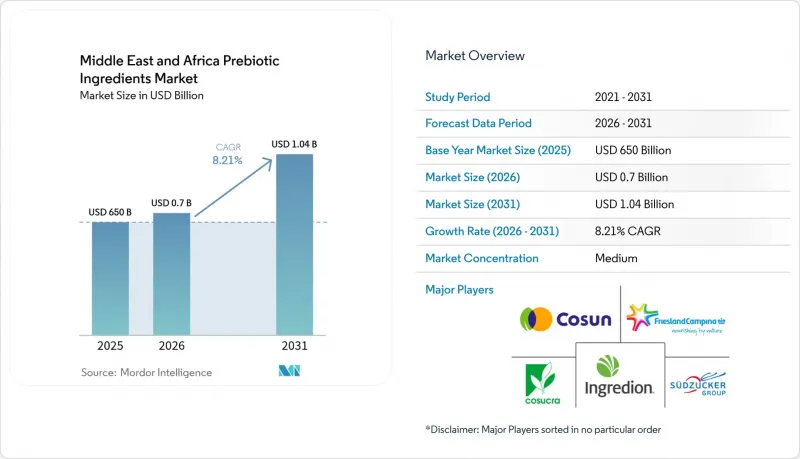
This report is Segmented by Ingredient Type (Inulin, Fructo-Oligosaccharides (FOS), Galacto-Oligosaccharides (GOS), Other Ingredients), Application (Infant Formula, Fortified Food and Beverage, Dietary Supplements, and More), and Country (South Africa, Saudi Arabia, United Arab Emirates, Nigeria, Egypt, and More). The Market Forecasts are Provided in Terms of Value (USD).
Middle East And Africa Prebiotic Ingredients Market Trends and Insights
Rising gut health awareness and digestive issues
The increasing awareness of gut health and the prevalence of digestive issues are driving the demand for prebiotic ingredients in the region. Consumers are recognizing the strong connection between immune function and gut health. Digestive disorders have seen a significant rise, with a 2025 study titled "Socioeconomic and Demographic Disparities in the Impact of Digestive Diseases in the Middle East and North Africa (MENA) Region" reporting that total cases of digestive diseases in MENA increased from 19.7 million to 45.4 million, as per the National Library of Medicine . This sharp rise highlights the growing health burden and the increasing demand for products that support digestive health and immunity. Consumers are becoming more aware that maintaining gut health can enhance immune resilience, driving interest in functional foods and supplements containing prebiotic fibers. In response to this trend, brands like Danone are addressing the demand with fortified dairy and infant nutrition products that include prebiotic ingredients aimed at optimizing gut microbiota. This focus on health is also fostering innovation in product development, particularly in infant nutrition and adult digestive health supplements, contributing to the growth of the prebiotic ingredients market in the Middle East and Africa, where gut health is a prominent health concern. The combination of rising digestive disease rates and increasing healthcare awareness continues to support growth opportunities for prebiotic ingredients in the region. This dynamic is shaping consumer education, brand strategies, and product portfolio expansions, all aligned with the emphasis on gut-mediated immune health in the Middle East and Africa markets.
Expansion of functional foods and beverages
The reformulation of functional food and beverages is advancing across urban areas in the Middle East and Africa, driven by rising incomes, a growing expatriate population, and rapid retail modernization, which are increasing the demand for healthier product options. For instance, Tate & Lyle highlighted this trend by showcasing its EUOLIGO fructo-oligosaccharides (FOS) and TASTEVA M stevia at Gulfood Manufacturing in November 2024, targeting beverage and confectionery manufacturers in the region seeking to reduce sugar content while maintaining sweetness and taste. Also, Euoligo Fos supports sugar reduction and fiber fortification, addressing important health concerns such as digestive health and overall nutritional quality. This innovation aligns with consumer preferences for natural, reduced-sugar ingredients, reflecting growing health awareness and regulatory pressures to lower sugar consumption. These reformulations address the demand for functional benefits, such as improved digestive health supported by prebiotic fibers, while also responding to broader cultural shifts toward wellness and preventive health among increasingly health-conscious and cosmopolitan urban populations. The combination of evolving consumer preferences and advancements in ingredient technology, as demonstrated by Tate & Lyle's offerings, is driving growth in the prebiotic ingredients segment of the functional foods and beverages market. Furthermore, these products enable manufacturers to differentiate themselves in a competitive retail environment that is increasingly focused on premiumization and clean-label trends, fostering sustained innovation and market expansion driven by consumer demand for products that deliver both health benefits and sensory quality in everyday foods and beverages.
High import dependency and chicory-inulin price volatility
Reliance on imports and price volatility of chicory-inulin pose significant challenges for the prebiotic ingredients market in the Middle East and Africa (MEA). The region depends heavily on imported chicory-derived inulin and fructooligosaccharides (FOS) from Europe and Asia due to limited local production of essential raw materials like chicory roots. This dependency increases exposure to global supply chain disruptions, rising logistics costs, and fluctuating freight rates, which amplify procurement risks given the region's distance from primary production hubs. Chicory-inulin prices are particularly volatile, influenced by weather conditions affecting European harvests, currency fluctuations, and competing demands from larger markets, creating uncertainty in formulation budgets and long-term contracts. For instance, periodic price adjustments for BENEO's Orafti inulin, a leading branded chicory prebiotic, impact MEA supply chains, forcing food and supplement producers to either absorb higher costs or seek alternatives. This situation discourages consistent inclusion rates, especially in cost-sensitive applications such as dairy, bakery, and infant nutrition, where profit margins are tight. Additionally, regional manufacturers face challenges in negotiating favorable terms with distant suppliers, often resulting in higher landed costs compared to domestic alternatives in more self-sufficient markets. While efforts to explore local blending or alternative fibers like acacia are underway, these measures are insufficient to offset chicory-inulin's dominance in premium prebiotic formulations. Consequently, market growth remains constrained, emphasizing the need for diversified sourcing strategies and regional production investments to mitigate these challenges.
Other drivers and restraints analyzed in the detailed report include:
- Product reformulation for sugar and calorie reduction
- Growing focus on gut health drives use of prebiotic fibers in pet foods and feed additives
- Limited consumer awareness in many developing markets
For complete list of drivers and restraints, kindly check the Table Of Contents.
Segment Analysis
Inulin held 45.83% of the ingredient-type share in 2025, driven by its cost-effectiveness, clean-label appeal, and decades of clinical validation that reinforce its role in digestive health and satiety applications across dairy, bakery, and supplements. Its versatility and established supply chains position inulin as the preferred fiber for manufacturers aiming to balance efficacy with affordability in premium formulations. Meanwhile, galacto-oligosaccharides (GOS) are projected to grow at a 9.98% CAGR through 2031, the fastest among ingredient types. This growth is attributed to their potent bifidogenic effects, which selectively nourish beneficial gut bacteria, and strong regulatory acceptance, particularly in infant formula, where GOS mimics human milk oligosaccharides for immune and digestive support. The increasing demand in urban markets is challenging inulin's lead as GOS adoption rises in early-life nutrition.
Fructo-oligosaccharides (FOS) maintain a balanced position in the market, valued for their neutral taste profile that enables seamless integration into beverage and confectionery applications without altering sensory qualities. For example, Tate & Lyle's EUOLIGO FOS, showcased at Gulfood Manufacturing in November 2024, supports sugar reduction efforts in the Middle East. Additionally, other ingredients like mannan-oligosaccharides (MOS) and functional fibers such as resistant starch and pectin are steadily gaining traction in animal feed and specialized human nutrition. These alternatives, despite having less robust clinical evidence compared to inulin and GOS, address niche applications such as pet nutrition and metabolic health, contributing to diversified portfolio strategies in the evolving prebiotic ingredients market.
Complete Report Scope:
- By Ingredient Type
- Inulin
- Fructo-oligosaccharides (FOS)
- Galacto-oligosaccharides (GOS)
- Other Ingredients (MOS and Other Functional Fibres)
- By Application
- Infant Formula
- Fortified Food and Beverage
- Dietary Supplements
- Animal Feed
- Other Applications
- By Country
- South Africa
- Saudi Arabia
- United Arab Emirates
- Nigeria
- Egypt
- Morocco
- Turkey
- Rest of Middle East and Africa
List of Companies Covered in this Report:
- Sudzucker Group
- Cooperatie Koninklijke Cosun U.A.
- Ingredion Incorporated
- Royal FrieslandCampina N.V.
- Baolingbao Biology Co., Ltd.
- Cosucra Groupe Warcoing SA
- Fonterra Co-operative Group Limited
- Tereos S.A.
- AIDP, Inc. (Olygose SAS)
- Nexira Group
- Tate & Lyle plc
- Kerry Group Plc
- Roquette Freres
- DSM-firmenich AG
- International Flavors & Fragrances Inc. (IFF)
- Clasado Biosciences Ltd.
- Jennewein Biotechnologie GmbH
- BASF SE
- Samyang Corp.
- Novonesis
Additional Benefits:
- The market estimate (ME) sheet in Excel format
- 3 months of analyst support
TABLE OF CONTENTS
1 INTRODUCTION
- 1.1 Study Assumptions and Market Definition
- 1.2 Scope of the Study
2 RESEARCH METHODOLOGY
3 EXECUTIVE SUMMARY
4 MARKET DYNAMICS
- 4.1 Market Overview
- 4.2 Market Drivers
- 4.2.1 Rising gut health awareness and digestive issues
- 4.2.2 Expansion of functional foods and beverages
- 4.2.3 Focus on infant and early-life nutrition
- 4.2.4 Government nutrition and fortification programmes
- 4.2.5 Product reformulation for sugar and calorie reduction
- 4.2.6 Growing focus on gut health drives use of prebiotic fibers in pet foods and feed additives
- 4.3 Market Restraints
- 4.3.1 High import dependency and chicory-inulin price volatility
- 4.3.2 Price sensitivity at manufacturer level
- 4.3.3 Limited consumer awareness in many developing markets
- 4.3.4 Regulatory ambiguity on "prebiotic" label claims
- 4.4 Supply Chain Analysis
- 4.5 Regulatory Landscape
- 4.6 Technological Outlook
- 4.7 Porter's Five Forces
- 4.7.1 Threat of New Entrants
- 4.7.2 Bargaining Power of Suppliers
- 4.7.3 Bargaining Power of Buyers
- 4.7.4 Threat of Substitutes
- 4.7.5 Intensity of Competitive Rivalry
5 MARKET SIZE AND GROWTH FORECASTS (VALUE)
- 5.1 By Ingredient Type
- 5.1.1 Inulin
- 5.1.2 Fructo-oligosaccharides (FOS)
- 5.1.3 Galacto-oligosaccharides (GOS)
- 5.1.4 Other Ingredients (MOS and Other Functional Fibres)
- 5.2 By Application
- 5.2.1 Infant Formula
- 5.2.2 Fortified Food and Beverage
- 5.2.3 Dietary Supplements
- 5.2.4 Animal Feed
- 5.2.5 Other Applications
- 5.3 By Country
- 5.3.1 South Africa
- 5.3.2 Saudi Arabia
- 5.3.3 United Arab Emirates
- 5.3.4 Nigeria
- 5.3.5 Egypt
- 5.3.6 Morocco
- 5.3.7 Turkey
- 5.3.8 Rest of Middle East and Africa
6 COMPETITIVE LANDSCAPE
- 6.1 Market Concentration
- 6.2 Strategic Moves
- 6.3 Market Positioning Analysis
- 6.4 Company Profiles (includes Global level Overview, Market level overview, Core Segments, Financials as available, Strategic Information, Market Rank/Share for key companies, Products and Services, and Recent Developments)
- 6.4.1 Sudzucker Group
- 6.4.2 Cooperatie Koninklijke Cosun U.A.
- 6.4.3 Ingredion Incorporated
- 6.4.4 Royal FrieslandCampina N.V.
- 6.4.5 Baolingbao Biology Co., Ltd.
- 6.4.6 Cosucra Groupe Warcoing SA
- 6.4.7 Fonterra Co-operative Group Limited
- 6.4.8 Tereos S.A.
- 6.4.9 AIDP, Inc. (Olygose SAS)
- 6.4.10 Nexira Group
- 6.4.11 Tate & Lyle plc
- 6.4.12 Kerry Group Plc
- 6.4.13 Roquette Freres
- 6.4.14 DSM-firmenich AG
- 6.4.15 International Flavors & Fragrances Inc. (IFF)
- 6.4.16 Clasado Biosciences Ltd.
- 6.4.17 Jennewein Biotechnologie GmbH
- 6.4.18 BASF SE
- 6.4.19 Samyang Corp.
- 6.4.20 Novonesis
7 MARKET OPPORTUNITIES AND FUTURE OUTLOOK

