PUBLISHER: Mordor Intelligence | PRODUCT CODE: 2114311

PUBLISHER: Mordor Intelligence | PRODUCT CODE: 2114311
South America Alcoholic Beverages - Market Share Analysis, Industry Trends & Statistics, Growth Forecasts (2026 - 2031)
According to Mordor Intelligence, south american alcoholic beverages market size in 2026 is estimated at USD 39.72 billion, growing from 2025 value of USD 38.04 billion with 2031 projections showing USD 49.28 billion, growing at 4.41% CAGR over 2026-2031.
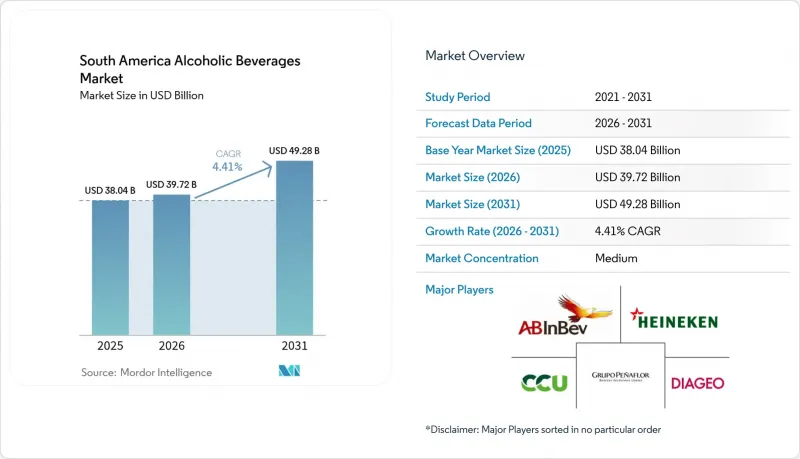
This report is Segmented by Product Type (Beer, Wine, Spirits, and Others), End User (Male, Female), Packaging (Bottles, Cans, and Others), Distribution Channel (On-Trade, Off-Trade), and Geography (Brazil, Argentina, Colombia, Chile, Peru, and Rest of South America). The Market Forecasts are Provided in Terms of Value and Volume.
South America Alcoholic Beverages Market Trends and Insights
Premiumization and Craft-Product Boom
The craft beer revolution transforms South America's alcoholic beverages landscape as consumers increasingly seek authentic, artisanal experiences over mass-market alternatives. Zero-alcohol beer in Brazil has experienced remarkable growth in recent years, highlighting how premiumization is expanding beyond conventional alcoholic beverages and gaining traction among health-conscious consumers. This trend reflects deeper consumer sophistication, where price sensitivity coexists with willingness to pay premiums for perceived quality and unique positioning. Regional craft breweries leverage local ingredients and cultural narratives to differentiate from multinational brands, creating micro-markets that command higher margins despite volume constraints. The premiumization wave extends to spirits, where aged rums, artisanal cachacas, and small-batch piscos gain traction among urban millennials and Generation Z consumers seeking Instagram-worthy experiences. Traditional players respond through acquisition strategies and premium line extensions, recognizing that craft positioning often translates to sustainable competitive advantages in saturated markets.
Product Innovation and New Flavors
Innovation cycles accelerate as beverage companies race to capture evolving taste preferences and lifestyle demands across South America's diverse consumer base. The ready-to-drink segment experiences explosive innovation, with Absolut and Sprite launching collaborative RTD products in Brazil during 2024, targeting consumers seeking convenience without compromising on brand prestige. Functional beverages gain prominence as health-conscious consumers demand products that deliver beyond basic refreshment, incorporating adaptogens, probiotics, and natural energy enhancers. Companies are forming partnerships to develop products such as non-alcoholic coffee beer, showcasing cross-category innovation that taps into regional coffee traditions while aligning with evolving preferences for mindful consumption. These innovations often succeed by combining familiar local flavors with international formats, creating products that feel both globally sophisticated and culturally relevant.
Escalating Excise Taxes and Complex Regulations
Regulatory complexity intensifies across South America as governments balance public health objectives with revenue generation, creating compliance burdens that disproportionately impact smaller producers and importers. Colombia introduces health-focused taxation through DIAN forms targeting ultra-processed beverages in 2025, reflecting regional trends toward sin taxes that create pricing pressures and administrative complexity. These regulatory shifts often favor large multinational corporations with dedicated compliance teams while creating barriers for craft producers and importers who lack the resources to navigate evolving requirements. Tax harmonization remains elusive across South American markets, forcing companies to maintain separate compliance systems for each jurisdiction and limiting economies of scale in production and distribution strategies.
Other drivers and restraints analyzed in the detailed report include:
- Explosive Growth of Low and Functional RTDs
- Growing Cocktail Culture
- Rising Health Concerns and Shift toward Non-Alcoholic Alternatives
For complete list of drivers and restraints, kindly check the Table Of Contents.
Segment Analysis
Beer maintains commanding market leadership with 61.54% share in 2025, reflecting South America's strong brewing traditions and price-sensitive consumer base, yet spirits emerge as the fastest-growing segment with 5.31% CAGR through 2031. This growth divergence signals fundamental shifts in consumption patterns as urbanization and rising disposable incomes drive premiumization trends that favor higher-margin spirit categories. Wine occupies a stable middle position, particularly strong in Argentina and Chile, where domestic production advantages create competitive pricing and cultural affinity.
Spirits growth acceleration reflects cocktail culture expansion, premiumization trends, and strategic brand positioning that targets aspirational consumers seeking sophisticated drinking experiences. The segment benefits from tourism growth, urban nightlife development, and social media influence that positions premium spirits as lifestyle signaling tools. Beer's mature market position creates defensive strategies focused on innovation, packaging optimization, and distribution efficiency rather than aggressive volume expansion, while wine faces pressure from climate-related production challenges and international competition that constrains growth potential despite regional production advantages.
Male consumers dominate with 68.02% market share in 2025, reflecting traditional consumption patterns and cultural norms across South America, while female consumption accelerates at 4.93% CAGR through 2031 as brands recognize this demographic's growth potential and purchasing power. This shift reflects broader social changes, including urbanization, workforce participation, and evolving gender roles that normalize female alcohol consumption across previously conservative markets. Female-targeted products emphasize lower alcohol content, sophisticated flavors, wellness positioning, and premium packaging that appeals to quality-conscious consumers willing to pay premiums for products that align with lifestyle aspirations.
The female segment's growth trajectory creates strategic opportunities for brands that successfully position products beyond traditional male-oriented marketing approaches. Marketing strategies increasingly emphasize social responsibility, health consciousness, and premium positioning that resonates with female consumers' decision-making criteria, while traditional male-focused beer marketing adapts to include broader demographic appeal without alienating core constituencies.
Complete Report Scope:
- By Product Type
- Beer
- Ale Beer
- Lager
- Non/Low-Alcohol Beer
- Others
- Wine
- Fortified Wine
- Still Wine
- Sparkling Wine
- Other Wine Types
- Spirits
- Brandy and Cognac
- Liqueur
- Rum
- Tequila and Mezcel
- Whiskies
- White Spirits
- Other Spirit Types
- Others
- Beer
- By End User
- Male
- Female
- By Packaging
- Bottles
- Cans
- Others
- By Distribution Channel
- On-Trade
- Off-Trade
- Specialty/Liquor Stores
- Other Off Trade Channels
- By Geography
- Brazil
- Argentina
- Colombia
- Chile
- Peru
- Rest of South America
List of Companies Covered in this Report:
- Anheuser-Busch InBev (Ambev)
- Heineken N.V.
- Diageo plc
- Grupo Penaflor
- Cervejaria Petropolis S/A
- CCU S.A.
- Brown-Forman Corp.
- Companhia Muller de Bebidas
- Pernod Ricard SA
- Suntory Global Spirits Inc.
- Bacardi Ltd.
- Campari Group
- Constellation Brands Inc.
- Vina Concha y Toro S.A.
- Bodega Catena Zapata
- Kirin Holdings (Brasil Kirin)
- Asahi Group Holdings
- Grupo Icasa (Cachaca 51)
- Compania de Las Cervecerias Peruanas Backus y Johnston
- Vina Santa Rita
Additional Benefits:
- The market estimate (ME) sheet in Excel format
- 3 months of analyst support
TABLE OF CONTENTS
1 INTRODUCTION
- 1.1 Study Assumptions and Market Definition
- 1.2 Scope of the Study
2 RESEARCH METHODOLOGY
3 EXECUTIVE SUMMARY
4 MARKET LANDSCAPE
- 4.1 Market Overview
- 4.2 Market Drivers
- 4.2.1 Premiumization and craft-product boom
- 4.2.2 Product innovation and new flavors
- 4.2.3 Explosive growth of low and functional RTDs
- 4.2.4 Growing cocktail culture
- 4.2.5 Cultural heritage and local traditions
- 4.2.6 Influence of tourism and festivals
- 4.3 Market Restraints
- 4.3.1 Escalating excise taxes and complex regulations
- 4.3.2 Rising health concerns and shift toward non-alcoholic alternatives
- 4.3.3 Climate-driven water stress hitting barley and grape yields
- 4.3.4 Counterfeit products and informal alcohol trade
- 4.4 Value Chain Analysis
- 4.5 Technological Outlook
- 4.6 Regulatory Landscape
- 4.7 Porter's Five Forces
- 4.7.1 Threat of New Entrants
- 4.7.2 Bargaining Power of Buyers/Consumers
- 4.7.3 Bargaining Power of Suppliers
- 4.7.4 Threat of Substitute Products
- 4.7.5 Intensity of Competitive Rivalry
5 MARKET SIZE AND GROWTH FORECASTS (VALUE AND VOLUME)
- 5.1 By Product Type
- 5.1.1 Beer
- 5.1.1.1 Ale Beer
- 5.1.1.2 Lager
- 5.1.1.3 Non/Low-Alcohol Beer
- 5.1.1.4 Others
- 5.1.2 Wine
- 5.1.2.1 Fortified Wine
- 5.1.2.2 Still Wine
- 5.1.2.3 Sparkling Wine
- 5.1.2.4 Other Wine Types
- 5.1.3 Spirits
- 5.1.3.1 Brandy and Cognac
- 5.1.3.2 Liqueur
- 5.1.3.3 Rum
- 5.1.3.4 Tequila and Mezcel
- 5.1.3.5 Whiskies
- 5.1.3.6 White Spirits
- 5.1.3.7 Other Spirit Types
- 5.1.4 Others
- 5.1.1 Beer
- 5.2 By End User
- 5.2.1 Male
- 5.2.2 Female
- 5.3 By Packaging
- 5.3.1 Bottles
- 5.3.2 Cans
- 5.3.3 Others
- 5.4 By Distribution Channel
- 5.4.1 On-Trade
- 5.4.2 Off-Trade
- 5.4.2.1 Specialty/Liquor Stores
- 5.4.2.2 Other Off Trade Channels
- 5.5 By Geography
- 5.5.1 Brazil
- 5.5.2 Argentina
- 5.5.3 Colombia
- 5.5.4 Chile
- 5.5.5 Peru
- 5.5.6 Rest of South America
6 COMPETITIVE LANDSCAPE
- 6.1 Market Concentration
- 6.2 Strategic Moves
- 6.3 Market Share Analysis
- 6.4 Company Profiles (includes Global level Overview, Market level overview, Core Segments, Financials (if available), Strategic Information, Market Rank/Share for key companies, Products, and Recent Developments)
- 6.4.1 Anheuser-Busch InBev (Ambev)
- 6.4.2 Heineken N.V.
- 6.4.3 Diageo plc
- 6.4.4 Grupo Penaflor
- 6.4.5 Cervejaria Petropolis S/A
- 6.4.6 CCU S.A.
- 6.4.7 Brown-Forman Corp.
- 6.4.8 Companhia Muller de Bebidas
- 6.4.9 Pernod Ricard SA
- 6.4.10 Suntory Global Spirits Inc.
- 6.4.11 Bacardi Ltd.
- 6.4.12 Campari Group
- 6.4.13 Constellation Brands Inc.
- 6.4.14 Vina Concha y Toro S.A.
- 6.4.15 Bodega Catena Zapata
- 6.4.16 Kirin Holdings (Brasil Kirin)
- 6.4.17 Asahi Group Holdings
- 6.4.18 Grupo Icasa (Cachaca 51)
- 6.4.19 Compania de Las Cervecerias Peruanas Backus y Johnston
- 6.4.20 Vina Santa Rita
7 MARKET OPPORTUNITIES AND FUTURE OUTLOOK

