PUBLISHER: Mordor Intelligence | PRODUCT CODE: 2114312

PUBLISHER: Mordor Intelligence | PRODUCT CODE: 2114312
Europe Nutricosmetics - Market Share Analysis, Industry Trends & Statistics, Growth Forecasts (2026 - 2031)
According to Mordor Intelligence, the European nutricosmetics market size was valued at USD 2.27 billion in 2025 and estimated to grow from USD 2.44 billion in 2026 to reach USD 3.48 billion by 2031, at a CAGR of 7.36% during the forecast period (2026-2031).
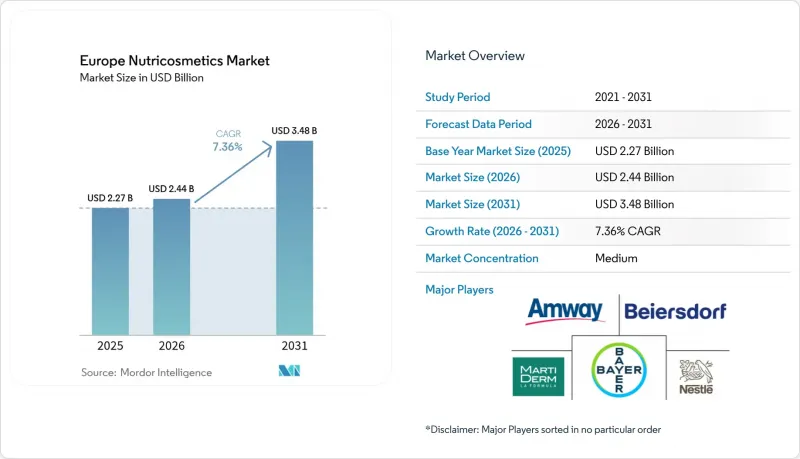
This report is Segmented by Product Type (Collagen and Peptides, Botanical Extracts, and More), Form (Tablets/Capsules, Liquids, and More), Distribution Channel (Supermarkets/Hypermarkets, Online Retail Stores, and More), and Country (United Kingdom, Germany, France, Italy, and More). The Market Forecasts are Provided in Terms of Value (USD).
Europe Nutricosmetics Market Trends and Insights
Increasing awareness of nutrient deficiencies and their impact on skin, hair, and nail health
Awareness about micronutrient deficiencies is increasing across Europe, significantly driving the growth of the nutricosmetics market. The Zero Hidden Hunger EU project, launched in 2024 and set to run until 2027, highlights that nearly 70% of Europeans belong to groups at higher risk of nutrient deficiencies. These groups include children, teenagers, women of childbearing age, older adults, immigrants, and socially disadvantaged populations, according to the European Food Information Council. The project involves 19 partner organizations from 12 countries working together to identify the extent of nutrient deficiencies and assess their health and economic impacts. The findings reveal that a lack of essential vitamins and minerals can directly affect skin elasticity, hair strength, and nail health. As a result, more consumers are turning to nutricosmetics products designed to improve beauty from within by addressing these deficiencies.
Higher consumer willingness to invest in premium self-care routines
Europeans are increasingly willing to spend on premium self-care products, which is driving significant growth in the nutricosmetics market. Personalized subscription services, such as those offered by Persona and The Nue Co., are transforming how consumers approach supplementation. Instead of viewing it as a one-time purchase, they now see it as an ongoing wellness routine. In the United Kingdom, a survey conducted by the PAGB Organization in July 2025 revealed that 84% of adults preferred self-care as their first choice for addressing health needs. This indicates a clear shift toward proactive and preventive health practices. As a result, more consumers across Europe are opting for high-quality, innovative nutricosmetic products that align with their focus on long-term wellness and self-care. The growing demand for experiential solutions within the category further supports this trend.
Strict European regulations on health and beauty claims
Strict regulatory oversight is posing significant challenges for nutricosmetics brands in Europe. In April 2025, the European Court of Justice mandated the uniform enforcement of Regulation 1924/2006, requiring all companies to provide strong scientific evidence to support any health or beauty claims they make. This change has raised compliance standards across the region, giving an advantage to larger multinational companies that have the financial resources to conduct clinical trials and maintain extensive regulatory teams. On the other hand, smaller companies, which often lack the budget for expensive evidence generation, are being forced to shift their focus toward general wellness messaging instead of making specific claims about product efficacy. As a result, these stricter rules are slowing down innovation for new entrants and increasing the overall cost of entering and competing in the market.
Other drivers and restraints analyzed in the detailed report include:
- Growing preference for natural, clean-label, and plant-based ingredients
- Launch of sugar-free gummies and low-calorie drinkable beauty shots
- Sustainability concerns related to sourcing marine ingredients
For complete list of drivers and restraints, kindly check the Table Of Contents.
Segment Analysis
Collagen and peptides are the key components driving the European nutricosmetics market in 2025, contributing 42.88% of the total revenue. Consumers highly trust these ingredients for their proven benefits in improving skin elasticity, firmness, and joint health. Products made from marine and bovine collagen are gaining popularity, available in various formats, including powders, gummies, and drinkable shots. The growing presence of these products in pharmacies and online platforms, along with a shift toward premium options such as hydrolyzed collagen or enhanced bioavailability formulations, is further boosting their demand.
Probiotics and postbiotics are emerging as the fastest-growing segment in the market, with an expected CAGR of 9.20% through 2031. This growth is driven by increasing awareness of the connection between gut health and skin health, as well as the role of the microbiome in addressing issues such as acne, sensitivity, and inflammation. Companies are focusing on creating strain-specific formulations backed by scientific research to cater to consumer demand for natural and effective solutions. Additionally, advancements in encapsulation technologies and the introduction of functional beverages are making probiotics and postbiotics more appealing and accessible to consumers across Europe.
Complete Report Scope:
- By Product Type
- Collagen and Peptides
- Vitamins and Minerals
- Omega-3 and EFAs
- Probiotics and Postbiotics
- Botanical Extracts
- Others
- By Form
- Tablets/Capsules
- Powders
- Liquids
- Gummies
- Others
- By Distribution Channel
- Supermarkets/Hypermarkets
- Health and Beauty Stores
- Online Retail Stores
- Others
- By Country
- United Kingdom
- Germany
- France
- Italy
- Spain
- Netherlands
- Sweden
- Poland
- Switzerland
- Rest of Europe
List of Companies Covered in this Report:
- Amway Corporation
- MartiDerm Group
- Pfizer Ltd.
- Lonza Group Ltd.
- Reckitt Benckiser Group plc
- Otsuka Holdings Co. Ltd.
- Beiersdorf AG
- Lucas Meyer Cosmetics
- Kerry Group PLC
- PB Leiner
- BASF SE
- Givaudan SA
- Vitabiotics Ltd.
- Blackmores Ltd.
- Lapi Gelatine S.p.A.
- Nestle SA
- Bayer AG
- DSM-Firmenich
- Havea Group (Biocyte)
- Unilever PLC
Additional Benefits:
- The market estimate (ME) sheet in Excel format
- 3 months of analyst support
TABLE OF CONTENTS
1 INTRODUCTION
- 1.1 Study Assumptions and Market Definition
- 1.2 Scope of the Study
2 RESEARCH METHODOLOGY
3 EXECUTIVE SUMMARY
4 MARKET LANDSCAPE
- 4.1 Market Overview
- 4.2 Market Drivers
- 4.2.1 Higher consumer willingness to invest in premium self care routines
- 4.2.2 Rising demand for ingestible collagen among fitness and wellness communities
- 4.2.3 Growing preference for natural, clean label, and plant based ingredients
- 4.2.4 Increasing awareness of nutrient deficiencies and their impact on skin, hair, and nail health
- 4.2.5 Launch of sugar free gummies and low calorie drinkable beauty shots
- 4.2.6 Beauty influencers collaborations with brands to co create limited edition nutricosmetics
- 4.3 Market Restraints
- 4.3.1 High product costs limit adoption among price sensitive consumers
- 4.3.2 Strict European regulations on health and beauty claims
- 4.3.3 Growing concerns about counterfeit and low quality supplements
- 4.3.4 Sustainability concerns related to sourcing marine ingredients
- 4.4 Regulatory Outlook
- 4.5 Consumer Behaviour Analysis
- 4.6 Porter's Five Forces
- 4.6.1 Threat of New Entrants
- 4.6.2 Bargaining Power of Buyers
- 4.6.3 Bargaining Power of Suppliers
- 4.6.4 Threat of Substitute Products
- 4.6.5 Intensity of Competitive Rivalry
5 MARKET SIZE AND GROWTH FORECASTS (VALUE)
- 5.1 By Product Type
- 5.1.1 Collagen and Peptides
- 5.1.2 Vitamins and Minerals
- 5.1.3 Omega-3 and EFAs
- 5.1.4 Probiotics and Postbiotics
- 5.1.5 Botanical Extracts
- 5.1.6 Others
- 5.2 By Form
- 5.2.1 Tablets/Capsules
- 5.2.2 Powders
- 5.2.3 Liquids
- 5.2.4 Gummies
- 5.2.5 Others
- 5.3 By Distribution Channel
- 5.3.1 Supermarkets/Hypermarkets
- 5.3.2 Health and Beauty Stores
- 5.3.3 Online Retail Stores
- 5.3.4 Others
- 5.4 By Country
- 5.4.1 United Kingdom
- 5.4.2 Germany
- 5.4.3 France
- 5.4.4 Italy
- 5.4.5 Spain
- 5.4.6 Netherlands
- 5.4.7 Sweden
- 5.4.8 Poland
- 5.4.9 Switzerland
- 5.4.10 Rest of Europe
6 COMPETITIVE LANDSCAPE
- 6.1 Market Concentration
- 6.2 Strategic Moves
- 6.3 Market Positioning Analysis
- 6.4 Company Profiles (includes Global-level Overview, Market-level Overview, Core Segments, Financials (if available), Strategic Information, Market Rank/Share, Products and Services, Recent Developments)
- 6.4.1 Amway Corporation
- 6.4.2 MartiDerm Group
- 6.4.3 Pfizer Ltd.
- 6.4.4 Lonza Group Ltd.
- 6.4.5 Reckitt Benckiser Group plc
- 6.4.6 Otsuka Holdings Co. Ltd.
- 6.4.7 Beiersdorf AG
- 6.4.8 Lucas Meyer Cosmetics
- 6.4.9 Kerry Group PLC
- 6.4.10 PB Leiner
- 6.4.11 BASF SE
- 6.4.12 Givaudan SA
- 6.4.13 Vitabiotics Ltd.
- 6.4.14 Blackmores Ltd.
- 6.4.15 Lapi Gelatine S.p.A.
- 6.4.16 Nestle SA
- 6.4.17 Bayer AG
- 6.4.18 DSM-Firmenich
- 6.4.19 Havea Group (Biocyte)
- 6.4.20 Unilever PLC
7 MARKET OPPORTUNITIES AND FUTURE OUTLOOK

