PUBLISHER: Mordor Intelligence | PRODUCT CODE: 2114330

PUBLISHER: Mordor Intelligence | PRODUCT CODE: 2114330
Europe Ready-to-Eat Food - Market Share Analysis, Industry Trends & Statistics, Growth Forecasts (2026 - 2031)
According to Mordor Intelligence, the Europe ready to eat food market size is expected to grow from USD 91.51 billion in 2025 to USD 97.23 billion in 2026 and is forecast to reach USD 131.64 billion by 2031 at 6.25% CAGR over 2026-2031.
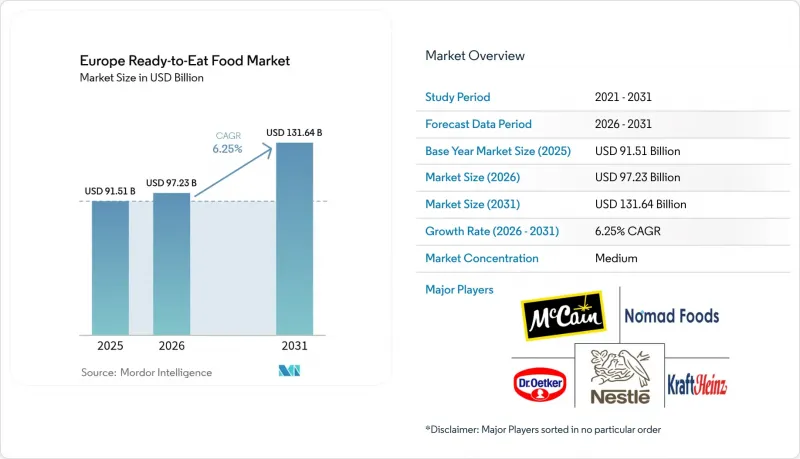
This report is Segmented by Product Type (Instant Breakfast/Cereals, Instant Soups and Snacks, Ready Meals, and More), Category (Conventional, Organic/Clean Label), Distribution Channels (Supermarkets/Hypermarkets, Convenience Stores, and More), and Geography (United Kingdom, Germany, France, Italy, Spain, Russia, Sweden, and More). The Market Forecasts are Provided in Terms of Value (USD).
Europe Ready-to-Eat Food Market Trends and Insights
Rising number of single-person households and dual-income families
The growing number of single-person households in Europe is reshaping the ready-to-eat (RTE) food market, boosting demand for single-serve and individually portioned meals. Eurostat data shows that between 2015 and 2024, single-person households without children in the European Union increased by 16.9%, compared to a 5.8% rise in all households . This demographic shift has driven consistent demand for portion-controlled, shelf-stable products that help reduce food waste while providing restaurant-quality experiences at home. The trend is further supported by the rise of dual-income families. In 2024, Eurostat reported that 57.8% of European Union households had all adults employed, either part-time or full-time . This reduces available cooking time and increases the willingness to pay a premium for convenience without sacrificing nutritional quality. Furthermore, smaller households spend more per capita on premium ready meals than traditional family units, driving not only volume growth but also product sophistication. Companies that offer single-serve formats and position their products as premium are well-placed to capture significant value in this expanding market segment.
Advancements in shelf-stable and chilled packaging technology
Technological advancements in Modified Atmosphere Packaging (MAP) are transforming supply chains and market reach for European ready-to-eat meal producers. These innovations extend product shelf life by 2 to 5 times compared to traditional packaging methods. Advanced gas-flush systems, which precisely balance CO2, N2, and O2, now preserve product integrity for weeks instead of days. This enables manufacturers to serve wider geographic markets while significantly reducing food waste across the value chain. The technology is particularly impactful for meat products and fresh pasta segments, where extended shelf life facilitates export opportunities and supports premium market positioning by maintaining visual appeal and nutritional value. European packaging machinery suppliers report a rapid increase in MAP adoption as producers seek to differentiate themselves through extended freshness claims. Implementation costs are offset by simplified logistics and expanded market access.
Ultra-processed food scrutiny creates reformulation pressure
Growing consumer awareness of the health risks associated with ultra-processed foods is driving regulatory momentum across European markets. However, the likelihood of comprehensive legislation remains low despite increasing pressure. The European Food Safety Authority (EFSA) continues to prioritize novel food assessments and nutritional transparency, adding complexity to compliance for ready-to-eat food manufacturers, particularly those with extensive ingredient lists or reliance on processing aids. At the same time, consumer advocacy groups are using the NOVA classification system to influence purchasing behavior, compelling companies to invest in reformulating products to reduce processing intensity while preserving taste and shelf stability. This regulatory uncertainty is challenging for companies, as it extends innovation timelines and raises development costs while they navigate evolving compliance requirements and maintain competitive positioning.
Other drivers and restraints analyzed in the detailed report include:
- Demand for plant-based and alternative protein meals
- Growth in the food processing industry
- Premium pricing vulnerability amid economic headwinds
For complete list of drivers and restraints, kindly check the Table Of Contents.
Segment Analysis
Ready meals contributed 36.12% of total revenue in 2025, emphasizing their popularity among time-constrained consumers. With brands introducing seasonal flavors and diverse cuisines, the European ready-to-eat food market is expected to grow steadily. Birds Eye's Mediterranean pasta range showcases the industry's move toward vegetable-focused options that combine indulgence with health benefits. Additionally, meat products, growing at a 7.2% CAGR (2026-2031), benefit from their high-protein appeal and advanced MAP solutions that preserve freshness and color. Fitness-focused consumers in markets like Germany and the U.K. increasingly prefer macro-labeled packaging, driving greater household adoption.
Instant breakfasts and soups continue to experience stable demand, supported by innovative sachet designs. Baked goods are adapting to the clean-label trend by replacing preservatives with natural enzymes. The "other" category, which primarily includes plant-based and ethnic specialties, acts as an incubator for niche concepts that could transition to mainstream retail. Across all segments, companies navigate EFSA's novel food pathway, weighing dossier costs against the advantages of being a first mover.
Complete Report Scope:
- Product Type
- Instant Breakfast / Cereals
- Instant Soups and Snacks
- Ready Meals
- Baked Goods
- Meat Products
- Other Product Types
- Category
- Conventional
- Organic/Clean Label
- Distribution Channels
- Supermarkets/Hypermarkets
- Convenience Stores
- Online Retail Stores
- Other Retail Channels
- Countries
- United Kingdom
- Germany
- France
- Italy
- Spain
- Russia
- Sweden
- Belgium
- Poland
- Netherlands
- Rest of Europe
List of Companies Covered in this Report:
- Nestle S.A.
- Nomad Foods Ltd
- Premier Foods Group Ltd
- McCain Foods Limited
- Ebro Foods S.A.
- Dr. Oetker KG
- Unilever PLC
- Kraft Heinz Company
- Frosta AG
- Kellanova
- BandG Foods, Inc.
- Conagra Brands, Inc.
- Associated British Foods
- Orkla ASA
- Bakkafrost
- Aryzta AG
- Lantmannen
- Groupe Savencia
- Kerry Group
- Pladis
Additional Benefits:
- The market estimate (ME) sheet in Excel format
- 3 months of analyst support
TABLE OF CONTENTS
1 INTRODUCTION
- 1.1 Study Assumptions and Market Definition
- 1.2 Scope of the Study
2 RESEARCH METHODOLOGY
3 EXECUTIVE SUMMARY
4 MARKET LANDSCAPE
- 4.1 Market Overview
- 4.2 Market Drivers
- 4.2.1 Rising number of single-person households and dual-income families
- 4.2.2 Advancements in shelf-stable and chilled packaging technology
- 4.2.3 Demand for plant-based and alternative protein meals
- 4.2.4 Growth in the food processing industry
- 4.2.5 Product innovation and flavor diversification
- 4.2.6 Changing consumer lifestyles
- 4.3 Market Restraints
- 4.3.1 Ultra-processed food scrutiny creates reformulation pressure
- 4.3.2 Perceived lack of freshness and quality
- 4.3.3 Heightened nutritional-transparency expectations
- 4.3.4 Premium pricing vulnerability amid economic headwinds
- 4.4 Consumer Behaviour Analysis
- 4.5 Regulatory Landscape
- 4.6 Technological Outlook
- 4.7 Porter's Five Forces
- 4.7.1 Threat of New Entrants
- 4.7.2 Bargaining Power of Buyers
- 4.7.3 Bargaining Power of Suppliers
- 4.7.4 Threat of Substitutes
- 4.7.5 Intensity of Competitive Rivalry
5 MARKET SIZE AND GROWTH FORECASTS (VALUE)
- 5.1 Product Type
- 5.1.1 Instant Breakfast / Cereals
- 5.1.2 Instant Soups and Snacks
- 5.1.3 Ready Meals
- 5.1.4 Baked Goods
- 5.1.5 Meat Products
- 5.1.6 Other Product Types
- 5.2 Category
- 5.2.1 Conventional
- 5.2.2 Organic/Clean Label
- 5.3 Distribution Channels
- 5.3.1 Supermarkets/Hypermarkets
- 5.3.2 Convenience Stores
- 5.3.3 Online Retail Stores
- 5.3.4 Other Retail Channels
- 5.4 Countries
- 5.4.1 United Kingdom
- 5.4.2 Germany
- 5.4.3 France
- 5.4.4 Italy
- 5.4.5 Spain
- 5.4.6 Russia
- 5.4.7 Sweden
- 5.4.8 Belgium
- 5.4.9 Poland
- 5.4.10 Netherlands
- 5.4.11 Rest of Europe
6 COMPETITIVE LANDSCAPE
- 6.1 Market Concentration
- 6.2 Strategic Moves
- 6.3 Market Share Analysis
- 6.4 Company Profiles (includes Global level Overview, Market level overview, Core Segments, Financials as available, Strategic Information, Market Rank/Share for key companies, Products and Services, and Recent Developments)
- 6.4.1 Nestle S.A.
- 6.4.2 Nomad Foods Ltd
- 6.4.3 Premier Foods Group Ltd
- 6.4.4 McCain Foods Limited
- 6.4.5 Ebro Foods S.A.
- 6.4.6 Dr. Oetker KG
- 6.4.7 Unilever PLC
- 6.4.8 Kraft Heinz Company
- 6.4.9 Frosta AG
- 6.4.10 Kellanova
- 6.4.11 BandG Foods, Inc.
- 6.4.12 Conagra Brands, Inc.
- 6.4.13 Associated British Foods
- 6.4.14 Orkla ASA
- 6.4.15 Bakkafrost
- 6.4.16 Aryzta AG
- 6.4.17 Lantmannen
- 6.4.18 Groupe Savencia
- 6.4.19 Kerry Group
- 6.4.20 Pladis
7 MARKET OPPORTUNITIES AND FUTURE OUTLOOK

