PUBLISHER: Mordor Intelligence | PRODUCT CODE: 2114331

PUBLISHER: Mordor Intelligence | PRODUCT CODE: 2114331
India Crane - Market Share Analysis, Industry Trends & Statistics, Growth Forecasts (2026 - 2031)
According to Mordor Intelligence, the India crane market size was valued at USD 1.48 billion in 2025 and estimated to grow from USD 1.58 billion in 2026 to reach USD 2.18 billion by 2031, at a CAGR of 6.70% during the forecast period (2026-2031).
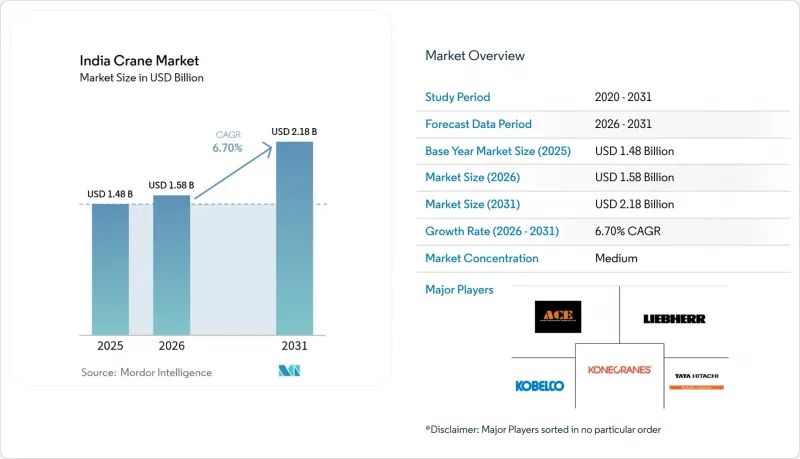
This report is Segmented by Machine Type (Mobile Cranes, Fixed/Tower Cranes, and More), Application (Construction, Mining and Excavation, Marine and Offshore, and More), Lifting Capacity (Below 20 Tons, 20-100 Tons, and More), Boom Type (Telescopic Boom, Lattice Boom, and More), by Power Source (Diesel, Hybrid, Fully-Electric). The Market Forecasts are Provided in Terms of Value (USD) and Volume in Units.
India Crane Market Trends and Insights
Surge in National Infrastructure Pipeline (NIP) Investments
The USD 1.4 trillion NIP funds highway, port, airport, and urban-transport projects, lifting annual crane demand by prioritizing mechanized construction over manual labor. Road works under Bharatmala and port upgrades via Sagarmala contribute 30-40% of all construction-equipment volumes. Contractors rely on rentals to ensure on-time availability, which underpins Sanghvi Movers' double-digit fleet additions.
Housing-Led Urban Revitalization Under Smart Cities Mission
The Smart Cities Mission funnels over USD 20 billion into 8,000 active projects, generating dense urban core lifting needs suited to tower cranes and compact mobiles . With over 65% tower-crane share, ACE plans 25-ton flattop launches to address high-rise clusters. Sustainability mandates push electric and hybrid cranes that cut emissions and noise. Project management platforms demand IoT-ready lifting solutions, turning telematics from optional to essential.
Shortage of Certified Crane Operators and Riggers
A shortfall in certified personnel limits fleet utilization as equipment sophistication outruns skill supply. The Infrastructure Equipment Skill Council offers 6- to 12-month courses, yet demand outstrips throughput. OEM-run academies train operators, but advanced wind-lift or metro-rigging expertise remains scarce, keeping labor a growth bottleneck.
Other drivers and restraints analyzed in the detailed report include:
- 24X7 Renewable-Energy Build-Out Driving Heavy-Lift Demand
- Automation Push: Telematics and Autonomous Cranes Pilots
- High Working-Capital Cycle for Small Rental Fleets
For complete list of drivers and restraints, kindly check the Table Of Contents.
Segment Analysis
The mobile-crane segment captured 62.55% of the India crane market size in 2025, thanks to fast deployment across road, port, and industrial sites. Its dominance persists as contractors demand versatile lifting that keeps pace with compressed project schedules. Fixed and Tower-crane demand, expanding at an 8.20% CAGR, mirrors growth in needing stable heavy-lift solutions. Fixed tower cranes remain staples in high-rise residential clusters under Smart Cities Mission, while marine cranes carve a niche through electric harbor installations such as Visakhapatnam's twin Liebherr LHM 550 units.
Mobile-crane manufacturers tailor designs around all-terrain mobility and telematics, deepening rental appeal. Crawler-crane OEMs focus on 400- to 800-ton models featuring long booms and self-assembly systems that cut erection time. Importantly, crawler units face stricter BIS scrutiny under high-risk categories, making certification history a procurement criterion. As rental fleets chase utilization, diversified inventories encompassing mobiles for general works and crawlers for specialist lifts become a competitive necessity. Consequently, ACE sustains scale in mobile lines, while SANY, Liebherr, and Kobelco target crawler opportunities with localized production aimed at the India crane market.
Construction retained 57.05% of 2025 revenue, positioning it as the backbone of the Indian crane market. Housing, commercial complexes, and transport corridors anchor steady lifting needs spanning 20- to 100-ton mobiles and tower cranes. Energy and utilities, however, post a 10.22% CAGR as super-heavy crawlers support 3 MW wind turbine erection across Gujarat and Karnataka. Mining, marine, and industrial manufacturing trail yet contribute niche demand requiring specialized dimensions or environmental compliance.
Construction-sector growth remains tied to NIP project rollouts and PPP execution momentum. Meanwhile, the renewable boom brings geographically concentrated but capacity-intensive requirements, prompting rental operators to cluster heavy gear near wind corridors for sequential deployment. Crane OEMs respond by integrating quick-transport systems and modular counterweights that shorten mobilization between remote sites. As power-plant developers mandate lower carbon footprints, hybrid and electric drives penetrate utility applications faster than general building, adding technological diversity to the Indian crane market.
Complete Report Scope:
- By Machine Type
- Mobile Cranes
- Fixed / Tower Cranes
- Marine & Port Cranes
- By Application
- Construction
- Mining and Excavation
- Marine and Offshore
- Industrial Manufacturing
- Energy and Utilities
- By Lifting Capacity
- Below 20 tons
- 20 - 100 tons
- 100 - 300 tons
- Above 300 tons
- By Boom Type
- Telescopic Boom
- Lattice Boom
- Knuckle Boom
- By Power Source
- Diesel
- Hybrid
- Fully-Electric
List of Companies Covered in this Report:
- Action Construction Equipment (ACE)
- Konecranes India
- Liebherr India
- SANY India
- Escorts Kubota
- Kobelco Construction Equipment India
- Tata Hitachi Construction Machinery
- TIL Ltd
- Palfinger India
- Anupam Industries
- Zoomlion India
- XCMG India
- Tadano India
- Sennebogen India
- Manitowoc India
- Indo Farm Equipment
Additional Benefits:
- The market estimate (ME) sheet in Excel format
- 3 months of analyst support
TABLE OF CONTENTS
1 Introduction
- 1.1 Study Assumptions and Market Definition
- 1.2 Scope of the Study
2 Research Methodology
3 Executive Summary
4 Market Landscape
- 4.1 Market Overview
- 4.2 Market Drivers
- 4.2.1 Surge In National Infrastructure Pipeline (NIP) Investments
- 4.2.2 Housing-Led Urban Revitalization Under Smart Cities Mission
- 4.2.3 24x7 Renewable-Energy Build-Out Driving Heavy-Lift Demand
- 4.2.4 Public Private Partnerships in Metro-Rail and RRTS Corridors
- 4.2.5 Rental-First Procurement Models Among EPC Contractors
- 4.2.6 Automation Push: Telematics and Autonomous Cranes Pilots
- 4.3 Market Restraints
- 4.3.1 Shortage of Certified Crane Operators and Riggers
- 4.3.2 Rupee Volatility Raising Imported Component Costs
- 4.3.3 Fragmented Safety Regulations Across Indian States
- 4.3.4 High Working-Capital Cycle for Small Rental Fleets
- 4.4 Value / Supply-Chain Analysis
- 4.5 Regulatory Landscape
- 4.6 Technological Outlook
- 4.7 Porter's Five Forces Analysis
- 4.7.1 Threat of New Entrants
- 4.7.2 Bargaining Power of Buyers/Consumers
- 4.7.3 Bargaining Power of Suppliers
- 4.7.4 Threat of Substitutes
- 4.7.5 Intensity of Competitive Rivalry
5 Market Size and Growth Forecasts (Value in USD and Volume in Units)
- 5.1 By Machine Type
- 5.1.1 Mobile Cranes
- 5.1.2 Fixed / Tower Cranes
- 5.1.3 Marine & Port Cranes
- 5.2 By Application
- 5.2.1 Construction
- 5.2.2 Mining and Excavation
- 5.2.3 Marine and Offshore
- 5.2.4 Industrial Manufacturing
- 5.2.5 Energy and Utilities
- 5.3 By Lifting Capacity
- 5.3.1 Below 20 tons
- 5.3.2 20 - 100 tons
- 5.3.3 100 - 300 tons
- 5.3.4 Above 300 tons
- 5.4 By Boom Type
- 5.4.1 Telescopic Boom
- 5.4.2 Lattice Boom
- 5.4.3 Knuckle Boom
- 5.5 By Power Source
- 5.5.1 Diesel
- 5.5.2 Hybrid
- 5.5.3 Fully-Electric
6 Competitive Landscape
- 6.1 Market Concentration
- 6.2 Strategic Moves
- 6.3 Market Share Analysis
- 6.4 Company Profiles (includes Global level Overview, Market level overview, Core Segments, Financials as available, Strategic Information, Market Rank/Share for key companies, Products & Services, and Recent Developments)
- 6.4.1 Action Construction Equipment (ACE)
- 6.4.2 Konecranes India
- 6.4.3 Liebherr India
- 6.4.4 SANY India
- 6.4.5 Escorts Kubota
- 6.4.6 Kobelco Construction Equipment India
- 6.4.7 Tata Hitachi Construction Machinery
- 6.4.8 TIL Ltd
- 6.4.9 Palfinger India
- 6.4.10 Anupam Industries
- 6.4.11 Zoomlion India
- 6.4.12 XCMG India
- 6.4.13 Tadano India
- 6.4.14 Sennebogen India
- 6.4.15 Manitowoc India
- 6.4.16 Indo Farm Equipment
7 Market Opportunities & Future Outlook

