PUBLISHER: Mordor Intelligence | PRODUCT CODE: 2114349

PUBLISHER: Mordor Intelligence | PRODUCT CODE: 2114349
Specialty Silica - Market Share Analysis, Industry Trends & Statistics, Growth Forecasts (2026 - 2031)
According to Mordor Intelligence, the specialty silica market size is projected to be 1.62 million tons in 2025, 1.68 million tons in 2026, and reach 2.03 million tons by 2031, growing at a CAGR of 3.82% from 2026 to 2031.
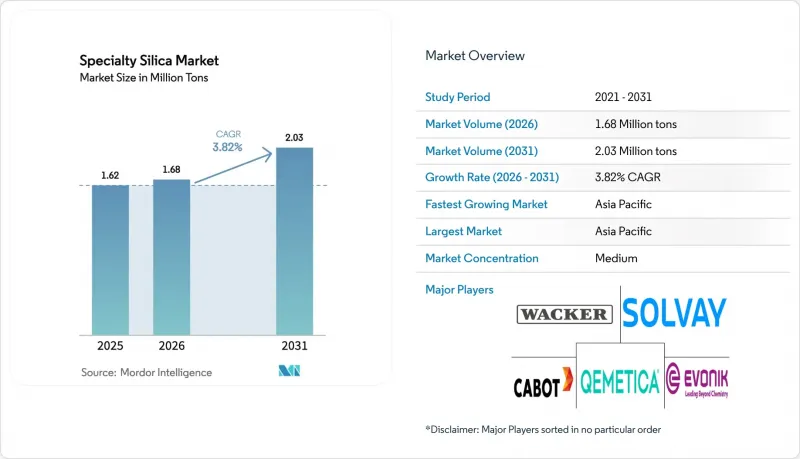
This report is Segmented by Type (Precipitated Silica, Silica Gel, and Others), Production Process (Wet/Precipitated, Flame Hydrolysis, and Bio-Silica From Rice-Husk Ash), Application (Rubber and Tires, Electronics and Semiconductors, and Others), and Geography (Asia-Pacific, North America, Europe, South America, and Middle East and Africa). The Market Forecasts are Provided in Terms of Volume (Tons).
Global Specialty Silica Market Trends and Insights
Increasing Demand from Rubber Industry
Tire makers now blend 80-100 parts per hundred rubber of precipitated silica to satisfy rolling-resistance targets that cut fuel consumption by 3-5% per vehicle. Chinese OEMs adopted Evonik's ULTRASIL grades in 2025 to prepare for China 7 rules that mirror Euro 7 thresholds. The silica-silane coupling system improves wet grip and lowers heat buildup, though it requires strict surface-area control, prompting several Chinese tire plants to co-locate near silica facilities. Replacement-tire demand in India and Southeast Asia is amplifying volume as motorists shift from bias-ply to radial designs. Fleet operators report tread-life gains of 15-20%, making silica-rich tires economically attractive despite an 8-10% price premium.
Growing Penetration from Personal-Care Rheology and Matting Agents
Cosmetic brands are replacing talc with colloidal and precipitated silica amid litigation over asbestos contamination and rising clean-label preference. Silica absorbs up to 2.5 times its weight in oil, delivering a matte finish without compromising skin feel. L'Oreal and Estee Lauder launched silica-rich foundations in 2025 that command price premiums in the prestige segment. Aerogel forms support controlled-release fragrance spheres that sell for USD 15-20 per kilogram, versus USD 2-3 for commodity precipitated grades. EU Cosmetics Regulation 1223/2009 mandates purity traceability, favoring established silica suppliers with ISO 22716 certification.
High Production Cost and Energy Intensity
Flame-hydrolysis consumes 8-10 MWh per ton, and EU electricity prices of EUR 150-200/MWh in 2026 lift cash costs by 35-40% at Wacker's Burghausen site. Carbon-border levies add EUR 80-100 per ton to imported silica, prompting a EUR 120 million onsite renewables program to cut emissions by 50% by 2028. Asian producers with coal-based baseload power undercut European fumed-silica prices by 25%, steering EU suppliers toward ultra-high-purity niches. Wet-precipitated routes use only 2-3 MWh per ton yet still face higher natural-gas prices for spray-drying. The narrowing margin forces Western firms to prioritize premium grades over commodity volumes.
Other drivers and restraints analyzed in the detailed report include:
- Shift Toward Low-VOC/High-Performance Industrial Coatings Requiring Specialty Silica
- Increasing Usage in EV Battery Separators and Solid-State Electrolytes
- Availability of Substitutes
For complete list of drivers and restraints, kindly check the Table Of Contents.
Segment Analysis
Precipitated silica accounted for 42.84% volume in 2025, underscoring its entrenched role in tire compounds and coatings that value a cost-to-performance ratio unattainable for higher-priced fumed grades, thereby anchoring specialty silica market size leadership. The segment is projected to post a 4.18% CAGR through 2031 as green-tire penetration deepens and wet-masterbatch processing raises loadings per tire. Silica gel demand grows steadily in pharmaceutical desiccants and chromatography media for single-use bioprocessing, while colloidal grades ride CMP-slurry expansion in advanced semiconductors. Fumed silica stays niche yet indispensable in silicone sealants, adhesives, and low-dielectric encapsulants that require less than 40 nm particle distributions. Fused silica commands the highest prices as it enables optical-fiber preforms and EUV photomasks with near-zero thermal expansion.
Complete Report Scope:
- By Type
- Precipitated Silica
- Silica Gel
- Colloidal Silica
- Fumed Silica
- Fused Silica
- By Production Process
- Wet/Precipitated
- Flame Hydrolysis
- Sol-Gel
- Bio-silica from Rice-Husk Ash
- By Application
- Rubber and Tires
- Personal Care
- Food and Feed Additives
- Chemicals
- Paints, Coatings and Inks
- Plastics
- Electronics and Semiconductors
- Metal and Refractories
- Other Applications (Healthcare and Pharmaceuticals, etc.)
- By Geography
- Asia-Pacific
- China
- India
- Japan
- South Korea
- ASEAN Countries
- Rest of Asia-Pacific
- North America
- United States
- Canada
- Mexico
- Europe
- Germany
- United Kingdom
- France
- Italy
- Rest of Europe
- South America
- Brazil
- Argentina
- Rest of South America
- Middle East and Africa
- Saudi Arabia
- South Africa
- Rest of Middle East and Africa
- Asia-Pacific
Geography Analysis
Asia-Pacific held 45.52% of specialty silica market size in 2025 and is projected to expand at a 4.55% CAGR through 2031, driven by China's production of 650 million tires that increasingly specify silica-silane compounds to meet impending China 7 standards. India emerges as a bio-silica front-runner with Tata Chemicals inaugurating a 20,000-ton Punjab plant that monetizes rice-husk waste and supplies domestic tire makers. Japan and South Korea remain global hubs for semiconductor-grade fumed and fused silica, leveraging stringent metal-contamination controls to serve 3 nm logic and EUV photomask markets. Vietnamese and Thai facilities built by Shandong Link Silica illustrate a migration of precipitated capacity toward lower-cost ASEAN locations that still access regional rubber demand.
North America captures incremental growth from EV battery-separator coatings and vaccine-grade mesoporous silica, segments where regulatory familiarity and cGMP infrastructure underpin premium pricing. Cabot's Tuscola, Illinois plant supplies 60% of regional fumed-silica needs for silicone rubber and CMP, while Mexican tire assemblies under USMCA rules boost precipitated-silica imports from Brazil. Europe's share growth rate is low due to elevated power prices and carbon levies that squeeze commodity margins, yet the region carves defensible niches in pharmaceutical and battery-grade grades where quality trumps cost. Capacity rationalization such as Solvay's 2025 divestment of commodity lines to Orbia underscores this shift.
South America centers on Brazil's tire and agricultural machinery sectors, with Imerys' Sao Paulo plant feeding Michelin and Bridgestone facilities. Middle East and Africa remain import-oriented, purchasing precipitated silica for coatings and construction fillers in Saudi Arabia and South Africa given the absence of high-purity quartz deposits. Geopolitical resource security and sustainability credentials will likely reinforce Asia-Pacific's quantitative lead, yet North America and Europe will continue to command a disproportionate share of value through specialized high-purity and pharmaceutical niches.
- 3M
- Cabot Corporation
- Clariant
- Denka Company Limited
- Elkem ASA
- Evonik Industries AG
- Fuji Silysia Chemical Ltd.
- Fuso Chemical Co., Ltd.
- Imerys
- Nouryon
- Oriental Silicas Corporation
- Oriental Silicas Corporation
- Orisil
- QEMETICA
- Solvay
- Tata Chemicals
- Tokuyama Corporation
- W. R. Grace & Co.
- Wacker Chemie AG
Additional Benefits:
- The market estimate (ME) sheet in Excel format
- 3 months of analyst support
TABLE OF CONTENTS
1 Introduction
- 1.1 Study Assumptions and Market Definition
- 1.2 Scope of the Study
2 Research Methodology
3 Executive Summary
4 Market Landscape
- 4.1 Market Overview
- 4.2 Market Drivers
- 4.2.1 Increasing Demand from Rubber Industry
- 4.2.2 Growing Penetration from Personal-Care Rheology and Matting Agents
- 4.2.3 Shift Toward Low-VOC/High-Performance Industrial Coatings Requiring Specialty Silica
- 4.2.4 Increasing Usage in EV Battery Separators and Solid-State Electrolytes
- 4.2.5 Growing Emphasis on Mesoporous Silica as Next-Gen Vaccine Adjuvant Carrier
- 4.3 Market Restraints
- 4.3.1 High Production Cost and Energy Intensity
- 4.3.2 Availability of Substitutes
- 4.3.3 Limited Supply of High-Purity Quartz Feedstock in Key Regions
- 4.4 Value Chain Analysis
- 4.5 Porter's Five Forces
- 4.5.1 Bargaining Power of Suppliers
- 4.5.2 Bargaining Power of Buyers
- 4.5.3 Threat of New Entrants
- 4.5.4 Threat of Substitutes
- 4.5.5 Degree of Competition
5 Market Size and Growth Forecasts (Volume)
- 5.1 By Type
- 5.1.1 Precipitated Silica
- 5.1.2 Silica Gel
- 5.1.3 Colloidal Silica
- 5.1.4 Fumed Silica
- 5.1.5 Fused Silica
- 5.2 By Production Process
- 5.2.1 Wet/Precipitated
- 5.2.2 Flame Hydrolysis
- 5.2.3 Sol-Gel
- 5.2.4 Bio-silica from Rice-Husk Ash
- 5.3 By Application
- 5.3.1 Rubber and Tires
- 5.3.2 Personal Care
- 5.3.3 Food and Feed Additives
- 5.3.4 Chemicals
- 5.3.5 Paints, Coatings and Inks
- 5.3.6 Plastics
- 5.3.7 Electronics and Semiconductors
- 5.3.8 Metal and Refractories
- 5.3.9 Other Applications (Healthcare and Pharmaceuticals, etc.)
- 5.4 By Geography
- 5.4.1 Asia-Pacific
- 5.4.1.1 China
- 5.4.1.2 India
- 5.4.1.3 Japan
- 5.4.1.4 South Korea
- 5.4.1.5 ASEAN Countries
- 5.4.1.6 Rest of Asia-Pacific
- 5.4.2 North America
- 5.4.2.1 United States
- 5.4.2.2 Canada
- 5.4.2.3 Mexico
- 5.4.3 Europe
- 5.4.3.1 Germany
- 5.4.3.2 United Kingdom
- 5.4.3.3 France
- 5.4.3.4 Italy
- 5.4.3.5 Rest of Europe
- 5.4.4 South America
- 5.4.4.1 Brazil
- 5.4.4.2 Argentina
- 5.4.4.3 Rest of South America
- 5.4.5 Middle East and Africa
- 5.4.5.1 Saudi Arabia
- 5.4.5.2 South Africa
- 5.4.5.3 Rest of Middle East and Africa
- 5.4.1 Asia-Pacific
6 Competitive Landscape
- 6.1 Market Concentration
- 6.2 Strategic Moves
- 6.3 Market Share(%)/Ranking Analysis
- 6.4 Company Profiles (includes Global level Overview, Market level overview, Core Segments, Financials as available, Strategic Information, Market Rank/Share for key companies, Products and Services, and Recent Developments)
- 6.4.1 3M
- 6.4.2 Cabot Corporation
- 6.4.3 Clariant
- 6.4.4 Denka Company Limited
- 6.4.5 Elkem ASA
- 6.4.6 Evonik Industries AG
- 6.4.7 Fuji Silysia Chemical Ltd.
- 6.4.8 Fuso Chemical Co., Ltd.
- 6.4.9 Imerys
- 6.4.10 Nouryon
- 6.4.11 Oriental Silicas Corporation
- 6.4.12 Oriental Silicas Corporation
- 6.4.13 Orisil
- 6.4.14 QEMETICA
- 6.4.15 Solvay
- 6.4.16 Tata Chemicals
- 6.4.17 Tokuyama Corporation
- 6.4.18 W. R. Grace & Co.
- 6.4.19 Wacker Chemie AG
7 Market Opportunities and Future Outlook
- 7.1 White-space and Unmet-Need Assessment
- 7.2 Emerging Use in Solid-state Batteries
- 7.3 Circular-economy Pathways for Bio-silica

