PUBLISHER: Mordor Intelligence | PRODUCT CODE: 2114351

PUBLISHER: Mordor Intelligence | PRODUCT CODE: 2114351
Europe Bath And Shower Products - Market Share Analysis, Industry Trends & Statistics, Growth Forecasts (2026 - 2031)
According to Mordor Intelligence, the Europe bath and shower products market size was valued at USD 12.72 billion in 2025 and estimated to grow from USD 13.15 billion in 2026 to reach USD 15.49 billion by 2031, at a CAGR of 3.35% during the forecast period (2026-2031).
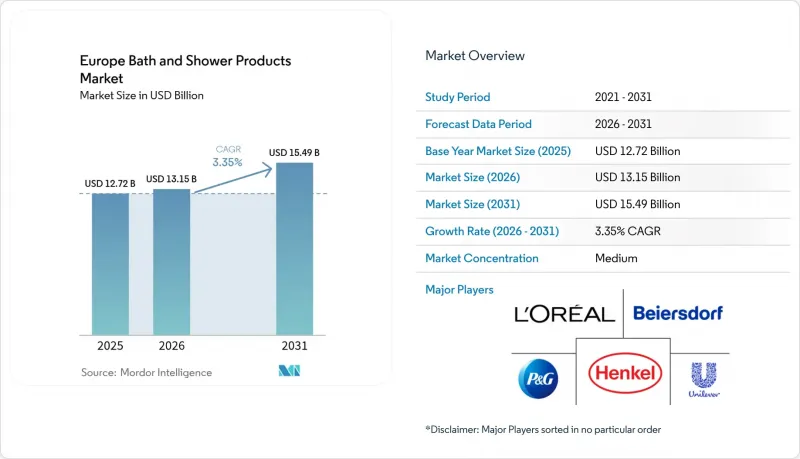
This report is Segmented by Product Type (Bar Soap, Body Wash/Shower Gel, Other Product Types), Ingredient (Conventional/Synthetic, Natural/Organic), End User (Kids/Children, Adult), Distribution Channel (Supermarkets/Hypermarkets, Specialty Stores, and More), and Geography (Germany, United Kingdom, Italy, France, and More). The Market Forecasts are Provided in Terms of Value (USD).
Europe Bath And Shower Products Market Trends and Insights
Rising consumer demand for natural and organic ingredients
Rising consumer demand for natural and organic ingredients significantly propels the Europe bath and shower products market, driven by heightened health consciousness, environmental awareness, and a shift toward clean beauty practices among millennials and Gen Z. According to the NSF 2024 survey, 74% of consumers consider organic ingredients important in personal care products, reflecting growing preference for skin-friendly, cruelty-free formulations featuring plant-based elements like aloe vera, shea butter, and essential oils . Consumers are scrutinizing ingredient lists more carefully, with 65% seeking clear and transparent information to identify potentially harmful substances, which aligns with a broader demand for sustainable and hypoallergenic options. This trend is particularly pronounced in key markets such as Germany and Sweden, where natural labels strongly influence purchasing decisions.
Growing focus on wellness and self-care routines
Growing focus on wellness and self-care routines is a key driver of the Europe bath and shower products market, as consumers increasingly view bathing as a holistic experience that supports mental and physical well-being. This trend emphasizes products designed to relax, rejuvenate, and provide sensory pleasure, such as aromatherapy-infused gels, moisturizing creams, and exfoliating scrubs. The rise of self-care rituals, particularly among millennials and Gen Z, has led to greater demand for premium, spa-like bath products that offer therapeutic benefits. Brands are capitalizing on this by incorporating natural extracts, essential oils, and soothing ingredients to enhance the bathing experience. The UK's Office for National Statistics reported 14.69 million millennials in the United Kingdom in 2023, indicating this demographic's substantial market potential. Additionally, wellness-focused consumers seek products that align with mindfulness and stress-relief practices. The market also reflects broader lifestyle shifts toward healthier habits and balanced living, reinforcing the role of bath and shower products in personal care.
Stringent regulations on chemical ingredients and safety
Stringent regulations on chemical ingredients and safety serve as a significant restraint in the Europe bath and shower products market, compelling manufacturers to navigate complex compliance landscapes under EU directives like REACH that restrict harmful substances such as parabens and microplastics. These mandates necessitate extensive reformulations, rigorous testing, and approval processes, which elevate production costs and delay product launches, particularly burdening smaller brands with limited resources. Frequent Safety Gate alerts result in bans and recalls of non-compliant items like shower gels and bath foams, disrupting supply chains and limiting market availability across Western Europe. Environmental requirements for biodegradable packaging and reduced plastics further intensify operational challenges, constraining innovation in synthetic-based formulations. In markets like Germany and France, multifunctional safety standards create disparities with price-sensitive Eastern regions, hindering overall affordability and market flexibility.
Other drivers and restraints analyzed in the detailed report include:
- Premiumization trends toward high-end, aromatic products
- Influence of social media and beauty influencers
- Consumer concerns over harmful substances like parabens
For complete list of drivers and restraints, kindly check the Table Of Contents.
Segment Analysis
Body wash and shower gel dominated the Europe bath and shower products market in 2025, capturing 50.92% of the revenue share. Their popularity stems from ease of use, versatility, and formulation benefits tailored for various skin types and preferences. Consumers appreciate the convenience of liquid formats in gel or creamy textures that offer moisturizing and aromatic experiences. Leading brands continuously innovate with new fragrances, natural ingredients, and dermatologist-tested formulas to maintain loyalty. Distribution through supermarkets, specialty shops, and e-commerce enhances accessibility across Europe. This segment's large market share reflects established consumer habits and broad appeal across age groups.
Although body wash and shower gel hold the largest market share, bar soap is the fastest-growing segment, forecasted to expand at a compound annual growth rate of 3.68% through 2031. Resurgence in bar soap popularity is driven by growing consumer interest in sustainable, eco-friendly, and plastic-free personal care options. Bar soaps are perceived as natural, minimalistic, and effective cleansing alternatives aligning with environmental consciousness. Artisanal and organic varieties appeal particularly to niche consumers seeking premium and artisanal products. Additionally, bar soap manufacturing often involves simpler processes, enabling innovation in fragrances and formulations. This growth trajectory suggests bar soaps will increasingly complement and challenge liquid formats in the European market.
Conventional and synthetic formulations commanded the largest share of the Europe bath and shower products market in 2025, accounting for 64.75% of total revenue. Their dominance arises from widespread consumer familiarity, cost-effectiveness, and established performance in cleansing and fragrance delivery. Major brands leverage extensive distribution networks and marketing to sustain loyalty among price-sensitive and traditional users. These products benefit from advanced synthetic technologies that enhance lather, stability, and shelf life compared to natural alternatives. However, growing regulatory pressures on chemical ingredients and consumer concerns over irritants pose challenges to long-term positioning. Despite these headwinds, conventional formulations remain the market mainstay, supported by innovation in milder synthetic blends.
Natural and organic ingredients represent the fastest-growing segment, projected to expand at a compound annual growth rate of 4.72% through 2031, surpassing the overall market's 3.35% trajectory. This surge reflects heightened consumer demand for clean beauty, sustainability, and transparency in personal care routines. Brands emphasize plant-based, chemical-free profiles that appeal to health-conscious and eco-aware demographics across Europe. Certifications like ECOCERT and Soil Association bolster credibility, driving premium pricing and niche loyalty. Supply chain advancements in sourcing organic botanicals further enable scalability and formulation diversity. Ultimately, this segment's momentum signals a broader industry shift toward ethical, nature-derived products.
Complete Report Scope:
- By Product Type
- Bar Soap
- Body Wash/Shower Gel
- Other Product Types
- By Ingredient
- Conventional/Synthetic
- Natural/Organic
- By End User
- Kids/Children
- Adult
- By Distribution Channel
- Supermarkets/Hypermarkets
- Specialty Stores
- Online Retail Stores
- Other Distribution Channels
- By Country
- Germany
- United Kingdom
- Italy
- France
- Spain
- Netherlands
- Poland
- Belgium
- Sweden
- Rest of Europe
List of Companies Covered in this Report:
- Unilever PLC
- L'Oreal S.A.
- The Procter & Gamble Company
- Beiersdorf AG
- Henkel AG & Co. KGaA
- Colgate-Palmolive Company
- Kenvue Inc.
- The Estee Lauder Companies Inc.
- PZ Cussons plc
- HARTMANN GROUP (Kneipp)
- Reckitt Benckiser Group plc
- Natura & Co
- L'Occitane International S.A.
- Clarins Group
- Coty Inc.
- Pierre Fabre S.A.
- WELEDA AG
- Molton Brown (Kao)
- Sephora Collection
- Rituals Cosmetics
Additional Benefits:
- The market estimate (ME) sheet in Excel format
- 3 months of analyst support
TABLE OF CONTENTS
1 INTRODUCTION
- 1.1 Study Assumptions and Market Definition
- 1.2 Scope of the Study
2 RESEARCH METHODOLOGY
3 EXECUTIVE SUMMARY
4 MARKET LANDSCAPE
- 4.1 Market Overview
- 4.2 Market Drivers
- 4.2.1 Rising consumer demand for natural and organic ingredients
- 4.2.2 Growing focus on wellness and self-care routines
- 4.2.3 Premiumization trends toward high-end, aromatic products
- 4.2.4 Increasing preference for sustainable and eco-friendly packaging
- 4.2.5 Influence of social media and beauty influencers
- 4.2.6 Innovation in cruelty-free and vegan formulations
- 4.3 Market Restraints
- 4.3.1 Stringent regulations on chemical ingredients and safety
- 4.3.2 Consumer concerns over harmful substances like parabens
- 4.3.3 Intense competition leading to price pressures
- 4.3.4 Rising manufacturing and raw material costs
- 4.4 Consumer Behavior Analysis
- 4.5 Regulatory Outlook
- 4.6 Porter's Five Forces
- 4.6.1 Bargaining Power of Buyers/Consumers
- 4.6.2 Bargaining Power of Suppliers
- 4.6.3 Threat of New Entrants
- 4.6.4 Threat of Substitute Products
- 4.6.5 Intensity of Competitive Rivalry
5 MARKET SIZE AND GROWTH FORECASTS (VALUE)
- 5.1 By Product Type
- 5.1.1 Bar Soap
- 5.1.2 Body Wash/Shower Gel
- 5.1.3 Other Product Types
- 5.2 By Ingredient
- 5.2.1 Conventional/Synthetic
- 5.2.2 Natural/Organic
- 5.3 By End User
- 5.3.1 Kids/Children
- 5.3.2 Adult
- 5.4 By Distribution Channel
- 5.4.1 Supermarkets/Hypermarkets
- 5.4.2 Specialty Stores
- 5.4.3 Online Retail Stores
- 5.4.4 Other Distribution Channels
- 5.5 By Country
- 5.5.1 Germany
- 5.5.2 United Kingdom
- 5.5.3 Italy
- 5.5.4 France
- 5.5.5 Spain
- 5.5.6 Netherlands
- 5.5.7 Poland
- 5.5.8 Belgium
- 5.5.9 Sweden
- 5.5.10 Rest of Europe
6 COMPETITIVE LANDSCAPE
- 6.1 Market Concentration
- 6.2 Strategic Moves
- 6.3 Market Share Analysis
- 6.4 Company Profiles (includes Global Overview, Market-level Overview, Core Segments, Financials, Strategic Information, Market Rank/Share, Products & Services, Recent Developments)
- 6.4.1 Unilever PLC
- 6.4.2 L'Oreal S.A.
- 6.4.3 The Procter & Gamble Company
- 6.4.4 Beiersdorf AG
- 6.4.5 Henkel AG & Co. KGaA
- 6.4.6 Colgate-Palmolive Company
- 6.4.7 Kenvue Inc.
- 6.4.8 The Estee Lauder Companies Inc.
- 6.4.9 PZ Cussons plc
- 6.4.10 HARTMANN GROUP (Kneipp)
- 6.4.11 Reckitt Benckiser Group plc
- 6.4.12 Natura & Co
- 6.4.13 L'Occitane International S.A.
- 6.4.14 Clarins Group
- 6.4.15 Coty Inc.
- 6.4.16 Pierre Fabre S.A.
- 6.4.17 WELEDA AG
- 6.4.18 Molton Brown (Kao)
- 6.4.19 Sephora Collection
- 6.4.20 Rituals Cosmetics
7 MARKET OPPORTUNITIES AND FUTURE OUTLOOK

