PUBLISHER: Mordor Intelligence | PRODUCT CODE: 2114362

PUBLISHER: Mordor Intelligence | PRODUCT CODE: 2114362
Biochemical Reagents - Market Share Analysis, Industry Trends & Statistics, Growth Forecasts (2026 - 2031)
According to Mordor Intelligence, the biochemical reagents market size is expected to increase from USD 44.27 billion in 2025 to USD 46.92 billion in 2026 and reach USD 66.34 billion by 2031, growing at a CAGR of 7.17% over 2026-2031.
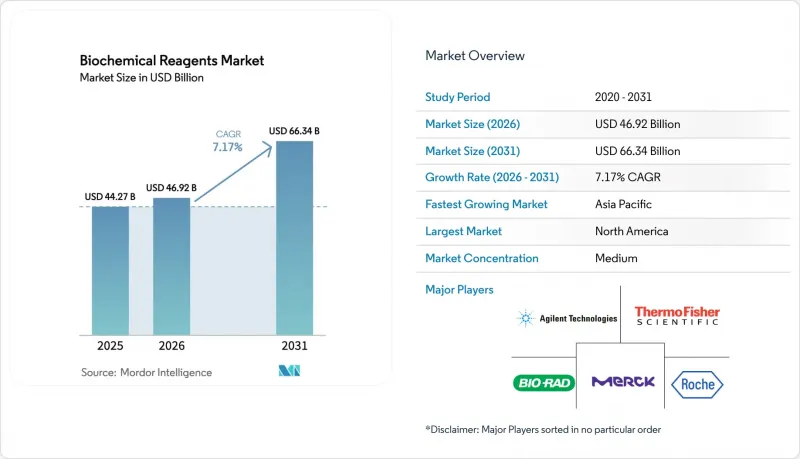
This report is Segmented by Product Type (PCR Reagent Kits, Cell & Tissue Culture Reagents, Electrophoresis Reagents, Chromatography Reagents, Flow Cytometry Reagents, and More), End User (Biotechnology Companies, and More), Application (Genomics, and More), Technology (PCR, and More), and Geography (North America, and More). The Market Forecasts are Provided in Terms of Value (USD).
Global Biochemical Reagents Market Trends and Insights
Soaring Demand for Molecular Diagnostics
Point-of-care settings now rely on ready-to-use PCR and isothermal mixes, lifting reagent throughput in hospital networks. The U.S. Food and Drug Administration cleared 23 new in-vitro diagnostic assays in 2025, 17 of which utilize PCR or NGS chemistries. Europe's IVDR is forcing suppliers to reformulate products with stronger stability data, driving incremental sales of enhanced buffer systems. Infectious-disease surveillance remains central, highlighted by the World Health Organization's 2025 AMR network that enrolled 120 countries, each standardizing PCR kits for pathogen detection. Lyophilized formulations that ship without refrigeration already represented 18% of PCR unit sales in 2025 and are expanding quickly as telehealth services proliferate.
Expansion of Genomics and Proteomics Research
Population-level sequencing is transitioning from pilots to national programs. The United Kingdom plans to sequence 5 million genomes by 2028, translating into roughly 15 million library prep kits over the span. Japan earmarked USD 800 million in 2025 to link genomic data with electronic medical records, prompting bulk orders for high-throughput sequencing reagents. On the proteomics front, the European Molecular Biology Laboratory established a data repository that sets common sample-prep specifications across laboratory networks. Single-cell sequencing programs funded by the U.S. National Science Foundation are spreading barcoding reagent demand across 30 academic sites.
Stringent Regulatory and Compliance Burden
Europe's IVDR imposes clinical evidence demands that add USD 0.5-2 million to each diagnostic reagent, delaying launches by up to 18 months. The FDA also signaled tighter control over laboratory-developed tests in 2025, unsettling hospital labs that historically prepared their own mixes. Only 40% of Asia-Pacific suppliers held ISO 13485 certification by 2025, limiting their ability to win global contracts. Environmental frameworks such as REACH added 18 solvents to restriction lists, triggering expensive reformulations.
Other drivers and restraints analyzed in the detailed report include:
- Rising Biopharma R&D Budgets Worldwide
- Automation and High-Throughput Screening Adoption
- Short Shelf-Life and Cold-Chain Costs
For complete list of drivers and restraints, kindly check the Table Of Contents.
Segment Analysis
Chromatography reagents held 37.63% of the biochemical reagents market share in 2025 and remain central to monoclonal-antibody purification. PCR kits are on course for a 10.44% CAGR to 2031, underpinned by point-of-care testing mandates and wide infectious-disease surveillance. The biochemical reagents market size for PCR kits is projected to grow from USD 11.2 billion in 2026 to USD 18.3 billion by 2031, reinforcing their momentum. Cell and tissue culture reagents continue to climb, energized by the maturing cell-therapy pipeline, while electrophoresis reagents experience moderate growth due to rising adoption of microfluidic alternatives.
Second-generation flow cytometry dyes now support 20-plus-parameter panels, driving 8-9% annual growth in that subcategory. NGS and genomics reagents are set for a steady 9-10% CAGR, buoyed by falling sequencing-run costs and population genomics. Specialty mixes aimed at CRISPR applications and single-cell barcoding grow fastest on a smaller base, capturing premium prices due to their customization level.
Biotechnology firms consumed 31.56% of the biochemical reagents market in 2025, sustained by heavy early-stage research pipelines. CRO demand is advancing at 10.06% CAGR through 2031, lifted by the outsourcing model favored by big pharma, pushing the biochemical reagents market size among CROs to a projected USD 9 billion by 2031. Pharmaceutical companies maintain a large yet steady footprint, whereas CDMOs represent a rising buyer block, particularly in cell culture media and chromatography resins used for contract biologics manufacture.
Hospitals and diagnostic reference labs are tightening quality controls by migrating to standardized kits. Academic and research institutes remain price sensitive, although new grants for large scale sequencing and proteomics bolster reagent procurement volumes.
Complete Report Scope:
- By Product Type
- PCR Reagent Kits
- Cell & Tissue Culture Reagents
- Electrophoresis Reagents
- Chromatography Reagents
- Flow Cytometry Reagents
- NGS & Genomics Reagents
- Other Specialty Reagents
- By End User
- Biotechnology Companies
- Pharmaceutical Companies
- Contract Research Organisations (CROs)
- CDMOs
- Hospitals
- Diagnostic Laboratories
- Academic & Research Institutes
- By Application
- Genomics
- Proteomics
- Clinical Diagnostics
- Drug Discovery & Development
- Others
- By Technology
- PCR
- Next-Generation Sequencing
- Isothermal Amplification
- Microarray & Others
- By Geography
- North America
- United States
- Canada
- Mexico
- Europe
- Germany
- France
- United Kingdom
- Italy
- Spain
- Rest of Europe
- Asia-Pacific
- China
- Japan
- India
- South Korea
- Australia
- Rest of Asia-Pacific
- Middle East & Africa
- GCC
- South Africa
- Rest of Middle East & Africa
- South America
- Brazil
- Argentina
- Rest of South America
- North America
Geography Analysis
North America generated 44.42% of global revenue in 2025 due to a robust reimbursement environment, mature regulatory pathways, and heavy public research funding. The United States accounts for three-quarters of regional sales and concentrates demand in bioclusters anchored by California and Massachusetts. Canada leverages Genome Canada's USD 180 million precision-medicine program to drive 5-6% annual growth. Mexico is expanding as pharma manufacturing shifts south, but logistics hurdles slow uptake.
Asia-Pacific is forecast to post a 9.35% CAGR, the fastest for any region. China is progressing from import dependence toward domestic supply, helped by a USD 2.3 billion enzyme facility initiative aimed at 30% local share by 2028. India's Department of Biotechnology introduced a USD 500 million cold-chain subsidy that improves penetration in tier-2 cities. Japan's aging population is boosting companion diagnostic volumes, while South Korea capitalizes on biosimilar expansion.
Europe, anchored by Germany, France, and the United Kingdom. Full IVDR enforcement prompted the withdrawal of about one-third of legacy kits, creating white-space for re-engineered offerings. The Middle East and Africa rise at 6-7% as Saudi Arabia and the United Arab Emirates build genomic centers to diversify their economies. South America advances at a similar clip, led by Brazil where ANVISA's streamlined approval rules cut regulatory drag.
- Abbott Laboratories
- Agilent Technologies
- Beckton Dickinson
- Bio-Rad Laboratories
- Danaher
- Enzo Biochem
- Roche
- Illumina
- Lonza Group
- Merck
- New England Biolabs
- Promega
- QIAGEN
- Revvity
- Siemens Healthineers
- Takara Bio
- Thermo Fisher Scientific
- Vazyme Biotech
- Waters Corporation
Additional Benefits:
- The market estimate (ME) sheet in Excel format
- 3 months of analyst support
TABLE OF CONTENTS
1 Introduction
- 1.1 Study Assumptions & Market Definition
- 1.2 Scope of the Study
2 Research Methodology
3 Executive Summary
4 Market Landscape
- 4.1 Market Overview
- 4.2 Market Drivers
- 4.2.1 Soaring Demand for Molecular Diagnostics
- 4.2.2 Expansion of Genomics & Proteomics Research
- 4.2.3 Rising Biopharma R&D Budgets Worldwide
- 4.2.4 Automation & High-Throughput Screening Adoption
- 4.2.5 AI-Optimized Reagent Formulation Pipelines
- 4.2.6 Localized Manufacturing Hubs In Emerging Markets
- 4.3 Market Restraints
- 4.3.1 Stringent Regulatory & Compliance Burden
- 4.3.2 Short Shelf-Life and Cold-Chain Costs
- 4.3.3 Enzyme-Supply Geopolitical Concentration Risk
- 4.3.4 Escalating IP Litigation Delaying Launches
- 4.4 Value / Supply-Chain Analysis
- 4.5 Regulatory Landscape
- 4.6 Technological Outlook
- 4.7 Porter's Five Forces Analysis
- 4.7.1 Threat of New Entrants
- 4.7.2 Bargaining Power of Suppliers
- 4.7.3 Bargaining Power of Buyers
- 4.7.4 Threat of Substitutes
- 4.7.5 Intensity of Competitive Rivalry
5 Market Size & Growth Forecasts (Value in USD)
- 5.1 By Product Type
- 5.1.1 PCR Reagent Kits
- 5.1.2 Cell & Tissue Culture Reagents
- 5.1.3 Electrophoresis Reagents
- 5.1.4 Chromatography Reagents
- 5.1.5 Flow Cytometry Reagents
- 5.1.6 NGS & Genomics Reagents
- 5.1.7 Other Specialty Reagents
- 5.2 By End User
- 5.2.1 Biotechnology Companies
- 5.2.2 Pharmaceutical Companies
- 5.2.3 Contract Research Organisations (CROs)
- 5.2.4 CDMOs
- 5.2.5 Hospitals
- 5.2.6 Diagnostic Laboratories
- 5.2.7 Academic & Research Institutes
- 5.3 By Application
- 5.3.1 Genomics
- 5.3.2 Proteomics
- 5.3.3 Clinical Diagnostics
- 5.3.4 Drug Discovery & Development
- 5.3.5 Others
- 5.4 By Technology
- 5.4.1 PCR
- 5.4.2 Next-Generation Sequencing
- 5.4.3 Isothermal Amplification
- 5.4.4 Microarray & Others
- 5.5 By Geography
- 5.5.1 North America
- 5.5.1.1 United States
- 5.5.1.2 Canada
- 5.5.1.3 Mexico
- 5.5.2 Europe
- 5.5.2.1 Germany
- 5.5.2.2 France
- 5.5.2.3 United Kingdom
- 5.5.2.4 Italy
- 5.5.2.5 Spain
- 5.5.2.6 Rest of Europe
- 5.5.3 Asia-Pacific
- 5.5.3.1 China
- 5.5.3.2 Japan
- 5.5.3.3 India
- 5.5.3.4 South Korea
- 5.5.3.5 Australia
- 5.5.3.6 Rest of Asia-Pacific
- 5.5.4 Middle East & Africa
- 5.5.4.1 GCC
- 5.5.4.2 South Africa
- 5.5.4.3 Rest of Middle East & Africa
- 5.5.5 South America
- 5.5.5.1 Brazil
- 5.5.5.2 Argentina
- 5.5.5.3 Rest of South America
- 5.5.1 North America
6 Competitive Landscape
- 6.1 Market Concentration
- 6.2 Market Share Analysis
- 6.3 Company Profiles (includes Global level Overview, Market level overview, Core Segments, Financials as available, Strategic Information, Market Rank/Share for key companies, Products and Services, and Recent Developments)
- 6.3.1 Abbott Laboratories
- 6.3.2 Agilent Technologies Inc.
- 6.3.3 Becton, Dickinson & Company
- 6.3.4 Bio-Rad Laboratories Inc.
- 6.3.5 Danaher Corporation
- 6.3.6 Enzo Biochem Inc.
- 6.3.7 F. Hoffmann-La Roche Ltd
- 6.3.8 Illumina Inc.
- 6.3.9 Lonza Group
- 6.3.10 Merck KGaA
- 6.3.11 New England Biolabs
- 6.3.12 Promega Corporation
- 6.3.13 QIAGEN N.V.
- 6.3.14 Revvity
- 6.3.15 Siemens Healthineers AG
- 6.3.16 Takara Bio Inc.
- 6.3.17 Thermo Fisher Scientific Inc.
- 6.3.18 Vazyme Biotech
- 6.3.19 Waters Corporation
7 Market Opportunities & Future Outlook
- 7.1 White-space & Unmet-need Assessment

