PUBLISHER: Mordor Intelligence | PRODUCT CODE: 2114365

PUBLISHER: Mordor Intelligence | PRODUCT CODE: 2114365
Calcium Oxide - Market Share Analysis, Industry Trends & Statistics, Growth Forecasts (2026 - 2031)
According to Mordor Intelligence, the calcium oxide market size was valued at 363.12 Million tons in 2025 and is estimated to grow from 374.27 Million tons in 2026 to reach 437.05 Million tons by 2031, at a CAGR of 3.15% during the forecast period (2026-2031).
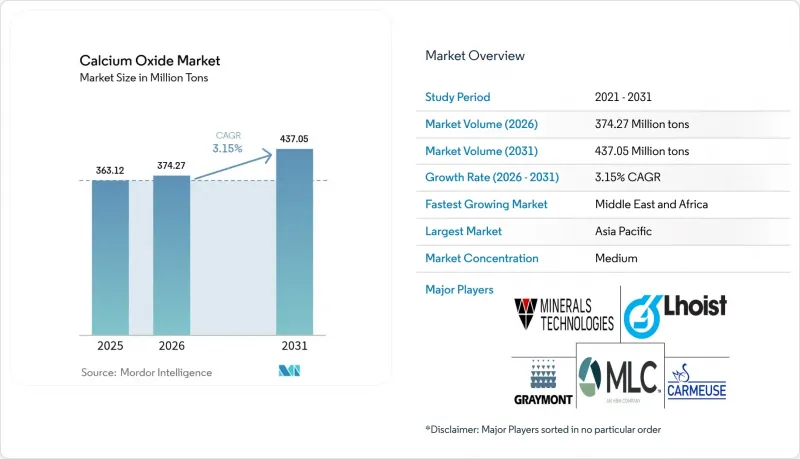
This report is Segmented by End-User Industry (Metallurgical, Construction, Fertilizer and Chemicals, Pulp and Paper, Refractory, and Other End-User Industries) and Geography (Asia-Pacific, North America, Europe, South America, and Middle-East and Africa). The Market Forecasts are Provided in Terms of Volume (Tons).
Global Calcium Oxide Market Trends and Insights
Surging Global Crude-Steel Output
Steel remains the single-largest consumer of calcium oxide, using 15-50 kilograms of quicklime per ton of crude steel, depending on furnace technology. China produced just over 1.0 billion tons of crude steel in 2024, a marginal decline yet still outsizing every other market. The OECD projects that 40.5% of new steel capacity through 2030 will continue to use the BF-BOF route, preserving lime intensity even as EAF penetration inches higher. India's National Steel Policy targets 300 million tons of capacity by 2030, largely BF-BOF, effectively locking in sustained quicklime offtake. The International Energy Agency calculates that fluxes in steelmaking account for 0.3 gigatons of process CO2 annually, underscoring the climate case for CCS-equipped kilns. Collectively, these factors underpin a demand floor for the calcium oxide market even under conservative steel-growth scenarios.
Rapid Infrastructure and Cement Demand in Asia-Pacific and Africa
Cement output reached 453 million tons in India during fiscal 2025, supported by a clinker-to-cement ratio near 0.75. Major ASEAN economies are plowing public budgets into rail, highways, and affordable housing, lifting regional cement production by 4-5% each year through 2030. Saudi Arabia's Vision 2030 megaprojects require huge volumes of low-carbon concrete; a 5,000-ton-per-day clinker-free line at Yanbu showcases how high-purity CaO can substitute Portland clinker while cutting embodied carbon by up to 80%. In Sub-Saharan Africa, 32.7 million hectares of acid soils are depressing crop yields, spurring agricultural-lime programs that dovetail with construction growth. These converging infrastructure and agricultural initiatives reinforce a robust volume trajectory for the calcium oxide market.
High Energy and CO2 Costs, Tightening Kiln-Emission Limits
Producing one ton of quicklime consumes 3.2-4.5 GJ of thermal energy, and natural gas can represent 60% of cash costs for gas-fired kilns. EU carbon prices near EUR 80 per ton of CO2 translate into an additional EUR 60-70 per ton of quicklime for legacy kilns emitting roughly 0.8 tons CO2 per ton product. Free-allowance reductions under ETS Phase IV intensify this burden each year. In the United States, emerging state-level programs and stricter New Source Performance Standards compel selective catalytic reduction and fabric-filter retrofits that raise capex without expanding capacity. Small, standalone producers find it increasingly difficult to finance such upgrades, feeding a consolidation trend in the calcium oxide market.
Other drivers and restraints analyzed in the detailed report include:
- Stricter Emissions Rules Boosting CaO Use in FGD and Water Treatment
- Low-Carbon Cement and Carbon-Looping Technologies Requiring High-Purity CaO
- Limestone and Natural-Gas Price Volatility
For complete list of drivers and restraints, kindly check the Table Of Contents.
Segment Analysis
The Metallurgical segment accounted for 42.57% of calcium oxide market share in 2025, reflecting its critical function as a flux in BF-BOF steelmaking. Although the global shift toward EAF technology lowers lime intensity to 5-15 kg per ton of steel, India's BF-centric expansion and persistent integrated capacity in China sustain absolute volume demand. Refractory-grade CaO for ladle linings commands price premiums, underpinned by quality certifications that limit new entrants.
Construction is energized by India's 453-million-ton cement output and ASEAN's infrastructure boom. Fertilizer and Chemicals is the fastest-expanding end-user industry, advancing at a 4.16% CAGR through 2031. Pulp and Paper mills retain stable quicklime usage of 80-120 kg per ton of pulp in kraft causticizing loops. Collectively, non-metallurgical industries provide diversification that cushions the calcium oxide market against steel-cycle volatility.
Complete Report Scope:
- By End-user Industry
- Metallurgical
- Construction
- Fertilizer and Chemicals
- Pulp and Paper
- Refractory
- Other End-user Industries (Rubber, Food and Beverages)
- By Geography
- Asia-Pacific
- China
- India
- Japan
- South Korea
- ASEAN Countries
- Rest of Asia-Pacific
- North America
- United States
- Canada
- Mexico
- Europe
- Germany
- United Kingdom
- Italy
- France
- Russia
- Spain
- Rest of Europe
- South America
- Brazil
- Argentina
- Rest of South America
- Middle-East and Africa
- Saudi Arabia
- South Africa
- Rest of Middle-East and Africa
- Asia-Pacific
Geography Analysis
Asia-Pacific led the calcium oxide market with 49.32% of 2025 volume, anchored by China's massive steel and cement sectors and India's accelerating infrastructure pipeline. Ultra-low-emission mandates for Chinese cement kilns are generating fresh demand for FGD-grade lime even as construction growth moderates. India's government has allocated USD 1.4 trillion under its National Infrastructure Pipeline, sustaining cement capacity additions and farm-lime distribution across 10 million hectares of acid soils.
North America benefits from the Infrastructure Investment and Jobs Act, which funds highway resurfacing, bridge rehabilitation, and water-system upgrades, all of which employ CaO in asphalt modification and water-softening treatments. While the U.S. steel sector's pivot toward EAF mini-mills reduces lime intensity, overall demand remains resilient due to automotive and appliance output. Mexico's nearshoring-boosted construction growth prompted Grupo Calidra to expand Bajio capacity, reinforcing the regional calcium oxide market.
Europe operates under high energy costs and stringent carbon targets. Regulation 2024/2620 classifies mineral carbonates as permanent sinks, encouraging CCS-ready kilns and high-purity CaO for alkali-activated binders. Germany and France lead low-carbon cement trials, whereas Poland and Romania emphasize cost-competitive grades for steel. The Middle-East and Africa region, projected to grow at 3.98% CAGR, leverages Saudi Vision 2030 megaprojects and sub-Saharan soil-liming programs. South America's demand hinges on Brazil's Cerrado agriculture and Argentina's lithium brine processing, both reliant on quicklime for pH moderation and impurity removal.
- AKJ Minchem Private Limited
- American Elements
- Astrra Chemicals
- CAO Industries Sdn Bhd
- Carmeuse
- GRAYMONT
- GREER LIME COMPANY
- Grupo Calidra
- Imerys
- Kemipex
- Lhoist
- Linwood Mining & Minerals Corporation
- Minerals Technologies Inc.
- Mississippi Lime Company d/b/a MLC.
- Nordkalk
- Pacific Lime and Cement Limited
- Pete Lien & Sons, Inc.
- Sibelco
- Sigma Minerals Ltd
- United States Lime & Minerals
Additional Benefits:
- The market estimate (ME) sheet in Excel format
- 3 months of analyst support
TABLE OF CONTENTS
1 Introduction
- 1.1 Study Assumptions and Market Definition
- 1.2 Scope of the Study
2 Research Methodology
3 Executive Summary
4 Market Landscape
- 4.1 Market Overview
- 4.2 Market Drivers
- 4.2.1 Surging global crude-steel output
- 4.2.2 Rapid infrastructure and cement demand in Asia-Pacific and Africa
- 4.2.3 Stricter emissions rules boosting CaO use in Flue Gas Desulfurization (FGD) and water treatment
- 4.2.4 Agricultural soil-health programs in emerging economies
- 4.2.5 Low-carbon cement and carbon-looping technologies requiring high-purity CaO
- 4.3 Market Restraints
- 4.3.1 High energy and CO2 costs, tightening kiln-emission limits
- 4.3.2 Limestone and natural-gas price volatility
- 4.3.3 Alternative sorbents/fluxes gaining share in steel
- 4.4 Value Chain Analysis
- 4.5 Porter's Five Forces
- 4.5.1 Threat of New Entrants
- 4.5.2 Bargaining Power of Suppliers
- 4.5.3 Bargaining Power of Buyers
- 4.5.4 Threat of Substitutes
- 4.5.5 Degree of Competition
5 Market Size and Growth Forecasts (Volume)
- 5.1 By End-user Industry
- 5.1.1 Metallurgical
- 5.1.2 Construction
- 5.1.3 Fertilizer and Chemicals
- 5.1.4 Pulp and Paper
- 5.1.5 Refractory
- 5.1.6 Other End-user Industries (Rubber, Food and Beverages)
- 5.2 By Geography
- 5.2.1 Asia-Pacific
- 5.2.1.1 China
- 5.2.1.2 India
- 5.2.1.3 Japan
- 5.2.1.4 South Korea
- 5.2.1.5 ASEAN Countries
- 5.2.1.6 Rest of Asia-Pacific
- 5.2.2 North America
- 5.2.2.1 United States
- 5.2.2.2 Canada
- 5.2.2.3 Mexico
- 5.2.3 Europe
- 5.2.3.1 Germany
- 5.2.3.2 United Kingdom
- 5.2.3.3 Italy
- 5.2.3.4 France
- 5.2.3.5 Russia
- 5.2.3.6 Spain
- 5.2.3.7 Rest of Europe
- 5.2.4 South America
- 5.2.4.1 Brazil
- 5.2.4.2 Argentina
- 5.2.4.3 Rest of South America
- 5.2.5 Middle-East and Africa
- 5.2.5.1 Saudi Arabia
- 5.2.5.2 South Africa
- 5.2.5.3 Rest of Middle-East and Africa
- 5.2.1 Asia-Pacific
6 Competitive Landscape
- 6.1 Market Concentration
- 6.2 Strategic Moves
- 6.3 Market Share (%)/Ranking Analysis
- 6.4 Company Profiles (includes Global level Overview, Market level overview, Core Segments, Financials as available, Strategic Information, Products and Services, and Recent Developments)
- 6.4.1 AKJ Minchem Private Limited
- 6.4.2 American Elements
- 6.4.3 Astrra Chemicals
- 6.4.4 CAO Industries Sdn Bhd
- 6.4.5 Carmeuse
- 6.4.6 GRAYMONT
- 6.4.7 GREER LIME COMPANY
- 6.4.8 Grupo Calidra
- 6.4.9 Imerys
- 6.4.10 Kemipex
- 6.4.11 Lhoist
- 6.4.12 Linwood Mining & Minerals Corporation
- 6.4.13 Minerals Technologies Inc.
- 6.4.14 Mississippi Lime Company d/b/a MLC.
- 6.4.15 Nordkalk
- 6.4.16 Pacific Lime and Cement Limited
- 6.4.17 Pete Lien & Sons, Inc.
- 6.4.18 Sibelco
- 6.4.19 Sigma Minerals Ltd
- 6.4.20 United States Lime & Minerals
7 Market Opportunities and Future Outlook
- 7.1 White-space and Unmet-Need Assessment

