PUBLISHER: Mordor Intelligence | PRODUCT CODE: 2114367

PUBLISHER: Mordor Intelligence | PRODUCT CODE: 2114367
General Industrial Oils - Market Share Analysis, Industry Trends & Statistics, Growth Forecasts (2026 - 2031)
According to Mordor Intelligence, the general industrial oils market size is estimated at 19.03 Billion liters in 2026, and is expected to reach 21.76 Billion liters by 2031, at a CAGR of 2.72% during the forecast period (2026-2031).
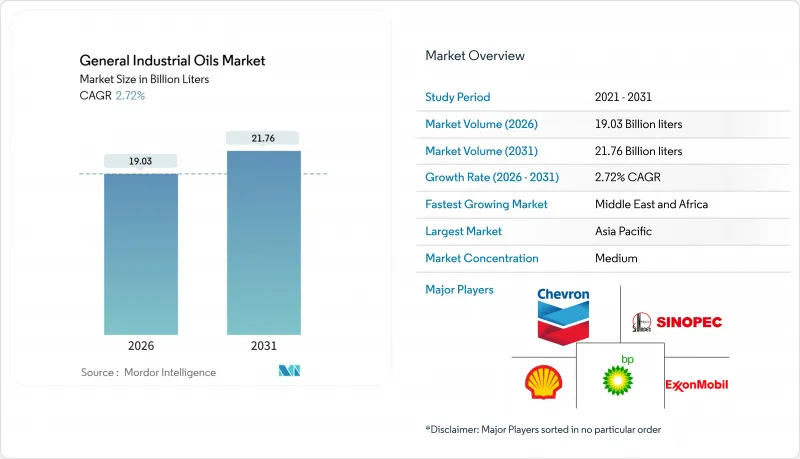
This report is Segmented by Product Type (Turbine Oil, Refrigeration Oil, Compressor Oil, Electrical Oil, and More), End-User Industry (Power Generation, Automotive and Other Transportation, Food and Beverage, Metallurgy and Metal Working, and More), and Geography (Asia-Pacific, North America, Europe, South America, and Middle-East and Africa). Market Forecasts are Provided in Terms of Volume (liters).
Global General Industrial Oils Market Trends and Insights
Expansion of Gas and Steam Turbine Fleets in Emerging Markets
Saudi Aramco's USD 1.2 billion order for 14 HA-class gas turbines at Jafurah in March 2025 underscores a wave of combined-cycle builds that each consume 4,500-5,000 liters of ISO VG 32 oil per unit. India's NTPC added 6.4 GW of capacity in fiscal 2025, lifting incremental turbine-oil demand by 22 million liters. Siemens Energy's TLV 9013 04 varnish limit is forcing formulators toward Group III bases priced 50-70% above Group I oils. Southeast Asian gas-to-power projects totaling 18 GW for 2026-2028 commissioning signal a sustained pull on premium turbine oils. Hydrogen co-firing trials at Mitsubishi's Takasago site reveal that only synthetic ester blends withstand nitration under 30% H2 environments.
Surging Refrigeration Demand from Global Cold-Chain Build-Out
India earmarked USD 480 million in 2025 for cold-storage expansion, where polyolester oils now power 42% of new R-32 systems. China's e-commerce fresh-food push lifted cold-chain logistics 14% in 2025, splitting lubricant demand between mineral R-22 oils inland and synthetic R-32 oils on the coast. Kigali timelines press markets to low-GWP refrigerants, yet R-32's A2L flammability adds compliance costs that delay rollouts in price-sensitive regions. Natural-refrigerant migration is tangible, Coca-Cola HBC rolled out 8,500 CO2 transcritical coolers (2025) that each require alkylbenzene or PAG fluids tuned for miscibility at subcritical pressures. Japan's FamilyMart installed 1,200 CO2 units in 2025, trimming oil charge per case by 40%.
Accelerating Adoption of Direct-Drive Electric Motors
ABB's AMI series secured 29% of European compressor installs in 2025, slicing lubricant consumption 65-75% by eliminating gearboxes. Danfoss VLT systems paired with permanent-magnet motors reduced hydraulic-oil use 70% in 4,200 molding machines commissioned in 2025. Atlas Copco's oil-free ZR VSD+ compressors reached 22% share in food applications, removing lubrication entirely. Bosch Rexroth calculates that electro-hydraulic actuators trimmed European hydraulic-fluid sales by 45 million liters in 2025. The General industrial oils market feels the volume pinch most acutely in gear and hydraulic categories.
Other drivers and restraints analyzed in the detailed report include:
- Growth of High-Speed Compressors in Petrochem and LNG
- OEM-Driven Switch to Condition-Monitoring Lubricants
- Stricter PFAS Limits Shrinking Legacy Additive Choices
For complete list of drivers and restraints, kindly check the Table Of Contents.
Segment Analysis
Hydraulic oil retained 51.77% of the General industrial oils market share in 2025, yet its modest 2.91% CAGR to 2031 hides a pivot to bio-based and synthetic variants that reduce fill volumes per asset while lifting revenue per liter. ISO VG 46 and VG 68 dominate mobile hydraulics, but Caterpillar's biodegradable fluids cut per-excavator oil capacity to 380 liters while extending drains to 3,500 hours. Turbine and compressor oils converge around ASTM D7843 varnish targets below 5 ΔE, accelerating diffusion of Group III bases. Refrigeration oils mirror the refrigerant transition: polyolesters for R-32 and R-454B took 38% of 2025 HVAC installs in Europe and North America, whereas alkylbenzene oils serve CO2 transcritical systems in Japan's retail network.
Heat-transfer fluids remain niche, priced at USD 8-12 per liter versus USD 2-3 for mineral oils, yet uptake in concentrated solar and specialty reactors is steady. Electrical-insulating oils split between mineral fluids (72% share) and natural esters, the latter advancing 18% in 2025 on urban-substation safety codes. Compressor oils bifurcate into high-speed PAO blends for petrochem and diester variants for temperature extremes. Multi-functional SKUs such as Shell's Omala S5 W, certified to ISO 6743-4 HM and DIN 51524-2, blur boundaries and widen addressable General industrial oils market demand.
Complete Report Scope:
- By Product Type
- Turbine Oil
- Refrigeration Oil
- Compressor Oil
- Electrical Oil
- Heat-Transfer Oil
- Hydraulic Oil
- By End-user Industry
- Power Generation
- Automotive and Other Transportation
- Heavy Equipment
- Food and Beverage
- Metallurgy and Metal Working
- Chemical Manufacturing
- Other End-user Industries
- By Geography
- Asia-Pacific
- China
- India
- Japan
- South Korea
- ASEAN Countries
- Rest of Asia-Pacific
- North America
- United States
- Canada
- Mexico
- Europe
- Germany
- United Kingdom
- France
- Italy
- Spain
- Russia
- NORDIC Countries
- Rest of Europe
- South America
- Brazil
- Argentina
- Rest of South America
- Middle-East and Africa
- Saudi Arabia
- South Africa
- Rest of Middle-East and Africa
- Asia-Pacific
Geography Analysis
Asia-Pacific anchored 46.12% of the General industrial oils market in 2025, gaining from China's Shenghong and Hengli base-oil builds that together added 330,000 t/a of Group II/III capacity. India's refiners expanded blending capacity by 100,000 t/a between 2024 and 2025 to serve construction and mobility booms. Yet regional growth faces feedstock volatility and on-ramping PFAS laws, with Japan already favoring ISO 14001-aligned synthetic and bio fluids. Nearshoring benefits Vietnam and Thailand, where semiconductor fabs consume 8,000 t of ultra-pure lubricants annually.
North America is buoyed by LNG export expansion and reshoring incentives, but rapid uptake of direct-drive motors and federal PFAS scrutiny temper volumes. Golden Pass LNG alone adds 18,000 liters of synthetic compressor oil per year, yet US manufacturing facilities built under the Inflation Reduction Act often employ oil-free machinery. Europe endures the sharpest regulatory friction; REACH Annex XVII forced a wave of reformulations that added USD 0.10 per liter in raw-material cost. Germany's hydraulics market saw 34% of units specify biodegradable fluids by 2025.
The Middle East and Africa post the quickest 2.93% CAGR for the General industrial oils market, catalyzed by Saudi Aramco's Jafurah field and SABIC's Jubail petrochemical build-out. South Africa's mines adopt synthetics to lengthen drains amid load-shedding, while the UAE targets manufacturing diversification that lifts premium-oil uptake. South America remains volume-focused, led by Brazil's farm-equipment fleet and Argentina's shale play, whereas Russia continues to rely on domestic Group I/II supply amid limited import options.
- Aarna Lube Pvt Ltd
- Apar Industries Ltd
- Arabian Petroleum Ltd
- Arabol Lubricants
- BP p.l.c.
- Castrol Limited
- Chevron Corporation
- China Petrochemical Corporation (Sinopec)
- Eastern Petroleum
- Exxon Mobil Corporation
- FUCHS SE
- HP Lubricants
- HP Lubricants
- Lubrita
- Paras Lubricants Ltd
- PETRONAS Lubricants International
- Repsol
- Shell plc
- Tashoil Company Pvt Ltd
- TotalEnergies SE
- Valvoline Corporation
Additional Benefits:
- The market estimate (ME) sheet in Excel format
- 3 months of analyst support
TABLE OF CONTENTS
1 Introduction
- 1.1 Study Assumptions & Market Definition
- 1.2 Scope of the Study
2 Research Methodology
3 Executive Summary
4 Market Landscape
- 4.1 Market Overview
- 4.2 Market Drivers
- 4.2.1 Expansion of gas and steam turbine fleets in emerging markets
- 4.2.2 Surging refrigeration demand from global cold-chain build-out
- 4.2.3 Growth of high-speed compressors in petrochem and LNG
- 4.2.4 OEM-driven switch to condition-monitoring lubricants
- 4.2.5 Data-centre immersion-cooling oils creating new niche
- 4.3 Market Restraints
- 4.3.1 Accelerating adoption of direct-drive electric motors
- 4.3.2 Volatility in Group I/II base-oil feedstock prices
- 4.3.3 Stricter PFAS limits shrinking legacy additive choices
- 4.4 Value Chain Analysis
- 4.5 Porter's Five Forces
- 4.5.1 Bargaining Power of Suppliers
- 4.5.2 Bargaining Power of Buyers
- 4.5.3 Threat of New Entrants
- 4.5.4 Threat of Substitutes
- 4.5.5 Degree of Competition
5 Market Size & Growth Forecasts (Volume)
- 5.1 By Product Type
- 5.1.1 Turbine Oil
- 5.1.2 Refrigeration Oil
- 5.1.3 Compressor Oil
- 5.1.4 Electrical Oil
- 5.1.5 Heat-Transfer Oil
- 5.1.6 Hydraulic Oil
- 5.2 By End-user Industry
- 5.2.1 Power Generation
- 5.2.2 Automotive and Other Transportation
- 5.2.3 Heavy Equipment
- 5.2.4 Food and Beverage
- 5.2.5 Metallurgy and Metal Working
- 5.2.6 Chemical Manufacturing
- 5.2.7 Other End-user Industries
- 5.3 By Geography
- 5.3.1 Asia-Pacific
- 5.3.1.1 China
- 5.3.1.2 India
- 5.3.1.3 Japan
- 5.3.1.4 South Korea
- 5.3.1.5 ASEAN Countries
- 5.3.1.6 Rest of Asia-Pacific
- 5.3.2 North America
- 5.3.2.1 United States
- 5.3.2.2 Canada
- 5.3.2.3 Mexico
- 5.3.3 Europe
- 5.3.3.1 Germany
- 5.3.3.2 United Kingdom
- 5.3.3.3 France
- 5.3.3.4 Italy
- 5.3.3.5 Spain
- 5.3.3.6 Russia
- 5.3.3.7 NORDIC Countries
- 5.3.3.8 Rest of Europe
- 5.3.4 South America
- 5.3.4.1 Brazil
- 5.3.4.2 Argentina
- 5.3.4.3 Rest of South America
- 5.3.5 Middle-East and Africa
- 5.3.5.1 Saudi Arabia
- 5.3.5.2 South Africa
- 5.3.5.3 Rest of Middle-East and Africa
- 5.3.1 Asia-Pacific
6 Competitive Landscape
- 6.1 Market Concentration
- 6.2 Strategic Moves
- 6.3 Market Share(%)/Ranking Analysis
- 6.4 Company Profiles (includes Global level Overview, Market level overview, Core Segments, Financials as available, Strategic Information, Products & Services, Recent Developments)
- 6.4.1 Aarna Lube Pvt Ltd
- 6.4.2 Apar Industries Ltd
- 6.4.3 Arabian Petroleum Ltd
- 6.4.4 Arabol Lubricants
- 6.4.5 BP p.l.c.
- 6.4.6 Castrol Limited
- 6.4.7 Chevron Corporation
- 6.4.8 China Petrochemical Corporation (Sinopec)
- 6.4.9 Eastern Petroleum
- 6.4.10 Exxon Mobil Corporation
- 6.4.11 FUCHS SE
- 6.4.12 HP Lubricants
- 6.4.13 HP Lubricants
- 6.4.14 Lubrita
- 6.4.15 Paras Lubricants Ltd
- 6.4.16 PETRONAS Lubricants International
- 6.4.17 Repsol
- 6.4.18 Shell plc
- 6.4.19 Tashoil Company Pvt Ltd
- 6.4.20 TotalEnergies SE
- 6.4.21 Valvoline Corporation
7 Market Opportunities and Future Outlook
- 7.1 White-space and Unmet-need Assessment

