PUBLISHER: Mordor Intelligence | PRODUCT CODE: 2114368

PUBLISHER: Mordor Intelligence | PRODUCT CODE: 2114368
Acrylate Monomers - Market Share Analysis, Industry Trends & Statistics, Growth Forecasts (2026 - 2031)
According to Mordor Intelligence, acrylate monomers market size in 2026 is estimated at USD 5.81 billion, growing from 2025 value of USD 5.54 billion with 2031 projections showing USD 7.39 billion, growing at 4.95% CAGR over 2026-2031.
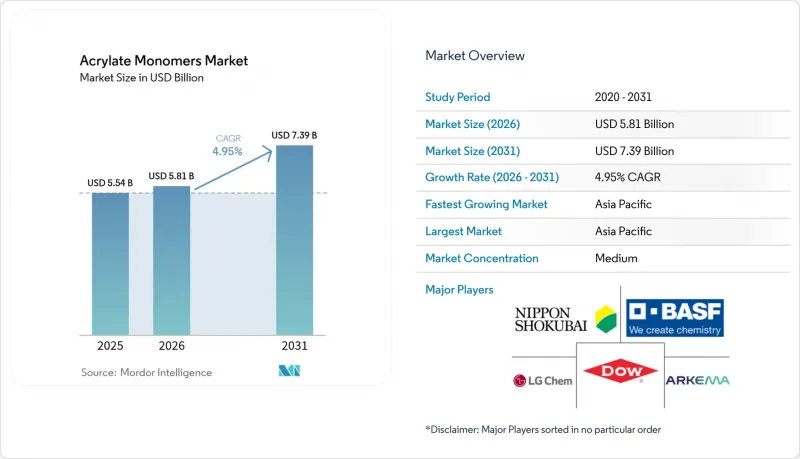
This report is Segmented by Type (Butyl Acrylate, Ethyl Acrylate, Ethylhexyl Acrylate, and Methyl Acrylate), Application (Paints and Coatings, Adhesives and Sealants, Plastics and Polymers, Printing Inks, and Other Applications), End-User Sector (Construction, Packaging, and More), and Geography (Asia-Pacific, North America, and More). The Market Forecasts are Provided in Terms of Value (USD).
Global Acrylate Monomers Market Trends and Insights
Low-VOC Architectural Coating Boom
Butyl-acrylate copolymers enable zero-VOC claims while preserving open time, wet-scrub durability, and alkalinity resistance, driving formulators to phase out vinyl acetate. China's 14th Five-Year Plan mandates low-emission coatings in many of the new residential projects by 2025, accelerating local emulsion-polymer output. In India, small paint makers are adopting pre-compounded acrylic binders to bypass in-house polymerization and speed regional color launches. Third-party verification through ISO 11890 testing and LEED v4.1 credits reinforces procurement criteria that favor advanced acrylic emulsions, underscoring their suitability for use in sustainable building practices.
Rapid Expansion of Pressure-Sensitive Adhesive Demand
E-commerce packaging, medical tapes, and automotive trim bonding drive the use of acrylate monomer in pressure-sensitive adhesives. Ethylhexyl acrylate supplied the PSA monomer feedstock because it supports low-temperature tack in hot-melt and solvent-free formulations. Southeast Asian corrugated box production is increasing, necessitating the use of optically clear adhesive films for flexible pouches. Medical wearables rely on acrylic PSAs with residual-monomer levels under 100 ppm to meet ISO 10993 skin-sensitization thresholds. FDA guidance on extractables is pushing device makers to specify high-purity ethyl acrylate in wound-care patches.
Volatile Propylene and Acrylic-Acid Feedstock Costs
Propylene spot values fluctuated in 2024 due to refinery maintenance, PDH start-ups, and polypropylene market competition. Formulators are trialing bio-based methyl acrylate derived from glycerol or lactic acid. The EU's Carbon Border Adjustment Mechanism embeds feedstock carbon intensity into procurement, encouraging the development of long-term propylene supply contracts.
Other drivers and restraints analyzed in the detailed report include:
- Asia-Pacific Construction Super-Cycle
- Rise of UV-Curable Acrylate Formulations for Flexible Electronics
- Regulatory Squeeze on Residual Monomer Toxicity
For complete list of drivers and restraints, kindly check the Table Of Contents.
Segment Analysis
Butyl acrylate accounts for 76.02% of the total volume and is expected to advance at a 5.18% CAGR through 2031. Continuous-reactor upgrades shorten cycle times, reducing energy consumption and enabling responsive spot market sales. Ethyl acrylate targets high-solids industrial coatings where faster cure rates justify its premium pricing. Ethylhexyl acrylate is a key component in pressure-sensitive adhesives that require low-temperature tack in medical and automotive tapes. Methyl acrylate occupies a niche in pharmaceutical intermediates and UV-curable oligomers, benefiting from rapid radical-polymerization kinetics.
Sustained investment in ISO 9001 and ISO 14001 certification is now mandatory for suppliers serving multinational paint and adhesive firms, raising entry barriers for regional producers. The acrylate monomers market continues to favor integrated players that can offer formulation assistance and residual monomer guarantees under 100 ppm. Continuous processes also provide consistent molecular-weight distribution, a key requirement for low-temperature flexibility in architectural coatings. Producers that retrofit reactors with advanced pressure control can toggle between monomer grades, maximizing asset utilization.
Complete Report Scope:
- By Type
- Butyl Acrylate
- Ethyl Acrylate
- Ethylhexyl Acrylate
- Methyl Acrylate
- By Application
- Paints and Coatings
- Adhesives and Sealants
- Plastics and Polymers
- Printing Inks
- Other Applications
- By End-User Sector
- Construction
- Automotive and Transportation
- Packaging
- Electronics and Electrical
- Healthcare and Hygiene
- By Geography
- Asia-Pacifc
- China
- India
- Japan
- South Korea
- Malaysia
- Thailand
- Indonesia
- Vietnam
- Rest of Asia-Pacific
- North America
- United States
- Canada
- Mexico
- Europe
- Germany
- United Kingdom
- France
- Italy
- Spain
- Nordic Countries
- Turkey
- Russia
- Rest of Europe
- South America
- Brazil
- Argentina
- Colombia
- Middle-East and Africa
- Saudi Arabia
- Qatar
- United Arab Emirates
- Nigeria
- Egypt
- South Africa
- Rest of Middle-East and Africa
- Asia-Pacifc
Geography Analysis
The Asia-Pacific region held 44.80% of the acrylate monomers market volume in 2025 and is projected to grow at a 5.28% CAGR from 2026 to 2031, at the highest regional pace. China is channeling butyl-acrylate emulsions into coatings for new housing units, while the Shenzhen and Suzhou electronics clusters utilize UV-curable oligomers for foldable screens. The National Infrastructure Pipeline spending on highways, airports, and affordable housing lifts demand in India.
North America commands a significant portion of global consumption. Canada's share concentrates on methyl acrylate for EV battery binders, supported by Strategic Innovation Fund co-grants. Mexico contributes as near-shoring drives ethylhexyl-acrylate uptake in automotive and electronics assembly, backed by USMCA rule-of-origin incentives.
Germany, France, and the United Kingdom lead Europe's demand. REACH fees and CBAM carbon levies encourage the substitution of methyl acrylate with bio-based alternatives. The Middle East and Africa share is centered on Saudi Arabian and UAE petrochemical hubs targeting export-oriented acrylic acid. ISO 9001 and ISO 14001 compliance are now mandatory credentials for suppliers entering multinational supply chains.
- Arkema
- BASF SE
- Bharat Petroleum Corporation Limited
- Dow
- Jurong Group
- LG Chem
- LobaChemie Pvt. Ltd.
- Mitsubishi Chemical Holdings Corporation
- Nippon Shokubai Co., Ltd
- Prasol Chemicals Limited
- Sasol
- Satellite Chemical Co. Ltd
- Shenyang Chemical Co Ltd
- SIBUR Holding PJSC
- Synthomer PLC
- Tasnee (national Industrialization Company)
- TOAGOSEI CO.,LTD.
- Tokyo Chemical Industry Co., Ltd.
- Wanhua
Additional Benefits:
- The market estimate (ME) sheet in Excel format
- 3 months of analyst support
TABLE OF CONTENTS
1 Introduction
- 1.1 Study Assumptions and Market Definition
- 1.2 Scope of the Study
2 Research Methodology
3 Executive Summary
4 Market Landscape
- 4.1 Market Overview
- 4.2 Market Drivers
- 4.2.1 Low-VOC architectural coating boom
- 4.2.2 Rapid expansion of pressure-sensitive adhesive demand
- 4.2.3 Asia-pacific construction super-cycle
- 4.2.4 Rise of UV-curable acrylate formulations for flexible electronics
- 4.2.5 On-shoring incentives and antidumping tariffs driving North America capacity adds
- 4.3 Market Restraints
- 4.3.1 Volatile propylene and acrylic-acid feedstock costs
- 4.3.2 Regulatory squeeze on residual monomer toxicity
- 4.3.3 Competition from next-gen polyurethane dispersions in coatings
- 4.4 Value Chain Analysis
- 4.5 Porter's Five Forces
- 4.5.1 Threat of New Entrants
- 4.5.2 Bargaining Power of Suppliers
- 4.5.3 Bargaining Power of Buyers
- 4.5.4 Threat of Substitutes
- 4.5.5 Degree of Competition
5 Market Size and Growth Forecasts (Value)
- 5.1 By Type
- 5.1.1 Butyl Acrylate
- 5.1.2 Ethyl Acrylate
- 5.1.3 Ethylhexyl Acrylate
- 5.1.4 Methyl Acrylate
- 5.2 By Application
- 5.2.1 Paints and Coatings
- 5.2.2 Adhesives and Sealants
- 5.2.3 Plastics and Polymers
- 5.2.4 Printing Inks
- 5.2.5 Other Applications
- 5.3 By End-User Sector
- 5.3.1 Construction
- 5.3.2 Automotive and Transportation
- 5.3.3 Packaging
- 5.3.4 Electronics and Electrical
- 5.3.5 Healthcare and Hygiene
- 5.4 By Geography
- 5.4.1 Asia-Pacifc
- 5.4.1.1 China
- 5.4.1.2 India
- 5.4.1.3 Japan
- 5.4.1.4 South Korea
- 5.4.1.5 Malaysia
- 5.4.1.6 Thailand
- 5.4.1.7 Indonesia
- 5.4.1.8 Vietnam
- 5.4.1.9 Rest of Asia-Pacific
- 5.4.2 North America
- 5.4.2.1 United States
- 5.4.2.2 Canada
- 5.4.2.3 Mexico
- 5.4.3 Europe
- 5.4.3.1 Germany
- 5.4.3.2 United Kingdom
- 5.4.3.3 France
- 5.4.3.4 Italy
- 5.4.3.5 Spain
- 5.4.3.6 Nordic Countries
- 5.4.3.7 Turkey
- 5.4.3.8 Russia
- 5.4.3.9 Rest of Europe
- 5.4.4 South America
- 5.4.4.1 Brazil
- 5.4.4.2 Argentina
- 5.4.4.3 Colombia
- 5.4.5 Middle-East and Africa
- 5.4.5.1 Saudi Arabia
- 5.4.5.2 Qatar
- 5.4.5.3 United Arab Emirates
- 5.4.5.4 Nigeria
- 5.4.5.5 Egypt
- 5.4.5.6 South Africa
- 5.4.5.7 Rest of Middle-East and Africa
- 5.4.1 Asia-Pacifc
6 Competitive Landscape
- 6.1 Market Concentration
- 6.2 Strategic Moves
- 6.3 Market Share (%)/Ranking Analysis
- 6.4 Company Profiles (includes Global-level Overview, Market-level Overview, Core Segments, Financials, Strategic Info, Market Rank/Share, Products and Services, Recent Developments)
- 6.4.1 Arkema
- 6.4.2 BASF SE
- 6.4.3 Bharat Petroleum Corporation Limited
- 6.4.4 Dow
- 6.4.5 Jurong Group
- 6.4.6 LG Chem
- 6.4.7 LobaChemie Pvt. Ltd.
- 6.4.8 Mitsubishi Chemical Holdings Corporation
- 6.4.9 Nippon Shokubai Co., Ltd
- 6.4.10 Prasol Chemicals Limited
- 6.4.11 Sasol
- 6.4.12 Satellite Chemical Co. Ltd
- 6.4.13 Shenyang Chemical Co Ltd
- 6.4.14 SIBUR Holding PJSC
- 6.4.15 Synthomer PLC
- 6.4.16 Tasnee (national Industrialization Company)
- 6.4.17 TOAGOSEI CO.,LTD.
- 6.4.18 Tokyo Chemical Industry Co., Ltd.
- 6.4.19 Wanhua
7 Market Opportunities and Future Outlook
- 7.1 White-space and Unmet-need Assessment

