PUBLISHER: Mordor Intelligence | PRODUCT CODE: 2114375

PUBLISHER: Mordor Intelligence | PRODUCT CODE: 2114375
In-memory Computing - Market Share Analysis, Industry Trends & Statistics, Growth Forecasts (2026 - 2031)
According to Mordor Intelligence, the global in-memory computing market size is expected to grow from USD 14.4 billion in 2025 to USD 16.82 billion in 2026 and is forecast to reach USD 36.59 billion by 2031 at 16.83% CAGR over 2026-2031.
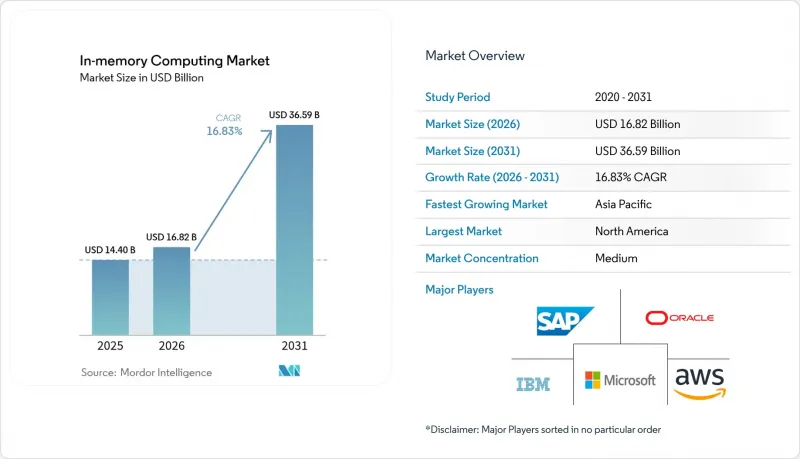
This report is Segmented by Component (In-Memory Data Management Platforms, In-Memory Application Platforms), Deployment Mode (On-Premises, Cloud/SaaS), Application (Real-Time Analytics & BI, High-Frequency Trading, and More), End-User Vertical (BFSI, Healthcare and Life Sciences, and More), Memory Technology, Organization Size, and Geography. The Market Forecasts are Provided in Terms of Value (USD).
Global In-memory Computing Market Trends and Insights
Explosion of Big Data
Organizations now generate multi-quintillion-byte data streams that must be queried in real time, forcing a shift from batch processing to streaming architectures anchored in memory-centric platforms. Healthcare providers run continuous patient-monitoring pipelines that flag clinical anomalies within seconds, while high-frequency traders move billions of dollars on microsecond calculations.
Growing Need for Rapid Data Processing
Customer interactions, factory automation, and connected vehicles demand latencies measured in microseconds. Mercedes-AMG cut engine test-cycle times by 94% after adopting a real-time in-memory analytics layer, effectively gaining an extra production day each week.
High Cost of DRAM at Hyperscale
DRAM price spikes of 50% in early 2025 raised the total cost of ownership for large clusters, delaying refresh cycles for memory-intensive workloads.
Other drivers and restraints analyzed in the detailed report include:
- Proliferation of AI-centric Workloads
- Declining Cost/GB of Persistent Memory
- Shortage of Skilled IMC Architects and Developers
For complete list of drivers and restraints, kindly check the Table Of Contents.
Segment Analysis
In-memory data management platforms held 61.34% revenue in 2025, underscoring demand for ACID-compliant, drop-in replacements to entrenched databases. Many banks migrated core analytics workloads without rewriting applications, capturing latency cuts of 20-40 ms per query. In contrast, in-memory application platforms are forecast to grow at 21.85% CAGR as digital-native firms design real-time microservices from the ground up. The component landscape is converging vendors weave SQL, streaming, and vector search into unified fabrics that house operational and analytical workloads side-by-side, shrinking data-movement overheads and easing DevOps.
Cloud models accounted for 70.88% revenue in 2025 and will outpace the overall in-memory computing market through 2031. Hyperscalers bundle high-memory instances, CXL-attached pools, and serverless scaling under pay-as-you-go terms, lowering the barrier for midsize adopters. AWS's Valkey-based ElastiCache tier costs 33% less than equivalent Redis clusters while boosting throughput over 2X, proving price-performance gains attractive to cost-sensitive SaaS providers.
Complete Report Scope:
- By Component
- In memory Data Management Platforms
- In memory Application Platforms
- By Deployment Mode
- On-premises
- Cloud / SaaS
- By Application
- Real-time Analytics & BI
- High-frequency Trading
- Fraud & Risk Management
- IoT/Edge Stream Processing
- By End-user Vertical
- BFSI
- Healthcare & Life Sciences
- IT & Telecom
- Government & Public Sector
- Manufacturing & Automotive
- By Memory Technology
- DRAM-based IMC
- NAND-based IMC (Redis on-flash, etc.)
- Persistent / Storage-class Memory (SCM)
- By Organization Size
- Large Enterprises
- Small & Medium Enterprises (SME)
- By Geography
- North America
- United States
- Canada
- Mexico
- Europe
- United Kingdom
- Germany
- France
- Italy
- Rest of Europe
- Asia-Pacific
- China
- Japan
- India
- South Korea
- Rest of Asia
- Middle East
- Israel
- Saudi Arabia
- United Arab Emirates
- Turkey
- Rest of Middle East
- Africa
- South Africa
- Egypt
- Rest of Africa
- South America
- Brazil
- Argentina
- Rest of South America
- North America
Geography Analysis
North America generated 37.25% of 2025 revenue, underpinned by deep capital markets, a robust talent ecosystem, and hyperscaler appetite for AI acceleration. Real-time payment rails, autonomous-vehicle pilots, and precision-medicine platforms keep memory footprints climbing across every state.
Asia-Pacific is scaling fastest at a 20.25% CAGR. China's state-backed semiconductor programs and India's Digital India cloud corridors are spawning megawatt-class data centers, many pre-wired for CXL fabric expansion. Regional 5G densification plus data-locality mandates pull inference tasks to country-level edges, favouring in-memory fabrics tuned for micro-services.
Europe is wrestling with capacity constraints yet funnelling record capital into new builds. Vantage Data Centers' EUR 720 million securitization-the first of its kind on the continent-signals growing investor confidence that AI workloads will soak up new racks quickly. The EU AI Act and sustainability rules are nudging enterprises toward energy-efficient in-memory architectures that balance throughput with power caps.
- SAP SE
- Oracle Corporation
- Microsoft Corporation
- International Business Machines Corporation (IBM)
- Amazon Web Services, Inc.
- Altibase Corporation
- GridGain Systems, Inc.
- GigaSpaces Technologies Ltd.
- Software AG
- TIBCO Software Inc.
- Hazelcast Inc.
- SAS Institute Inc.
- MongoDB, Inc.
- DataStax, Inc.
- Redis Ltd. (Redis Labs)
- MemVerge, Inc.
- Hewlett Packard Enterprise Company
- Fujitsu Limited
- KX Systems, Inc.
- Volt Active Data, Inc.
- Aerospike Inc.
Additional Benefits:
- The market estimate (ME) sheet in Excel format
- 3 months of analyst support
TABLE OF CONTENTS
1 INTRODUCTION
- 1.1 Study Assumptions & Market Definition
- 1.2 Scope of the Study
2 RESEARCH METHODOLOGY
3 EXECUTIVE SUMMARY
4 MARKET LANDSCAPE
- 4.1 Market Overview
- 4.2 Market Drivers
- 4.2.1 Explosion of Big Data
- 4.2.2 Growing Need for Rapid Data Processing
- 4.2.3 Proliferation of AI-centric Workloads (LLMs, vector search)
- 4.2.4 Declining Cost/GB of Persistent Memory (e.g., Intel Optane successors)
- 4.2.5 Rising Adoption of Real-time Fraud Detection in BFSI
- 4.2.6 Edge-side In-Memory Analytics for 5G Telco Clouds
- 4.3 Market Restraints
- 4.3.1 High Cost of DRAM at Hyperscale
- 4.3.2 Data Gravity & Inter-cluster Latency
- 4.3.3 Vendor Lock-in Concerns for Proprietary IMC Appliances
- 4.3.4 Shortage of Skilled IMC Architects & Developers
- 4.4 Value / Supply-Chain Analysis
- 4.5 Regulatory Landscape (Data Residency & Sovereignty)
- 4.6 Technological Outlook (CXL?attached memory pools, DDR5, MRAM)
- 4.7 Porter's Five Forces
- 4.7.1 Bargaining Power of Suppliers
- 4.7.2 Bargaining Power of Buyers
- 4.7.3 Threat of New Entrants
- 4.7.4 Threat of Substitutes
- 4.7.5 Intensity of Competitive Rivalry
5 MARKET SIZE & GROWTH FORECASTS (VALUE, USD BILLION)
- 5.1 By Component
- 5.1.1 In memory Data Management Platforms
- 5.1.2 In memory Application Platforms
- 5.2 By Deployment Mode
- 5.2.1 On-premises
- 5.2.2 Cloud / SaaS
- 5.3 By Application
- 5.3.1 Real-time Analytics & BI
- 5.3.2 High-frequency Trading
- 5.3.3 Fraud & Risk Management
- 5.3.4 IoT/Edge Stream Processing
- 5.4 By End-user Vertical
- 5.4.1 BFSI
- 5.4.2 Healthcare & Life Sciences
- 5.4.3 IT & Telecom
- 5.4.4 Government & Public Sector
- 5.4.5 Manufacturing & Automotive
- 5.5 By Memory Technology
- 5.5.1 DRAM-based IMC
- 5.5.2 NAND-based IMC (Redis on-flash, etc.)
- 5.5.3 Persistent / Storage-class Memory (SCM)
- 5.6 By Organization Size
- 5.6.1 Large Enterprises
- 5.6.2 Small & Medium Enterprises (SME)
- 5.7 By Geography
- 5.7.1 North America
- 5.7.1.1 United States
- 5.7.1.2 Canada
- 5.7.1.3 Mexico
- 5.7.2 Europe
- 5.7.2.1 United Kingdom
- 5.7.2.2 Germany
- 5.7.2.3 France
- 5.7.2.4 Italy
- 5.7.2.5 Rest of Europe
- 5.7.3 Asia-Pacific
- 5.7.3.1 China
- 5.7.3.2 Japan
- 5.7.3.3 India
- 5.7.3.4 South Korea
- 5.7.3.5 Rest of Asia
- 5.7.4 Middle East
- 5.7.4.1 Israel
- 5.7.4.2 Saudi Arabia
- 5.7.4.3 United Arab Emirates
- 5.7.4.4 Turkey
- 5.7.4.5 Rest of Middle East
- 5.7.5 Africa
- 5.7.5.1 South Africa
- 5.7.5.2 Egypt
- 5.7.5.3 Rest of Africa
- 5.7.6 South America
- 5.7.6.1 Brazil
- 5.7.6.2 Argentina
- 5.7.6.3 Rest of South America
- 5.7.1 North America
6 COMPETITIVE LANDSCAPE
- 6.1 Market Concentration
- 6.2 Strategic Moves
- 6.3 Market Share Analysis
- 6.4 Company Profiles (includes Global level Overview, Market level overview, Core Segments, Financials as available, Strategic Information, Market Rank/Share for key companies, Products & Services, and Recent Developments)
- 6.4.1 SAP SE
- 6.4.2 Oracle Corporation
- 6.4.3 Microsoft Corporation
- 6.4.4 International Business Machines Corporation (IBM)
- 6.4.5 Amazon Web Services, Inc.
- 6.4.6 Altibase Corporation
- 6.4.7 GridGain Systems, Inc.
- 6.4.8 GigaSpaces Technologies Ltd.
- 6.4.9 Software AG
- 6.4.10 TIBCO Software Inc.
- 6.4.11 Hazelcast Inc.
- 6.4.12 SAS Institute Inc.
- 6.4.13 MongoDB, Inc.
- 6.4.14 DataStax, Inc.
- 6.4.15 Redis Ltd. (Redis Labs)
- 6.4.16 MemVerge, Inc.
- 6.4.17 Hewlett Packard Enterprise Company
- 6.4.18 Fujitsu Limited
- 6.4.19 KX Systems, Inc.
- 6.4.20 Volt Active Data, Inc.
- 6.4.21 Aerospike Inc.
7 MARKET OPPORTUNITIES & FUTURE OUTLOOK
- 7.1 White-space & Unmet-need Assessment

