PUBLISHER: Mordor Intelligence | PRODUCT CODE: 2114388

PUBLISHER: Mordor Intelligence | PRODUCT CODE: 2114388
Europe Wound Care Management - Market Share Analysis, Industry Trends & Statistics, Growth Forecasts (2026 - 2031)
According to Mordor Intelligence, the European wound care management market size was valued at USD 4.65 billion in 2025 and estimated to grow from USD 4.88 billion in 2026 to reach USD 6.23 billion by 2031, at a CAGR of 4.99% during the forecast period (2026-2031).
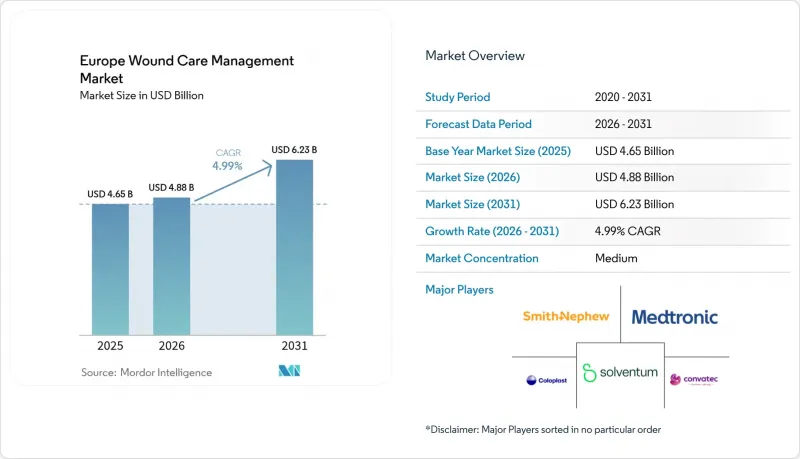
This report is Segmented by Product (Wound Care [Dressings, Wound-Care Devices, and More] and Wound Closure), Wound Type (Chronic Wounds and Acute Wounds), End User (Hospitals & Specialty Wound Clinics and More), Mode of Purchase (Institutional Procurement and Retail / OTC Channel), and Geography (Germany, United Kingdom, and More). The Market and Forecasts are Provided in Terms of Value (USD).
Europe Wound Care Management Market Trends and Insights
Increasing incidences of chronic wounds & diabetic ulcers
Prevalence of diabetes mellitus in EU member states climbed from 7.01% in 2009 to 7.96% in 2019, translating into 61 million adults now living with the condition. Chronic wounds affect 2.21 per 1,000 citizens and carry an average treatment bill of EUR 15,000 (USD 17,476) per diabetic-foot-ulcer patient in Germany, encouraging hospitals to move rapidly toward bioactive dressings and portable NPWT platforms that help compress episode-of-care costs. Real-world data from the Barcelona metro area indicate wound treatment outlays of EUR 34.99 million (USD 40.77 million) over three years, suggesting EUR 1.76 billion (USD 2.05 billion) in national spending for Spain. Socioeconomic disparities exacerbate the burden, as lower educational levels and unemployment are associated with higher ulcer incidence, particularly in Eastern and Southern Europe .
Escalating volume of elective & trauma-related surgeries
Deferred procedures from the pandemic era have pushed surgical caseloads above pre-2020 baselines across top European centres. Robotic, image-guided, and day-surgery pathways shorten hospital stay but demand sophisticated post-operative dressings that can transition safely to home care . Average reimbursements for complex tissue transfers range from EUR 5,933 (USD 6,912) for pedicled flaps to EUR 8,517 (USD 9,922) for free flaps across five major economies, underscoring high stakes for reliable closure technologies. Staple-compatible dressings and absorbable sealants are therefore gaining mindshare among theatre managers seeking to curtail operating-room turnover times.
Reimbursement hurdles for advanced wound care across major EU economies
German statutory insurance data show that 76% of leg ulcer patients depend on older hydroactive or foam dressings, revealing a collision between clinician preference and budget caps. French surveys echo the concern: 89% of caregivers would rather opt for premium therapies, yet formularies limit their freedom of choice. Although economic models demonstrate that NPWT delivers superior long-term savings, high first-invoice prices and fragmented approval pathways hinder penetration, effectively diluting growth prospects for the European wound care management market in price-sensitive regions.
Other drivers and restraints analyzed in the detailed report include:
- Rapidly ageing European population base
- Adoption of AI-enabled digital wound imaging for precision treatment
- EU-MDR compliance burden squeezing SME margins
For complete list of drivers and restraints, kindly check the Table Of Contents.
Segment Analysis
Wound care products accounted for 65.78% of the European wound care management market share in 2025, driven by hydrofiber, alginate, and antimicrobial dressings that reduce the frequency of changes and infection risk. Hospitals still purchase gauze for basic cases, yet advanced dressings are winning formularies where staff shortages and infection-control metrics drive procurement. Leading portfolios now pair dressings with cloud-connected imaging dashboards, reinforcing loyalty contracts with group purchasing organisations.
Wound closure solutions, although smaller, are set to record a 5.72% CAGR through 2031. Sutures remain theatre stalwarts, but staplers and topical adhesives are quickly gaining traction in minimally invasive segments. Smith+Nephew's RENASYS pipeline and Solventum's V.A.C. Peel & Place dressing, which allows seven-day wear, underscore the direction of innovation. Growth prospects hinge on the European wound care management market size for OR-compatible sealants, which could reach over USD 1.6 billion by 2031 under current adoption trends.
Chronic wounds accounted for 59.05% of applications in the European wound care management market in 2025, reflecting the high prevalence of diabetes and vascular diseases. Diabetic foot and venous leg ulcers attract intensive resource utilization, with German per-patient expenditures reaching EUR 15,000. Molecular profiling now links down-regulated FGF7 and elevated MMP10 to stalled healing, paving the way for precision topical therapies.
Acute wounds display the fastest 5.63% CAGR, aligned with surging surgical backlogs and trauma admissions. Burns, surgical incisions, and lacerations favour rapid-closure kits and absorbable barrier films, creating scope for hybrid dressings integrating silver or iodine reservoirs. The future addressable Europe wound care management market size for acute indications may reach approximately USD 2.08 billion by 2031 if theatre volumes maintain their 2025 trajectory.
Complete Report Scope:
- By Product
- Wound Care
- Dressings
- Traditional Gauze & Tape Dressings
- Advanced Dressings
- Wound-Care Devices
- Negative Pressure Wound Therapy (NPWT)
- Oxygen & Hyperbaric Systems
- Electrical Stimulation Devices
- Other Wound Care Devices
- Topical Agents
- Other Wound Care Products
- Dressings
- Wound Closure
- Sutures
- Surgical Staplers
- Tissue Adhesives, Strips, Sealants & Glues
- Wound Care
- By Wound Type
- Chronic Wounds
- Diabetic Foot Ulcer
- Pressure Ulcer
- Venous Leg Ulcer
- Other Chronic Wounds
- Acute Wounds
- Surgical/Traumatic Wounds
- Burns
- Other Acute Wounds
- Chronic Wounds
- By End User
- Hospitals & Specialty Wound Clinics
- Long-term Care Facilities
- Home-Healthcare Settings
- By Mode of Purchase
- Institutional Procurement
- Retail / OTC Channel
- By Geography
- Germany
- United Kingdom
- France
- Italy
- Spain
- Rest of Europe
List of Companies Covered in this Report:
- Solventum
- Smiths Group
- Molnlycke Health Care
- Coloplast
- Hartmann Group
- B. Braun
- Cardinal Health
- ConvaTec Group plc
- Medtronic
- Johnson & Johnson
- Essity AB (BSN medical)
- Lohmann & Rauscher GmbH
- Baxter
- Acelity LP Inc. (KCI)
- Medela
- Integra LifeSciences Corp.
- Organogenesis Holdings
- Urgo Medical
- Derma Sciences (Integra)
- Advanced Medical Solutions Group
Additional Benefits:
- The market estimate (ME) sheet in Excel format
- 3 months of analyst support
TABLE OF CONTENTS
1 Introduction
- 1.1 Study Assumptions & Market Definition
- 1.2 Scope of the Study
2 Research Methodology
3 Executive Summary
4 Market Landscape
- 4.1 Market Overview
- 4.2 Market Drivers
- 4.2.1 Increasing incidences of chronic wounds & diabetic ulcers
- 4.2.2 Escalating volume of elective & trauma?related surgeries
- 4.2.3 Rapidly ageing European population base
- 4.2.4 Rising prevalence of diabetes & obesity
- 4.2.5 Adoption of AI-enabled digital wound imaging for precision treatment
- 4.2.6 Hospital-to-home shift driving portable NPWT uptake
- 4.3 Market Restraints
- 4.3.1 Reimbursement hurdles for advanced wound care across major EU economies
- 4.3.2 High episode-of-care costs versus conventional dressings
- 4.3.3 EU-MDR compliance burden squeezing SME margins
- 4.3.4 Supply-chain volatility in collagen/alginate raw materials & growing AMR concerns
- 4.4 Regulatory Landscape
- 4.5 Technological Outlook
- 4.6 Porters Five Forces Analysis
- 4.6.1 Threat of New Entrants
- 4.6.2 Bargaining Power of Buyers
- 4.6.3 Bargaining Power of Suppliers
- 4.6.4 Threat of Substitutes
- 4.6.5 Intensity of Competitive Rivalry
5 Market Size & Growth Forecasts (Value, USD)
- 5.1 By Product
- 5.1.1 Wound Care
- 5.1.1.1 Dressings
- 5.1.1.1.1 Traditional Gauze & Tape Dressings
- 5.1.1.1.2 Advanced Dressings
- 5.1.1.2 Wound-Care Devices
- 5.1.1.2.1 Negative Pressure Wound Therapy (NPWT)
- 5.1.1.2.2 Oxygen & Hyperbaric Systems
- 5.1.1.2.3 Electrical Stimulation Devices
- 5.1.1.2.4 Other Wound Care Devices
- 5.1.1.3 Topical Agents
- 5.1.1.4 Other Wound Care Products
- 5.1.1.1 Dressings
- 5.1.2 Wound Closure
- 5.1.2.1 Sutures
- 5.1.2.2 Surgical Staplers
- 5.1.2.3 Tissue Adhesives, Strips, Sealants & Glues
- 5.1.1 Wound Care
- 5.2 By Wound Type
- 5.2.1 Chronic Wounds
- 5.2.1.1 Diabetic Foot Ulcer
- 5.2.1.2 Pressure Ulcer
- 5.2.1.3 Venous Leg Ulcer
- 5.2.1.4 Other Chronic Wounds
- 5.2.2 Acute Wounds
- 5.2.2.1 Surgical/Traumatic Wounds
- 5.2.2.2 Burns
- 5.2.2.3 Other Acute Wounds
- 5.2.1 Chronic Wounds
- 5.3 By End User
- 5.3.1 Hospitals & Specialty Wound Clinics
- 5.3.2 Long-term Care Facilities
- 5.3.3 Home-Healthcare Settings
- 5.4 By Mode of Purchase
- 5.4.1 Institutional Procurement
- 5.4.2 Retail / OTC Channel
- 5.5 By Geography
- 5.5.1 Germany
- 5.5.2 United Kingdom
- 5.5.3 France
- 5.5.4 Italy
- 5.5.5 Spain
- 5.5.6 Rest of Europe
6 Competitive Landscape
- 6.1 Market Concentration
- 6.2 Market Share Analysis
- 6.3 Company Profiles (includes Global level Overview, Market level overview, Core Segments, Financials as available, Strategic Information, Market Rank/Share for key companies, Products & Services, and Recent Developments)
- 6.3.1 Solventum
- 6.3.2 Smith & Nephew plc
- 6.3.3 Molnlycke Health Care AB
- 6.3.4 Coloplast A/S
- 6.3.5 Paul Hartmann AG
- 6.3.6 B. Braun Melsungen AG
- 6.3.7 Cardinal Health Inc.
- 6.3.8 ConvaTec Group plc
- 6.3.9 Medtronic plc
- 6.3.10 Johnson & Johnson (Ethicon)
- 6.3.11 Essity AB (BSN medical)
- 6.3.12 Lohmann & Rauscher GmbH
- 6.3.13 Baxter International Inc.
- 6.3.14 Acelity LP Inc. (KCI)
- 6.3.15 Medela AG
- 6.3.16 Integra LifeSciences Corp.
- 6.3.17 Organogenesis Holdings
- 6.3.18 Urgo Medical
- 6.3.19 Derma Sciences (Integra)
- 6.3.20 Advanced Medical Solutions Group plc
7 Market Opportunities & Future Outlook
- 7.1 White-space & Unmet-Need Assessment

