PUBLISHER: Mordor Intelligence | PRODUCT CODE: 2114393

PUBLISHER: Mordor Intelligence | PRODUCT CODE: 2114393
Europe Wood-plastic Composite (WPC) - Market Share Analysis, Industry Trends & Statistics, Growth Forecasts (2026 - 2031)
According to Mordor Intelligence, the Europe wood-plastic composite market size is expected to grow from 657.82 kilotons in 2025 to 704.21 kilotons in 2026 and is forecast to reach 989.99 kilotons by 2031 at 7.05% CAGR over 2026-2031.
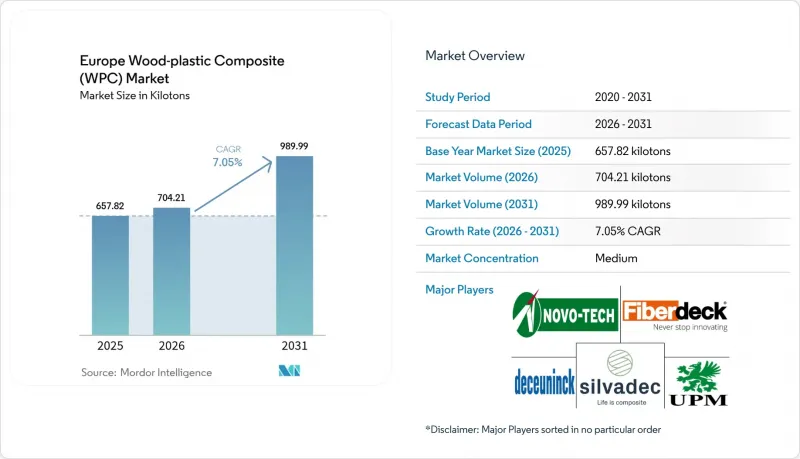
This report is Segmented by Polymer Type(Polyethylene, Polypropylene, and Other Polymer Types), Application (Decking, Auto-Interior Components, Siding and Fencing, Technical Applications, Furniture, and Consumer Goods), and Geography (Germany, United Kingdom, France, Belgium, Italy, Spain, Finland, Norway, Denmark, Sweden, and Rest of Europe). The Market Forecasts are Provided in Terms of Volume (Tons).
Europe Wood-plastic Composite (WPC) Market Trends and Insights
Sustainable Characteristics of WPC Drive Circular Economy Adoption
European brands position Europe Wood Plastic Composite market offerings as carbon-smarter substitutes that can lock up to half of their polymer matrix in recyclate while still clearing VinylPlus audits. Mechanical recyclers feed sorted film and rigids into twin-screw extruders, and coupling agents restore fiber-matrix adhesion so decking boards retain flexural strength. The integration of municipal solid-waste streams diverts landfill tonnage and shields processors from virgin polymer volatility. Germany's take-back schemes now certify geo-tracked wood fiber streams, a regulatory advantage that increases buyer confidence. Even with polymer chain scission after multiple melt cycles, compounders maintain dimensional stability by blending virgin pellets at calibrated thresholds. As a result, the Europe Wood Plastic Composite market secures environmental credits that translate into specification wins with public-sector contractors.
Construction-Sector Demand Resurgence Accelerates Infrastructure Investment
ING's 2025 outlook confirmed that Europe's building output returns to positive territory, converting EU Recovery Fund disbursements into renovation outlays that favor low-maintenance cladding. Nordic developers retrofit schools and municipal offices with insulated composite facades that withstand freeze-thaw cycles. Capital projects in France bundle WPC walkways with flood-resilient flood-barrier systems for coastal towns. Suppliers embed hidden-clip systems to reduce onsite labor, an advantage in high-wage Western Europe. Re-roofing and balcony revamps fuel inventory turnover in specialty merchant channels, while public procurement frameworks increasingly score bids on life-cycle emissions. Consequently, the construction rebound supplies a durable volume baseline for the Europe Wood Plastic Composite market.
Higher Upfront Cost vs. Pressure-Treated Timber Limits Mass-Market Penetration
Price comparisons in Romania and Bulgaria show WPC decking retailing at 40-60% premiums versus impregnated spruce boards, keeping cash-constrained homeowners on traditional lumber. Labor savings only accrue over years, whereas purchase decisions remain dominated by invoice totals. Builders face certification fees for CE marking under EN 15534, inflating entry barriers for small lot sizes. Subsidy programs rarely target composite materials, leaving processors to craft own-brand financing schemes. Until production economies of scale or recycled-content credits compress cost curves, this restraint moderates unit uptake in peripheral economies, tempering volume expansion for the Europe Wood Plastic Composite market.
Other drivers and restraints analyzed in the detailed report include:
- Lightweighting Push in European Automotive Interiors Creates Niche Opportunities
- EU Anti-Dumping Duties on Asian Plywood Spur WPC Substitution
- UV / Weathering and Color-Fade Challenges Require Advanced Stabilization Systems
For complete list of drivers and restraints, kindly check the Table Of Contents.
Segment Analysis
Polyethylene recorded a 52.06% share of the Europe Wood Plastic Composite market in 2025, underscoring the entrenched processing infrastructure and its compatibility with softwood fibers. Un-foamed PE profiles exhibit low melt viscosity, enabling high line speeds that translate into cost-per-linear-meter advantages. The segment benefits from widespread availability of post-consumer high-density polyethylene streams sourced from bottle reclaimers, which plug easily into extrusion recipes. Compounders leverage maleic-anhydride-grafted compatibilizers to stabilize the interface, allowing boards to pass EN 310 flexural testing with modest virgin polymer additions. Despite these strengths, PE's comparatively low heat-deflection temperature curtails its use in automotive or technical panels that encounter service temperatures above 90 °C.
Polypropylene, although trailing in volume, is projected to register the segment-leading 7.75% CAGR as OEMs seek higher heat performance and stiffness for interior modules. Researchers at European institutes demonstrate that PP-based composites deliver 15% higher flexural modulus than PE analogues at equal fiber loadings, while absorbing 25% less moisture. Mold-in-color capability aligns with carmaker demands for class-A surfaces that avoid paint. However, PP processing necessitates tighter thermal windows to avert oxidative degradation, compelling processors to invest in nitrogen-blanketed gravimetric feeders. PVC maintains smaller niches in window profiles and marine decking where inherent UV and flame behavior outweigh cost. Emerging bio-resins such as PLA and PHA remain below 1% share due to price, yet pilot lines in the Netherlands explore their integration, signaling future possibilities for diversifying the Europe Wood Plastic Composite market.
Complete Report Scope:
- By Polymer Type
- Polyethylene (PE)
- Polypropylene (PP)
- Polyvinyl Chloride (PVC)
- Other Polymer Types
- By Application
- Decking
- Auto-interior Components
- Siding and Fencing
- Technical Applications
- Furniture
- Consumer Goods
- By Geography
- Germany
- United Kingdom
- France
- Belgium
- Italy
- Spain
- Finland
- Norway
- Denmark
- Sweden
- Rest of Europe
List of Companies Covered in this Report:
- Bausano S.p.A
- Beologic NV
- Coperion GmbH
- Deceuninck
- Fiberdeck
- FKuR
- JELU-WERK J. Ehrler GmbH & Co. KG
- Kosche Holzwerkstoffe GmbH & Co. KG
- MOLLER GMBH & CO. KG
- Naftex GmbH
- NaturinForm
- NOVO-TECH GmbH & Co. KG
- Novowood by Iperwood srl
- PolyPlank Solutions AB
- RENOLIT SE
- Silvadec
- TECHWOODN Co., Ltd.
- The AZEK Company Inc.
- Trex Company, Inc.
- UPM
Additional Benefits:
- The market estimate (ME) sheet in Excel format
- 3 months of analyst support
TABLE OF CONTENTS
1 Introduction
- 1.1 Study Assumptions and Market Definition
- 1.2 Scope of the Study
2 Research Methodology
3 Executive Summary
4 Market Landscape
- 4.1 Market Overview
- 4.2 Market Drivers
- 4.2.1 Sustainable Characteristics of WPC Drive Circular Economy Adoption
- 4.2.2 Construction-Sector Demand Resurgence Accelerates Infrastructure Investment
- 4.2.3 Lightweighting Push in European Automotive Interiors Creates Niche Opportunities
- 4.2.4 EU Anti-Dumping Duties on Asian Plywood Spur WPC Substitution
- 4.2.5 EUDR Traceability Boosts Demand for Certified-Origin WPC
- 4.2.6 Low-Temperature Silicone-Coupling Tech Enables High-Recycled-Content WPC
- 4.3 Market Restraints
- 4.3.1 Higher Upfront Cost vs. Pressure-Treated Timber Limits Mass-Market Penetration
- 4.3.2 UV / Weathering and Color-Fade Challenges Require Advanced Stabilization Systems
- 4.3.3 Fire-Performance Compliance Costs Under EU Building Codes
- 4.4 Value Chain Analysis
- 4.5 Porter's Five Forces
- 4.5.1 Bargaining Power of Suppliers
- 4.5.2 Bargaining Power of Buyers
- 4.5.3 Threat of New Entrants
- 4.5.4 Threat of Substitutes
- 4.5.5 Degree of Competition
5 Market Size and Growth Forecasts (Volume)
- 5.1 By Polymer Type
- 5.1.1 Polyethylene (PE)
- 5.1.2 Polypropylene (PP)
- 5.1.3 Polyvinyl Chloride (PVC)
- 5.1.4 Other Polymer Types
- 5.2 By Application
- 5.2.1 Decking
- 5.2.2 Auto-interior Components
- 5.2.3 Siding and Fencing
- 5.2.4 Technical Applications
- 5.2.5 Furniture
- 5.2.6 Consumer Goods
- 5.3 By Geography
- 5.3.1 Germany
- 5.3.2 United Kingdom
- 5.3.3 France
- 5.3.4 Belgium
- 5.3.5 Italy
- 5.3.6 Spain
- 5.3.7 Finland
- 5.3.8 Norway
- 5.3.9 Denmark
- 5.3.10 Sweden
- 5.3.11 Rest of Europe
6 Competitive Landscape
- 6.1 Market Concentration
- 6.2 Strategic Moves
- 6.3 Market Share (%)/Ranking Analysis
- 6.4 Company Profiles {(includes Global level Overview, Market level overview, Core Segments, Financials as available, Strategic Information, Market Rank/Share for key companies, Products and Services, and Recent Developments)}
- 6.4.1 Bausano S.p.A
- 6.4.2 Beologic NV
- 6.4.3 Coperion GmbH
- 6.4.4 Deceuninck
- 6.4.5 Fiberdeck
- 6.4.6 FKuR
- 6.4.7 JELU-WERK J. Ehrler GmbH & Co. KG
- 6.4.8 Kosche Holzwerkstoffe GmbH & Co. KG
- 6.4.9 MOLLER GMBH & CO. KG
- 6.4.10 Naftex GmbH
- 6.4.11 NaturinForm
- 6.4.12 NOVO-TECH GmbH & Co. KG
- 6.4.13 Novowood by Iperwood srl
- 6.4.14 PolyPlank Solutions AB
- 6.4.15 RENOLIT SE
- 6.4.16 Silvadec
- 6.4.17 TECHWOODN Co., Ltd.
- 6.4.18 The AZEK Company Inc.
- 6.4.19 Trex Company, Inc.
- 6.4.20 UPM
7 Market Opportunities and Future Outlook
- 7.1 White-space and Unmet-need Assessment

