PUBLISHER: Mordor Intelligence | PRODUCT CODE: 2114406

PUBLISHER: Mordor Intelligence | PRODUCT CODE: 2114406
China Flexible Packaging - Market Share Analysis, Industry Trends & Statistics, Growth Forecasts (2026 - 2031)
According to Mordor Intelligence, China flexible packaging market size in 2026 is estimated at USD 50.77 billion, growing from 2025 value of USD 49.03 billion with 2031 projections showing USD 60.44 billion, growing at 3.55% CAGR over 2026-2031.
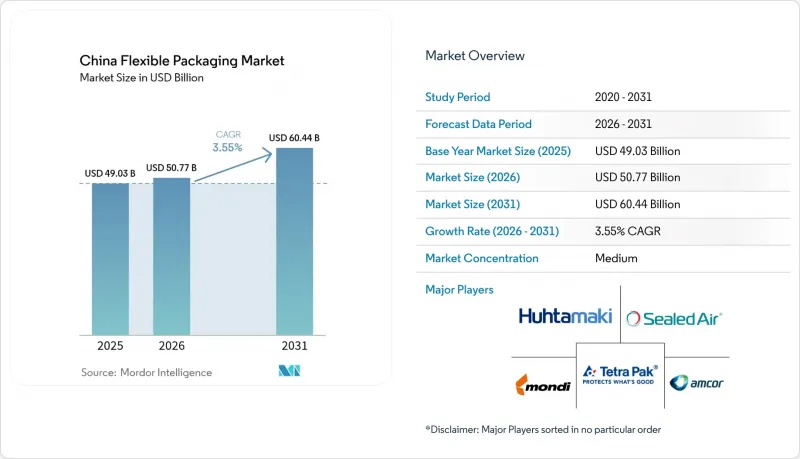
This report is Segmented by Material Type (Plastic, Paper, and More), Product Type (Bags and Pouches, Films and Wraps, and More), End-User Industry (Food, Beverage, Healthcare and Pharmaceutical, and More), Printing Technology (Flexography, Rotogravure, and Digital Printing). The Market Forecasts are Provided in Terms of Value (USD).
China Flexible Packaging Market Trends and Insights
Rising Demand for E-Commerce Ready Packaging
E-commerce logistics generated CNY 6.4 trillion (USD 0.91 trillion) in the first three quarters of 2024, up 4.2% year-on-year, prompting platforms to mandate mailers that survive conveyor handling and doorstep drop-offs without tearing. Converters have responded with co-extruded polyethylene-polyamide films that boost puncture resistance yet preserve heat-seal speed, enabling fulfillment centers to process an extra 8-10 parcels per minute. Freight operators favor flexible mailers because a unit weighs 40-50% less than a similar-sized corrugated box, cutting both carbon output and surcharges tied to dimensional weight. Brands add QR-code traceability and holographic seals, which elevate tooling costs beyond the reach of small converters lacking digital presses. The result is a bifurcated China flexible packaging market where premium e-commerce formats command 15-20% pricing power while commodity pillow packs chase volume. Large converters installing nanographic presses create an insurmountable moat around short-run orders, tightening the supply chain for last-mile durable mailers.
Government Push for Green Manufacturing in Packaging
The State Council's 2024 Extended Producer Responsibility rules make brand owners financially accountable for post-consumer collection, accelerating demand for mono-polyethylene and polypropylene films that pass curbside recyclability tests. Coastal provinces with earlier enforcement clocks are auditing converter lines quarterly, and fines for non-compliant laminate structures rose 35% in 2024 over 2023. Brand procurement teams now score suppliers on recycled-content disclosure, nudging tier-1 converters to publish life-cycle inventory data and pursue ISO 14001 certifications. Smaller inland players face capital-expenditure barriers as each line retrofit costs USD 2-4 million, forcing them to cede multinational accounts or accept price erosion. Post-consumer resin suppliers have begun issuing food-contact compliant grades, giving early adopters a 3-4 percentage-point margin lift. Over the medium term, the new rules entrench a sustainability premium inside the China flexible packaging market while sidelining firms that continue to rely on mixed-material laminates.
Stringent Single-Use Plastics Ban Roadmap
Provincial regulators scheduled phase-outs of non-recyclable multilayer films by 2026, demanding 85% recovery rates for flexible formats. Lines that still laminate polyethylene with polyamide risk de-listing from supermarket shelves in Jiangsu and Zhejiang. Retooling a seven-layer extrusion line costs USD 2-4 million, weighing on firms with thin cash cushions. Some converters migrate production inland to skirt audits, but brand owners increasingly insist on site visits and ISO-14001 certificates, closing the loophole. The policy gap between coastal and inland regions fragments the China flexible packaging market, with advanced players nudging ahead while late adopters watch margin erosion.
Other drivers and restraints analyzed in the detailed report include:
- Proliferation of Cold-Chain Logistics for Fresh Food Delivery
- Growth of Domestic FMCG Brands Requiring Differentiated Packs
- Volatile Petrochemical Feedstock Prices
For complete list of drivers and restraints, kindly check the Table Of Contents.
Segment Analysis
Plastic still owns 67.85% of China flexible packaging market share in 2025, propelled by polyethylene's balance of seal strength and cost efficiency. Bioplastics, though comparatively small, are pacing at a 5.32% CAGR because consumer goods companies must hit 30% renewable-content pledges by 2028. The China flexible packaging market size for bioplastics in personal care is projected to rise sharply as brand owners willingly absorb the 20-30% cost premium. Polyethylene holds sway in staple food pouches and e-commerce mailers, aided by expansion of post-consumer resin grades that cut virgin usage without sacrificing machinability. Polypropylene's clarity secures beverage overwraps, while polyethylene-terephthalate and polyamide appear in barrier-critical lines such as seafood packs. Over the forecast horizon, resin demand bifurcates between low-cost commodity films and high-barrier, mono-material solutions that satisfy recycling audits.
Bioplastics adoption centers on tier-1 cosmetic aisles, where polylactic-acid sachets convey clean-label cues. Moisture sensitivity challenges are gradually mitigated by multi-layer PLA-coated papers that withstand high-humidity logistics. Converters experimenting with starch-blend films bank on premium margin upside even at slower line speeds. Metal-foil laminates retreat to pharmaceutical niches as oxygen-barrier monomaterial designs mature. Taken together, material dynamics underscore how sustainability triggers value shifts inside the China flexible packaging market, spurring converters to recalibrate asset footprints toward recyclable or renewable substrates.
Bags and pouches delivered 47.10% of 2025 revenue, reflecting entrenched usage across snacks, frozen meat, and pet food. Sachets and stick packs, however, clock the fastest 4.52% CAGR as households gravitate toward single-serve convenience, especially in lower-tier cities. China flexible packaging market size for sachets in electrolyte powder alone is forecast to double by 2031 on the back of gym culture and direct-to-consumer beverage sachets. Stand-up pouches remain king where reclosing, spouts, or zippers extend product life once opened, but portion packs thrive on impulse buys and e-commerce sample bundles.
Digital printing fuels sachet customization, letting brands test micro-SKUs without cylinder cost, while Landa's S10P platform pushes variable data at near flexographic speeds. Films and wraps face slowing growth as integrated e-commerce fulfilment reduces secondary overwrap needs. Labels and shrink sleeves gain in premium beverages, aided by tactile lacquers and anti-counterfeit inks. Overall, product-mix evolution reinforces the China flexible packaging market's shift toward lightweight, portion-aligned formats that fit modern lifestyles.
Complete Report Scope:
- By Material Type
- Plastic
- Polyethylene (PE)
- Polypropylene (PP)
- Polyethylene Terephthalate (PET)
- Polyamide (PA)
- Other Plastics
- Paper
- Metal Foil
- Bioplastics and Compostable Materials
- Plastic
- By Product Type
- Bags and Pouches
- Films and Wraps
- Sachets and Stick Packs
- Labels and Sleeves
- By End-User Industry
- Food
- Meat, Poultry and Seafood
- Confectionery and Bakery
- Dairy Products
- Snacks
- Frozen Food
- Other Food Products
- Beverage
- Alcoholic
- Non-Alcoholic
- Healthcare and Pharmaceutical
- Personal Care and Cosmetics
- Agriculture and Horticulture
- Other End-Use Industries
- Food
- By Printing Technology
- Flexography
- Rotogravure
- Digital Printing
- Other Printing Technologies
List of Companies Covered in this Report:
- Amcor Plc
- Mondi Plc
- Sealed Air Corporation
- Huhtamaki Oyj
- Tetra Pak International SA
- Southern Packaging Group Ltd.
- Huangshan Novel Co. Ltd.
- Zhejiang Chengde Packaging Technology Co. Ltd.
- Jiangsu Caihua Packaging Group Co. Ltd.
- Shanghai AirPaq Packaging Technology Development Co. Ltd.
- Wuxi Huaxing Pharmaceutical Packaging Co. Ltd.
- Jiangsu Shenkai High-Tech Packaging Co. Ltd.
- Hangzhou Hansin New Packing Material Co. Ltd.
- Jiangsu Litel Green Packaging Co. Ltd.
- Texin Pack Printing Co. Ltd.
- Hunan Xinxiangwei Packaging Co. Ltd.
- Jieshou Tianhong New Material Co. Ltd.
- Kinderway Packaging Co. Ltd.
- Southern Plastic Carrying Co. Ltd.
Additional Benefits:
- The market estimate (ME) sheet in Excel format
- 3 months of analyst support
TABLE OF CONTENTS
1 INTRODUCTION
- 1.1 Study Assumptions and Market Definition
- 1.2 Scope of the Study
2 RESEARCH METHODOLOGY
3 EXECUTIVE SUMMARY
4 MARKET LANDSCAPE
- 4.1 Market Overview
- 4.2 Market Drivers
- 4.2.1 Rising Demand for E-Commerce Ready Packaging
- 4.2.2 Government Push for Green Manufacturing in Packaging
- 4.2.3 Proliferation of Cold-Chain Logistics for Fresh Food Delivery
- 4.2.4 Growth of Domestic FMCG Brands Requiring Differentiated Packs
- 4.2.5 Rapid Advancement in High-Barrier Monomaterial Films
- 4.2.6 Capital Inflow from Private Equity into Flexible Packaging
- 4.3 Market Restraints
- 4.3.1 Stringent Single-Use Plastics Ban Roadmap
- 4.3.2 Volatile Petrochemical Feedstock Prices
- 4.3.3 Recycling Infrastructure Gaps in Lower-Tier Cities
- 4.3.4 Rising Competition from Rigid Sustainable Alternatives
- 4.4 Industry Value Chain Analysis
- 4.5 Regulatory Landscape
- 4.6 Technological Outlook
- 4.7 Porter's Five Forces Analysis
- 4.7.1 Bargaining Power of Suppliers
- 4.7.2 Bargaining Power of Buyers
- 4.7.3 Threat of New Entrants
- 4.7.4 Threat of Substitutes
- 4.7.5 Intensity of Competitive Rivalry
- 4.8 Impact of Macroeconomic Factors on the Market
5 MARKET SIZE AND GROWTH FORECASTS (VALUE)
- 5.1 By Material Type
- 5.1.1 Plastic
- 5.1.1.1 Polyethylene (PE)
- 5.1.1.2 Polypropylene (PP)
- 5.1.1.3 Polyethylene Terephthalate (PET)
- 5.1.1.4 Polyamide (PA)
- 5.1.1.5 Other Plastics
- 5.1.2 Paper
- 5.1.3 Metal Foil
- 5.1.4 Bioplastics and Compostable Materials
- 5.1.1 Plastic
- 5.2 By Product Type
- 5.2.1 Bags and Pouches
- 5.2.2 Films and Wraps
- 5.2.3 Sachets and Stick Packs
- 5.2.4 Labels and Sleeves
- 5.3 By End-User Industry
- 5.3.1 Food
- 5.3.1.1 Meat, Poultry and Seafood
- 5.3.1.2 Confectionery and Bakery
- 5.3.1.3 Dairy Products
- 5.3.1.4 Snacks
- 5.3.1.5 Frozen Food
- 5.3.1.6 Other Food Products
- 5.3.2 Beverage
- 5.3.2.1 Alcoholic
- 5.3.2.2 Non-Alcoholic
- 5.3.3 Healthcare and Pharmaceutical
- 5.3.4 Personal Care and Cosmetics
- 5.3.5 Agriculture and Horticulture
- 5.3.6 Other End-Use Industries
- 5.3.1 Food
- 5.4 By Printing Technology
- 5.4.1 Flexography
- 5.4.2 Rotogravure
- 5.4.3 Digital Printing
- 5.4.4 Other Printing Technologies
6 COMPETITIVE LANDSCAPE
- 6.1 Market Concentration
- 6.2 Strategic Moves
- 6.3 Market Share Analysis
- 6.4 Company Profiles (includes Global Level Overview, Market Level Overview, Core Segments, Financials as available, Strategic Information, Market Rank/Share for Key Companies, Products and Services, and Recent Developments)
- 6.4.1 Amcor Plc
- 6.4.2 Mondi Plc
- 6.4.3 Sealed Air Corporation
- 6.4.4 Huhtamaki Oyj
- 6.4.5 Tetra Pak International SA
- 6.4.6 Southern Packaging Group Ltd.
- 6.4.7 Huangshan Novel Co. Ltd.
- 6.4.8 Zhejiang Chengde Packaging Technology Co. Ltd.
- 6.4.9 Jiangsu Caihua Packaging Group Co. Ltd.
- 6.4.10 Shanghai AirPaq Packaging Technology Development Co. Ltd.
- 6.4.11 Wuxi Huaxing Pharmaceutical Packaging Co. Ltd.
- 6.4.12 Jiangsu Shenkai High-Tech Packaging Co. Ltd.
- 6.4.13 Hangzhou Hansin New Packing Material Co. Ltd.
- 6.4.14 Jiangsu Litel Green Packaging Co. Ltd.
- 6.4.15 Texin Pack Printing Co. Ltd.
- 6.4.16 Hunan Xinxiangwei Packaging Co. Ltd.
- 6.4.17 Jieshou Tianhong New Material Co. Ltd.
- 6.4.18 Kinderway Packaging Co. Ltd.
- 6.4.19 Southern Plastic Carrying Co. Ltd.
7 MARKET OPPORTUNITIES AND FUTURE OUTLOOK
- 7.1 White-Space and Unmet-Need Assessment

