PUBLISHER: Mordor Intelligence | PRODUCT CODE: 2114409

PUBLISHER: Mordor Intelligence | PRODUCT CODE: 2114409
Thailand Textile - Market Share Analysis, Industry Trends & Statistics, Growth Forecasts (2026 - 2031)
According to Mordor Intelligence, the Thailand textile market size is expected to grow from USD 4.91 billion in 2025 to USD 4.97 billion in 2026 and is forecast to reach USD 5.37 billion by 2031 at 1.56% CAGR over 2026-2031.
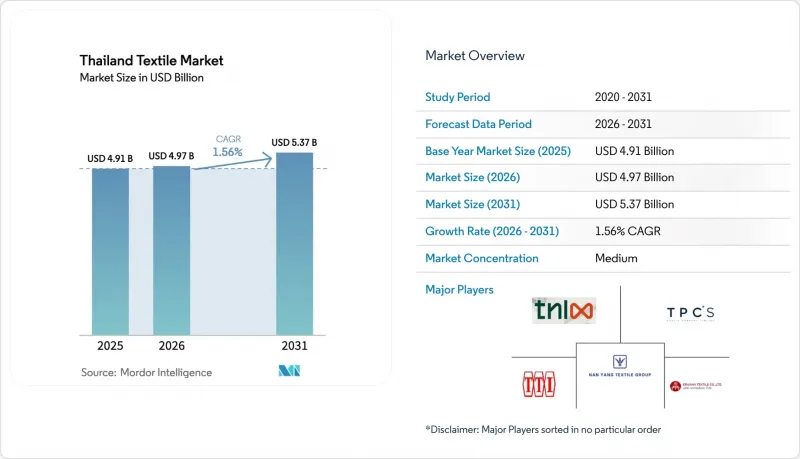
This report is Segmented by Application (Fashion & Apparel, Industrial/Technical, Household & Home, Medical & Healthcare, Automotive & Transport, and Others), by Raw Material (Natural Fibers, Synthetic Fibers, Recycled Fibers, and Others), and by Process/Technology (Woven, Knitted, Non-Woven, and 3-D Weaving & Spacer Fabrics). Market Forecasts are Provided in Terms of Value (USD).
Thailand Textile Market Trends and Insights
Domestic Tourism-Led Apparel Rebound
Tourist spending rebounded to 88% of 2019 levels in 2025, driving a 22% jump in casual-wear and resort apparel sales. Pratunam and Chatuchak wholesalers responded by sourcing smaller, more varied fabric lots, which lifted mill utilization rates in central Thailand. Regional shopping festivals added new outlets for immediate sales, bypassing traditional distributors. E-wallet campaigns by the Tourism Authority continue to spur purchases of locally made garments, keeping factory order books steady into 2026. The sustained flow of visitors is thus anchoring near-term fabric demand despite export headwinds..
Government BOI Incentives for Machinery Modernization
The Smart & Sustainable Textile scheme grants eight-year tax holidays and 50% import-duty waivers on advanced looms, digital printers, and water-treatment systems. Forty-seven approved projects totaling USD 343 million aimed to trim energy use by up to 30% per meter of cloth by end-2025. Indorama's melt-spinning upgrades alone cut its energy intensity by 15%, underscoring the immediate payoff for large mills. SMEs lacking collateral still struggle to co-invest, widening the productivity gap within the Thailand textile market. Over the medium term, higher capital intensity is expected to contain labor-cost pressures.
Rising Labor Costs and Skilled-Labor Shortages
Minimum wages increased to USD 11.50 per day in 2025, lifting total labor expenses by 21% versus 2023. Younger workers continue to migrate into electronics and automotive assembly, leaving 23,000 textile vacancies unfilled. Automation eases pressure in spinning and weaving, yet dyeing and final inspection remain human-intensive. Enrollment in industry-backed vocational programs reached only 1,800 students in 2025, well below the 5,000 annual entrants needed to stabilize the workforce. Unless training pipelines expand, rising wage floors will squeeze the Thailand textile market's cost competitiveness.
Other drivers and restraints analyzed in the detailed report include:
- E-Commerce-Driven Quick-Response Supply Chains
- Local Availability of Synthetic & Viscose Fiber Capacity
- Cheaper Apparel Imports from China & Vietnam
For complete list of drivers and restraints, kindly check the Table Of Contents.
Segment Analysis
Fashion and apparel retained a 62.67% Thailand textile market share in 2025, anchored by tourism-driven casual wear demand and quick-response orders from e-commerce platforms. Industrial and technical textiles captured 18% of revenue and are forecast to post the fastest 1.95% CAGR, propelled by airbags, medical nonwovens, and geotextiles required in the Eastern Economic Corridor. Apparel volume growth flattens after 2027 as low-priced imports from China and Vietnam erode margins, yet domestic mills still rely on the segment for scale and working-capital turnover.
Manufacturers are reallocating loom hours toward specification-driven fabrics that command up to 25% higher average selling prices, while retaining short-run apparel lines for cash flow. ISO 13485-certified nonwoven producers already supply Thai and ASEAN hospitals, proving that compliance unlocks premium contracts. Airbag-grade nylon yarn from the Toyobo-Indorama venture illustrates how automotive clusters pull in local content under just-in-time schedules. Over the forecast horizon, technical uses are expected to lift their slice of the Thailand textile market size to roughly USD 1 billion, offsetting the commoditization of mass-market clothing.
Complete Report Scope:
- By Application
- Fashion & Apparel
- Industrial/Technical Textiles
- Household & Home Textiles
- Medical & Healthcare Textiles
- Automotive & Transport Textiles
- Others (Protective, Sports Textiles, etc.)
- By Raw Material
- Natural Fibers
- Cotton
- Wool
- Silk
- Synthetic Fibers
- Polyester
- Nylon
- Rayon / Viscose
- Acrylic
- Polypropylene
- Recycled Fibers
- Others (Speciality High-Performance Fibers (Aramid, Carbon, UHMWPE))
- Natural Fibers
- By Process / Technology
- Woven
- Knitted
- Non-woven
- Spunlaid (Spunbond / Melt-blown)
- Dry-laid Hydro-entangled
- Wet-Laid
- Needle-punched
- 3-D Weaving & Spacer Fabrics
List of Companies Covered in this Report:
- Thanulux PCL
- Textile Prestige PCL
- Nan Yang Textile Group
- Thai Textile Industry PCL
- Erawan Textile Co Ltd
- Luckytex (Thailand) PCL
- High-Tech Apparel Co Ltd
- Hong Seng Knitting Co Ltd
- Thai Toray Textile Mills PCL
- Thai Acrylic Fibre Co Ltd
- Thai Rayon PCL
- Toray Textiles (Thailand) PCL
- Indorama Polyester Industries PCL
- Kangwal Textile Co Ltd
- Indo Thai Synthetics Co Ltd
- Wacoal (Thailand) PCL
- PASAYA (Tara Textile Co Ltd)
- Perma Corporation Co Ltd
- Sahapattanapibul Textile Unit
- Empire Textile Co Ltd
Additional Benefits:
- The market estimate (ME) sheet in Excel format
- 3 months of analyst support
TABLE OF CONTENTS
1 Introduction
- 1.1 Study Assumptions & Market Definition
- 1.2 Scope of the Study
2 Research Methodology
3 Executive Summary
4 Market Landscape
- 4.1 Market Overview
- 4.2 Market Drivers
- 4.2.1 Domestic tourism-led apparel rebound
- 4.2.2 Government BOI incentives for machinery modernisation
- 4.2.3 E-commerce-driven quick-response supply chains
- 4.2.4 Local availability of synthetic & viscose fibre capacity
- 4.2.5 Technical-textile demand from Thai automotive & medical clusters
- 4.2.6 Blockchain traceability adoption for ESG compliance (under-reported)
- 4.3 Market Restraints
- 4.3.1 Rising labour costs & skilled-labour shortages
- 4.3.2 Cheaper apparel imports from China & Vietnam
- 4.3.3 Tight SME credit caused by elevated NPL ratios (under-reported)
- 4.3.4 Water-stress regulations on dyeing/finishing effluents (under-reported)
- 4.4 Value / Supply-Chain Analysis
- 4.5 Regulatory Outlook
- 4.6 Technological Outlook
- 4.7 Industry Attractiveness - Porter's Five Forces
- 4.7.1 Bargaining Power of Buyers
- 4.7.2 Bargaining Power of Suppliers
- 4.7.3 Threat of New Entrants
- 4.7.4 Threat of Substitutes
- 4.7.5 Competitive Rivalry
- 4.8 Impact of Geopolitics on Textile Market
5 Market Size & Growth Forecasts (Value, In USD Billion)
- 5.1 By Application
- 5.1.1 Fashion & Apparel
- 5.1.2 Industrial/Technical Textiles
- 5.1.3 Household & Home Textiles
- 5.1.4 Medical & Healthcare Textiles
- 5.1.5 Automotive & Transport Textiles
- 5.1.6 Others (Protective, Sports Textiles, etc.)
- 5.2 By Raw Material
- 5.2.1 Natural Fibers
- 5.2.1.1 Cotton
- 5.2.1.2 Wool
- 5.2.1.3 Silk
- 5.2.2 Synthetic Fibers
- 5.2.2.1 Polyester
- 5.2.2.2 Nylon
- 5.2.2.3 Rayon / Viscose
- 5.2.2.4 Acrylic
- 5.2.2.5 Polypropylene
- 5.2.3 Recycled Fibers
- 5.2.4 Others (Speciality High-Performance Fibers (Aramid, Carbon, UHMWPE))
- 5.2.1 Natural Fibers
- 5.3 By Process / Technology
- 5.3.1 Woven
- 5.3.2 Knitted
- 5.3.3 Non-woven
- 5.3.3.1 Spunlaid (Spunbond / Melt-blown)
- 5.3.3.2 Dry-laid Hydro-entangled
- 5.3.3.3 Wet-Laid
- 5.3.3.4 Needle-punched
- 5.3.4 3-D Weaving & Spacer Fabrics
6 Competitive Landscape
- 6.1 Market Concentration
- 6.2 Strategic Moves
- 6.3 Market Share Analysis
- 6.4 Company Profiles {(includes Global level Overview, Market level overview, Core Segments, Financials as available, Strategic Information, Products & Services, and Recent Developments)}
- 6.4.1 Thanulux PCL
- 6.4.2 Textile Prestige PCL
- 6.4.3 Nan Yang Textile Group
- 6.4.4 Thai Textile Industry PCL
- 6.4.5 Erawan Textile Co Ltd
- 6.4.6 Luckytex (Thailand) PCL
- 6.4.7 High-Tech Apparel Co Ltd
- 6.4.8 Hong Seng Knitting Co Ltd
- 6.4.9 Thai Toray Textile Mills PCL
- 6.4.10 Thai Acrylic Fibre Co Ltd
- 6.4.11 Thai Rayon PCL
- 6.4.12 Toray Textiles (Thailand) PCL
- 6.4.13 Indorama Polyester Industries PCL
- 6.4.14 Kangwal Textile Co Ltd
- 6.4.15 Indo Thai Synthetics Co Ltd
- 6.4.16 Wacoal (Thailand) PCL
- 6.4.17 PASAYA (Tara Textile Co Ltd)
- 6.4.18 Perma Corporation Co Ltd
- 6.4.19 Sahapattanapibul Textile Unit
- 6.4.20 Empire Textile Co Ltd
7 Market Opportunities & Future Outlook
- 7.1 White-space & Unmet-Need Assessment

