PUBLISHER: Mordor Intelligence | PRODUCT CODE: 2114414

PUBLISHER: Mordor Intelligence | PRODUCT CODE: 2114414
Cloud Testing - Market Share Analysis, Industry Trends & Statistics, Growth Forecasts (2026 - 2031)
According to Mordor Intelligence, the cloud testing market size was valued at USD 1.87 billion in 2025 and estimated to grow from USD 1.99 billion in 2026 to reach USD 2.74 billion by 2031, at a CAGR of 6.56% during the forecast period (2026-2031).
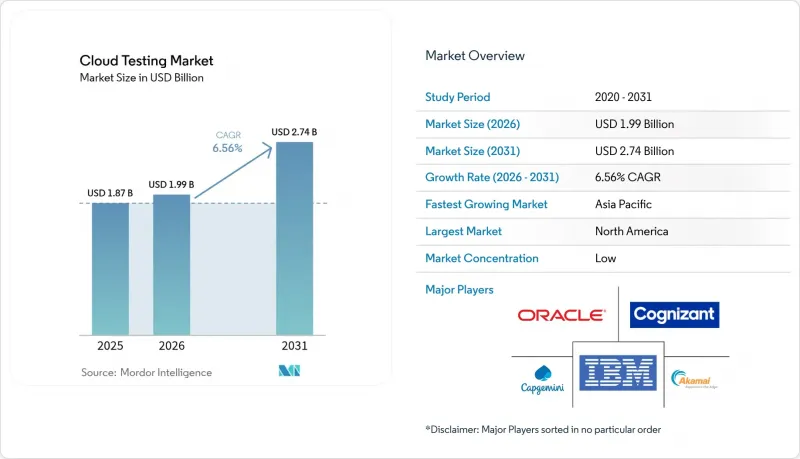
This report is Segmented by Component (Tool Type and Service), Enterprise Size (Small and Medium Enterprise and Large Enterprise), End-User Industry (BFSI, Healthcare, IT and Telecom, Media and Entertainment, Retail, and Other End-User Industries), and Geography (North America, South America, Europe, Asia-Pacific, Middle East and Africa). The Market Forecasts are Provided in Terms of Value (USD).
Global Cloud Testing Market Trends and Insights
Accelerated Shift to DevOps and CI/CD Demanding Continuous Testing
Organizations that adopt DevOps release code significantly more frequently than traditional teams, and this cadence necessitates automated validation at every pipeline stage. The Continuous Delivery Foundation recorded deployment frequencies 208 times higher among mature practitioners, a gap that hinges on cloud-hosted suites able to spin up and tear down resources in minutes. Docker's 2024 survey confirmed that testing and debugging remain time sinks even in cloud environments, reinforcing demand for integrated tooling. Perforce found that 75% of practitioners view AI-driven testing as pivotal, and 57% already run workloads in the cloud. Financial services and SaaS providers, where release velocity shapes competitiveness, adopt these platforms earliest. Global service-management frameworks such as ISO/IEC 20000 now recommend continuous testing, embedding it into compliance roadmaps.
Growing Complexity of Multi-Cloud Architectures Requiring End-to-End Validation
Most of enterprises operate in multi-cloud settings, exposing them to misconfigurations that waste spend and heighten risk. Banking supervisors warn that vendor lock-in threats prompt institutions to adopt dual- or triple-provider strategies, but this approach requires rigorous cross-platform testing of failover mechanisms and API gateways. Supervisory agencies in Europe now require threat-led penetration tests for systemically important institutions, driving adoption of unified dashboards that consolidate security, performance, and compliance results. Tool vendors that visualize estate-wide results while minimizing license sprawl gain a competitive advantage. The cloud testing market thus rewards platforms that stay neutral yet integrate natively with AWS, Azure, and Google Cloud.
Data Security and Compliance Concerns Restricting Test-Data Movement
European Central Bank guidance obliges financial institutions to retain audit rights and maintain exit strategies when outsourcing to the cloud. The Digital Operational Resilience Act layers on penetration-testing mandates and third-party registries, making some firms wary of moving production-like datasets into shared environments. HIPAA and GDPR heighten risks for providers that handle personal health information or data of EU citizens. Vendors respond with encrypted storage, single-tenant regions and synthetic-data tooling, yet adoption still slows when privacy officers demand extra reviews. Consequently, data-masking and sub-setting technologies are rising in tandem with the cloud testing market, ensuring teams can validate functionality without exposing sensitive records.
Other drivers and restraints analyzed in the detailed report include:
- Cost and Scalability Benefits of Cloud-Based Testing Tools vs On-Premise
- Explosion of Mobile and IoT Applications Needing Higher Test Coverage
- Legacy Infrastructure Inertia in Highly Regulated Sectors
For complete list of drivers and restraints, kindly check the Table Of Contents.
Segment Analysis
Tool Type platforms generated the largest slice of the cloud testing market in 2025, accounting for 54.10% of revenue and positioning the segment to grow at 8.35% CAGR through 2031. Demand concentrates on performance, load and security modules that plug directly into CI/CD pipelines and spin up infrastructure only when needed, minimizing idle spend. Enterprises also gravitate toward interoperability testing that validates microservices across multi-cloud estates and toward resilience tests that prove failover under chaotic conditions. Usage-based pricing lowers entry barriers, encouraging broader experimentation and making the cloud testing market size for tools swell faster than services. AI additions now generate test cases and heal scripts, trimming repetitive labor and letting senior engineers focus on edge conditions.
Service offerings, which combine managed and professional services, retained 45.90% in 2025 but trail in growth. Clients that lack internal expertise still rely on integrators such as Cognizant, Wipro and Qualitest for outcome-based contracts, particularly when regulatory compliance frameworks require formal attestations. Vendor portfolios increasingly emphasize advisory on AI-bias validation, IoT device hardening and data-residency architectures. Even so, as platform usability improves and internal DevOps maturity rises, many enterprises shift routine regression runs back in-house, a trend that restrains service revenue expansion within the broader cloud testing market.
Complete Report Scope:
- By Component
- Tool Type
- Performance and Load Testing
- Interoperability and Compatibility Testing
- Stress and Recovery Testing
- Security Testing
- System Integration and User Acceptance Testing
- Other Tool Types
- Service
- Managed Service
- Professional Service
- Tool Type
- By Enterprise Size
- Small and Medium Enterprise
- Large Enterprise
- By End-user Industry
- BFSI
- Healthcare
- IT and Telecom
- Media and Entertainment
- Retail
- Other End-user Industries
- By Geography
- North America
- United States
- Canada
- Mexico
- South America
- Brazil
- Argentina
- Rest of South America
- Europe
- Germany
- United Kingdom
- France
- Netherlands
- Rest of Europe
- Asia-Pacific
- China
- India
- Japan
- South Korea
- ASEAN
- Rest of Asia-Pacific
- Middle East and Africa
- Middle East
- Saudi Arabia
- United Arab Emirates
- Rest of Middle East
- Africa
- South Africa
- Nigeria
- Rest of Africa
- Middle East
- North America
Geography Analysis
North America generated 43.20% of the 2025 revenue, reflecting mature DevOps practices and a dense concentration of software firms that treat fast release cycles as a competitive advantage. U.S. financial institutions, large SaaS providers, and the federal sector all emphasize resilience, driving continual investment in automated testing. Canada's technology ecosystem reflects these priorities, with provincial digital government programs adopting cloud-native QA frameworks. Mexico's near-shore development centers further boost regional consumption as they supply code to North American clients.
The Asia-Pacific region is expected to be the fastest-growing geography, with a 8.12% CAGR through 2031, driven by sovereign-cloud buildouts, mobile-centric consumer habits, and large public-sector digitalization mandates. China's push to localize software stacks sparks demand for domestic toolchains, while India's 25% annual growth in public cloud fuels uptake among both startups and state agencies. Southeast Asia's USD 263 billion digital economy expansion adds transactional workloads that must be performance-tested across fragmented network conditions. Japan and South Korea focus on private-cloud migrations of mission-critical SAP landscapes, which require regression suites to validate converted business logic.
Europe balances high adoption with rigorous oversight. The Digital Operational Resilience Act, effective January 2025, forces banks to document cloud testing procedures, retain threat-led-penetration partners and maintain exit strategies. Germany, France and the United Kingdom lead spending, leveraging multi-tenant regions that comply with GDPR data-sovereignty rules. The Netherlands' dense data-center footprint attracts hyperscalers and independent testing vendors, forming a regional hub. Elsewhere, Brazil's fintech boom, Saudi Arabia's sovereign-cloud mandates and South Africa's mobile-banking surge collectively widen the customer base, ensuring that the cloud testing market remains globally contested.
- IBM Corporation
- Microsoft Corporation
- Oracle Corporation
- Capgemini SE
- Cognizant Technology Solutions Corp.
- Wipro Limited
- Akamai Technologies Inc.
- Broadcom Inc. (BlazeMeter)
- SmartBear Software Inc.
- Micro Focus International plc
- Tricentis GmbH
- Sauce Labs Inc.
- Google LLC
- Amazon Web Services Inc.
- Keysight Technologies
- Parasoft Corporation
- Cigniti Technologies Ltd
- Invensis Technologies Pvt Ltd
- Cygnet Infotech Pvt Ltd
- Testlio Inc.
- Applause App Quality Inc.
- Qualitest Group
Additional Benefits:
- The market estimate (ME) sheet in Excel format
- 3 months of analyst support
TABLE OF CONTENTS
1 INTRODUCTION
- 1.1 Study Assumptions and Market Definition
- 1.2 Scope of the Study
2 RESEARCH METHODOLOGY
3 EXECUTIVE SUMMARY
4 MARKET LANDSCAPE
- 4.1 Market Overview
- 4.2 Market Drivers
- 4.2.1 Accelerated Shift To DevOps and CI/CD Demanding Continuous Testing
- 4.2.2 Growing Complexity of Multi-Cloud Architectures Requiring End-To-End Validation
- 4.2.3 Cost And Scalability Benefits of Cloud-Based Testing Tools Vs On-Premises
- 4.2.4 Explosion Of Mobile and IoT Applications Needing Higher Test Coverage
- 4.2.5 Usage-Based Pricing Models Democratising Access For Smbs
- 4.2.6 Integration Of AI-Powered Autonomous Testing Within Cloud Platforms
- 4.3 Market Restraints
- 4.3.1 Data Security and Compliance Concerns Restricting Test-Data Movement
- 4.3.2 Legacy Infrastructure Inertia in Highly Regulated Sectors
- 4.3.3 Escalating Cloud Egress Costs For Large Test Datasets
- 4.3.4 Tool sprawl and skill gaps causing orchestration complexity
- 4.4 Industry Value Chain Analysis
- 4.5 Regulatory Landscape
- 4.6 Impact of Macroeconomic Factors on the Market
- 4.7 Technological Outlook
- 4.8 Industry Stakeholder Analysis
- 4.9 Porter's Five Forces Analysis
- 4.9.1 Threat of New Entrants
- 4.9.2 Bargaining Power of Buyers/Consumers
- 4.9.3 Bargaining Power of Suppliers
- 4.9.4 Threat of Substitute Products
- 4.9.5 Intensity of Competitive Rivalry
5 MARKET SIZE AND GROWTH FORECASTS (VALUE)
- 5.1 By Component
- 5.1.1 Tool Type
- 5.1.1.1 Performance and Load Testing
- 5.1.1.2 Interoperability and Compatibility Testing
- 5.1.1.3 Stress and Recovery Testing
- 5.1.1.4 Security Testing
- 5.1.1.5 System Integration and User Acceptance Testing
- 5.1.1.6 Other Tool Types
- 5.1.2 Service
- 5.1.2.1 Managed Service
- 5.1.2.2 Professional Service
- 5.1.1 Tool Type
- 5.2 By Enterprise Size
- 5.2.1 Small and Medium Enterprise
- 5.2.2 Large Enterprise
- 5.3 By End-user Industry
- 5.3.1 BFSI
- 5.3.2 Healthcare
- 5.3.3 IT and Telecom
- 5.3.4 Media and Entertainment
- 5.3.5 Retail
- 5.3.6 Other End-user Industries
- 5.4 By Geography
- 5.4.1 North America
- 5.4.1.1 United States
- 5.4.1.2 Canada
- 5.4.1.3 Mexico
- 5.4.2 South America
- 5.4.2.1 Brazil
- 5.4.2.2 Argentina
- 5.4.2.3 Rest of South America
- 5.4.3 Europe
- 5.4.3.1 Germany
- 5.4.3.2 United Kingdom
- 5.4.3.3 France
- 5.4.3.4 Netherlands
- 5.4.3.5 Rest of Europe
- 5.4.4 Asia-Pacific
- 5.4.4.1 China
- 5.4.4.2 India
- 5.4.4.3 Japan
- 5.4.4.4 South Korea
- 5.4.4.5 ASEAN
- 5.4.4.6 Rest of Asia-Pacific
- 5.4.5 Middle East and Africa
- 5.4.5.1 Middle East
- 5.4.5.1.1 Saudi Arabia
- 5.4.5.1.2 United Arab Emirates
- 5.4.5.1.3 Rest of Middle East
- 5.4.5.2 Africa
- 5.4.5.2.1 South Africa
- 5.4.5.2.2 Nigeria
- 5.4.5.2.3 Rest of Africa
- 5.4.5.1 Middle East
- 5.4.1 North America
6 COMPETITIVE LANDSCAPE
- 6.1 Market Concentration
- 6.2 Strategic Moves
- 6.3 Market Share Analysis
- 6.4 Company Profiles (includes Global level Overview, Market level overview, Core Segments, Financials as available, Strategic Information, Market Rank/Share for key companies, Products and Services, and Recent Developments)
- 6.4.1 IBM Corporation
- 6.4.2 Microsoft Corporation
- 6.4.3 Oracle Corporation
- 6.4.4 Capgemini SE
- 6.4.5 Cognizant Technology Solutions Corp.
- 6.4.6 Wipro Limited
- 6.4.7 Akamai Technologies Inc.
- 6.4.8 Broadcom Inc. (BlazeMeter)
- 6.4.9 SmartBear Software Inc.
- 6.4.10 Micro Focus International plc
- 6.4.11 Tricentis GmbH
- 6.4.12 Sauce Labs Inc.
- 6.4.13 Google LLC
- 6.4.14 Amazon Web Services Inc.
- 6.4.15 Keysight Technologies
- 6.4.16 Parasoft Corporation
- 6.4.17 Cigniti Technologies Ltd
- 6.4.18 Invensis Technologies Pvt Ltd
- 6.4.19 Cygnet Infotech Pvt Ltd
- 6.4.20 Testlio Inc.
- 6.4.21 Applause App Quality Inc.
- 6.4.22 Qualitest Group
7 MARKET OPPORTUNITIES AND FUTURE OUTLOOK
- 7.1 White-space and Unmet-Need Assessment

