PUBLISHER: Mordor Intelligence | PRODUCT CODE: 2114447

PUBLISHER: Mordor Intelligence | PRODUCT CODE: 2114447
Underwater Lighting - Market Share Analysis, Industry Trends & Statistics, Growth Forecasts (2026 - 2031)
According to Mordor Intelligence, the underwater lighting market size in 2026 is estimated at USD 425.13 million, growing from 2025 value of USD 410.12 million with 2031 projections showing USD 508.76 million, growing at 3.66% CAGR over 2026-2031.
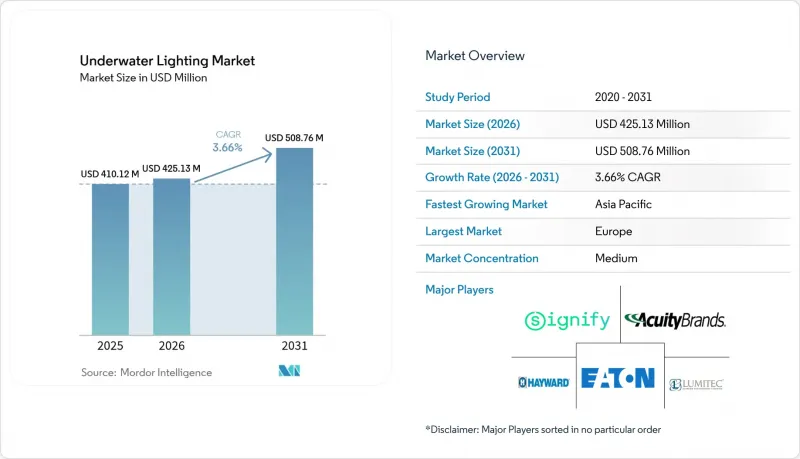
This report is Segmented by Lighting Source (LED, and Halogen), Mounting Type (Surface-Mounted, Flush/Thru-Hull, and Portable), Application (Swimming Pools, Fountains and Water Features, and More), End User (Residential, Commercial and Hospitality, Industrial/Marine Infrastructure, and More), Sales Channel (OEM, and Aftermarket), and Geography. The Market Forecasts are Provided in Terms of Value (USD).
Global Underwater Lighting Market Trends and Insights
Rising Demand for Underwater Lights in Pools and Aesthetic Landscaping
Residential and municipal pool permits in the United States rose 8.9% in 2024, stimulating LED retrofits that cut energy use by 85% versus halogen and stretch lifespans to 50,000 hours. Fluidra noted that products carrying sustainability credentials, including LED fixtures, contributed 51% of its 2023 sales, confirming the pull from eco-conscious buyers. Middle-Eastern resorts now specify multi-zone RGB packages controlled via DMX512 to synchronize fountains with facade lighting, elevating lights from basic safety gear to key design elements. Higher fixture counts per project lift average sales values, while IEC 60598-2-18 compliance and voluntary ENERGY STAR labels support procurement decisions. Together, these factors reinforce an upgrade cycle that keeps the underwater lighting market growing even as pool construction moderates.
Government Incentives Accelerating LED Adoption in Retrofits
The US EECBG voucher program funds LED upgrades in public aquatic centers, compressing payback periods to under three years. EU Directive 2024/1275 obliges automatic lighting controls in non-residential buildings by 2027, pushing commercial pool operators toward networked LEDs. Norway's Innovation Norway financed Havlandet's pilot salmon farm, proving that grant support can de-risk early use of spectrally tuned luminaires. Mowi Feed's 2024 factory retrofit with Glamox LEDs slashed electricity consumption by 60% after RoHS restrictions removed fluorescent tubes from the market. Public-sector funding thus accelerates the baseline shift to LEDs across both civic and industrial venues.
High Initial Capital Cost of Marine-Grade LED Fixtures
Premium housings in aluminum-bronze and borosilicate glass push retail prices to USD 1,200 for flush-fit lights and USD 2,850 for high-output thru-hull units. Although life-cycle analysis favors LEDs thanks to 50,000-hour ratings and 85% energy savings, sticker shock slows adoption among small boat owners and budget-focused municipalities. Financing options are scarce because lenders view lighting as discretionary, leaving customers to fund upgrades up front. This cost hurdle weighs heaviest in emerging coastal economies where discretionary boating budgets remain tight, tempering short-term expansion of the underwater lighting market.
Other drivers and restraints analyzed in the detailed report include:
- Increasing Construction of Luxury Hotels, Resorts and Water Parks
- Increasing Construction of Luxury Hotels, Resorts and Water Parks
- Challenging Maintenance in Corrosive Saltwater Environments
For complete list of drivers and restraints, kindly check the Table Of Contents.
Segment Analysis
LEDs controlled 78.64% of the underwater lighting market size in 2025, and their share continues rising as RGB and smart variants post a 5.32% CAGR. Multi-chip arrays match or exceed metal-halide brightness while eliminating 10-minute restrike delays. Halogen lingers almost solely in legacy pool niches where transformers and wiring resist LED retrofits, yet accelerating regulatory bans should push halogen toward single-digit presence by 2030. Spectrally tuned LEDs tailored to salmon photoreceptors illustrate the technology's biological versatility, opening revenue far from traditional leisure markets. Meanwhile, phosphor-converted packages such as Signify's SeaCage hit 150 lm/W, and lab prototypes reveal scope for further efficiency gains. As connectivity platforms improve, fixture firmware updates and color-scene libraries create post-sale revenue, strengthening supplier margins and anchoring customers in proprietary ecosystems. Collectively, these factors secure LEDs as the undisputed engine of the underwater lighting market.
Flush-mounts and thru-hulls increasingly bundle intelligent thermal throttling that protects diode junctions during stagnant water events, sharply reducing failure rates. While halogen replacement bulbs still sell into existing niches, distributors report steady decline in unit volumes. Metal-halide fixtures defend a final stronghold among operators demanding extreme lumen density in tight envelopes, but continual LED advances in chip density and cooling threaten even this bastion. Consequently, investors continue to funnel capital into LED-specific R&D rather than prolonging legacy lamp life-cycles. The underwater lighting industry therefore aligns its product roadmaps almost exclusively around LED architectures.
Surface-mounted lights retained 64.12% revenue in 2025 because do-it-yourself owners favor bolt-on simplicity. Yet flush and thru-hull units will grow 6.02% annually as boatbuilders install them during lay-up, embedding wiring before gelcoat and avoiding future penetrations. OceanLED's Explore TH series supports wet-maintenance, letting crews swap lenses without hauling out, a feature that neutralizes historic service drawbacks. Flush profiles slash drag and reduce entanglement risks for fishing nets and mooring lines, appealing to performance-oriented skippers. Builders also value the through-hull's clean exterior aesthetic that supports premium vessel branding.
Retrofit complexity keeps surface-mount fixtures dominant in the aftermarket because owners can fit lights with basic hand tools. Conversely, new yachts integrate flush units to avoid warranty disputes over drilled hulls. Clip-on and portable lights address photographers and dive-tour operators who need brief, battery-powered luminance, but their low lumen output limits broader growth. As more OEMs pre-wire hulls for lights, an increasing portion of the underwater lighting market revenue will shift to factory channels and away from retail DIY installations.
Complete Report Scope:
- By Lighting Source
- LED
- Halogen
- Metal-Halide / Others
- By Mounting Type
- Surface-Mounted
- Flush / Thru-Hull
- Portable / Clip-On
- By Application
- Swimming Pools
- Fountains and Water Features
- Boats and Yachts
- Aquaculture and Research
- By End User
- Residential
- Commercial and Hospitality
- Industrial / Marine Infrastructure
- Defense and Government
- By Sales Channel
- OEM
- Aftermarket
- By Geography
- North America
- United States
- Canada
- Mexico
- South America
- Brazil
- Argentina
- Chile
- Rest of South America
- Europe
- United Kingdom
- Germany
- France
- Italy
- Spain
- Rest of Europe
- Asia-Pacific
- China
- Japan
- India
- South Korea
- Australia and New Zealand
- Rest of Asia-Pacific
- Middle East and Africa
- Middle East
- United Arab Emirates
- Saudi Arabia
- Turkey
- Rest of Middle East
- Africa
- South Africa
- Kenya
- Nigeria
- Rest of Africa
- Middle East
- North America
Geography Analysis
Europe led the underwater lighting market in 2025 with 31.88% revenue share, driven by EU Directive 2024/1275 energy mandates and the RoHS-enforced fluorescent phase-out that fueled retrofit demand. Norway's 1.3 million-ton salmon output underpins steady orders for spectrally tuned LEDs, as evidenced by Signify's Salmon Evolution win. Italy's EUR 8.33 billion yacht sector supports winter refit activity, while Germany and France tighten pool efficiency standards, spurring domestic pool upgrades. The UK's Lumishore, now under Garmin, exports high-value RGB fixtures, highlighting Europe's innovation role.
Asia-Pacific is projected to record a 5.62% CAGR through 2031, propelled by China's coastal tourism investments, Singapore's Sentosa developments, and Australia's AUD 10.12 billion boating industry. Chinese Tier-2 cities fund wave pools and lazy rivers that require chlorine-resistant LEDs, while Singapore links submerged lights to BMS dashboards for energy analytics. Australia's remote cruising routes elevate reliability requirements, pushing buyers toward IP68-rated hardware. Japan's flat residential construction limits pool growth, but land-based fish farms adopt LEDs for yellowtail and sea bream. India's leisure-boating niche remains cost-sensitive, yet luxury resorts in Goa and Kerala specify RGB systems to compete globally.
North America generated roughly 27.74% of global revenue in 2025. US pool permits climbed 8.9%, and NMMA-reported spending kept after-sales lights moving despite a slight dip in new-boat units. DOE vouchers encourage municipal pool retrofits, while Florida sea-turtle ordinances require amber or red spectra during nesting season, prompting tunable products, Canada's shorter boating season compresses installation windows, making inventory forecasting critical. Mexico's Cancun resorts demand color-changing lagoon lighting to attract U.S. tourists. Collectively, these regional nuances keep suppliers agile and diversified, reinforcing long-run stability for the underwater lighting market.
- Lumitec LLC
- Signify N.V.
- Eaton Corporation plc
- Acuity Brands Inc.
- Hayward Industries Inc.
- OceanLED Marine Ltd.
- Lumishore Ltd.
- Aqualuma LED Lighting Pty Ltd.
- Shadow-Caster Inc.
- Perko Inc.
- TH Marine Supplies LLC
- Attwood Corporation
- Huaxia Lighting Co. Ltd.
- Global Light and Power LLC
- Dabmar Lighting Inc.
- Wibre-Elektrogerate Edmund Breuninger GmbH and Co. KG
- Spa Electrics Pty Ltd.
- Bluefin LED Ltd.
- Deep Glow Technologies Inc.
- Underwater Lights Ltd.
- Bigblue Dive Lights Inc.
Additional Benefits:
- The market estimate (ME) sheet in Excel format
- 3 months of analyst support
TABLE OF CONTENTS
1 INTRODUCTION
- 1.1 Study Assumptions and Market Definition
- 1.2 Scope of the Study
2 RESEARCH METHODOLOGY
3 EXECUTIVE SUMMARY
4 MARKET LANDSCAPE
- 4.1 Market Overview
- 4.2 Market Drivers
- 4.2.1 Rising Demand for Underwater Lights in Pools and Aesthetic Water-Featured Landscaping
- 4.2.2 Government Incentives Accelerating LED Adoption in Lighting Retrofits
- 4.2.3 Increasing Construction of Luxury Hotels, Resorts and Water Parks
- 4.2.4 Growing Recreational Boating and Yachting Activities
- 4.2.5 Emergence of Smart/IoT-Enabled Underwater Lighting Systems
- 4.2.6 Deep-Sea Aquaculture's Need for Spectrally Tuned Submersible LEDs
- 4.3 Market Restraints
- 4.3.1 High Initial Capital Cost of Marine-Grade LED Fixtures
- 4.3.2 Challenging Maintenance in Corrosive Saltwater Environments
- 4.3.3 Lack of Harmonized Global Safety Standards Increasing Certification Costs
- 4.3.4 Light Pollution Regulations Limiting Illumination in Sensitive Marine Habitats
- 4.4 Industry Value / Supply-Chain Analysis
- 4.5 Impact of Macroeconomic Factors on the Market
- 4.6 Regulatory Landscape
- 4.7 Technological Outlook
- 4.8 Porter's Five Forces Analysis
- 4.8.1 Threat of New Entrants
- 4.8.2 Bargaining Power of Buyers
- 4.8.3 Bargaining Power of Suppliers
- 4.8.4 Threat of Substitutes
- 4.8.5 Intensity of Competitive Rivalry
5 MARKET SIZE AND GROWTH FORECASTS (VALUE)
- 5.1 By Lighting Source
- 5.1.1 LED
- 5.1.2 Halogen
- 5.1.3 Metal-Halide / Others
- 5.2 By Mounting Type
- 5.2.1 Surface-Mounted
- 5.2.2 Flush / Thru-Hull
- 5.2.3 Portable / Clip-On
- 5.3 By Application
- 5.3.1 Swimming Pools
- 5.3.2 Fountains and Water Features
- 5.3.3 Boats and Yachts
- 5.3.4 Aquaculture and Research
- 5.4 By End User
- 5.4.1 Residential
- 5.4.2 Commercial and Hospitality
- 5.4.3 Industrial / Marine Infrastructure
- 5.4.4 Defense and Government
- 5.5 By Sales Channel
- 5.5.1 OEM
- 5.5.2 Aftermarket
- 5.6 By Geography
- 5.6.1 North America
- 5.6.1.1 United States
- 5.6.1.2 Canada
- 5.6.1.3 Mexico
- 5.6.2 South America
- 5.6.2.1 Brazil
- 5.6.2.2 Argentina
- 5.6.2.3 Chile
- 5.6.2.4 Rest of South America
- 5.6.3 Europe
- 5.6.3.1 United Kingdom
- 5.6.3.2 Germany
- 5.6.3.3 France
- 5.6.3.4 Italy
- 5.6.3.5 Spain
- 5.6.3.6 Rest of Europe
- 5.6.4 Asia-Pacific
- 5.6.4.1 China
- 5.6.4.2 Japan
- 5.6.4.3 India
- 5.6.4.4 South Korea
- 5.6.4.5 Australia and New Zealand
- 5.6.4.6 Rest of Asia-Pacific
- 5.6.5 Middle East and Africa
- 5.6.5.1 Middle East
- 5.6.5.1.1 United Arab Emirates
- 5.6.5.1.2 Saudi Arabia
- 5.6.5.1.3 Turkey
- 5.6.5.1.4 Rest of Middle East
- 5.6.5.2 Africa
- 5.6.5.2.1 South Africa
- 5.6.5.2.2 Kenya
- 5.6.5.2.3 Nigeria
- 5.6.5.2.4 Rest of Africa
- 5.6.5.1 Middle East
- 5.6.1 North America
6 COMPETITIVE LANDSCAPE
- 6.1 Market Concentration
- 6.2 Strategic Moves
- 6.3 Market Share Analysis
- 6.4 Company Profiles (includes Global level Overview, Market level overview, Core Segments, Financials as available, Strategic Information, Market Rank/Share for key companies, Products and Services, and Recent Developments)
- 6.4.1 Lumitec LLC
- 6.4.2 Signify N.V.
- 6.4.3 Eaton Corporation plc
- 6.4.4 Acuity Brands Inc.
- 6.4.5 Hayward Industries Inc.
- 6.4.6 OceanLED Marine Ltd.
- 6.4.7 Lumishore Ltd.
- 6.4.8 Aqualuma LED Lighting Pty Ltd.
- 6.4.9 Shadow-Caster Inc.
- 6.4.10 Perko Inc.
- 6.4.11 TH Marine Supplies LLC
- 6.4.12 Attwood Corporation
- 6.4.13 Huaxia Lighting Co. Ltd.
- 6.4.14 Global Light and Power LLC
- 6.4.15 Dabmar Lighting Inc.
- 6.4.16 Wibre-Elektrogerate Edmund Breuninger GmbH and Co. KG
- 6.4.17 Spa Electrics Pty Ltd.
- 6.4.18 Bluefin LED Ltd.
- 6.4.19 Deep Glow Technologies Inc.
- 6.4.20 Underwater Lights Ltd.
- 6.4.21 Bigblue Dive Lights Inc.
7 MARKET OPPORTUNITIES AND FUTURE OUTLOOK
- 7.1 White-Space and Unmet-Need Assessment

