PUBLISHER: Mordor Intelligence | PRODUCT CODE: 2114450

PUBLISHER: Mordor Intelligence | PRODUCT CODE: 2114450
Human Centric Lighting - Market Share Analysis, Industry Trends & Statistics, Growth Forecasts (2026 - 2031)
According to Mordor Intelligence, human centric lighting market size in 2026 is estimated at USD 4.52 billion, growing from 2025 value of USD 3.92 billion with 2031 projections showing USD 9.22 billion, growing at 15.32% CAGR over 2026-2031.
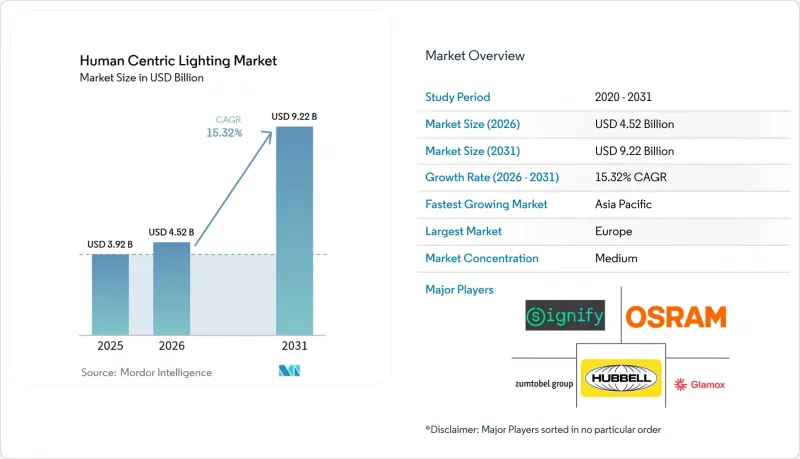
This report is Segmented by Offering (Hardware, Software, and Services), Installation Type (New Installations, and Retrofit Installations), Light Source (LED, OLED, Fluorescent, and More), Fixture Type (Downlights, and More), Connectivity Technology (Wired, and Wireless), Application (Commercial, Residential, and More), and Geography. The Market Forecasts are Provided in Terms of Value (USD).
Global Human Centric Lighting Market Trends and Insights
Accelerated Workplace-Wellbeing Mandates in Europe
European policy has moved beyond basic occupational safety toward holistic wellbeing, prompting rapid adoption of tunable lighting in offices. Oxford University research linked higher employee well-being scores with stronger financial performance, reinforcing the business rationale. The EU Pay Transparency Directive has broadened corporate disclosures to include environmental quality, placing lighting under greater scrutiny. Field studies conducted by Alcon Lighting, showed that appropriate spectral tuning cut absenteeism by 4.5% and lifted creative output by 15% in office pilots. Companies now view lighting upgrades as a dual lever for wellbeing and sustainability, accelerating the specification of human-centric systems in new projects and major retrofits.
Regulatory Push for Energy-Positive Buildings in North America
The United States targets a 65% reduction in building-sector greenhouse-gas emissions by 2035, positioning advanced lighting controls as a pivotal lever. The 2021 International Energy Conservation Code, recently adopted for federally backed housing, imposes stringent efficiency requirements that reward integrated lighting and controls. Networked systems have delivered 49% energy savings compared with LED-only upgrades, meeting both decarbonization and occupant-wellbeing objectives . Designers increasingly specify circadian-supportive luminaires alongside daylight and occupancy sensors to satisfy whole-building performance metrics.
Limited Interoperability Across Vendor Protocols
Fragmented control standards raise integration costs and slow multi-site rollouts. United States Department of Energy studies found persistent terminology and communication mismatches that impede connected-lighting performance. Building owners often face vendor lock-in or must fund gateways that add complexity over the system lifecycle. DALI-2 certification programs improve prospects for plug-and-play operation, as seen in Siemens' KNX/DALI gateway. Yet a unified global standard remains elusive, constraining volume procurement and cross-portfolio analytics.
Other drivers and restraints analyzed in the detailed report include:
- Rapid LED Price Erosion Enabling Retrofits in Asia
- Demand for Circadian-Aligned Healthcare Lighting
- Inadequate Installer Skill-Set in Emerging Economies
For complete list of drivers and restraints, kindly check the Table Of Contents.
Segment Analysis
Hardware contributed 71.10% of 2025 revenue, anchored by luminaires, drivers, and sensors that enable spectral tuning. As financing models evolve, customers increasingly favor outcome-based contracts that bundle equipment, software, and maintenance. Subscription models reduce upfront capital, aligning costs with realized benefits. Several multinational providers now guarantee lighting performance metrics under multi-year service agreements. The human centric lighting market is therefore pivoting toward recurring revenue streams that appeal to asset-light corporate strategies.
Service revenue is forecast to climb at 22.88% annually through 2031, making it the fastest-growing component of the human centric lighting market. Providers monitor installations remotely, optimize scenes via cloud analytics, and update firmware over-the-air, ensuring continuous compliance with wellbeing standards. This data-driven approach strengthens client retention and opens pathways for cross-selling air-quality and space-use analytics.
Retrofits held a 59.85% share in 2025 as organizations upgraded existing facilities to capture immediate wellbeing and energy gains. These projects delivered quick wins with minimal structural changes, reinforcing confidence in circadian-tuned lighting. However, architects now embed spectral design early in building programs. As a result, new installations are projected to grow at 17.95% CAGR through 2031, surpassing retrofit growth.
Integrating human-centric lighting at the design stage allows holistic coordination with HVAC, shading, and facade systems. Luminaire-level lighting controls create self-contained nodes that simplify commissioning and support granular personalization. Studies of integrated HVAC and lighting controls recorded a 69% drop in lighting energy use while maintaining circadian targets. Such gains reinforce the inclusion of dynamic lighting in green-building certifications.
Complete Report Scope:
- By Offering
- Hardware
- Software
- Services
- By Installation Type
- New Installations
- Retrofit Installations
- By Light Source
- LED
- OLED
- Fluorescent
- Others
- By Fixture Type
- Downlights
- Troffers and Panels
- Suspended Luminaires
- Linear Strips and Wraps
- Others
- By Connectivity Technology
- Wired (DALI, PoE, KNX, etc.)
- Wireless (Bluetooth, Zigbee, Wi-Fi, Li-Fi)
- By Application
- Commercial
- Offices and Corporate
- Retail and Supermarkets
- Hospitality
- Healthcare Facilities
- Educational Institutions
- Industrial
- Manufacturing Plants
- Warehouses and Logistics
- Residential
- Public Infrastructure and Smart Cities
- Commercial
- By Geography
- North America
- United States
- Canada
- Mexico
- Europe
- Germany
- United Kingdom
- France
- Italy
- Spain
- Nordics (Denmark, Sweden, Norway, Finland)
- Rest of Europe
- Asia-Pacific
- China
- Japan
- South Korea
- India
- Southeast Asia
- Australia
- Rest of Asia-Pacific
- South America
- Brazil
- Argentina
- Rest of South America
- Middle East
- Gulf Cooperation Council Countries
- Turkey
- Rest of Middle East
- Africa
- South Africa
- Nigeria
- Rest of Africa
- North America
Geography Analysis
Europe led the human centric lighting market with a 37.10% share in 2025, propelled by strong worker-wellbeing regulation and municipal smart-lighting programs. Copenhagen's retrofit of 18,800 light points demonstrated 55% energy savings while improving perceived safety and installation quality. EU directives on building performance continue to raise minimum lighting standards, and industry group Lighting Europe estimated that human-centric solutions could reach 7% of the region's total lighting demand.
Asia Pacific is expanding at a 19.65% CAGR from 2026 to 2031, driven by urbanization and price declines in tunable LEDs. China spearheads premium installations in hospitality and corporate sectors, leveraging lighting quality to differentiate guest and tenant experience . The International Finance Corporation projected USD 1.5 trillion in green-building investment by 2035 across emerging Asian markets, creating fertile ground for circadian-aligned lighting. Workforce training and interoperability barriers temper the pace but do not alter the uptrend.
North America shows robust momentum under building-decarbonization mandates. The Department of Energy frames advanced lighting as a primary instrument for cutting electricity demand in commercial properties, Utilities promote luminaire-level controls through market-transformation initiatives, exemplified by the Ameren Illinois program that links rebates to connected-lighting adoption. Canadian jurisdictions follow a similar trajectory, blending wellness metrics into energy-code updates.
- Signify Lighting NV
- ams OSRAM AG
- Zumtobel Group AG
- Hubbell Inc.
- Glamox AS
- Trilux GmbH and Co. KG
- Wipro Lighting
- Fagerhult Group
- Legrand SA
- Waldmann Lighting
- Helvar Oy Ab
- Lutron Electronics Co. Inc.
- Acuity Brands Inc.
- LG Electronics (LG Innotek)
- Sharp Corp.
- Feilo Sylvania
- Seoul Semiconductor Co. Ltd.
- Cree Lighting
- Lumitech GmbH
- PhotonStar LED Group
- R2 Innovative Lighting
- PureEdge Lighting
Additional Benefits:
- The market estimate (ME) sheet in Excel format
- 3 months of analyst support
TABLE OF CONTENTS
1 INTRODUCTION
- 1.1 Study Assumptions and Market Definition
- 1.2 Scope of the Study
2 RESEARCH METHODOLOGY
3 EXECUTIVE SUMMARY
4 MARKET LANDSCAPE
- 4.1 Market Overview
- 4.2 Market Drivers
- 4.2.1 Accelerated Workplace-Wellbeing Mandates in Europe
- 4.2.2 Regulatory Push for Energy-Positive Buildings in North America
- 4.2.3 Rapid LED Price Erosion Enabling HCL Retrofits in Asia
- 4.2.4 Demand for Circadian-Aligned Healthcare Lighting
- 4.2.5 Smart-City Pilots Driving Municipal Adoption in Nordics
- 4.2.6 SaaS-based Lighting-as-a-Service (LaaS) Revenue Models
- 4.3 Market Restraints
- 4.3.1 Limited Inter-operability Across Vendor Protocols
- 4.3.2 High Complexity of Human Factors Validation in Industrial Sites
- 4.3.3 Inadequate Installer Skill-set in Emerging Economies
- 4.3.4 ROI Uncertainty for Large-Scale Residential Deployments
- 4.4 Industry Ecosystem Analysis
- 4.5 Technological Outlook
- 4.6 Porter's Five Forces Analysis
- 4.6.1 Bargaining Power of Suppliers
- 4.6.2 Bargaining Power of Buyers
- 4.6.3 Threat of New Entrants
- 4.6.4 Threat of Substitute Products
- 4.6.5 Intensity of Competitive Rivalry
5 MARKET SIZE AND GROWTH FORECASTS (VALUES)
- 5.1 By Offering
- 5.1.1 Hardware
- 5.1.2 Software
- 5.1.3 Services
- 5.2 By Installation Type
- 5.2.1 New Installations
- 5.2.2 Retrofit Installations
- 5.3 By Light Source
- 5.3.1 LED
- 5.3.2 OLED
- 5.3.3 Fluorescent
- 5.3.4 Others
- 5.4 By Fixture Type
- 5.4.1 Downlights
- 5.4.2 Troffers and Panels
- 5.4.3 Suspended Luminaires
- 5.4.4 Linear Strips and Wraps
- 5.4.5 Others
- 5.5 By Connectivity Technology
- 5.5.1 Wired (DALI, PoE, KNX, etc.)
- 5.5.2 Wireless (Bluetooth, Zigbee, Wi-Fi, Li-Fi)
- 5.6 By Application
- 5.6.1 Commercial
- 5.6.1.1 Offices and Corporate
- 5.6.1.2 Retail and Supermarkets
- 5.6.1.3 Hospitality
- 5.6.1.4 Healthcare Facilities
- 5.6.1.5 Educational Institutions
- 5.6.2 Industrial
- 5.6.2.1 Manufacturing Plants
- 5.6.2.2 Warehouses and Logistics
- 5.6.3 Residential
- 5.6.4 Public Infrastructure and Smart Cities
- 5.6.1 Commercial
- 5.7 By Geography
- 5.7.1 North America
- 5.7.1.1 United States
- 5.7.1.2 Canada
- 5.7.1.3 Mexico
- 5.7.2 Europe
- 5.7.2.1 Germany
- 5.7.2.2 United Kingdom
- 5.7.2.3 France
- 5.7.2.4 Italy
- 5.7.2.5 Spain
- 5.7.2.6 Nordics (Denmark, Sweden, Norway, Finland)
- 5.7.2.7 Rest of Europe
- 5.7.3 Asia-Pacific
- 5.7.3.1 China
- 5.7.3.2 Japan
- 5.7.3.3 South Korea
- 5.7.3.4 India
- 5.7.3.5 Southeast Asia
- 5.7.3.6 Australia
- 5.7.3.7 Rest of Asia-Pacific
- 5.7.4 South America
- 5.7.4.1 Brazil
- 5.7.4.2 Argentina
- 5.7.4.3 Rest of South America
- 5.7.5 Middle East
- 5.7.5.1 Gulf Cooperation Council Countries
- 5.7.5.2 Turkey
- 5.7.5.3 Rest of Middle East
- 5.7.6 Africa
- 5.7.6.1 South Africa
- 5.7.6.2 Nigeria
- 5.7.6.3 Rest of Africa
- 5.7.1 North America
6 COMPETITIVE LANDSCAPE
- 6.1 Market Concentration
- 6.2 Strategic Moves
- 6.3 Market Share Analysis
- 6.4 Company Profiles (includes Global level Overview, Market level overview, Core Segments, Financials as available, Strategic Information, Market Rank/Share for key companies, Products and Services, and Recent Developments)
- 6.4.1 Signify Lighting NV
- 6.4.2 ams OSRAM AG
- 6.4.3 Zumtobel Group AG
- 6.4.4 Hubbell Inc.
- 6.4.5 Glamox AS
- 6.4.6 Trilux GmbH and Co. KG
- 6.4.7 Wipro Lighting
- 6.4.8 Fagerhult Group
- 6.4.9 Legrand SA
- 6.4.10 Waldmann Lighting
- 6.4.11 Helvar Oy Ab
- 6.4.12 Lutron Electronics Co. Inc.
- 6.4.13 Acuity Brands Inc.
- 6.4.14 LG Electronics (LG Innotek)
- 6.4.15 Sharp Corp.
- 6.4.16 Feilo Sylvania
- 6.4.17 Seoul Semiconductor Co. Ltd.
- 6.4.18 Cree Lighting
- 6.4.19 Lumitech GmbH
- 6.4.20 PhotonStar LED Group
- 6.4.21 R2 Innovative Lighting
- 6.4.22 PureEdge Lighting
7 MARKET OPPORTUNITIES AND FUTURE OUTLOOK
- 7.1 White-space and Unmet-Need Assessment

