PUBLISHER: Mordor Intelligence | PRODUCT CODE: 2114460

PUBLISHER: Mordor Intelligence | PRODUCT CODE: 2114460
Commercial Aircraft Evacuation System - Market Share Analysis, Industry Trends & Statistics, Growth Forecasts (2026 - 2031)
According to Mordor Intelligence, the commercial aircraft evacuation systems market size was valued at USD 1.62 billion in 2025 and estimated to grow from USD 1.73 billion in 2026 to reach USD 2.37 billion by 2031, at a CAGR of 6.52% during the forecast period (2026-2031).
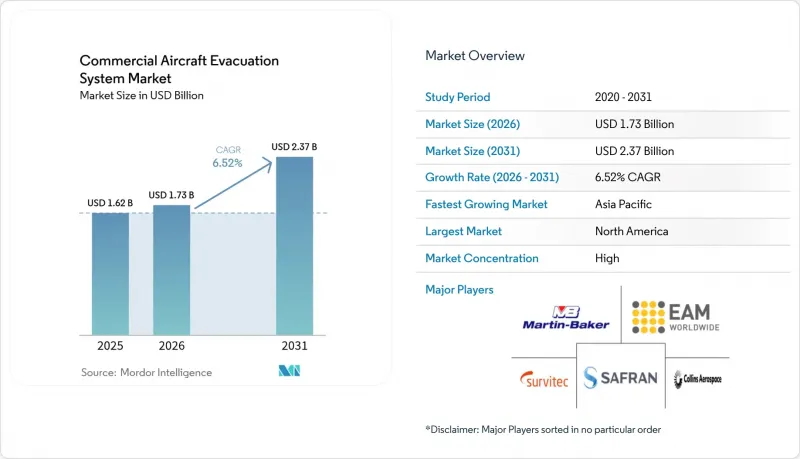
This report is Segmented by Equipment Type (Evacuation Slides, Life Rafts, and Personal Floatation Devices), Aircraft Type (Narrowbody, Widebody, and Regional Jets), Fitment (Linefit and Retrofit), and Geography (North America, Europe, Asia-Pacific, and More). The Market Forecasts are Provided in Terms of Value (USD).
Global Commercial Aircraft Evacuation System Market Trends and Insights
Fleet renewal cycles accelerate equipment-replacement demand
Airlines worldwide are retiring legacy airframes in favor of fuel-efficient A320neo and B737 MAX variants, each delivered with state-of-the-art evacuation slides engineered for high-density cabins. Safran recorded a 35% year-over-year jump in A320 slide shipments during 1H 2024, underscoring OEM pull-through. Replacement also stimulates aftermarket retrofits because operators strive for fleetwide equipment uniformity to ease crew training. Higher-seat-count layouts increase required exit-rate performance, pushing suppliers to integrate lightweight fabrics and rapid-inflation valves. Regulatory compliance timing further nudges carriers to retrofit ahead of certification deadlines rather than absorb disruptive mid-life upgrades.
Post-2024 regulatory standards reshape testing protocols
Section 365 of the 2024 FAA Reauthorization Act orders real-world evacuation studies covering smoke, low-visibility, and baggage interference variables. EASA mirrored the shift, compelling slide makers to validate performance at extreme temperature and structural-damage thresholds. The JAL A350 incident revealed behavior-driven delays and spurred demands for crew-coordination data during certification. Compliance costs elongate product-development cycles yet confer scale advantages on incumbents fluent in multi-jurisdictional approval. Suppliers capable of digital-twin simulation and mixed-reality testing gain early-mover credibility, jointly elevating overall market standards.
Long-term OEM contracts create market-entry barriers
Collins Aerospace's 50-year distribution pact with Satair typifies enduring supply agreements that govern airframe life cycles. Airbus and Boeing lean on legacy partners to minimize certification risk, confining opportunities for newcomers who face USD 10 million-plus platform-qualification costs. Safran's 2024 divestiture of its North American actuation unit to Woodward demonstrates portfolio reshaping as incumbents consolidate rather than yield share. Airlines prefer vendors with global spares networks and proven safety pedigrees, cementing entry hurdles. Consequently, only niche play remains for start-ups specializing in lightweight textiles or modular raft canisters.
Other drivers and restraints analyzed in the detailed report include:
- MRO demand intensifies for aging-fleet overhauls
- Low-cost-carrier expansion drives installation volume
- Persistent cabin-baggage delays elevate liability risk
For complete list of drivers and restraints, kindly check the Table Of Contents.
Segment Analysis
Evacuation slides generated the largest 59.68% market share of commercial aircraft evacuation systems in 2025 and propelled a 6.89% CAGR. Slides couple lightweight polyurethane fabrics with dual-lane architecture to improve exit-rate efficiency; embedded IoT nodes transmit pressure, temperature, and deployment-readiness status to airline dashboards. Real-time health monitoring underpins condition-based maintenance, slashing unscheduled removals by more than 25% on early adopter fleets.
Life rafts are the second-largest contributing line, buoyed by EASA's tightened ditching-survivability criteria for extended diversion routes. Survitec's 152-person Seahaven raft showcases advances in compact valise form factors and quadruple-redundant CO2 inflation valves. Although the smallest in revenue, personal flotation devices register steady renewals given heightened passenger-capacity metrics and regulatory calls for adult-infant size standardization. Growth headwinds arise from weight-reduction pressures, pushing suppliers to adopt ultra-high-molecular-weight polyethylene (UHNWP) fabrics. Yet slides maintain clear dominance through 2031, due to mandatory fitment on every exit door and competitive tech roadmaps.
Complete Report Scope:
- By Equipment Type
- Evacuation Slides
- Life Rafts
- Personal Floatation Devices
- By Aircraft Type
- Narrowbody
- Widebody
- Regional Jets
- By Fitment
- Linefit
- Retrofit
- By Geography
- North America
- United States
- Canada
- Mexico
- Europe
- United Kingdom
- France
- Germany
- Italy
- Rest of Europe
- Asia-Pacific
- China
- India
- Japan
- South Korea
- Australia
- Rest of Asia-Pacific
- South America
- Brazil
- Rest of South America
- Middle East and Africa
- Middle East
- United Arab Emirates
- Saudi Arabia
- Rest of Middle East
- Africa
- South Africa
- Rest of Africa
- Middle East
- North America
Geography Analysis
North America comprised 29.55% of the 2025 value, driven by entrenched aerospace OEM clusters in Seattle, Wichita, and Montreal that expedite certification cycles and sustain proximity supply chains. The region also houses the densest network of Part 145 slide-repair stations, cutting turnaround times and fortifying aftermarket stability. FAA leadership in rule-making shapes global benchmarks, giving US suppliers early technical foresight.
Asia-Pacific is forecasted to be the fastest climber with a 7.23% CAGR, propelled by Airbus's 19,500 aircraft delivery outlook and China's 5.7% annual RPK growth. Indian carriers logged double-digit traffic rebounds, ordering next-generation narrowbodies outfitted with predictive-maintenance slides. Regional governments court local assembly lines, pressing suppliers to establish joint ventures in Tianjin and Hyderabad that comply with offset policies yet retain IP control.
Europe remains technologically influential through EASA's rigorous human-factor testing and composite-material programs originating in Toulouse and Hamburg. Brexit-related customs frictions temporarily hampered cross-Channel slide sub-component flows, though dual-site warehousing alleviated delays. Middle East and Africa, while smaller, witness steady uptake among Gulf mega-carriers expanding widebody fleets; however, political instability tempers sub-Saharan activity. South America benefits from LCC penetration in Brazil and Argentina, but macro-economic volatility caps fleet-renewal cadence.
- Safran SA
- Collins Aerospace (RTX Corporation)
- Survitec Group Limited
- Trelleborg AB
- SWITLIK SURVIVAL PRODUCTS
- EAM Worldwide
- FCAH Aerospace
- DART Aerospace Company
- Lufthansa Technik AG
- Hong Kong Aircraft Engineering Company Limited
- HRD Aero Systems, Inc.
Additional Benefits:
- The market estimate (ME) sheet in Excel format
- 3 months of analyst support
TABLE OF CONTENTS
1 INTRODUCTION
- 1.1 Study Assumptions and Market Definition
- 1.2 Scope of the Study
2 RESEARCH METHODOLOGY
3 EXECUTIVE SUMMARY
4 MARKET LANDSCAPE
- 4.1 Market Overview
- 4.2 Market Drivers
- 4.2.1 Fleet renewal cycles across narrowbody and widebody aircraft programs
- 4.2.2 Stricter FAA and EASA evacuation testing standards post-2024
- 4.2.3 Growing MRO demand for evacuation slide overhauls in aging aircraft
- 4.2.4 Expansion of low-cost carriers (LCCs) fueling new evacuation system installations
- 4.2.5 Integration of battery powered smart sensor evacuation slides reducing maintenance requirements
- 4.2.6 Adoption of mixed-reality crew training mandates to enhance evacuation readiness
- 4.3 Market Restraints
- 4.3.1 Long-term OEM evacuation system supply contracts limiting new entrants
- 4.3.2 Persistent cabin baggage evacuation delays increasing liability and safety risks
- 4.3.3 Rising raw material costs squeezing manufacturer margins
- 4.3.4 Limited FAA-approved independent MRO capacity constraining aftermarket growth
- 4.4 Supply Chain Analysis
- 4.5 Regulatory Landscape
- 4.6 Technological Outlook
- 4.7 Porter's Five Forces Analysis
- 4.7.1 Bargaining Power of Suppliers
- 4.7.2 Bargaining Power of Buyers
- 4.7.3 Threat of New Entrants
- 4.7.4 Threat of Substitute Products
- 4.7.5 Intensity of Competitive Rivalry
5 MARKET SIZE AND GROWTH FORECASTS (VALUE)
- 5.1 By Equipment Type
- 5.1.1 Evacuation Slides
- 5.1.2 Life Rafts
- 5.1.3 Personal Floatation Devices
- 5.2 By Aircraft Type
- 5.2.1 Narrowbody
- 5.2.2 Widebody
- 5.2.3 Regional Jets
- 5.3 By Fitment
- 5.3.1 Linefit
- 5.3.2 Retrofit
- 5.4 By Geography
- 5.4.1 North America
- 5.4.1.1 United States
- 5.4.1.2 Canada
- 5.4.1.3 Mexico
- 5.4.2 Europe
- 5.4.2.1 United Kingdom
- 5.4.2.2 France
- 5.4.2.3 Germany
- 5.4.2.4 Italy
- 5.4.2.5 Rest of Europe
- 5.4.3 Asia-Pacific
- 5.4.3.1 China
- 5.4.3.2 India
- 5.4.3.3 Japan
- 5.4.3.4 South Korea
- 5.4.3.5 Australia
- 5.4.3.6 Rest of Asia-Pacific
- 5.4.4 South America
- 5.4.4.1 Brazil
- 5.4.4.2 Rest of South America
- 5.4.5 Middle East and Africa
- 5.4.5.1 Middle East
- 5.4.5.1.1 United Arab Emirates
- 5.4.5.1.2 Saudi Arabia
- 5.4.5.1.3 Rest of Middle East
- 5.4.5.2 Africa
- 5.4.5.2.1 South Africa
- 5.4.5.2.2 Rest of Africa
- 5.4.5.1 Middle East
- 5.4.1 North America
6 COMPETITIVE LANDSCAPE
- 6.1 Market Concentration
- 6.2 Strategic Moves
- 6.3 Market Share Analysis
- 6.4 Company Profiles (includes Global level Overview, Market level overview, Core Segments, Financials as available, Strategic Information, Market Rank/Share for key companies, Products and Services, and Recent Developments)
- 6.4.1 Safran SA
- 6.4.2 Collins Aerospace (RTX Corporation)
- 6.4.3 Survitec Group Limited
- 6.4.4 Trelleborg AB
- 6.4.5 SWITLIK SURVIVAL PRODUCTS
- 6.4.6 EAM Worldwide
- 6.4.7 FCAH Aerospace
- 6.4.8 DART Aerospace Company
- 6.4.9 Lufthansa Technik AG
- 6.4.10 Hong Kong Aircraft Engineering Company Limited
- 6.4.11 HRD Aero Systems, Inc.
7 MARKET OPPORTUNITIES AND FUTURE OUTLOOK
- 7.1 White-space and Unmet-Need Assessment

