PUBLISHER: Mordor Intelligence | PRODUCT CODE: 2114470

PUBLISHER: Mordor Intelligence | PRODUCT CODE: 2114470
Varicose Veins Treatment - Market Share Analysis, Industry Trends & Statistics, Growth Forecasts (2026 - 2031)
According to Mordor Intelligence, the global varicose veins treatment market size in 2026 is estimated at USD 1.39 billion, growing from 2025 value of USD 1.32 billion with 2031 projections showing USD 1.78 billion, growing at 5.12% CAGR over 2026-2031.
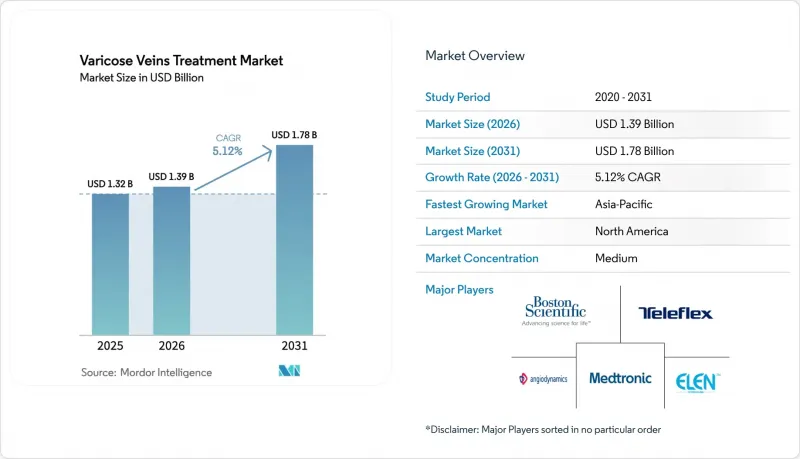
This report Segments the Industry Into Treatment Type (Endovenous Ablation, Sclerotherapy and More), Product (Ablation Devices, Venous Closure Products, and More), by End User (Hospitals, Specialized Vein Centers and Others), by Vein Type (Great Saphenous Vein, Small Saphenous Vein and More) and Geography (North America, Europe and More). The Market Forecasts are Provided in Terms of Value (USD).
Global Varicose Veins Treatment Market Trends and Insights
Rising Preference for Minimally Invasive Surgeries
Patients are increasingly opting for outpatient solutions that shorten recovery time and minimize scarring. Endovenous ablation, cyanoacrylate closure, and foam sclerotherapy now dominate the varicose vein treatment market, offering clinical efficacy comparable to open surgery with fewer complications. VenaSeal achieves a 94.6% five-year closure rate, allowing for an immediate return to activity and illustrating the competitive edge of catheter-based systems. The shift is accelerating the retirement of vein stripping, redirecting capital toward radiofrequency generators, endolaser consoles, and NTNT technologies that fit office-based workflows. As device portfolios broaden, technology leaders differentiate through lower recurrence rates and simplified anesthesia requirements. Product positioning centered on patient convenience has become a central marketing pillar that resonates across both self-pay and reimbursed channels.
Obesity-Driven Chronic Venous Insufficiency
Escalating obesity prevalence correlates with heightened venous hypertension, propelling demand for interventional care. Overweight individuals experience a 1.5-fold greater risk of varicose pathology because excess weight impairs venous valve competence. Women with elevated BMI report lower quality-of-life scores and higher pain indices, pushing providers to recommend definitive procedures earlier in the disease course. This demographic trend expands the varicose vein treatment market by amplifying the need for compression therapy, ablative devices, and follow-up diagnostics. Device makers respond with larger-diameter catheters and enhanced delivery systems to accommodate diverse vein calibers. Public health initiatives that encourage weight reduction indirectly support procedure volume by improving caregiver awareness and referral patterns.
High Out-of-Pocket Cost
Procedures deemed purely cosmetic often fall outside insurance coverage, requiring patients to self-fund multiple sessions and ancillary imaging. Emerging markets feel the pinch more acutely where payer networks remain nascent, dampening penetration of premium catheters and specialty adhesives. Providers respond by offering flexible payment plans and batching bilateral treatments to reduce per-leg cost, yet price sensitivity persists. The constraint steers some patients toward compression-only management, slowing adoption curves in lower-income segments. Equipment makers are therefore engineering simplified RF consoles with modular pricing to address clinics in cost-constrained geographies.
Other drivers and restraints analyzed in the detailed report include:
- Medicare Reimbursement Expansion for Endovenous Thermal Ablation
- Tele-consult Triaging Boosting Early Referrals
- Safety Concerns
For complete list of drivers and restraints, kindly check the Table Of Contents.
Segment Analysis
Sclerotherapy accounted for 68.32% of 2025 revenue, reflecting its versatility in treating small-diameter vessels and spider veins. Endovenous ablation, however, is registering a 6.87% CAGR that lifts its contribution to the varicose vein treatment market over the forecast horizon. The technique's success rides on devices such as ClosureFast, which posts 91.9% closure and 94.9% reflux-free outcomes five years after intervention. With each clinical update, payers become increasingly comfortable funding ablation as a first-line option, thereby displacing ligation and stripping.
Technological momentum now centers on non-thermal, non-tumescent systems, such as ClariVein MOCA, which combines mechanical agitation with sclerosant delivery. Cyanoacrylate adhesive closure further enhances patient satisfaction by eliminating post-procedure stocking requirements, which are critical for compliance in warmer climates. These innovations reduce anesthesia time and enable same-room turnover, advantages that specialty clinics leverage to achieve higher daily procedure volumes. As a result, segment analysts expect a continued reweighting toward catheter-based interventions within the varicose vein treatment market.
Ablation platforms generated 46.45% of 2025 sales, underscoring the primacy of RF and laser consoles. Yet, accessories and compression products are growing at a rate of 6.31% per year, as they underpin peri-procedural success. Graduated stockings remain the mainstay of conservative therapy and post-ablation prophylaxis, endorsed by the American Venous Forum for symptom relief and ulcer prevention.
Foam-injection kits, epitomized by Varithena with its patented Microfoam UDSS technology, reinforce the segment with a ready-to-use formulation that bypasses the need for manual mixing steps. Ultrasound probes, disposable introducers, and fiberoptic light guides round out accessory demand by ensuring accurate vein access and thermal control. The procedural stack, therefore, widens the varicose vein treatment market size through ancillary revenue streams even as console margins compress. Manufacturing roadmaps emphasize ergonomic handles, single-use locking syringes, and color-coded catheter sets to streamline training and inventory tracking.
Complete Report Scope:
- By Treatment Type
- Endovenous Ablation
- Radiofrequency (RFA)
- Laser (EVLA)
- Mechanochemical (MOCA)
- Cyanoacrylate Closure
- Sclerotherapy
- Liquid
- Foam
- Surgical Ligation & Stripping
- Others
- Endovenous Ablation
- By Product
- Ablation Devices
- RFA Generators & Catheters
- Laser Consoles & Fibers
- Non-thermal Closure Systems
- Sclerotherapy Injection Kits
- Support Devices & Accessories
- Ablation Devices
- By End User
- Hospitals
- Specialized Vein Centers
- Others
- By Vein Type
- Great Saphenous Vein
- Small Saphenous Vein
- Perforator & Accessory Veins
- By Geography
- North America
- United States
- Canada
- Mexico
- Europe
- Germany
- United Kingdom
- France
- Italy
- Spain
- Rest of Europe
- Asia-Pacific
- China
- Japan
- India
- South Korea
- Australia
- Rest of Asia- Pacific
- Middle East and Africa
- GCC
- South Africa
- Rest of Middle East and Africa
- South America
- Brazil
- Argentina
- Rest of South America
- North America
Geography Analysis
North America retained a 42.85% revenue share in 2025, underpinned by advanced imaging infrastructure, high awareness, and favorable Medicare policies that reimburse endovenous ablation after failed conservative care. Hospital chains have expanded their outpatient suites, and payer bundles reward efficiency, allowing clinicians to schedule bilateral procedures in a single visit. Boston Scientific's launch of the FARAPULSE Pulsed Field Ablation System drove regional sales growth of 13.8% year over year, underscoring a robust appetite for technology.
Europe follows, buoyed by strong public systems in Germany, the United Kingdom, and France that swiftly incorporate evidence-backed devices. The region has adopted NTNT approaches, and regulatory clarity supports rapid rollouts once post-market surveillance confirms safety. Reimbursement parity between RF and laser methods levels the playing field and sparks iterative upgrades, such as dual-heating catheters from BD. Southern European nations mirror adoption patterns with a lag tied to fiscal budgets, yet patient demand remains stable due to high cosmetic expectations. The Asia-Pacific region posts the fastest growth rate of 6.12%, driven by capacity expansion in Japan, China, and India. Japan's strict credentialing standards slow the adoption of lasers but stimulate innovation in training simulators and e-credential platforms. China's 2024 approval of FARAPULSE unlocked a population base that can swell the varicose vein treatment market size once urban outpatient chains scale rapid private-insurance growth in India, coupled with rising middle-class incomes, to fuel device imports. Australia and South Korea maintain steady upgrade cycles as clinics retire older diode lasers in favor of RF generators. The Middle East, led by GCC states, adopts premium cyanoacrylate systems as affluent patients prefer compression-free recovery. Sub-Saharan Africa grows from a smaller base; supply chain volatility around sclerosant drugs curtails volume in public hospitals, but private centers in South Africa sustain modest uptake. South America, spearheaded by Brazil and Argentina, experiences rising procedural counts aligned with expanded private coverage.
- Medtronic
- AngioDynamics
- Boston Scientific
- Biolitec
- Lumenis
- Teleflex
- Venclose Inc.
- VVT Medical Ltd.
- Merit Medical Systems
- LeMaitre Vascular
- Theraclion SA
- F Care Systems
- Dornier MedTech
- Eufoton Srl
- Candela Medical
- Quanta System
- Won Tech
Additional Benefits:
- The market estimate (ME) sheet in Excel format
- 3 months of analyst support
TABLE OF CONTENTS
1 Introduction
- 1.1 Study Assumptions & Market Definition
- 1.2 Scope of the Study
2 Research Methodology
3 Executive Summary
4 Market Landscape
- 4.1 Market Overview
- 4.2 Market Drivers
- 4.2.1 Rising Preference for Minimally-invasive Surgeries
- 4.2.2 Rising Obesity-driven Chronic Venous Insufficiency
- 4.2.3 Medicare Reimbursement Expansion for Endovenous Thermal Ablation in the United States
- 4.2.4 Tele-consult Triaging Boosting Early Referrals
- 4.2.5 Surge in Office-based Vein Clinics Adopting NTNT Technologies Across Europe
- 4.2.6 Rapid Uptake of Cyanoacrylate Adhesive Closure Systems in Middle-Eastern Private Hospitals
- 4.3 Market Restraints
- 4.3.1 High out-of-pocket Cost
- 4.3.2 Safety Concerns
- 4.3.3 Stock-outs of Sclerosant Drugs in Sub-Saharan Public Hospitals
- 4.3.4 Rigid Laser-ablation Credentialing Rules Slowing Adoption in Japan
- 4.4 Supply-Chain Analysis
- 4.5 Regulatory & Technological Outlook
- 4.6 Porter's Five Forces Analysis
- 4.6.1 Threat of New Entrants
- 4.6.2 Bargaining Power of Suppliers
- 4.6.3 Bargaining Power of Buyers
- 4.6.4 Threat of Substitutes
- 4.6.5 Competitive Rivalry
5 Market Size & Growth Forecasts (Value)
- 5.1 By Treatment Type
- 5.1.1 Endovenous Ablation
- 5.1.1.1 Radiofrequency (RFA)
- 5.1.1.2 Laser (EVLA)
- 5.1.1.3 Mechanochemical (MOCA)
- 5.1.1.4 Cyanoacrylate Closure
- 5.1.2 Sclerotherapy
- 5.1.2.1 Liquid
- 5.1.2.2 Foam
- 5.1.3 Surgical Ligation & Stripping
- 5.1.4 Others
- 5.1.1 Endovenous Ablation
- 5.2 By Product
- 5.2.1 Ablation Devices
- 5.2.1.1 RFA Generators & Catheters
- 5.2.1.2 Laser Consoles & Fibers
- 5.2.1.3 Non-thermal Closure Systems
- 5.2.2 Sclerotherapy Injection Kits
- 5.2.3 Support Devices & Accessories
- 5.2.1 Ablation Devices
- 5.3 By End User
- 5.3.1 Hospitals
- 5.3.2 Specialized Vein Centers
- 5.3.3 Others
- 5.4 By Vein Type
- 5.4.1 Great Saphenous Vein
- 5.4.2 Small Saphenous Vein
- 5.4.3 Perforator & Accessory Veins
- 5.5 By Geography
- 5.5.1 North America
- 5.5.1.1 United States
- 5.5.1.2 Canada
- 5.5.1.3 Mexico
- 5.5.2 Europe
- 5.5.2.1 Germany
- 5.5.2.2 United Kingdom
- 5.5.2.3 France
- 5.5.2.4 Italy
- 5.5.2.5 Spain
- 5.5.2.6 Rest of Europe
- 5.5.3 Asia-Pacific
- 5.5.3.1 China
- 5.5.3.2 Japan
- 5.5.3.3 India
- 5.5.3.4 South Korea
- 5.5.3.5 Australia
- 5.5.3.6 Rest of Asia- Pacific
- 5.5.4 Middle East and Africa
- 5.5.4.1 GCC
- 5.5.4.2 South Africa
- 5.5.4.3 Rest of Middle East and Africa
- 5.5.5 South America
- 5.5.5.1 Brazil
- 5.5.5.2 Argentina
- 5.5.5.3 Rest of South America
- 5.5.1 North America
6 Competitive Landscape
- 6.1 Market Concentration
- 6.2 Market Share Analysis
- 6.3 Company Profiles {(includes Global level Overview, Market level overview, Core Segments, Financials as available, Strategic Information, Market Rank/Share for key companies, Products & Services, and Recent Developments)}
- 6.3.1 Medtronic plc
- 6.3.2 AngioDynamics Inc.
- 6.3.3 Boston Scientific Corp.
- 6.3.4 biolitec AG
- 6.3.5 Lumenis Ltd.
- 6.3.6 Teleflex Incorporated
- 6.3.7 Venclose Inc.
- 6.3.8 VVT Medical Ltd.
- 6.3.9 Merit Medical Systems Inc.
- 6.3.10 LeMaitre Vascular Inc.
- 6.3.11 Theraclion SA
- 6.3.12 F Care Systems
- 6.3.13 Dornier MedTech
- 6.3.14 Eufoton Srl
- 6.3.15 Candela Medical (Syneron Medical Ltd)
- 6.3.16 Quanta System
- 6.3.17 Won Tech Co. Ltd
7 Market Opportunities & Future Outlook
- 7.1 White-space & Unmet-Need Assessment

