PUBLISHER: Mordor Intelligence | PRODUCT CODE: 2114473

PUBLISHER: Mordor Intelligence | PRODUCT CODE: 2114473
Hemodialysis - Market Share Analysis, Industry Trends & Statistics, Growth Forecasts (2026 - 2031)
According to Mordor Intelligence, the hemodialysis market size is estimated at USD 38.94 billion in 2026, and is expected to reach USD 49.37 billion by 2031, at a CAGR of 4.86% during the forecast period (2026-2031).
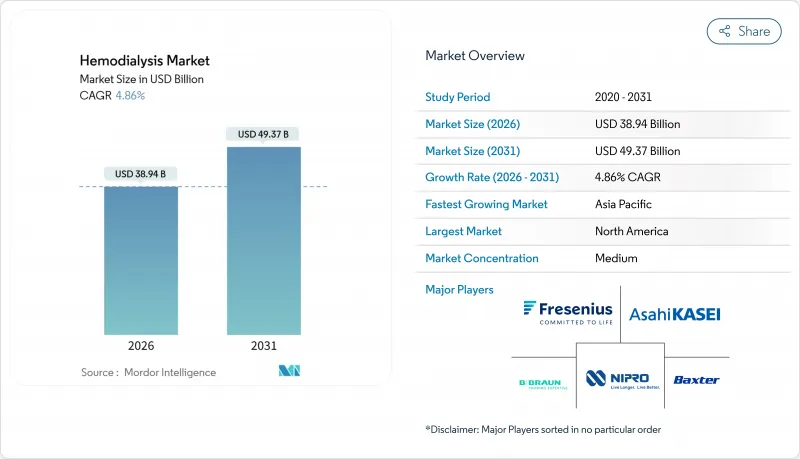
This report is Segmented by Product & Service (Equipment [Hemodialysis Machines and More], Consumables and Accessories[Bloodlines & Tubing Sets and More], and Services), Modality (Conventional Long-Hour, Short Daily, Nocturnal), End User (In-Center Dialysis, Home Dialysis), and Geography (North America, Europe, Asia-Pacific, Middle East & Africa, South America). The Market Forecasts are Provided in Terms of Value (USD).
Global Hemodialysis Market Trends and Insights
Rising Global ESRD Prevalence
Global dialysis incidence keeps rising, exemplified by 130,754 new U.S. patients in 2024 and Japan's total pool exceeding 350,000 by 2025. Diabetes and hypertension explain most cases, yet chronic kidney disease of unknown etiology in agricultural belts of Central America and South Asia is accelerating demand. Rural expansion programs, such as China's USD 1.2 billion county-level build-out, widen the addressable base. Because ESRD is non-elective, these demographics underpin secular volume growth that insulates the hemodialysis market from economic cycles. As incidence rises, providers must scale staff and infrastructure, cementing equipment and consumable pull-through.
Growing Adoption of Home Hemodialysis
Home penetration reached 12.8% of U.S. dialysis patients by mid-2025, buoyed by Medicare incentives that reward nephrologists for prescribing home therapy. Systems like Outset Medical's Tablo remove separate water-treatment needs, slashing setup costs by 40%. Australia leads OECD peers with 22% of new patients starting at home thanks to 85% equipment subsidies and caregiver training mandates. Workforce shortages-nephrology nurse vacancy rates stood at 18% in 2025-push stakeholders toward self-care pathways. Coupled with user-friendly interfaces and remote troubleshooting, home programs are positioned to win younger, working-age cohorts.
High Treatment Costs Versus Peritoneal Dialysis
Annual in-center hemodialysis spending averages USD 89,000 in the United States versus USD 62,000 for peritoneal dialysis, prompting PD-first mandates in Canada, the U.K., and Australia. Hong Kong achieved 78% PD initiation in 2025 by paying nephrologists a premium for PD oversight. Escalating nurse pay-up 8.2% annually from 2023-25-amplifies this cost gap. While hemodialysis remains vital for patients unable to handle PD logistics, value-based purchasing schemes highlight its relative expense, moderating uptake in some health systems.
Other drivers and restraints analyzed in the detailed report include:
- Reimbursement Expansions in Major Markets
- Technological Innovations in High-Flux Dialyzers
- Vascular-Access Infections and Complications
For complete list of drivers and restraints, kindly check the Table Of Contents.
Segment Analysis
Consumables and accessories are projected to expand at an 8.34% CAGR to 2031, surpassing equipment's 41.24% share in the hemodialysis market as of 2025. Razor-and-blade strategies, such as Nikkiso's USD 500 monthly subscription machine, bundle bloodlines, concentrates, and service into one predictable fee. Global shipments of bloodlines and tubing surpassed 1.2 billion units in 2025, reflecting their single-use necessity.
High-flux therapy protocols raise bicarbonate-dialysate demand, adding USD 3 per treatment in concentrate revenue. Antimicrobial-coated catheters captured 22% of the North American subsector, demonstrating clinicians' willingness to invest in infection mitigation. Services, from maintenance to on-site water-system management, grow 5.2% annually as independent clinics outsource biomedical engineering tasks. This consumables-heavy mix insulates the hemodialysis market size from capital-budget cycles while anchoring manufacturers to patient retention metrics.
Complete Report Scope:
- By Products and Services
- Equipment
- Hemodialysis Machines
- Dialysate Delivery Systems
- Others
- Consumables and Accessories
- Bloodlines & Tubing Sets
- Concentrates & Solutions
- Hemostasis Devices
- Catheters & Fistula Needle
- Other consumables and accessories
- Services
- Equipment
- By Modality
- Conventional Long-hour Hemodialysis
- Short Daily Hemodialysis
- Nocturnal Hemodialysis
- By End User
- In-center Dialysis
- Hospitals
- Others
- Home Dialysis
- In-center Dialysis
- By Geography
- North America
- United States
- Canada
- Mexico
- Europe
- Germany
- France
- United Kingdom
- Italy
- Spain
- Rest of Europe
- Asia-Pacific
- China
- Japan
- India
- South Korea
- Australia
- Rest of Asia-Pacific
- Middle East & Africa
- GCC
- South Africa
- Rest of Middle East & Africa
- South America
- Brazil
- Argentina
- Rest of South America
- North America
Geography Analysis
North America contributed 38.54% of 2025 revenue, anchored by Medicare's USD 240 per-session clinic payment and a 550,000-patient base. Incident ESRD growth slowed to 1.8% in 2024, yet mortality fell to 16.2%, reflecting cardiovascular-care improvements. Canada's British Columbia achieved 28% home penetration via compulsory education and nephrologist bonuses. Mexico's Seguro Popular now funds twice-weekly treatments, adding 18,000 slots by 2027.
Europe captured 29% of global revenue, led by Germany's 1,350 per-million prevalence under generous tariffs. France's pre-emptive transplant rate hit 18%, tempering volume growth but improving outcomes. The U.K. mandate that suitable patients start at home lifted national home prevalence to 19% in 2025. Spain and Italy leverage European Investment Bank financing to modernize rural centers.
Asia-Pacific is the fastest-growing segment at a 7.02% CAGR, propelled by China's 820,000-patient population yet low 570 per-million penetration. India expanded district-hospital dialysis to 680 sites through public-private concessions. Japan recorded its first dialysis decline, down 0.8% in 2025 after aggressive CKD screening. Tele-nephrology deployments in South Korea and Australia reduce hospitalizations by 14% among 12,000 monitored home patients.
The Middle East and Africa held 6.2% of revenue, with Saudi Arabia's Vision 2030 expanding capacity to 42,000 patients in 2025. UAE water mandates force centers to install recycling systems, raising CAPEX yet improving efficiency. Solar-powered pilots in Kenya lower energy costs by 30%, offering a blueprint for rural Sub-Saharan Africa.
South America made up 4.8% of revenue, dominated by Brazil's 144,000 publicly funded patients under SUS despite tariff stagnation since 2018. Argentina's currency pressures triggered operator exits in 2025, whereas Chile's 12% tariff hike revived investment. Colombia opened 35 rural centers in 2024 through municipal programs.
- Allmed Medical GmbH
- Asahi Kasei Medical
- B. Braun
- Baxter
- Dialife SA
- Fresenius
- Guangdong Future Dialysis Tech.
- JMS Co., Ltd
- Kawasumi Laboratories
- Medivators Inc. (Cantel)
- Medtronic
- Nikkiso Co., Ltd.
- Nipro
- Outset Medical
- Quanta Dialysis Technologies
- Rockwell Medical
- Shanwaishan Medical Group
- SWS Hemodialysis Care Co., Ltd.
- Toray Medical Co., Ltd.
- WEGO Group
Additional Benefits:
- The market estimate (ME) sheet in Excel format
- 3 months of analyst support
TABLE OF CONTENTS
1 Introduction
- 1.1 Study Assumptions & Market Definition
- 1.2 Scope of the Study
2 Research Methodology
3 Executive Summary
4 Market Landscape
- 4.1 Market Overview
- 4.2 Market Drivers
- 4.2.1 Rising Global Prevalence of End-Stage Renal Disease (ESRD)
- 4.2.2 Growing Adoption of Home Hemodialysis
- 4.2.3 Reimbursement Expansions in Major Markets
- 4.2.4 Technological Innovations in High-Flux Dialyzers
- 4.2.5 Integration of Tele-Nephrology Platforms for Remote Monitoring
- 4.2.6 Public-Private Partnership Dialysis Roll-Outs in LMICs
- 4.3 Market Restraints
- 4.3.1 High Treatment Costs Versus Peritoneal Dialysis
- 4.3.2 Vascular-Access Infections & Complications
- 4.3.3 Emerging Wearable Artificial-Kidney Substitutes
- 4.3.4 Water-Scarcity Regulations Tightening Ultrapure-Water Use
- 4.4 Value / Supply-Chain Analysis
- 4.5 Regulatory Landscape
- 4.6 Technological Outlook
- 4.7 Porter's Five Forces Analysis
- 4.7.1 Threat of New Entrants
- 4.7.2 Bargaining Power of Suppliers
- 4.7.3 Bargaining Power of Buyers
- 4.7.4 Threat of Substitutes
- 4.7.5 Industry Rivalry
5 Market Size & Growth Forecasts (Value, USD)
- 5.1 By Products and Services
- 5.1.1 Equipment
- 5.1.1.1 Hemodialysis Machines
- 5.1.1.2 Dialysate Delivery Systems
- 5.1.1.3 Others
- 5.1.2 Consumables and Accessories
- 5.1.2.1 Bloodlines & Tubing Sets
- 5.1.2.2 Concentrates & Solutions
- 5.1.2.3 Hemostasis Devices
- 5.1.2.4 Catheters & Fistula Needle
- 5.1.2.5 Other consumables and accessories
- 5.1.3 Services
- 5.1.1 Equipment
- 5.2 By Modality
- 5.2.1 Conventional Long-hour Hemodialysis
- 5.2.2 Short Daily Hemodialysis
- 5.2.3 Nocturnal Hemodialysis
- 5.3 By End User
- 5.3.1 In-center Dialysis
- 5.3.1.1 Hospitals
- 5.3.1.2 Others
- 5.3.2 Home Dialysis
- 5.3.1 In-center Dialysis
- 5.4 By Geography
- 5.4.1 North America
- 5.4.1.1 United States
- 5.4.1.2 Canada
- 5.4.1.3 Mexico
- 5.4.2 Europe
- 5.4.2.1 Germany
- 5.4.2.2 France
- 5.4.2.3 United Kingdom
- 5.4.2.4 Italy
- 5.4.2.5 Spain
- 5.4.2.6 Rest of Europe
- 5.4.3 Asia-Pacific
- 5.4.3.1 China
- 5.4.3.2 Japan
- 5.4.3.3 India
- 5.4.3.4 South Korea
- 5.4.3.5 Australia
- 5.4.3.6 Rest of Asia-Pacific
- 5.4.4 Middle East & Africa
- 5.4.4.1 GCC
- 5.4.4.2 South Africa
- 5.4.4.3 Rest of Middle East & Africa
- 5.4.5 South America
- 5.4.5.1 Brazil
- 5.4.5.2 Argentina
- 5.4.5.3 Rest of South America
- 5.4.1 North America
6 Competitive Landscape
- 6.1 Market Concentration
- 6.2 Market Share Analysis
- 6.3 Company Profiles (includes Global level Overview, Market level overview, Core Segments, Financials as available, Strategic Information, Market Rank/Share for key companies, Products and Services, and Recent Developments)
- 6.3.1 Allmed Medical GmbH
- 6.3.2 Asahi Kasei Medical
- 6.3.3 B. Braun Melsungen AG
- 6.3.4 Baxter International Inc.
- 6.3.5 Dialife SA
- 6.3.6 Fresenius Medical Care AG & Co. KGaA
- 6.3.7 Guangdong Future Dialysis Tech.
- 6.3.8 JMS Co., Ltd
- 6.3.9 Kawasumi Laboratories Inc.
- 6.3.10 Medivators Inc. (Cantel)
- 6.3.11 Medtronic plc
- 6.3.12 Nikkiso Co., Ltd.
- 6.3.13 Nipro Corporation
- 6.3.14 Outset Medical Inc.
- 6.3.15 Quanta Dialysis Technologies
- 6.3.16 Rockwell Medical Inc.
- 6.3.17 Shanwaishan Medical Group
- 6.3.18 SWS Hemodialysis Care Co., Ltd.
- 6.3.19 Toray Medical Co., Ltd.
- 6.3.20 WEGO Group
7 Market Opportunities & Future Outlook
- 7.1 White-space & Unmet-need Assessment

