PUBLISHER: Mordor Intelligence | PRODUCT CODE: 2114479

PUBLISHER: Mordor Intelligence | PRODUCT CODE: 2114479
High Altitude Pseudo Satellites - Market Share Analysis, Industry Trends & Statistics, Growth Forecasts (2026 - 2031)
According to Mordor Intelligence, the high-altitude pseudo-satellites market size is expected to grow from USD 85.30 million in 2025 to USD 102.28 million in 2026 and is forecasted to reach USD 247.56 million by 2031 at a 19.34% CAGR over 2026-2031.
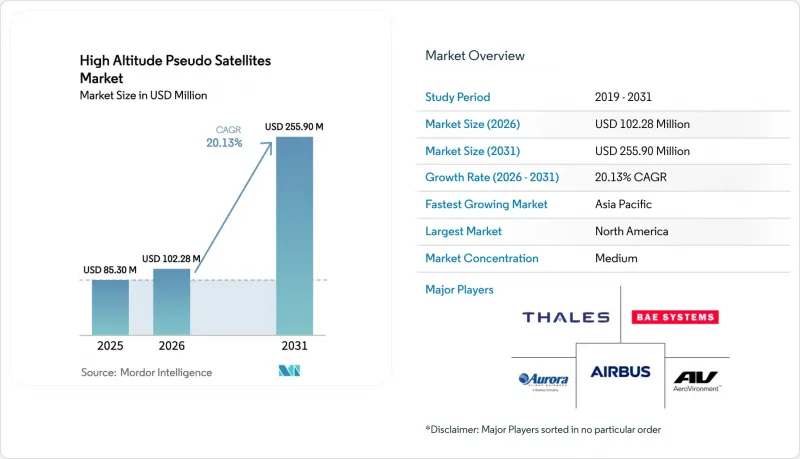
This report is Segmented by Technology (Stratospheric Balloons, Unmanned Aerial Vehicles, Airships), Application (Communication and Connectivity, ISR, and More), End-User (Government and Defense, and Commercial, Research), Power Source (Solar-Electric, and More), and Geography (North America, Europe, and More). Market Forecasts are Provided in Terms of Value (USD).
Global High Altitude Pseudo Satellites Market Trends and Insights
Rapid 5G/6G NTN Roll-Outs
Telecom operators integrate stratospheric platforms into non-terrestrial networks to extend 5G coverage into areas where traditional tower economics are insufficient. Space Compass utilized an Aalto Zephyr to serve 1,000 users across a 140 km radius in Kenya in March 2025, confirming the commercial viability of its service. HAPSMobile demonstrated 38 GHz millimeter-wave connectivity in May 2024 and targets commercial service in Japan by late 2026, positioning the high-altitude pseudo-satellite (HAPS) market for early 6G integration. 3GPP Release 18 treats HAPS as a network node, allowing vendors to ship dual-mode radios through established supply chains. These moves reduce integration risk, accelerate equipment certification, and anchor revenue projections for operators that prioritize rural and maritime coverage.
Growing ISR and Persistent Surveillance Outlays
Defense ministries are redirecting surveillance budgets toward stratospheric platforms that can loiter for months and cost less than crewed aircraft. The United States Army evaluates unmanned alternatives because manned ISR flights exceed USD 10,000 per hour, while platforms like BAE Systems' PHASA-35 demonstrated 24-hour stratospheric endurance in December 2024 with a doubled payload capacity. Sceye's NASA partnership exemplifies civil-government adoption for wildfire tracking and methane detection, further broadening the high-altitude pseudo-satellite (HAPS) market's customer base. Persistent presence without refueling underpins new concepts of operation where assets remain on-station year-round, improving situational awareness.
High CAPEX and Maintenance Cost per Flight-Hour
Acquiring a single platform demands USD 10 million-USD 50 million, a hurdle for operators without sovereign backing or deep capital pools. Multi-month missions consume USD 2.16 million to USD 10.8 million in direct OPEX, and each retrieval cycle can cost an additional USD 1 million for controlled descent, hull inspection, and gas replenishment. Limited secondary markets lock in depreciation, while rapid technology advances threaten obsolescence. These economics narrow the addressable high-altitude pseudo-satellites (HAPS) market to well-funded telecom carriers and defense agencies until modular designs drive down unit prices.
Other drivers and restraints analyzed in the detailed report include:
- Cost Advantage over LEO Constellations
- Advances in Ultra-Light Solar/Battery Systems
- Spectrum and Airspace Regulatory Complexity
For complete list of drivers and restraints, kindly check the Table Of Contents.
Segment Analysis
Unmanned aerial vehicles controlled 59.85% of the 2025 revenue within the high-altitude pseudo-satellite market, due to their proven solar-electric designs capable of carrying 150-lb payloads and multi-month flights. Airships emerge as the fastest-growing class at a 25.45% CAGR, propelled by hull fabrics that hold helium for year-long missions without retrieval. Balloons remain the low-cost choice for sub-30-day scientific campaigns. AeroVironment's Horus A gained FAA certification in October 2024, demonstrating a clear path to commercial ISR contracting, whereas Sceye's 270-ft airship targets telecom backhaul with a stationary footprint over 10,000 km2.
Airships leverage buoyancy to hover almost motionless, consuming minimal propulsion energy, which is an advantage for video surveillance and backhaul applications that require stable pointing. UAVs utilize continuous propeller thrust, sacrificing higher energy needs for agile repositioning when disasters or seasonal events alter demand. Balloons serve universities needing rapid launches but lack station-keeping and controllability. Taken together, these trade-offs diversify revenue channels within the high-altitude pseudo-satellite (HAPS) market, with each technology catering to specific endurance, payload, and capital expenditure (Capex) tolerances.
Communication and connectivity platforms captured 42.55% of the 2025 revenue in the high-altitude pseudo-satellites (HAPS) market, and this portion is projected to grow at a 24.40% CAGR as mobile network operators embed HAPS nodes into rural 5G rollouts, reducing the need for expensive tower grids in sparsely populated areas. Intelligence, surveillance, and reconnaissance (ISR) capabilities follow, with militaries shifting from crewed patrol aircraft to persistent "eyes-in-the-sky" stratospheric assets that can loiter for weeks without refueling. Earth-observation and climate-monitoring demand is rising because NASA and USGS procure methane and wildfire data from stratospheric airships, creating a civilian revenue stream that diversifies operator income. Navigation and scientific missions remain niche but benefit from shared airtime, amortizing platform costs across multiple payload types to maintain high utilization.
The March 2025 Zephyr field trial demonstrated that one HAPS platform can cover the area typically served by approximately 50 macro towers, validating a compelling economic lever for rural telecom carriers. BAE Systems integrated a synthetic-aperture radar into its PHASA-35, demonstrating the ISR potential for border and maritime surveillance at a fraction of the cost of crewed aircraft. Sceye's civil contracts demonstrate how environmental sensing revenues can subsidize connectivity payloads, creating blended business models. As dual-payload missions that pair broadband links with high-resolution imagery become common, operators increase flight utilization and shorten payback periods. This diversification reduces reliance on any single customer class, strengthens cash flows, and broadens the total addressable market for high-altitude pseudo-satellites (HAPS).
Complete Report Scope:
- By Technology
- Stratospheric Balloons
- Unmanned Aerial Vehicles
- Airships
- By Application
- Communication and Connectivity
- Intelligence, Surveillance and Reconnaissance (ISR)
- Earth Observation and Climate Monitoring
- Navigation and Positioning
- Scientific and Research Missions
- By End-User
- Government and Defense
- Commercial Enterprises
- Research Institutions
- By Power Source
- Solar-Electric
- Hybrid Hydrogen-Fuel-Cell
- Battery
- By Geography
- North America
- United States
- Canada
- Mexico
- Europe
- United Kingdom
- France
- Germany
- Italy
- Rest of Europe
- Asia-Pacific
- China
- India
- Japan
- Australia
- South Korea
- Rest of Asia-Pacific
- South America
- Brazil
- Rest of South America
- Middle East and Africa
- Middle East
- Saudi Arabia
- United Arab Emirates
- Turkey
- Rest of Middle East
- Africa
- South Africa
- Rest of Africa
- Middle East
- North America
Geography Analysis
North America captured 35.50% of the 2025 revenue, buoyed by the Federal Aviation Administration's (FAA) high-altitude corridors, the Federal Communications Commission's 47 GHz spectrum allocations, and the Department of Defense's ISR budgets, which underwrite multi-year contracts. AeroVironment's Horus A certification demonstrates that clear rules can shorten commercialization timelines, while partnerships with NASA and the USGS act as anchor tenants that de-risk cash flows. Venture capital and mature aerospace supply chains concentrate early production in the United States, fostering economies of scale that lower unit cost and expand the overall high-altitude pseudo-satellites (HAPS) market.
Asia-Pacific advances fastest at 25.70% CAGR through 2031, propelled by Japan's scheduled commercial launches, India's border-surveillance pilots, and China's near-space vehicle programs. SoftBank's late-2026 service will bridge significant coverage gaps and ensure seamless handoffs between terrestrial and stratospheric cells. Kenya's proof-of-concept offers a template for emerging economies in Southeast Asia and Pacific islands, illustrating how HAPS enables mobile-money ecosystems and e-government services. Regional regulators in Australia and South Korea, as they evaluate spectrum releases, further widen the addressable high-altitude pseudo-satellite (HAPS) market.
Europe holds a mid-tier share but faces a regulatory lag until EASA's operational rules are finalized in 2026. BAE Systems' PHASA-35 and DLR's HAP-alpha flights demonstrate technical competence despite slower approvals. Middle Eastern operators deploy HAPS for oil-field connectivity under permissive airspace regimes, while Africa and South America remain embryonic, focusing on pilots in the Amazon and Sahel regions. Adoption is expected to accelerate once local regulators adopt ICAO templates, diversifying the global high-altitude pseudo-satellites (HAPS) market footprint.
- AeroVironment, Inc.
- Airbus SE
- BAE Systems plc
- Thales Group
- Aerostar LLC
- Mira Aerospace Ltd.
- Sceye Inc.
- Stratosyst s.r.o.
- Involve Space S.R.L.
- HAPSMobile Inc. (SoftBank Corp.)
- Aurora Flight Sciences (The Boeing Company)
- Avealto Limited
- Zero 2 Infinity, S.L.
- Kea Aerospace Limited
- Stratospheric Platforms Ltd.
- Atlas LTA Advanced Technology, Ltd.
- Sierra Nevada Company, LLC.
- Maraal Aerospace Pvt. Ltd.
- Voltitude Ltd.
Additional Benefits:
- The market estimate (ME) sheet in Excel format
- 3 months of analyst support
TABLE OF CONTENTS
1 INTRODUCTION
- 1.1 Study Assumptions
- 1.2 Scope of the Study
2 RESEARCH METHODOLOGY
3 EXECUTIVE SUMMARY
4 MARKET LANDSCAPE
- 4.1 Market Overview
- 4.2 Market Drivers
- 4.2.1 Rapid 5G/6G NTN roll-outs
- 4.2.2 Growing ISR and persistent surveillance outlays
- 4.2.3 Cost advantage over LEO constellations
- 4.2.4 Advances in ultra-light solar/battery systems
- 4.2.5 Carbon-reduction mandates favoring low-emission rural backhaul
- 4.2.6 Stratospheric air-traffic corridors opened by regulators
- 4.3 Market Restraints
- 4.3.1 High CAPEX and maintenance cost per flight-hour
- 4.3.2 Spectrum and airspace regulatory complexity
- 4.3.3 Stratospheric wind-shear unpredictability
- 4.3.4 Insurance and liability gaps for more than 30-day unmanned sorties
- 4.4 Value Chain Analysis
- 4.5 Regulatory Landscape
- 4.6 Technological Outlook
- 4.7 Portera€(TM)s Five Forces Analysis
- 4.7.1 Bargaining Power of Suppliers
- 4.7.2 Bargaining Power of Buyers
- 4.7.3 Threat of New Entrants
- 4.7.4 Threat of Substitutes
- 4.7.5 Intensity of Competitive Rivalry
5 MARKET SIZE AND GROWTH FORECASTS (VALUE)
- 5.1 By Technology
- 5.1.1 Stratospheric Balloons
- 5.1.2 Unmanned Aerial Vehicles
- 5.1.3 Airships
- 5.2 By Application
- 5.2.1 Communication and Connectivity
- 5.2.2 Intelligence, Surveillance and Reconnaissance (ISR)
- 5.2.3 Earth Observation and Climate Monitoring
- 5.2.4 Navigation and Positioning
- 5.2.5 Scientific and Research Missions
- 5.3 By End-User
- 5.3.1 Government and Defense
- 5.3.2 Commercial Enterprises
- 5.3.3 Research Institutions
- 5.4 By Power Source
- 5.4.1 Solar-Electric
- 5.4.2 Hybrid Hydrogen-Fuel-Cell
- 5.4.3 Battery
- 5.5 By Geography
- 5.5.1 North America
- 5.5.1.1 United States
- 5.5.1.2 Canada
- 5.5.1.3 Mexico
- 5.5.2 Europe
- 5.5.2.1 United Kingdom
- 5.5.2.2 France
- 5.5.2.3 Germany
- 5.5.2.4 Italy
- 5.5.2.5 Rest of Europe
- 5.5.3 Asia-Pacific
- 5.5.3.1 China
- 5.5.3.2 India
- 5.5.3.3 Japan
- 5.5.3.4 Australia
- 5.5.3.5 South Korea
- 5.5.3.6 Rest of Asia-Pacific
- 5.5.4 South America
- 5.5.4.1 Brazil
- 5.5.4.2 Rest of South America
- 5.5.5 Middle East and Africa
- 5.5.5.1 Middle East
- 5.5.5.1.1 Saudi Arabia
- 5.5.5.1.2 United Arab Emirates
- 5.5.5.1.3 Turkey
- 5.5.5.1.4 Rest of Middle East
- 5.5.5.2 Africa
- 5.5.5.2.1 South Africa
- 5.5.5.2.2 Rest of Africa
- 5.5.5.1 Middle East
- 5.5.1 North America
6 COMPETITIVE LANDSCAPE
- 6.1 Market Concentration
- 6.2 Strategic Moves
- 6.3 Market Share Analysis
- 6.4 Company Profiles (includes Global-level Overview, Market-level Overview, Core Segments, Financials, Strategic Information, Market Rank / Share, Products and Services, Recent Developments)
- 6.4.1 AeroVironment, Inc.
- 6.4.2 Airbus SE
- 6.4.3 BAE Systems plc
- 6.4.4 Thales Group
- 6.4.5 Aerostar LLC
- 6.4.6 Mira Aerospace Ltd.
- 6.4.7 Sceye Inc.
- 6.4.8 Stratosyst s.r.o.
- 6.4.9 Involve Space S.R.L.
- 6.4.10 HAPSMobile Inc. (SoftBank Corp.)
- 6.4.11 Aurora Flight Sciences (The Boeing Company)
- 6.4.12 Avealto Limited
- 6.4.13 Zero 2 Infinity, S.L.
- 6.4.14 Kea Aerospace Limited
- 6.4.15 Stratospheric Platforms Ltd.
- 6.4.16 Atlas LTA Advanced Technology, Ltd.
- 6.4.17 Sierra Nevada Company, LLC.
- 6.4.18 Maraal Aerospace Pvt. Ltd.
- 6.4.19 Voltitude Ltd.
7 MARKET OPPORTUNITIES AND FUTURE OUTLOOK
- 7.1 White-space and Unmet-Need Assessment

