PUBLISHER: Mordor Intelligence | PRODUCT CODE: 2114493

PUBLISHER: Mordor Intelligence | PRODUCT CODE: 2114493
Wipes - Market Share Analysis, Industry Trends & Statistics, Growth Forecasts (2026 - 2031)
According to Mordor Intelligence, the wipes market was valued at USD 18.31 billion in 2025 and is projected to grow from USD 18.81 billion in 2026 to USD 21.54 billion by 2031, registering a CAGR of 2.75% during the forecast period (2026-2031).
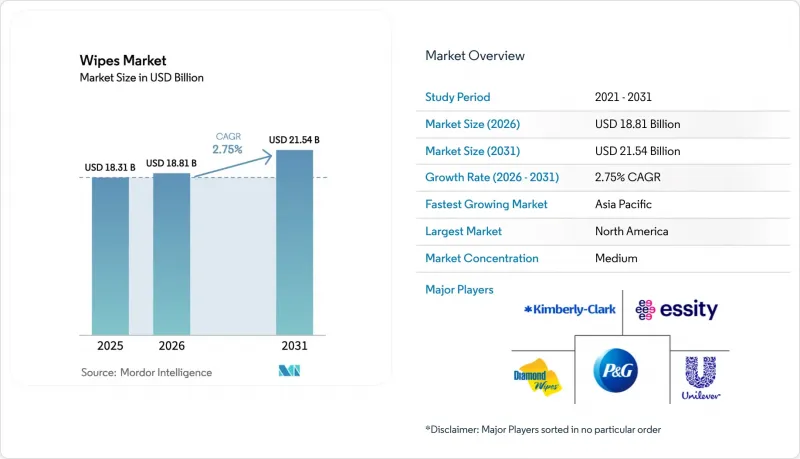
This report is Segmented by Product Type (Baby Wipes, Cosmetic Wipes, and More), Ingredient (Conventional and Natural/Organic), Distribution Channel (Supermarkets/Hypermarkets, Convenience/Grocery Stores, Online Retail Stores, and Other Distribution Channels), and Geography (North America, Europe, Asia-Pacific, South America, and Middle East and Africa). The Market Forecasts are Provided in Terms of Value (USD).
Global Wipes Market Trends and Insights
Rising hygiene and sanitation awareness
Increasing awareness of hygiene and sanitation has become a key driver of the global wipes market, significantly influencing consumer behavior and institutional hygiene practices worldwide. Greater emphasis on personal cleanliness, surface disinfection, and germ prevention, accelerated by global public health events and reinforced by ongoing awareness campaigns, has made the use of wipes a routine part of daily life. Consumers now perceive wipes as a primary preventive hygiene solution rather than an occasional convenience product, leading to increased usage across baby care, personal hygiene, household cleaning, and on-the-go applications. Similarly, institutional environments such as hospitals, clinics, schools, offices, hospitality venues, and public transportation systems have strengthened sanitation protocols, incorporating disinfectant and cleaning wipes into their standard procedures. The portability and single-use nature of wipes meet heightened hygiene standards by reducing cross-contamination risks compared to reusable cleaning tools. Additionally, growing awareness of skin-safe hygiene has driven demand for dermatologically tested, alcohol-free, and sensitive-skin formulations, particularly among families with infants and elderly individuals.
Product innovation and advanced formulations
Product innovation and advanced formulations are key growth drivers in the global wipes market, as manufacturers focus on enhancing performance, skin safety, and sensory appeal to meet increasing consumer expectations. As wipes evolve from basic cleaning products to skin-contact hygiene solutions, advancements in substrate technology, lotion chemistry, and product design have become critical for competitive differentiation. Companies are prioritizing the development of softer and stronger nonwoven fibers, improved absorbency, pH-balanced and minimal-ingredient formulations, and dermatologically tested solutions to address concerns related to skin irritation, sensitivity, and safety for daily use, particularly in baby and personal care segments. Advanced formulations also support multifunctionality, enabling wipes to provide cleansing, moisturizing, and protective benefits in a single product, thereby increasing usage frequency and enhancing value perception. For example, in September 2025, WaterWipes introduced a new line of stronger, softer wipes specifically designed for sensitive skin. This updated range featured an embossed pattern made from finer, softer fibers, improving both cleansing efficiency and comfort while reinforcing the brand's positioning for sensitive skin.
Environmental concerns and sustainability issues
Environmental concerns and sustainability challenges have emerged as a critical restraint on the global wipes market, particularly for conventional wet wipes made from synthetic fibers and non-biodegradable plastics. Growing awareness of plastic pollution, microplastic release, and wastewater system blockages caused by improper disposal of wipes has significantly heightened public scrutiny and diminished consumer confidence in traditional products. Municipal authorities and environmental organizations across various regions have repeatedly highlighted the substantial role of wipes in sewage clogging and fatberg formation, further intensifying negative consumer sentiment and driving stricter disposal practices. These sustainability concerns have resulted in escalating regulatory pressures, with governments enforcing more stringent labeling requirements, mandatory plastic-content disclosures, and outright bans on specific wipe formulations, thereby creating substantial compliance challenges for manufacturers.
Other drivers and restraints analyzed in the detailed report include:
- Rising female workforce is driving the market growth
- Shift toward sustainable and eco-friendly solutions
- Regulatory restrictions and compliance burden
For complete list of drivers and restraints, kindly check the Table Of Contents.
Segment Analysis
Baby wipes are projected to account for 39.86% of total market revenue in 2025, reflecting their strong and sustained dominance. This growth is driven by their necessity for hygiene, frequent daily usage, and ongoing product innovation. Considered an essential caregiving product rather than a discretionary item, baby wipes maintain consistent demand among households with infants and toddlers. Their usage extends beyond diaper changes to general skin cleansing, hand and face wiping, and on-the-go hygiene, significantly increasing per-capita consumption. Additionally, heightened parental awareness regarding infant skin health has bolstered demand for gentle, hypoallergenic, alcohol-free, fragrance-free, and dermatologically tested formulations. These attributes position baby wipes as a safer alternative to water and cloth in various settings. Furthermore, the increasing availability of eco-friendly and biodegradable baby wipes has attracted environmentally conscious consumers, further driving market growth.
Moist toilet wipes are expected to grow at a CAGR of 2.83% through 2031, driven by changing hygiene habits, product repositioning, and increasing adoption beyond traditional toilet paper usage. Consumers are associating moist toilet wipes with enhanced personal cleanliness, comfort, and skin care, particularly for sensitive skin, elderly users, and individuals with medical or mobility-related needs. Compared to dry toilet paper, moist wipes are perceived as more effective for thorough cleansing, encouraging a gradual shift toward combined usage rather than complete substitution. Product innovation has been critical in sustaining growth, with manufacturers introducing flushable variants, biodegradable substrates, pH-balanced formulations, and alcohol- and fragrance-free options to address skin sensitivity and environmental concerns. Additionally, the growing emphasis on sustainable and environmentally friendly products has led to the development of compostable and plastic-free moist wipes, appealing to eco-conscious consumers and supporting long-term market expansion.
Complete Report Scope:
- By Product Type
- Baby Wipes
- Cosmetic Wipes
- Moist Toilet Wipes
- Home Care Wipes
- Others
- By Ingredient
- Conventional
- Natural/Organic
- By Distribution Channel
- Supermarkets/Hypermarkets
- Convenience/Grocery Stores
- Online Retail Stores
- Other Distribtution Channels
- By Geography
- North America
- United States
- Canada
- Mexico
- Rest of North America
- Europe
- Germany
- United Kingdom
- Italy
- France
- Spain
- Netherlands
- Poland
- Belgium
- Sweden
- Rest of Europe
- Asia-Pacific
- China
- India
- Japan
- Australia
- Indonesia
- South Korea
- Thailand
- Singapore
- Rest of Asia-Pacific
- South America
- Brazil
- Argentina
- Colombia
- Chile
- Peru
- Rest of South America
- Middle East and Africa
- South Africa
- Saudi Arabia
- United Arab Emirates
- Nigeria
- Egypt
- Morocco
- Turkey
- Rest of Middle East and Africa
- North America
Geography Analysis
North America holding 40.19% of the global wipes market revenue in 2025 reflects the region's mature consumption patterns, strong hygiene culture, and deep penetration of wipes across baby care, personal hygiene, household cleaning, and healthcare applications. High awareness of infection prevention, routine use of disinfectant and personal wipes, and strong institutional demand from hospitals, long-term care facilities, offices, and hospitality sectors underpin sustained volumes. The region also benefits from brand-led innovation, premium product adoption, and widespread availability across supermarkets, pharmacies, and online platforms. Consumers in North America are early adopters of value-added features such as dermatologically tested formulations, sensitive-skin variants, and multipurpose wipes, supporting higher average selling prices and reinforcing the region's revenue leadership.
In contrast, Asia-Pacific is the fastest-growing regional market, expanding at a CAGR of 3.81% through 2031, driven by rapid urbanization, expanding middle-class populations, and accelerating development of e-commerce infrastructure. Urban lifestyles and longer commuting times are increasing demand for on-the-go hygiene solutions, while rising health awareness is supporting the adoption of baby wipes, personal care wipes, and household disinfectant wipes across both metropolitan and tier-2 cities. The region is also seeing strong momentum from digital-first retail models, with online marketplaces and quick-commerce platforms improving product accessibility and repeat purchasing. Local manufacturers and multinational brands are actively tailoring formulations, pack sizes, and pricing strategies to suit diverse climatic conditions, skin sensitivities, and cultural hygiene practices, enabling the Asia-Pacific to outperform other regions in growth momentum.
Europe, meanwhile, is playing a pivotal role in reshaping global wipes standards through regulatory leadership, particularly around sustainability and plastic reduction. Environmental concerns related to microplastics, wastewater blockages, and non-biodegradable substrates have prompted stricter oversight of wipe composition and labeling. This regulatory direction is influencing not only regional product portfolios but also global formulation strategies, as multinational brands seek harmonization across markets. For instance, in November 2025, the Department of Agriculture, Environment and Rural Affairs (DAERA) announced new regulations prohibiting the sale and supply of wet wipes containing plastic, with limited exemptions for business-to-business supply and medical use . Such measures are accelerating innovation in plastic-free, biodegradable, and cellulose-based wipes, positioning Europe as a global benchmark for environmentally responsible wipes manufacturing and compliance.
- Procter & Gamble Company
- Kimberly-Clark Corporation
- Essity AB
- Johnson & Johnson
- Diamond Wipes International Inc.
- Unilever PLC
- Unicharm Corporation
- The Clorox Company
- Reckitt Benckiser Group PLC
- Suominen Corporation
- Rockline Industries, Inc.
- La Fresh Group Inc.
- Dude Products Inc.
- Nice-Pak Products, Inc.
- Medline Industries LP
- Dreumex BV
- Berkshire Corporation
- Albaad Massuot Yitzhak Ltd.
- Hangzhou C&S Paper Co.
- Gojo Industries, Inc.
Additional Benefits:
- The market estimate (ME) sheet in Excel format
- 3 months of analyst support
TABLE OF CONTENTS
1 INTRODUCTION
- 1.1 Study Assumptions and Market Definition
- 1.2 Scope of the Study
2 RESEARCH METHODOLOGY
3 EXECUTIVE SUMMARY
4 MARKET LANDSCAPE
- 4.1 Market Overview
- 4.2 Market Drivers
- 4.2.1 Rising hygiene and sanitation awareness
- 4.2.2 Product innovation and advanced formulations
- 4.2.3 Rising female workforce is driving the market growth
- 4.2.4 Shift toward sustainable and eco friendly solutions
- 4.2.5 Branding, marketing and product awareness
- 4.2.6 Increasing preference for skin friendly, and dermatologically tested
- 4.3 Market Restraints
- 4.3.1 Environmental concerns and sustainability issues
- 4.3.2 Regulatory restrictions and compliance burden
- 4.3.3 Fluctuating raw material prices
- 4.3.4 Competition from alternative cleaning products
- 4.4 Consumer Behaviour Analysis
- 4.5 Regulatory Landscape
- 4.6 Technological Outlook
- 4.7 Porter's Five Forces Analysis
- 4.7.1 Threat of New Entrants
- 4.7.2 Bargaining Power of Buyers
- 4.7.3 Bargaining Power of Suppliers
- 4.7.4 Threat of Substitutes
- 4.7.5 Intensity of Competitive Rivalry
5 MARKET SIZE AND GROWTH FORECASTS (VALUE)
- 5.1 By Product Type
- 5.1.1 Baby Wipes
- 5.1.2 Cosmetic Wipes
- 5.1.3 Moist Toilet Wipes
- 5.1.4 Home Care Wipes
- 5.1.5 Others
- 5.2 By Ingredient
- 5.2.1 Conventional
- 5.2.2 Natural/Organic
- 5.3 By Distribution Channel
- 5.3.1 Supermarkets/Hypermarkets
- 5.3.2 Convenience/Grocery Stores
- 5.3.3 Online Retail Stores
- 5.3.4 Other Distribtution Channels
- 5.4 By Geography
- 5.4.1 North America
- 5.4.1.1 United States
- 5.4.1.2 Canada
- 5.4.1.3 Mexico
- 5.4.1.4 Rest of North America
- 5.4.2 Europe
- 5.4.2.1 Germany
- 5.4.2.2 United Kingdom
- 5.4.2.3 Italy
- 5.4.2.4 France
- 5.4.2.5 Spain
- 5.4.2.6 Netherlands
- 5.4.2.7 Poland
- 5.4.2.8 Belgium
- 5.4.2.9 Sweden
- 5.4.2.10 Rest of Europe
- 5.4.3 Asia-Pacific
- 5.4.3.1 China
- 5.4.3.2 India
- 5.4.3.3 Japan
- 5.4.3.4 Australia
- 5.4.3.5 Indonesia
- 5.4.3.6 South Korea
- 5.4.3.7 Thailand
- 5.4.3.8 Singapore
- 5.4.3.9 Rest of Asia-Pacific
- 5.4.4 South America
- 5.4.4.1 Brazil
- 5.4.4.2 Argentina
- 5.4.4.3 Colombia
- 5.4.4.4 Chile
- 5.4.4.5 Peru
- 5.4.4.6 Rest of South America
- 5.4.5 Middle East and Africa
- 5.4.5.1 South Africa
- 5.4.5.2 Saudi Arabia
- 5.4.5.3 United Arab Emirates
- 5.4.5.4 Nigeria
- 5.4.5.5 Egypt
- 5.4.5.6 Morocco
- 5.4.5.7 Turkey
- 5.4.5.8 Rest of Middle East and Africa
- 5.4.1 North America
6 COMPETITIVE LANDSCAPE
- 6.1 Market Concentration
- 6.2 Strategic Moves
- 6.3 Market Share Analysis
- 6.4 Company Profiles (includes Global level Overview, Market level overview, Core Segments, Financials as available, Strategic Information, Market Rank/Share for key companies, Products and Services, and Recent Developments)
- 6.4.1 Procter & Gamble Company
- 6.4.2 Kimberly-Clark Corporation
- 6.4.3 Essity AB
- 6.4.4 Johnson & Johnson
- 6.4.5 Diamond Wipes International Inc.
- 6.4.6 Unilever PLC
- 6.4.7 Unicharm Corporation
- 6.4.8 The Clorox Company
- 6.4.9 Reckitt Benckiser Group PLC
- 6.4.10 Suominen Corporation
- 6.4.11 Rockline Industries, Inc.
- 6.4.12 La Fresh Group Inc.
- 6.4.13 Dude Products Inc.
- 6.4.14 Nice-Pak Products, Inc.
- 6.4.15 Medline Industries LP
- 6.4.16 Dreumex BV
- 6.4.17 Berkshire Corporation
- 6.4.18 Albaad Massuot Yitzhak Ltd.
- 6.4.19 Hangzhou C&S Paper Co.
- 6.4.20 Gojo Industries, Inc.
7 MARKET OPPORTUNITIES AND FUTURE OUTLOOK

