PUBLISHER: Mordor Intelligence | PRODUCT CODE: 2114500

PUBLISHER: Mordor Intelligence | PRODUCT CODE: 2114500
Certification And Testing - Market Share Analysis, Industry Trends & Statistics, Growth Forecasts (2026 - 2031)
According to Mordor Intelligence, the certification and testing market size was valued at USD 210.03 billion in 2025 and estimated to grow from USD 218.04 billion in 2026 to reach USD 262.84 billion by 2031, at a CAGR of 3.81% during the forecast period (2026-2031).
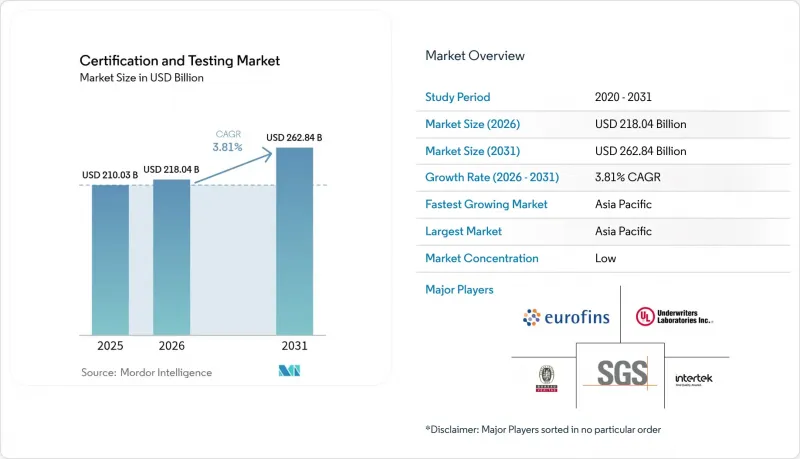
This report is Segmented by Sourcing Type (In-House, and Outsourced), End-User Vertical (Construction and Engineering, Chemicals, Food and Healthcare, Energy and Commodities, and More), Testing Type (Mechanical, and More) Certification Type (Product, Management System, and More), Service Type (Certification, and Testing), and Geography. The Market Forecasts are Provided in Terms of Value (USD).
Global Certification And Testing Market Trends and Insights
Intensifying Global Trade Compliance Mandates
Governments continue to tighten origin-verification and conformity documentation. The World Customs Organization issued digital certificate guidelines in 2024, prompting exporters to provide accredited laboratory data that matches treaty annexes. The EU's Registered Exporter scheme now requires ISO 17025 test reports on select goods, doubling certification queues from Southeast Asian suppliers since mid-2024. The United States added third-party test evidence for dual-use items under updated Export Administration Regulations. Large multi-accredited labs, therefore, win volume as their certificates travel globally, while regional providers rush to secure International Accreditation Forum recognition.
Rapid Expansion of Cross-Border E-Commerce
Major marketplaces have imposed stricter pre-listing protocols. Amazon requires ISO 17025 reports for electronics, toys, and personal-care items in the United States, the EU, and Japan, thereby excluding untested goods. Alibaba's Tmall Global auto-delists products lacking FCC, CE, or CCC marks, resulting in a 40% surge in certification inquiries from Chinese exporters in 2024. The EU Digital Services Act makes platforms jointly liable for unsafe products, reinforcing these rules. Smaller brands, therefore, outsource compliance work to external labs, accelerating the shift toward asset-light operations in the certification and testing market.
Volatility in Industrial Capex Cycles
Testing volume tracks new-product launches and plant startups. India's statistical office documented a 66.3% increase in private-sector capital expenditure (capex) between fiscal 2021-22 and 2024-25, temporarily boosting laboratory demand. When global PMI indices dipped in Q2 2024, certification queues thinned within two quarters, leaving spare capacity. In-house labs feel the squeeze more acutely because they carry fixed overhead, which hastens the move to outsourcing. Regional providers often cut prices during downturns, squeezing margins across the certification and testing market.
Other drivers and restraints analyzed in the detailed report include:
- Proliferation of IoT and Smart Devices Requiring Certification
- Rising Focus on Product Safety and Quality Among Consumers
- Complex and Fragmented Regulatory Standards Across Regions
For complete list of drivers and restraints, kindly check the Table Of Contents.
Segment Analysis
Outsourced providers controlled 63.98% certification and testing market share in 2025 and will climb at a 4.42% CAGR through 2031, well above the headline rate. This dominance stems from the significant investment required to keep ISO 17025 labs current, a cost that most manufacturers now treat as variable rather than fixed. UL Solutions' 8.1% revenue jump in Q3 2024 demonstrates how large networks capture flows as clients exit captive facilities.
Hybrid models still matter. Pharmaceutical and semiconductor firms maintain in-house labs to protect IP, yet 60% now outsource at least 30% of test volume, chiefly for peak loads or niche disciplines. Digital-twin standards under ISO 23247 could blur boundaries further by allowing internal simulation to screen designs before external confirmation. Overall, outsourced specialists set the pace, and their scale unlocks the analytics and automation budgets required to maintain high efficiency in the certification and testing market.
Food and healthcare accounted for 28.15% of 2025 revenue, as the FDA FSMA Rule 204 and GFSI schemes tightened traceability and hygiene demands. The certification and testing market size for these verticals remains resilient because audits occur across planting, processing, and distribution.
Transportation, however, registers the fastest 5.28% CAGR. UN Regulations 155 and 156 compel cybersecurity and software-update audits for every new vehicle type sold in the EU and Japan, expanding laboratory pipelines for penetration tests and over-the-air update validation. IATF 16949 certifications increased by 12% in 2024, indicating a cascading pressure on supply chains. Battery safety work adds another layer, with Intertek and UL constructing dedicated centers to meet UN 38.3 and IEC 62133 demands. As electrification and autonomy advance, transportation becomes the primary driver of growth within the certification and testing market.
Complete Report Scope:
- By Sourcing Type
- In-House
- Outsourced
- By End-User Vertical
- Construction and Engineering
- Chemicals
- Food and Healthcare
- Energy and Commodities
- Transportation
- Products and Retail
- Industrial
- Other End-User Verticals
- By Testing Type
- Mechanical Testing
- Electrical and Electronics Testing
- Chemical Testing
- Environmental and Climatic Testing
- Non-Destructive Testing (NDT)
- EMC and Radio Testing
- Software and Cybersecurity Testing
- By Certification Type
- Product Certification
- Management System Certification
- Personnel Certification
- Service Certification
- By Service Type
- Testing
- Certification
- By Geography
- North America
- United States
- Canada
- Mexico
- South America
- Brazil
- Argentina
- Rest of South America
- Europe
- Germany
- United Kingdom
- France
- Italy
- Spain
- Rest of Europe
- Asia-Pacific
- China
- Japan
- India
- South Korea
- Australia
- Rest of Asia-Pacific
- Middle East and Africa
- Middle East
- Saudi Arabia
- United Arab Emirates
- Turkey
- Rest of Middle East
- Africa
- South Africa
- Egypt
- Nigeria
- Rest of Africa
- Middle East
- North America
Geography Analysis
Asia-Pacific contributed 39.88% of 2025 turnover and is advancing at a 4.21% CAGR, almost double the global clip. China's widened CCC catalog now spans chargers and industrial robots, lifting local laboratory volume 15% year-over-year. India's BIS move into electronics and telecom equipment created processing backlogs and spurred capacity additions in Bangalore and Pune.
North America expands near the market average. FCC equipment authorization and OSHA safety marks remain evergreen requirements, while Inflation Reduction Act incentives for batteries introduce new test categories. Canada's Standards Council upholds ISO 17025 accreditation, sustaining cross-border equivalence.
Europe exhibits steady demand under CE marking rules, although Brexit necessitates dual certification for suppliers selling into both the EU and the United Kingdom. The Middle East is tightening rules as Saudi Arabia's SASO and the UAE's ESMA implement distinct conformity assessment schemes, creating parallel pathways that lengthen launch cycles. South America and Africa remain modest contributors, yet Brazil's INMETRO and South Africa's SABS are expanding lists of compulsory items, hinting at gradual upside.
- SGS SA
- Intertek Group PLC
- Bureau Veritas SA
- DEKRA SE
- TUV SUD AG
- Underwriters Laboratories Inc.
- DNV AS
- Eurofins Scientific SE
- ALS Limited
- BSI Group
- SAI Global Pty Limited
- MISTRAS Group Inc.
- Element Materials Technology Group Ltd.
- TUV Rheinland AG
- TUV NORD GROUP
- Applus Services SA
- Kiwa NV
- Lloyd's Register Group Ltd.
- MET Laboratories Inc.
- UL Solutions Inc.
Additional Benefits:
- The market estimate (ME) sheet in Excel format
- 3 months of analyst support
TABLE OF CONTENTS
1 INTRODUCTION
- 1.1 Study Assumptions and Market Definition
- 1.2 Scope of the Study
2 RESEARCH METHODOLOGY
3 EXECUTIVE SUMMARY
4 MARKET LANDSCAPE
- 4.1 Market Overview
- 4.2 Market Drivers
- 4.2.1 Intensifying Global Trade Compliance Mandates
- 4.2.2 Rapid Expansion of Cross-Border E-Commerce
- 4.2.3 Proliferation of IoT and Smart Devices Requiring Certification
- 4.2.4 Rising Focus on Product Safety and Quality Among Consumers
- 4.2.5 Growing Adoption of Digital Twin Based Remote Certification
- 4.2.6 Emergence of Sustainability Linked Certification Schemes
- 4.3 Market Restraints
- 4.3.1 Volatility in Industrial Capex Cycles
- 4.3.2 Complex and Fragmented Regulatory Standards Across Regions
- 4.3.3 Talent Shortage in Specialized Testing Disciplines
- 4.3.4 Cybersecurity Concerns Over Remote Auditing Platforms
- 4.4 Industry Value Chain Analysis
- 4.5 Regulatory Landscape
- 4.6 Technological Outlook
- 4.7 Impact of Macroeconomic Factors on the Market
- 4.8 Investment Analysis
- 4.9 Porter's Five Forces Analysis
- 4.9.1 Threat of New Entrants
- 4.9.2 Bargaining Power of Buyers
- 4.9.3 Bargaining Power of Suppliers
- 4.9.4 Threat of Substitute Products
- 4.9.5 Intensity of Competitive Rivalry
5 MARKET SIZE AND GROWTH FORECASTS (VALUE)
- 5.1 By Sourcing Type
- 5.1.1 In-House
- 5.1.2 Outsourced
- 5.2 By End-User Vertical
- 5.2.1 Construction and Engineering
- 5.2.2 Chemicals
- 5.2.3 Food and Healthcare
- 5.2.4 Energy and Commodities
- 5.2.5 Transportation
- 5.2.6 Products and Retail
- 5.2.7 Industrial
- 5.2.8 Other End-User Verticals
- 5.3 By Testing Type
- 5.3.1 Mechanical Testing
- 5.3.2 Electrical and Electronics Testing
- 5.3.3 Chemical Testing
- 5.3.4 Environmental and Climatic Testing
- 5.3.5 Non-Destructive Testing (NDT)
- 5.3.6 EMC and Radio Testing
- 5.3.7 Software and Cybersecurity Testing
- 5.4 By Certification Type
- 5.4.1 Product Certification
- 5.4.2 Management System Certification
- 5.4.3 Personnel Certification
- 5.4.4 Service Certification
- 5.5 By Service Type
- 5.5.1 Testing
- 5.5.2 Certification
- 5.6 By Geography
- 5.6.1 North America
- 5.6.1.1 United States
- 5.6.1.2 Canada
- 5.6.1.3 Mexico
- 5.6.2 South America
- 5.6.2.1 Brazil
- 5.6.2.2 Argentina
- 5.6.2.3 Rest of South America
- 5.6.3 Europe
- 5.6.3.1 Germany
- 5.6.3.2 United Kingdom
- 5.6.3.3 France
- 5.6.3.4 Italy
- 5.6.3.5 Spain
- 5.6.3.6 Rest of Europe
- 5.6.4 Asia-Pacific
- 5.6.4.1 China
- 5.6.4.2 Japan
- 5.6.4.3 India
- 5.6.4.4 South Korea
- 5.6.4.5 Australia
- 5.6.4.6 Rest of Asia-Pacific
- 5.6.5 Middle East and Africa
- 5.6.5.1 Middle East
- 5.6.5.1.1 Saudi Arabia
- 5.6.5.1.2 United Arab Emirates
- 5.6.5.1.3 Turkey
- 5.6.5.1.4 Rest of Middle East
- 5.6.5.2 Africa
- 5.6.5.2.1 South Africa
- 5.6.5.2.2 Egypt
- 5.6.5.2.3 Nigeria
- 5.6.5.2.4 Rest of Africa
- 5.6.5.1 Middle East
- 5.6.1 North America
6 COMPETITIVE LANDSCAPE
- 6.1 Market Concentration
- 6.2 Strategic Moves
- 6.3 Market Share Analysis
- 6.4 Company Profiles (includes Global Level Overview, Market Level Overview, Core Segments, Financials as Available, Strategic Information, Market Rank/Share for Key Companies, Products and Services, and Recent Developments)
- 6.4.1 SGS SA
- 6.4.2 Intertek Group PLC
- 6.4.3 Bureau Veritas SA
- 6.4.4 DEKRA SE
- 6.4.5 TUV SUD AG
- 6.4.6 Underwriters Laboratories Inc.
- 6.4.7 DNV AS
- 6.4.8 Eurofins Scientific SE
- 6.4.9 ALS Limited
- 6.4.10 BSI Group
- 6.4.11 SAI Global Pty Limited
- 6.4.12 MISTRAS Group Inc.
- 6.4.13 Element Materials Technology Group Ltd.
- 6.4.14 TUV Rheinland AG
- 6.4.15 TUV NORD GROUP
- 6.4.16 Applus Services SA
- 6.4.17 Kiwa NV
- 6.4.18 Lloyd's Register Group Ltd.
- 6.4.19 MET Laboratories Inc.
- 6.4.20 UL Solutions Inc.
7 MARKET OPPORTUNITIES AND FUTURE OUTLOOK
- 7.1 White-Space and Unmet-Need Assessment

