PUBLISHER: Mordor Intelligence | PRODUCT CODE: 2114507

PUBLISHER: Mordor Intelligence | PRODUCT CODE: 2114507
Polyurethane (PU) Film - Market Share Analysis, Industry Trends & Statistics, Growth Forecasts (2026 - 2031)
According to Mordor Intelligence, the polyurethane film market size is estimated at 282.71 kilotons in 2026, and is expected to reach 392.46 kilotons by 2031, at a CAGR of 6.78% during the forecast period (2026-2031).
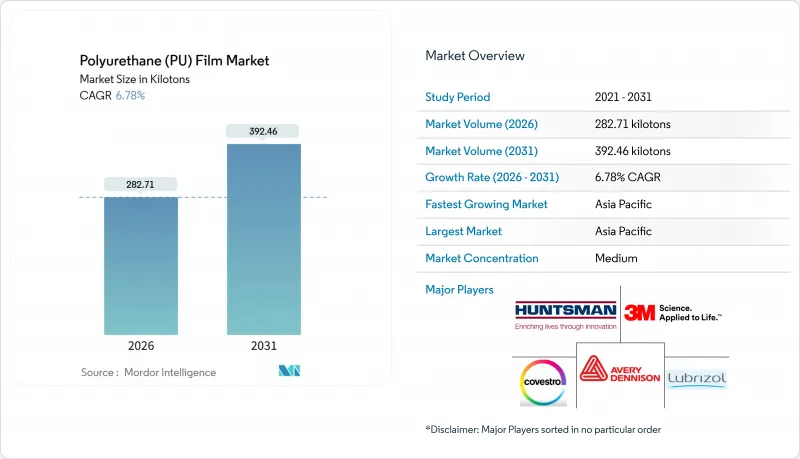
This report is Segmented by Chemical Class (Polyester, Polyether, and Polycaprolactone), Processing Method (Blown Film Extrusion, Cast Film Extrusion, and Solution Coating), End-Use Industry (Footwear and Apparel, Medical Supplies, and More), and Geography (Asia-Pacific, North America, Europe, South America, and Middle-East and Africa). The Market Forecasts are Provided in Terms of Volume (Tons).
Global Polyurethane (PU) Film Market Trends and Insights
Surging Demand for Waterproof and Breathable Membranes in High-Performance Sportswear
Outdoor-apparel brands are redesigning membrane stacks as scrutiny of fluorinated chemicals intensifies. GORE-TEX commercialized its ePE membrane with major brands for the 2025 winter collections, replacing fluoropolymer-rich laminates while keeping durability benchmarks. Polyether films dominate because their hydrolytic stability extends product life in humid climates, reducing warranty claims and supporting a 6.78% polyurethane film market CAGR. Converters now graft hydrophobic siloxane groups by plasma treatment, lowering contact angles below 110° without PFAS and maintaining breathability. Investment in Asian coating lines reflects the regional concentration of contract manufacturers that supply global brands. This pull-through effect reinforces demand visibility for 2026-2028 purchase cycles.
Rapid Substitution of PVC Films in Medical Device Components Owing to REACH and FDA Pressure
The European Chemicals Agency banned lead stabilizers in PVC in 2023, and the FDA updated guidance in 2024 to tighten phthalate controls, prompting North American and EU hospitals to migrate to polyether films that meet ISO 10993 without extra extractable testing. Medical buyers value the reduced gas permeability of polyurethane, which extends IV-bag shelf life, and procurement teams are awarding multiyear contracts that underpin a 7.08% CAGR for the segment. Ease of compliance shortens validation cycles by up to nine months, accelerating conversions across infusion, surgical-drape, and wound-care portfolios. Japanese device manufacturers mirror this trend to secure uninterrupted export certification.
Volatile MDI/TDI Feedstock Pricing Linked to Benzene and Crude Swings
Between November 2024 and January 2025, European MDI spot prices surged. This uptick was largely influenced by benzene's alignment with Brent's fluctuations. Additionally, an outage at BASF's cracker led to a reduced supply of aniline, further tightening converter margins. Huntsman initiated a strategic review that highlights the challenges mid-tier producers face in navigating market spikes due to their limited scale. While vertical integration presents a potential solution, ADNOC's acquisition of Covestro stands out as a prime example of the industry's pivot towards securing captive feedstocks, particularly in the polyurethane film sector.
Other drivers and restraints analyzed in the detailed report include:
- Growth of Foldable and Flexible Electronics Requiring Ultra-Thin Optical-Grade Films
- Mass Adoption of Paint-Protection Films in Used-Car Refurbishing Ecosystems
- Supply-Demand Imbalance of Specialty Diols After 2024 Capacity Outages
For complete list of drivers and restraints, kindly check the Table Of Contents.
Segment Analysis
Polyether chemistry carried 44.36% of the 2025 volume, bolstered by its hydrolytic stability. This stability has made it a preferred choice for sectors like footwear, outdoor gear, and building membranes, especially in regions where humidity levels soar above 80% for most of the year. The market for polyurethane films, a subset of this category, is poised for growth. This is largely due to the introduction of bio-attributed MDI, which permits renewable content without the need for reformulation. Polycaprolactone variants, however, post a 7.01% CAGR, driven by their use in ISO 10993-approved wound dressings. These dressings offer the advantage of in-situ biodegradation, streamlining clinical removal processes. On the other hand, certain polyester grades are losing market share. This is primarily because paint-protection installers are opting for polyether. Its lower glass-transition temperature makes it more suitable for self-healing topcoats. Additionally, initiatives like Covestro's glycolysis recycling partnership, which focuses on circular raw materials, further solidify polyether's dominance in the polyurethane film market.
While emerging capacities in the Asia-Pacific region could reshape cost dynamics by 2028, polyether's technical advantages remain formidable. This is true until polycaprolactone reaches cost parity within a competitive margin. Reinforcing this premium pricing power are hospital formularies and sustainability commitments from consumer brands. Vendors are capitalizing on this by highlighting their recycled-content certifications. Such factors bolster resilience in the face of challenges, like the oversupply of commodity TPU, which is exerting pressure on baseline margins throughout the polyurethane film sector.
Complete Report Scope:
- By Chemical Class
- Polyester
- Polyether
- Polycaprolactone
- By Processing Method
- Blown Film Extrusion
- Cast Film Extrusion
- Solution Coating
- By End-use Industry
- Footwear and Apparel
- Medical Supplies
- Sports Equipment
- Building and Construction
- Other End-user Industries
- By Geography
- Asia-Pacific
- China
- India
- Japan
- South Korea
- ASEAN Countries
- Rest of Asia-Pacific
- North America
- United States
- Canada
- Mexico
- Europe
- Germany
- United Kingdom
- France
- Italy
- Russia
- Rest of Europe
- South America
- Brazil
- Argentina
- Rest of South America
- Middle-East and Africa
- Saudi Arabia
- South Africa
- Rest of Middle-East and Africa
- Asia-Pacific
Geography Analysis
Asia-Pacific commanded 49.52% volume in 2025 and will advance at a 6.93% CAGR to 2031 on the back of Chinese TPU expansion and South Korea's foldable-display surge. In 2025, Covestro bolstered local supply chains by adding dispersion capacity in China and debottlenecking Thailand for footwear grades. Meanwhile, Vietnam and Indonesia, with their humid climates, continue to serve as prime contract-manufacturing hubs, favoring polyether films for waterproof footwear linings and boosting regional consumption.
In North America, the medical-supplies category outpaces other local applications. This growth is largely driven by hospital mandates that exclude phthalate-plasticized PVC. Additionally, the U.S. used-car fleet fuels a surge in paint-protection wraps, contributing to growth as these wraps extend vehicle life cycles. XPEL, capitalizing on this trend, derived a significant portion of its revenue from North American operations, underscoring the region's significance. Furthermore, Mexico's light-vehicle production, spurred by nearshoring, has amplified aftermarket demand.
Europe's polyurethane film market is adapting to REACH Annex XVII regulations, leading to a shift from PVC in medical and building membranes. A consumption bloc comprising Germany, France, the United Kingdom, and Italy accounts for a significant share of the market, with Germany's automotive aftermarket driving the demand for paint protection. Covestro's expansion in Krefeld-Uerdingen in March 2025 bolstered regional supply, and ADNOC's acquisition provides a buffer against European feedstock fluctuations. While Brazil and Argentina lead South American consumption, currency volatility hampers upgrades to specialty grades. Adoption of these grades in the Middle East and Africa remains limited, with the exception of Saudi Arabia and South Africa.
- 3M
- American Polyfilm Inc.
- Avery Dennison Corporation
- BASF SE
- Covestro AG
- Ding Zing Advanced Materials Inc.
- Gerlinger Industries GmbH
- Huntsman International LLC
- Mitsui Chemicals India Pvt. Ltd.
- Nihon Matai Co. Ltd,
- Novotex Italiana S.p.A.
- Okura Industries Co. Ltd
- Permali Gloucester Ltd
- Schweitzer-Mauduit International Inc.
- The Lubrizol Corporation
- Wiman Corporation
Additional Benefits:
- The market estimate (ME) sheet in Excel format
- 3 months of analyst support
TABLE OF CONTENTS
1 Introduction
- 1.1 Study Assumptions and Market Definition
- 1.2 Scope of the Study
2 Research Methodology
3 Executive Summary
4 Market Landscape
- 4.1 Market Overview
- 4.1.1 Market Drivers
- 4.1.1.1 Surging demand for waterproof and breathable membranes in high-performance sportswear
- 4.1.1.2 Rapid substitution of PVC films in medical device components owing to REACH and FDA pressure
- 4.1.1.3 Growth of foldable and flexible electronics requiring ultra-thin optical-grade PU films
- 4.1.1.4 Mass adoption of paint-protection films (PPF) in used-car refurbishing ecosystems
- 4.1.1.5 Defense programs specifying low-signature polyurethane coatings for UAV skins
- 4.1.2 Market Restraints
- 4.1.2.1 Volatile MDI/TDI feedstock pricing linked to benzene and crude swings
- 4.1.2.2 Supply-demand imbalance of specialty diols (e.g., H12MDI) after 2024 capacity outages
- 4.1.2.3 Processing window sensitivity leading to high rejection rates in thermoforming lines
- 4.1.1 Market Drivers
- 4.2 Value Chain Analysis
- 4.3 Porter's Five Forces
- 4.3.1 Bargaining Power of Suppliers
- 4.3.2 Bargaining Power of Buyers
- 4.3.3 Threat of New Entrants
- 4.3.4 Threat of Substitutes
- 4.3.5 Degree of Competition
5 Market Size and Growth Forecasts (Volume)
- 5.1 By Chemical Class
- 5.1.1 Polyester
- 5.1.2 Polyether
- 5.1.3 Polycaprolactone
- 5.2 By Processing Method
- 5.2.1 Blown Film Extrusion
- 5.2.2 Cast Film Extrusion
- 5.2.3 Solution Coating
- 5.3 By End-use Industry
- 5.3.1 Footwear and Apparel
- 5.3.2 Medical Supplies
- 5.3.3 Sports Equipment
- 5.3.4 Building and Construction
- 5.3.5 Other End-user Industries
- 5.4 By Geography
- 5.4.1 Asia-Pacific
- 5.4.1.1 China
- 5.4.1.2 India
- 5.4.1.3 Japan
- 5.4.1.4 South Korea
- 5.4.1.5 ASEAN Countries
- 5.4.1.6 Rest of Asia-Pacific
- 5.4.2 North America
- 5.4.2.1 United States
- 5.4.2.2 Canada
- 5.4.2.3 Mexico
- 5.4.3 Europe
- 5.4.3.1 Germany
- 5.4.3.2 United Kingdom
- 5.4.3.3 France
- 5.4.3.4 Italy
- 5.4.3.5 Russia
- 5.4.3.6 Rest of Europe
- 5.4.4 South America
- 5.4.4.1 Brazil
- 5.4.4.2 Argentina
- 5.4.4.3 Rest of South America
- 5.4.5 Middle-East and Africa
- 5.4.5.1 Saudi Arabia
- 5.4.5.2 South Africa
- 5.4.5.3 Rest of Middle-East and Africa
- 5.4.1 Asia-Pacific
6 Competitive Landscape
- 6.1 Market Concentration
- 6.2 Strategic Moves
- 6.3 Market Share(%)/Ranking Analysis
- 6.4 Company Profiles {(includes Global level Overview, Market level overview, Core Segments, Financials as available, Strategic Information, Products and Services, and Recent Developments)}
- 6.4.1 3M
- 6.4.2 American Polyfilm Inc.
- 6.4.3 Avery Dennison Corporation
- 6.4.4 BASF SE
- 6.4.5 Covestro AG
- 6.4.6 Ding Zing Advanced Materials Inc.
- 6.4.7 Gerlinger Industries GmbH
- 6.4.8 Huntsman International LLC
- 6.4.9 Mitsui Chemicals India Pvt. Ltd.
- 6.4.10 Nihon Matai Co. Ltd,
- 6.4.11 Novotex Italiana S.p.A.
- 6.4.12 Okura Industries Co. Ltd
- 6.4.13 Permali Gloucester Ltd
- 6.4.14 Schweitzer-Mauduit International Inc.
- 6.4.15 The Lubrizol Corporation
- 6.4.16 Wiman Corporation
7 Market Opportunities and Future Outlook
- 7.1 White-space and Unmet-need Assessment

